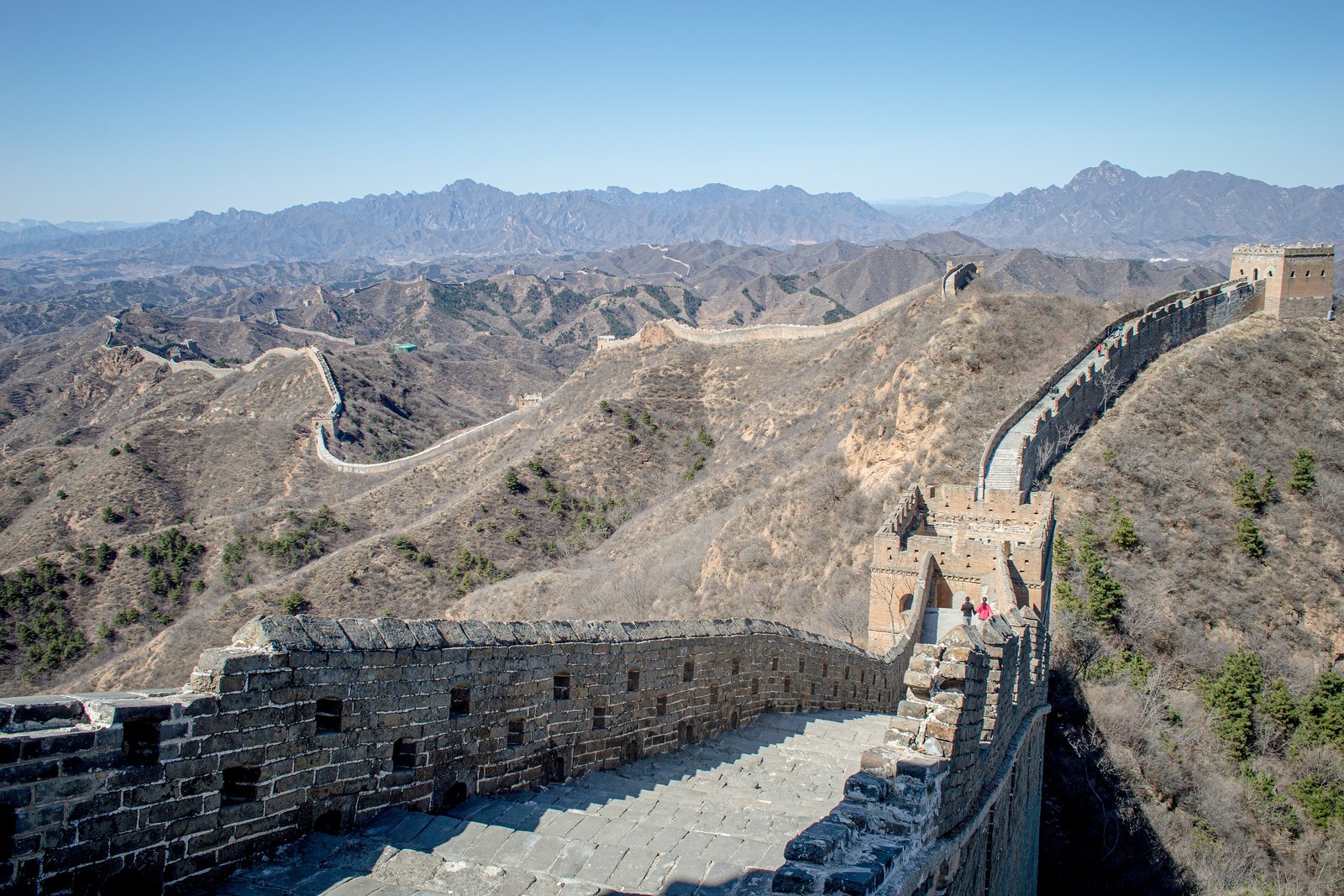

- Where
- Across northern China
from Liaodong to Lop Lake - Coordinates
- 40.4380° N
116.5619° E (Mutianyu section) - Length
- 21,196.18 km of sites
China’s 2012 survey - Sites
- 43,721 walls, trenches
towers and passes - Best known
- Ming dynasty brick
1368–1644 - Status
- UNESCO World Heritage, 1987
- Entry
- Restored sections ticketed
passport needed at Badaling
Climbed a long spine of grey brick over the ridges, steps so steep that I went up some of them on my hands. From every little tower it ran on to the next and the next, into the haze, the same colour as the hills, until I could not tell where the building stopped. Ate my lunch in a tower doorway, out of the wind, enormously pleased with myself.
The short answer
The Great Wall of China is a series of fortifications built across the northern frontier of Chinese states and empires against the peoples of the Eurasian steppe. UNESCO dates the joining of earlier walls into one defensive system to around 220 BC, under the first Qin emperor, Qin Shi Huang, and says that building went on until the Ming dynasty (1368–1644), when the Wall became the world’s largest military structure; Wikipedia’s account dates the first walls to the seventh century BC. In June 2012 China’s State Administration of Cultural Heritage, reporting a survey carried out with the national mapping bureau since 2007, measured everything it counts as the Great Wall at 21,196.18 kilometres, made up of 43,721 sites in 15 provinces, autonomous regions and municipalities. The sections most visitors walk are Ming brick, in the mountains north of Beijing. UNESCO inscribed the Great Wall in 1987.
Why it's worth knowing
The name suggests one structure. The survey describes something else: thousands of separate wall sections, ramparts and trenches, single towers and forts, left by many states and dynasties, often on different lines. Wikipedia’s summary of the survey’s conclusions gives 10,051 wall sections, 1,764 ramparts or trenches, 29,510 individual buildings and 2,211 fortifications or passes, and notes that there is no agreed definition of what counts as the Great Wall at all.
What the builders used was whatever lay to hand. Wikipedia’s account of the construction describes stone in the mountains and rammed earth, stamped between board frames, on the plains, because hauling materials any distance was so hard; the Ming added fired brick, lime and cut stone, and built most strongly near their capital. Much of the western Wall is mud, and it erodes.
So the Wall is the colour of the ground it stands on, and in places it is the ground. The first stage of the survey measured the Ming Wall alone at 8,851.8 kilometres, a figure Chinese state media reported in 2009. Wikipedia’s summary divides it into 6,259 kilometres of built wall, 359 kilometres of trenches and 2,232 kilometres of natural barriers: hills and rivers that the Ming left to do the job. About a quarter of the most famous Great Wall was never built.
The field notes
Hard to see from orbit
The best-known fact about the Great Wall is not a fact. NASA’s own account says the Wall is generally not visible to the unaided eye from low Earth orbit, and certainly not from the Moon, because it is narrow and made of material about the same colour and texture as the land around it. The astronaut Leroy Chiao photographed part of it from the International Space Station on a sunny day after snow; NASA reports that he did not see the Wall himself and was not sure the picture showed it. Wikipedia records that China’s first astronaut, Yang Liwei, said he could not see it either.
The myth is older than spaceflight. NASA dates the idea that the Wall could be seen from the Moon to at least 1938; Wikipedia finds an earlier version in a letter of 1754 by the English antiquary William Stukeley, who wrote that the Chinese wall “may be discerned at the Moon”.
The rice in the mortar
Many accounts of the Wall say that its bricks were bound with a mortar of lime and sticky-rice soup. Wikipedia’s article on the Wall says so, citing Smithsonian magazine (2017) and the magazine World Archaeology (2010). The chemistry behind the story was published in 2010, when Fuwei Yang, Bingjian Zhang and Qinglin Ma, in Accounts of Chemical Research, identified amylopectin, a starch from sticky rice, as the organic part of ancient Chinese lime mortar, and described its use in tombs, in urban construction and in water-control works.
The abstract of that paper, the one usually cited for the Wall, does not name the Great Wall, and this entry could not confirm that any of its samples came from it. The sticky-rice Wall is given here as the magazines give it, not as a finding.
Notes in the bricks
Ming bricks were fired in kilns, and some of their makers left words on them. In December 2025 China Daily reported finds from an excavation at Jiankou, a steep section in the mountains of Beijing’s Huairou district. Two bricks from one watchtower had been inscribed before firing, scratched into the wet clay, probably with a stick or a nail: one reads “North Kiln: 550 jin” and the other “One Row: 79 jin”, a jin being 500 grams. They record weight rather than number, which the excavators said may tell historians something new about how the kilns were run.
On a floor brick at the top of the neighbouring tower, the same report says, someone had written a short poem about wine and melancholy before the brick was fired; it ends with a three-year-old child’s hair turning white. A stele in that tower dates it to 1573, the first year of the Wanli emperor.
What is disappearing
Much of the Wall is not preserved. Wikipedia cites a 2012 report by China’s heritage administration that 22 per cent of the Ming Wall, 1,961 kilometres, has disappeared: taken for building stone, cut for roads and mines, and worn down by wind and sand. China’s State Council brought the Wall under its own protection regulations from 1 December 2006; they forbid taking earth, bricks or stone from it, carving or writing on it, driving on it, and organising activities on sections not opened to visitors. In 2023 construction workers in Shanxi widened a gap in the Wall to let an excavator through, and the police, as Wikipedia reports, described the damage as irreversible.
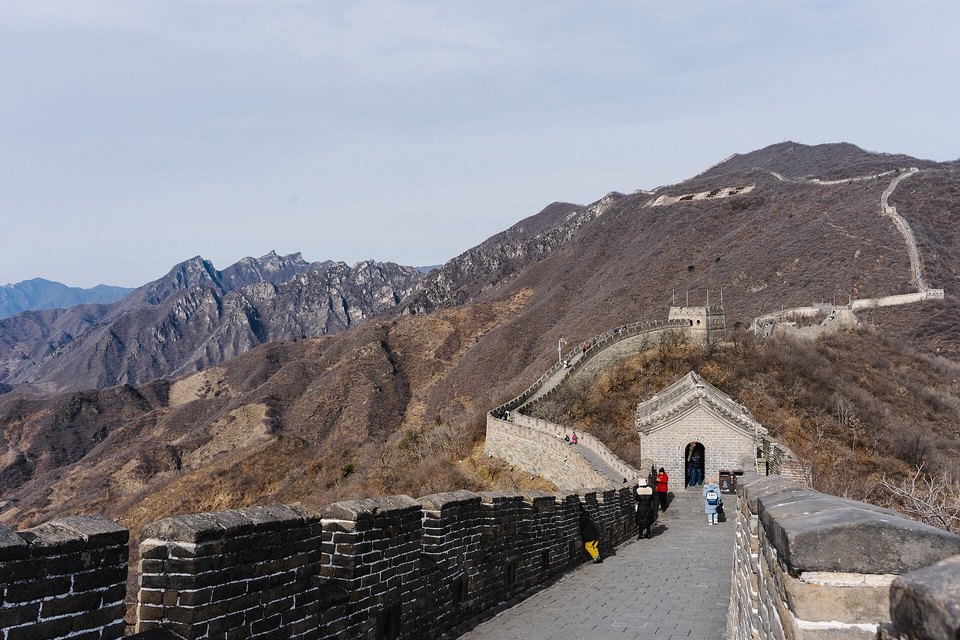
The restored wall at Mutianyu in late winter, February 2024.
Photograph: Lloyd Tudor · CC BY-SA 4.0
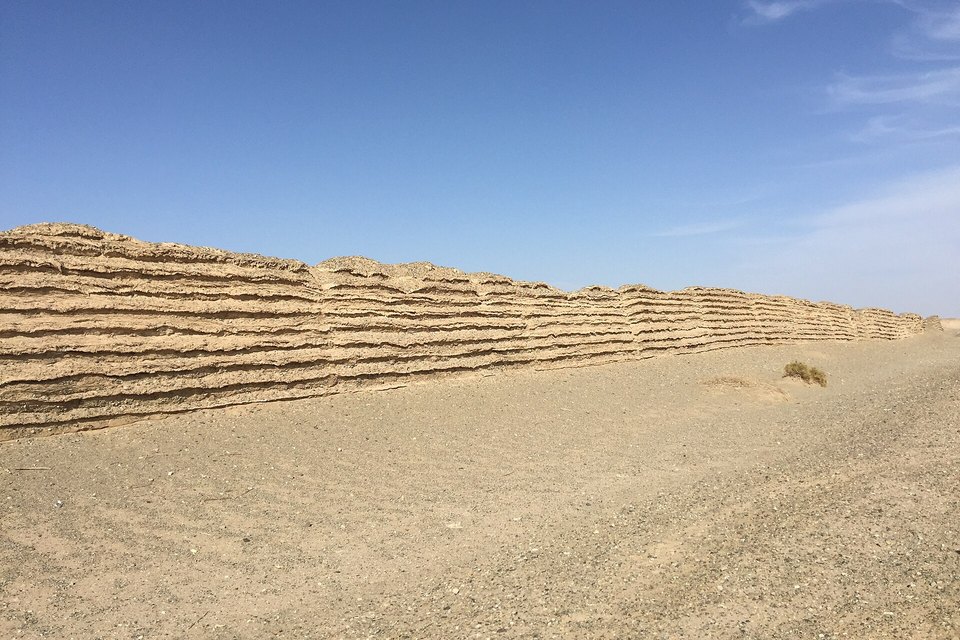
Han-dynasty wall ruins near Dunhuang, Gansu, built of local material rather than brick, October 2015.
Photograph: 慕尼黑啤酒 · Great Wall of Han Dynasty · CC BY-SA 3.0 · cropped
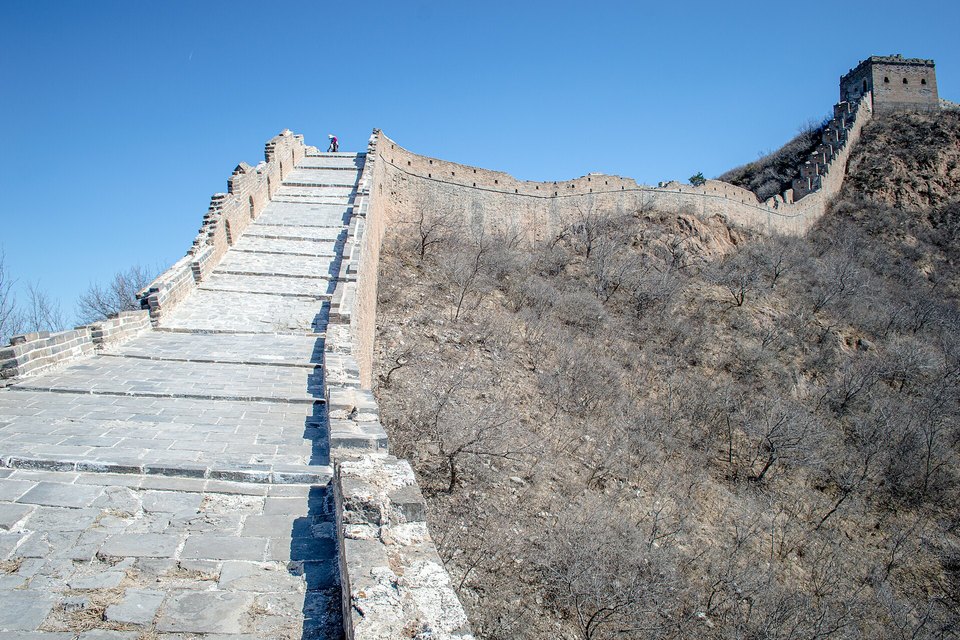
A steep restored climb to a watchtower, March 2016.
Photograph: Philip Nalangan · CC BY 4.0 · cropped
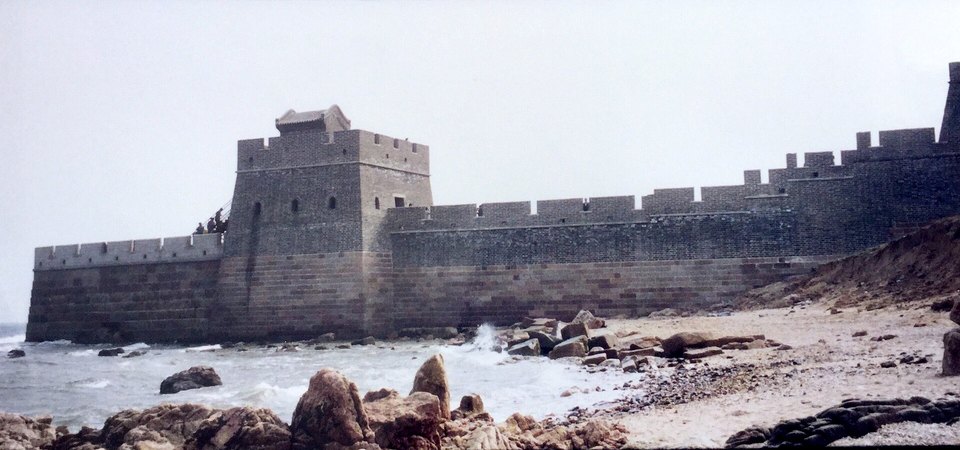
Old Dragon's Head at Shanhaiguan, where the wall runs into the sea, 1995.
Photograph: Prince Roy · Old Dragon's Head of Great Wall · CC BY 2.0
- Walk away from the gate, in the direction fewer people are walking, at least as far as the next tower.
- Leave every brick where it is, even the loose ones. Somebody carried it up here.
- Use your hands on the steepest steps and feel no embarrassment about it whatsoever.
- Sit in a tower doorway for a while and look back the way you came.
- Walk to the end. (The end kept moving. Chose a tower, called it the end, and ticked the item in very small letters.)
A brick with a note on it. At Jiankou, a section of the Great Wall in the mountains north of Beijing, an excavation reported in December 2025 found Ming bricks with words scratched into the wet clay before firing: “North Kiln: 550 jin” on one, “One Row: 79 jin” on another, weights noted by the kilns that made them. A floor brick in the next watchtower carries a short poem about wine and melancholy. Almost every brick in the Wall says nothing; a few went up the mountain with a message already fired into the clay.
Tally, in the marginSomebody wrote the weight on it and sent it up the mountain, like a parcel. I have been reading the floor ever since, and so far all the others have kept their business to themselves.
Getting there
How to get there. Beijing is the usual gateway. The restored Ming sections most visited, Badaling, Mutianyu and Juyongguan, stand in the mountains north of the city and are reached by coach, tour or car; Mutianyu, in Huairou district, is about 70 kilometres north-east of the centre. Badaling was the first section opened to the public and is the busiest: Wikipedia records nearly 10 million visitors in 2018 and a daily limit of 65,000 from 2019. Mutianyu has about 2.25 kilometres of restored wall on a mountain ridge, reached on foot, by chairlift or by gondola, with a toboggan run for the way down.
Tickets. The Beijing municipal government’s visitor pages list tickets for Mutianyu, Badaling and Juyongguan as sold on site, with no advance reservation, and say that foreign visitors can buy tickets and enter at Badaling with a passport. They give Mutianyu’s hours as 07:30 to 18:00 from 16 March to 15 November and 08:00 to 17:30 for the rest of the year. Prices change, so this entry does not give them.
Stay on the open sections. Unrestored stretches are fragile. The 2006 regulations forbid organising activities on sections not developed for visitors and forbid taking bricks or stones; a loose brick on the path belongs where it lies.
On the Wall. Mountain sections are steep, with uneven steps. Go early in the day, take water, and walk beyond the first towers from the entrance.
Safety. The State Department has mainland China at Level 2, exercise increased caution, because of the arbitrary enforcement of local laws, exit bans and the risk of unjust detention. Its advisories of 4 September 2026 restate that level, and none of its area warnings touches the Wall.
Mark this place
Common questions
How long is the Great Wall of China?
China’s State Administration of Cultural Heritage measured the Great Wall at 21,196.18 kilometres in 2012, after a survey begun in 2007 with the national mapping bureau. The figure covers 43,721 sites, including walls, trenches, towers and forts from many dynasties, in 15 provinces, autonomous regions and municipalities. The Ming dynasty’s wall alone had been measured at 8,851.8 kilometres in 2009.
Can you see the Great Wall of China from space?
Not from the Moon, and only with great difficulty, if at all, from low Earth orbit. NASA says the Great Wall is narrow and built of material about the same colour and texture as the land around it. The astronaut Leroy Chiao photographed it from the International Space Station after a snowfall, but by NASA’s account he did not see it himself and was unsure the photograph showed it.
When was the Great Wall of China built?
Over some two thousand years. The first Chinese border walls date from the seventh century BC. UNESCO dates the joining of earlier walls into one defensive system to around 220 BC, under the Qin emperor Qin Shi Huang, and building continued until the Ming dynasty (1368–1644), which built the brick-and-stone sections most visitors see north of Beijing.
Is the Great Wall of China one continuous wall?
No. The Great Wall of China is many walls and defences built by different states and dynasties, often on different lines. Wikipedia’s summary of China’s 2012 survey counts 10,051 wall sections, 1,764 ramparts or trenches, 29,510 individual buildings and 2,211 fortifications or passes, and divides the Ming line into built wall, trenches and 2,232 kilometres of hills and rivers used as natural barriers.
Was sticky rice used in the Great Wall’s mortar?
Magazine accounts cited by Wikipedia, including Smithsonian’s in 2017, say that lime and sticky-rice mortar held Great Wall bricks together. The 2010 study usually cited, by Yang, Zhang and Ma in Accounts of Chemical Research, identified amylopectin from sticky rice in ancient Chinese lime mortar used in tombs, urban construction and water-control works, but its abstract does not name the Great Wall, and this entry could not confirm Great Wall samples.
Which sections of the Great Wall can you visit from Beijing?
The restored Ming sections nearest Beijing are Badaling, Mutianyu and Juyongguan, in the mountains north of the city. Badaling, the first section opened to the public, has had a daily limit of 65,000 visitors since 2019. Mutianyu, about 70 kilometres north-east of central Beijing, has about 2.25 kilometres of restored wall, a chairlift and a gondola. Beijing’s municipal visitor pages list tickets at all three as sold on site.
Is it legal to take a brick from the Great Wall?
No. China’s regulations on the protection of the Great Wall, in force since 1 December 2006, forbid taking earth, bricks or stones from it, carving or writing on it, driving vehicles on it, and organising activities on sections not opened to visitors. Wikipedia reports that inscribed Great Wall bricks have been pilfered and sold.
Is the Great Wall of China disappearing?
Parts of it are. Wikipedia cites a 2012 report by China’s State Administration of Cultural Heritage that 22 per cent of the Ming Great Wall, 1,961 kilometres, has disappeared, through the removal of stone for houses and roads, construction, mining and erosion. Much of the western Wall is built of mud and wears away in sandstorms.