Region
Asia
Temple cities and mountain shrines, limestone towers and vast caves, high pastures and island coasts, from the steppe to the tropics.
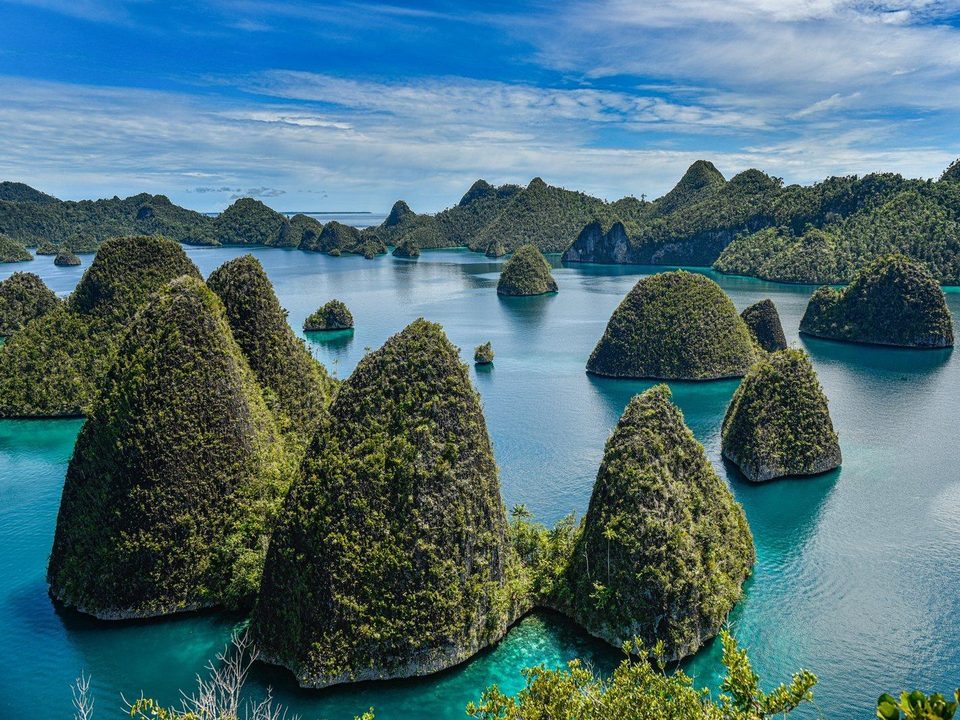
Raja Ampat. Photograph: Rolandandika, CC BY-SA 4.0, cropped
Asia's places run from high steppe pasture to coral reef and limestone coast in the tropics. Some were built as temples and shrines, from Angkor Wat in Cambodia to Paro Taktsang on its granite cliff in Bhutan. Others are ground still at work: Aogashima, a village of Tokyo on a Pacific island, sits inside a double volcano that the Japan Meteorological Agency monitors. Limestone shapes many more, as tower karst along rivers, islands in a bay and caves, among them Vietnam's Hang Sơn Đoòng, entered on permit expeditions. In the high country the seasons set the pattern: Song-Köl, a lake among Kyrgyzstan's summer pastures, is visited from June to September, and black-necked cranes winter in a Bhutanese valley.
46 places in this region
 AogashimaTokyo Metropolis, Izu Islands
Around 170 people living inside an active double caldera, cooking with volcanic steam, on an island the ferry often cannot reach.
 Hang Sơn ĐoòngQuang Tri Province, Vietnam
The world's largest cave keeps its own clouds and grows its own jungle: found by a farmer sheltering from a storm, then lost for eighteen years.
 Living Root BridgesMeghalaya, India
In one of the wettest inhabited places on Earth, the Khasi grow bridges from living fig roots: architecture that heals itself and strengthens with age.
 Song-KölNaryn Region, Kyrgyzstan
A lake two miles up with no town and no trees, only a season: yurts and herds arrive each June, and by October it all belongs to the wind again.
 Zhangjiajie & WulingyuanHunan Province, China
Three thousand stone towers wearing trees for hats: when the mist rises past their feet, whole mountains cast off and float.
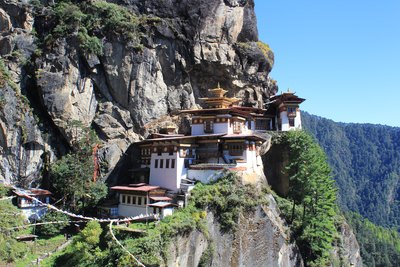 Paro TaktsangParo District, Bhutan
A monastery glued to a rock wall nine hundred metres above the valley, in a country that writes its forests into its constitution.
 Raja AmpatSouthwest Papua, Indonesia
The highest reef biodiversity ever recorded, on islands that also happen to be made of battery metal.
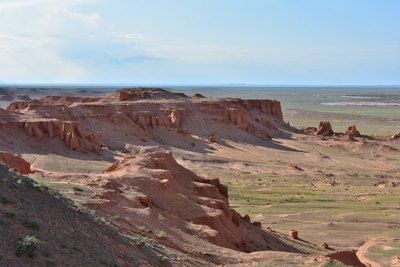 The Flaming CliffsÖmnögovi Province, Mongolia
In 1923 a team here found the first dinosaur eggs anyone recognised as such, and science blamed the wrong animal for stealing them for seventy years.
 Taroko GorgeHualien County, Taiwan
A river cuts through solid marble while the island keeps rising to meet it, and since 2024, the gorge has been carefully putting itself back together.
 The haenyeo of JejuJeju Province, South Korea
Women who dive to twenty metres on one breath, by rule and without tanks. Over 4,500 of them in 2013; about 2,600 by the end of 2024.
 Gunung MuluSarawak, Malaysian Borneo
No road in, some of the largest caves on Earth, and millions of bats pouring out of one at dusk. Several of its famous records are out of date.
 Angkor WatSiem Reap, Cambodia
The famous building is one temple. Lidar flown in 2012 showed the forest around it hides a planned city of embankments, ponds and roads, and the temple was built into the grid.
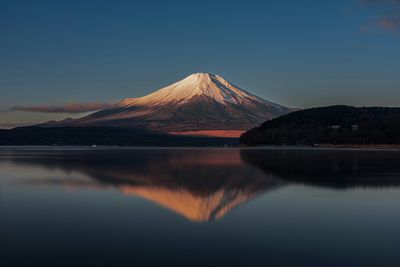 Mount FujiShizuoka and Yamanashi, Japan
The summit of Japan's national symbol is shrine land: the state took it after the Meiji Restoration, the Supreme Court ruled for the shrine in 1974, and it was handed back in 2004. The prefectural border across the top was never drawn.
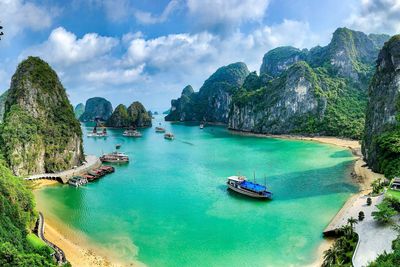 Ha Long BayQuang Ninh province, Vietnam
A limestone tower landscape that the sea has flooded: UNESCO calls it the most extensive marine-invaded tower karst on Earth. Every island carries a notch the tide has dissolved at its foot.
 The Great WallNorthern China (coordinates: the Mutianyu section, Beijing)
Not one wall but thousands of sections, trenches and towers built over two thousand years, of whatever the ground offered. China's own survey of its Ming line counts hills and rivers as part of it.
 RegistanSamarkand, Uzbekistan
Three tiled madrasas facing each other across Samarkand's central square. When a minaret of the oldest began to lean in 1918, the engineer of Moscow's radio tower set it straight in 1932.
 Fushimi Inari TaishaFushimi Ward, Kyoto, Japan
The tunnels of vermilion gates on the Inari shrine's mountain are offerings, given since the Edo period for prayers made or answered. The giver's name is on the back of each.
 BorobudurMagelang Regency, Central Java, Indonesia
Borobudur's first chapter, 160 carved panels on cause and effect, lies behind a later stone base. It was photographed once, in 1890–91, and covered again; one corner is open.
 SigiriyaMatale District, Central Province, Sri Lanka
Visitors to Sri Lanka's Lion Rock scratched verses into its polished Mirror Wall between the 8th and 10th centuries. Hundreds survive, including one from a man who declined to write a poem.
 The Chocolate HillsBohol, Central Visayas, Philippines
Rounded limestone mounds rise out of the rice fields of Bohol by the hundred and turn brown in the dry season. Three official counts give three different totals.
 Hawa MahalJaipur, Rajasthan, India
A Jaipur landmark that is mostly a screen: five storeys of latticed windows over a bazaar street, built in 1799 so royal women could watch the city unseen.
 Mount BromoEast Java, Indonesia
An active volcano standing in a plain of grey volcanic sand inside an older crater in East Java. The sand sea has been a nature reserve since 1919, and the Tenggerese carry offerings to the crater every year.
 Kuang Si FallsLuang Prabang Province, Laos
A waterfall outside Luang Prabang that spills through a staircase of milky blue pools over pale stone the water laid down itself, with rescued moon bears and sun bears dozing beside the path.
 Hội AnDa Nang (formerly Quảng Nam province), Vietnam
A trading port that lost its trade when its river silted, and so kept its timber houses, its assembly halls and a little covered bridge with a temple on it. The river still floods the old town most autumns.
 Maya BayKo Phi Phi Le, Krabi province, Thailand
A cove on a limestone island in the Andaman Sea, reshaped for a film and then overrun, closed for three and a half years to recover and reopened with swimming banned. Its shallows are now a nursery for blacktip reef sharks.
 The Li RiverGuilin and Yangshuo, Guangxi, China
A river winding between limestone towers that rise one by one from flat green fields, from Guilin down to Yangshuo. One bend near Xingping is on the back of China's 20-yuan note, and people stand there holding the note up to the view.
 Lake KaindyAlmaty Region, Kazakhstan
A mountain lake that an earthquake made in moments, drowning a spruce forest where it stood. The trunks still rise from the water, pale above and green below, and nobody is quite sure which year they drowned.
 MoynaqKarakalpakstan, Uzbekistan
A fishing port on the Aral Sea until the rivers that fed the sea were diverted for cotton. The water has gone out of sight; the town's fishing boats lie rusting on the sand, and the town is still lived in.
 HampiVijayanagara district, Karnataka, India
The ruined capital of the Vijayanagara Empire, among granite boulders on the Tungabhadra. Its stone chariot is on India's fifty-rupee note, and its oldest temple never stopped holding worship.
 KharkhorinÖvörkhangai Province, Mongolia
The capital of the Mongol Empire stood here, with a silver tree that poured drinks for the khan's guests. The city was razed, its stones built into a monastery, and a granite turtle still sits in the grass at its edge.
 LanyuTaitung County, Taiwan
A volcanic island off south-east Taiwan, home of the Tao, who build their fishing boats by hand from planks and arrange their year around the flying fish. Visitors are asked to leave the boats, and the drying fish, alone.
 Ogasawara IslandsTokyo Metropolis, Japan
Subtropical islands about 1,000 km south of Tokyo with no airport, reached by a ferry of about 24 hours that sails roughly once a week. UNESCO listed them for snails and plants found nowhere else.
 Ban Gioc WaterfallCao Bằng province, Vietnam
A wide, tiered waterfall on the Quay Son River in Vietnam’s far north, falling into a green pool below karst hills. China shares it and calls it Detian; visitors from Vietnam see it from the southern bank.
 BatanesBatanes, Philippines
The northernmost province of the Philippines: small, steep islands in the Luzon Strait where the Ivatan build in stone and lime under thick grass roofs, against the wind, rather than in wood and bamboo.
 El NidoPalawan, Philippines
A bay of sheer limestone islands at the northern tip of Palawan, with lagoons reached by kayak, and a town renamed in 1954 after the edible swiftlet nests in its cliffs: el nido is Spanish for ‘the nest’.
 Ifugao Rice TerracesIfugao, northern Luzon, Philippines
Mountainsides in northern Luzon cut into stepped rice fields by the Ifugao: in 1995 the first site on UNESCO’s World Heritage List as a cultural landscape, and, by the archaeologists’ dating, built in the seventeenth century rather than two thousand years ago.
 Côn ĐảoHo Chi Minh City Special Zone, Vietnam
A group of forested islands off southern Vietnam, mostly national park, where green turtles nest in greater numbers than anywhere else in the country. Its French colonial prison, used from 1861 to 1975, is now a national memorial.
 Jigokudani Monkey ParkYamanouchi, Nagano Prefecture, Japan
A steaming gorge in the mountains of Nagano where a troop of wild macaques, fed by the park since 1964 to keep them off the apple orchards, sits up to its necks in a hot-spring pool through the snowy winter.
 Shirakawa-goShirakawa, Gifu Prefecture, Japan
A village of steep thatched farmhouses in a snowy valley of central Japan, built three and four storeys high under the roof for raising silkworms, where neighbours still gather to re-thatch them and the whole village rehearses each autumn for fire.
 Phobjikha ValleyWangdue Phodrang District, Bhutan
A wide, marshy valley high in central Bhutan where most of the country’s black-necked cranes spend the winter, below a monastery they are said to circle on arrival, and where electricity reaches the houses underground so that no wires cross the birds’ flight.
 BozzhyraMangystau Region, Kazakhstan
A valley of white chalk towers and two great pale fangs on the edge of a desert plateau in western Kazakhstan, carved from the floor of a vanished sea and still scattered with its shells, a long 4x4 drive from the Caspian coast.
 Yehliu GeoparkWanli District, New Taipei, Taiwan
A cape of sandstone on Taiwan’s north coast where waves and wind have carved hundreds of mushroom rocks, among them the Queen’s Head, a profile in stone whose neck has been measured, guarded and worried over as it wears thinner every year.
 Kampong AyerBandar Seri Begawan, Brunei-Muara District, Brunei
A town on stilts over the Brunei River, of wooden houses, schools, mosques and fire stations joined by plank walkways and water taxis, lived in for centuries and facing Brunei’s capital across the water.
 NaraNara Prefecture, Japan
Japan’s first permanent capital, where a bronze Buddha 16 metres high sits in a hall that was the world’s largest wooden building until 1998, three thousand stone lanterns line the way to a forest shrine, and deer bow for crackers.
 Tsurui and KushiroKushiro subprefecture, Hokkaidō
The snowy dairy country on the edge of Japan’s largest marsh where red-crowned cranes, once thought extinct in Japan, gather each winter to be fed and to dance, and roost at dawn in a steaming river.
 Danum ValleyEastern Sabah, Borneo, Malaysia
Unlogged lowland rainforest in eastern Sabah, set aside by the timber concession around it, where pittas and hornbills live, scientists have worked since the 1980s, and the tallest tropical tree yet measured stands.
About this hub
Nearby on the shelf
- Sacred & ancient places (collection, 36)
- Volcanoes (collection, 12)
- The whole map
Know somewhere that belongs here?
Each place page names its sources and the date it was checked.
Photo credits for the thumbnails
- Aogashima: Source: Geospatial Information Authority of Japan, Attribution only licence (GSI Japan), cropped, resized
- Hang Sơn Đoòng: Photograph: Dave Bunnell, CC BY-SA 4.0
- Living Root Bridges: Photograph: PJeganathan, CC BY-SA 4.0, cropped
- Song-Köl: Photograph: Thomas Holbach, CC BY 4.0, cropped
- Zhangjiajie & Wulingyuan: Photograph: chensiyuan, CC BY-SA 4.0, cropped
- Paro Taktsang: Photograph: Arian Zwegers from Brussels, Belgium, Paro, Taktsang Goemba (Tiger's Nest), CC BY 2.0
- Raja Ampat: Photograph: Rolandandika, CC BY-SA 4.0
- The Flaming Cliffs: Photograph: Richard Mortel, Bayanzag (Flaming Cliffs), Gobi Desert, Mongolia (29), CC BY 2.0
- Taroko Gorge: Photograph: Balon Greyjoy, CC0
- The haenyeo of Jeju: Photograph: Republic of Korea (Korea.net), Jeju Island 20141128 01, CC BY-SA 2.0, cropped
- Gunung Mulu: Photograph: Nur Nafis Naim, CC BY-SA 4.0
- Angkor Wat: Photograph: Alexey Komarov, CC BY-SA 4.0
- Mount Fuji: Photograph: Steven Lynn via Unsplash, Unsplash licence
- Ha Long Bay: Photograph: Marina Lobato via Unsplash, Unsplash licence, cropped
- The Great Wall: Photograph: Philip Nalangan, CC BY 4.0, cropped
- Registan: Photograph: Kraftabbas, CC BY-SA 4.0, cropped
- Fushimi Inari Taisha: Photograph: Basile Morin, CC BY-SA 4.0
- Borobudur: Photograph: Justine Hong, Borobudur Sunrise 2012-01-05, CC BY 2.0, cropped
- Sigiriya: Photograph: C.J. Hatton, CC BY-SA 4.0
- The Chocolate Hills: Photograph: Vyacheslav Argenberg, CC BY 4.0
- Hawa Mahal: Photograph: Adityaoberai, CC BY 4.0
- Mount Bromo: Photograph: Ronald Tagra, Sea of Sand, Bromo and Batok, CC BY 2.0
- Kuang Si Falls: Photograph: Basile Morin, CC BY-SA 4.0
- Hội An: Photograph: Steffen Schmitz (Carschten) / Wikimedia Commons, CC BY-SA 4.0, cropped
- Maya Bay: Photograph: Nnthurber, CC BY-SA 4.0, cropped
- The Li River: Photograph: chensiyuan, CC BY-SA 4.0, cropped
- Lake Kaindy: Photograph: RS128, CC BY-SA 4.0
- Moynaq: Photograph: Arian Zwegers, Moynaq, Aral Sea, CC BY 2.0
- Hampi: Photograph: Arian Zwegers, Hampi, Vittala Temple, chariot, CC BY 2.0
- Kharkhorin: Photograph: François Philipp, Protecting Turtle, Erdene Zuu Monastery, CC BY 2.0
- Lanyu: Photograph: Pai-Shih Lee, Orchid Island (Lanyu), CC BY 2.0, cropped
- Ogasawara Islands: Photograph: Ootahara, CC0, cropped
- Ban Gioc Waterfall: Photograph: Rod Waddington, Ban Gioc Falls, CC BY-SA 2.0, cropped
- Batanes: Photograph: Greenthumb331, CC BY-SA 4.0, cropped
- El Nido: Photograph: Mario von Rotz via Unsplash, Unsplash licence
- Ifugao Rice Terraces: Photograph: Jose Nicdao (Flickr), Banaue Rice Terraces pic by J. Nicdao - Flickr, CC BY 2.0
- Côn Đảo: Photograph: Lam Tr Th, Côn Đảo, Bà Rịa - Vũng Tàu, Vietnam - panoramio (10), CC BY-SA 3.0, cropped
- Jigokudani Monkey Park: Photograph: Romain Guy, CC0, cropped
- Shirakawa-go: Photograph: 663highland, Ogi Shirakawa-gō, Gifu, Japan, CC BY 2.5
- Phobjikha Valley: Photograph: Phuentsho, CC BY-SA 4.0, cropped
- Bozzhyra: Photograph: Максат79, CC BY-SA 4.0, cropped
- Yehliu Geopark: Photograph: Johan Jönsson, CC BY-SA 4.0
- Kampong Ayer: Photograph: Yu Chu Chin (Pangalau), CC BY-SA 4.0
- Nara: Photograph: Alex via Unsplash, Unsplash licence
- Tsurui and Kushiro: Photograph: paul milley via Unsplash, Unsplash licence
- Danum Valley: Photograph: Christopher Michel, Morning fog over Danum Valley, CC BY 2.0