
- Where
- Gulf of Guinea, off Central Africa
São Tomé and Príncipe - Coordinates
- 1.6167° N
7.4000° E - Biome
- Equatorial rainforest, secondary forest
over old plantations, mangrove - The island
- About 142 km²
highest point 947–948 m - Population
- 7,324 at the 2012 census
8,420 estimated in 2018 - Status
- UNESCO Biosphere Reserve, 2012
the whole island - Best visited
- June–September, the drier season
Rain in the morning so heavy the red road ran like a river, then sun, and steam off every leaf at once. Green volcanic spires stood up out of the forest like the teeth of something asleep. At an old plantation house facing the sea I was shown a patch of lawn where somebody once waited all morning for the clouds to clear. Behind the house are the long low buildings where the workers lived. I stood in front of those for longer.
The short answer
Príncipe is the smaller and more northerly of the two main islands that make up São Tomé and Príncipe, in the Gulf of Guinea off the coast of Central Africa. It is an eroded volcanic island of around 142 square kilometres, with gentle, long-farmed country in the north and a range of steep phonolite peaks in the south rising to 947 or 948 metres, depending on the survey. It had 7,324 people at the 2012 census and an estimated 8,420 in 2018, about a third of them in the small capital, Santo António. In 2012 UNESCO designated the entire island, with its islets and surrounding sea, a Biosphere Reserve. And on 29 May 1919, at Roça Sundy in the island’s north-west, the British astronomer Arthur Eddington photographed a total solar eclipse in one of the two observations that confirmed Einstein’s general theory of relativity.
Why it's worth knowing
The eclipse is usually told as a clean triumph: an expedition sails to a remote island, photographs the stars beside the darkened Sun, finds them displaced by exactly the amount Einstein predicted, and makes him the most famous scientist in the world. The last part is true. The rest is more interesting than that.
The days before the eclipse were cloudy, and on the morning itself a heavy thunderstorm broke over the island from about ten until half past eleven — unusual, the expedition noted, for the time of year. Totality lasted about five minutes, shortly after two in the afternoon. Eddington and his colleague Edwin Cottingham took sixteen plates through drifting cloud. Most of them could not be used: the stars simply were not visible. The Príncipe result rests mainly on two stars.
It was the second expedition, at Sobral in Brazil, that carried most of the weight — and even there, the main telescope’s images were blurred and the published conclusion relied on a small backup instrument. The analysis has been argued over for decades. The modern reading, set out below, is that the team was careful and the conclusion sound, but that it was a conclusion wrung from very little.
And the ground Eddington stood on has a history of its own. Roça Sundy was a cocoa plantation, and in the first decade of the twentieth century São Tomé and Príncipe was the largest cocoa exporter in the world, worked by contract labourers brought from Angola, Mozambique and Cape Verde under conditions that British investigators called slavery under another name. Cadbury stopped buying the islands’ cocoa in 1909, ten years before the astronomers arrived.
So one of the great moments in the history of physics took place on a plantation whose labour system had already been exposed to the world, on a morning when it rained. Both facts are part of what happened on Príncipe, and the island is better understood holding both.
The field notes
Sixteen plates, mostly cloud
The test was simple to state. Light from a star passing close to the Sun should be bent by its gravity. Newtonian reasoning predicted a deflection, at the Sun’s edge, of about 0.87 seconds of arc; Einstein’s completed theory predicted 1.75, twice as much. The only time stars can be photographed beside the Sun is during a total eclipse, and the eclipse of 29 May 1919 had the unusual advantage of placing the Sun in front of the bright Hyades cluster.
The Príncipe account, as published by Dyson, Eddington and Davidson in the Philosophical Transactions of the Royal Society in 1920 and summarised by Malcolm Longair for the Royal Society in 2015, is candid. Totality ran from 2h 13m 5s to 2h 18m 7s Greenwich time. The crescent Sun was seen continuously through cloud only from about 1.55. Conditions improved in the last third of the eclipse, a few suitable stars appeared on a few plates, and most weight in the reduction went on two of them. The Príncipe deflection came out at 1.61 seconds of arc, with an uncertainty of about 0.3.
Eddington had meant to measure all the plates on the island, but a strike by the steamship company meant leaving early, and most of the work was done back in Cambridge. He did measure one before he left. His notebook for 3 June records that it gave a result agreeing with Einstein.
At Sobral, the weather was better. The small four-inch telescope gave 1.98 seconds of arc, with an uncertainty of 0.12; the main instrument’s images were out of focus, its result depended on how the analysis handled that, and the authors set it aside as unreliable. The combined results were announced at a joint meeting of the Royal Society and the Royal Astronomical Society on 6 November 1919, and the newspapers did the rest.
Was it fudged?
The question has been put seriously, and it deserves a straight account rather than a verdict.
From the 1970s onwards historians and sociologists of science asked whether Eddington, already persuaded of relativity, had discarded the inconvenient Sobral data to get the answer he wanted. The case was made most widely in Harry Collins and Trevor Pinch’s book The Golem.
Two things answered it. In 1979 the Sobral plates were remeasured at the Royal Greenwich Observatory with a modern machine, and the reanalysis supported the original conclusion. And the historian Daniel Kennefick, in Physics Today in 2009, examined the decisions made in 1919 and concluded that the team’s treatment of the data was defensible and, if anything, less biased than some later eclipse analyses.
What no one disputes is that the 1919 measurements were thin. Eclipse measurements in visible light stayed contested for decades, and it was radio astronomy in the late 1960s that settled the deflection at the full value Einstein predicted. Príncipe’s place in the story is secure; the idea that it proved anything on its own is not.
The Chocolate Islands
Cocoa came to the islands from Brazil in 1819, and the first tree to reach maturity is recorded on Príncipe, in 1824 by one account and 1822 by another. By 1905 São Tomé and Príncipe had become the world’s largest producer and exporter of cocoa, and it kept that position until the British Gold Coast, now Ghana, overtook it in 1911.
The plantations, called roças, ran on imported labour. Portugal had abolished slavery in its colonies, and the estates recruited serviçais — contract workers — from Angola, Mozambique and Cape Verde; an estimated 67,000 were brought in between 1888 and 1908. In 1905 the British journalist Henry Nevinson published the first of a series of articles, collected in 1906 as A Modern Slavery, tracing people from the Angolan interior to the island plantations. A British Foreign Office report of 1906 concluded that slaves had been renamed serviçais. Portugal denied it.
The British chocolate makers who bought most of the islands’ cocoa — Cadbury, Fry’s and Rowntree’s — held out for years, and Cadbury began its boycott on 9 March 1909. Pests, disease and the loss of buyers then did the rest, and after independence in 1975 most of the great estates declined or were abandoned. Many of their buildings are now standing ruins in secondary forest.
Roça Sundy now
Sundy was once the second-largest roça on Príncipe. It sits in the north-west of the island, above the sea, and it is where Eddington and Cottingham set up their telescope.
In 2019, the centenary year, an agroforestry and tourism company built a chocolate factory on the old estate, and the owner’s house was converted into a hotel. A telescope and displays about the eclipse are kept at the house. The long rows of workers’ buildings, some roofless, stand around the old square behind it.
It is possible to visit Sundy for the eclipse and never think about the rows. It is better not to.
The south, where nobody lives
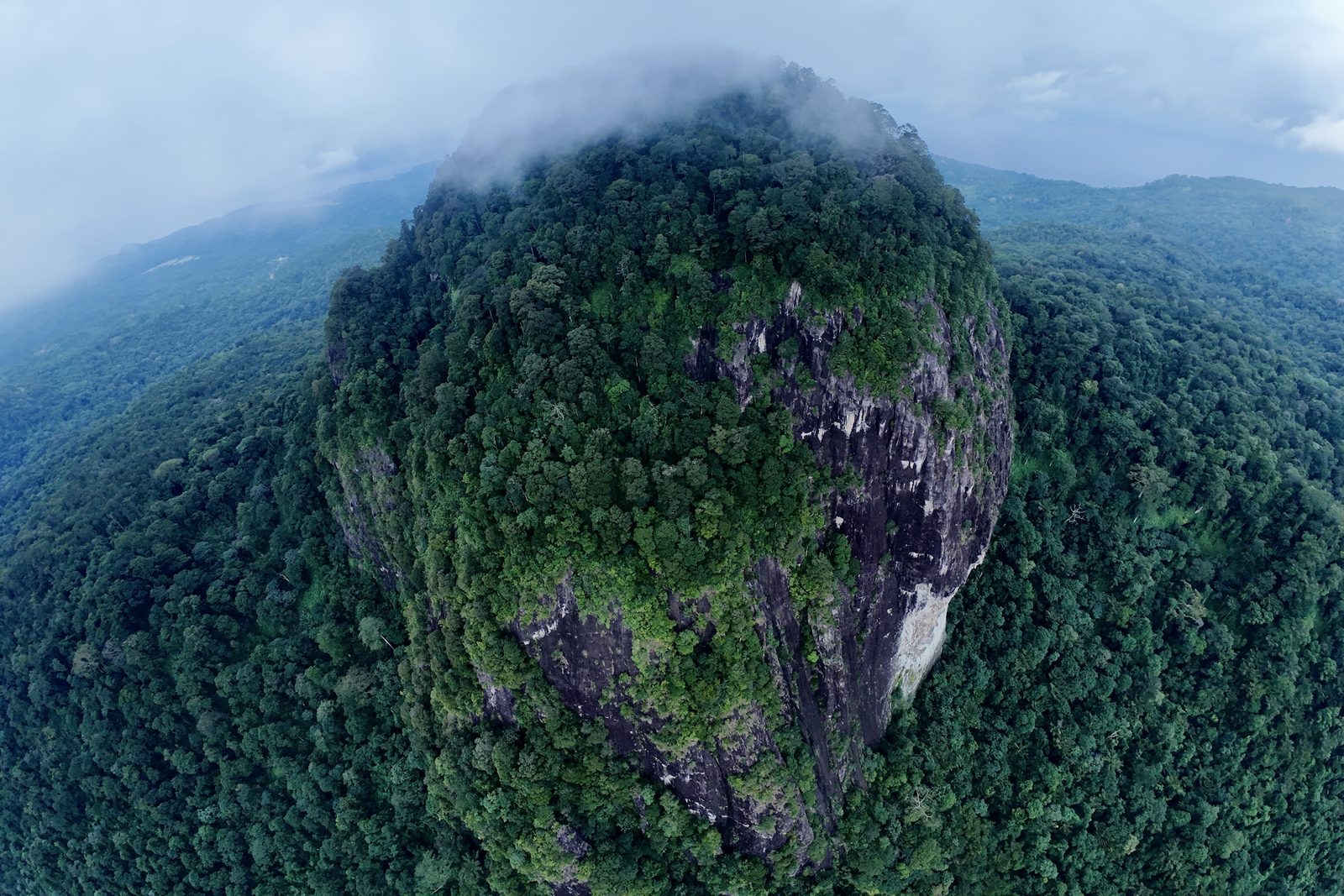
The southern half of Príncipe is a different island: a massif of steep phonolite peaks between 500 and 948 metres, covered in forest that includes the island’s patch of primary rainforest. It has been protected since 2006 as the Obô Natural Park and is uninhabited.
Príncipe has a list of birds found nowhere else, among them the Príncipe kingfisher, the Príncipe sunbird, the Príncipe starling, Dohrn’s thrush-babbler and the Príncipe scops owl. UNESCO’s biosphere description records high rates of endemism in plants, molluscs, insects, reptiles and bats as well, and notes the island’s importance for nesting sea turtles, seabirds and whales.
The biosphere designation, in 2012, covered the whole island and its sea. In 2025 it was extended to São Tomé, which made São Tomé and Príncipe the first country designated a biosphere reserve in its entirety.
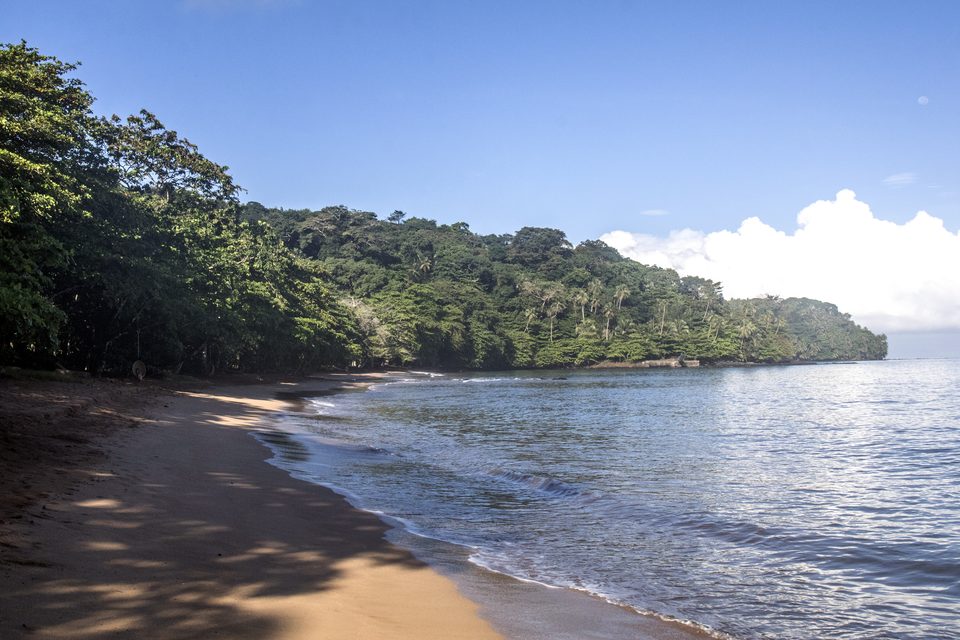
The beach below Sundy, in early morning light.
Photograph: Charles J. Sharp · CC BY-SA 4.0
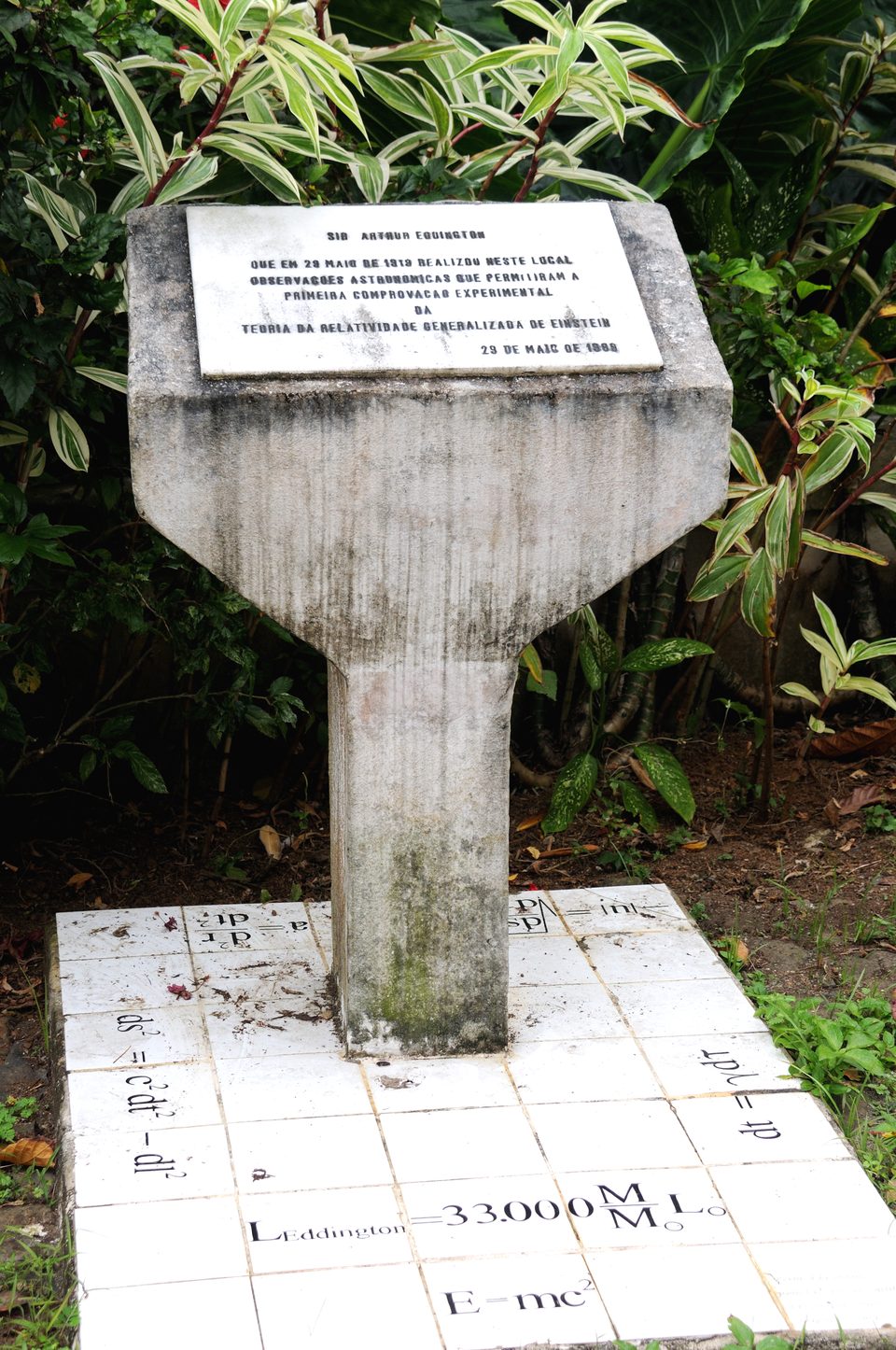
The memorial to the 1919 eclipse observations at Roça Sundy.
Photograph: Josep M. Gracia · CC BY-SA 4.0
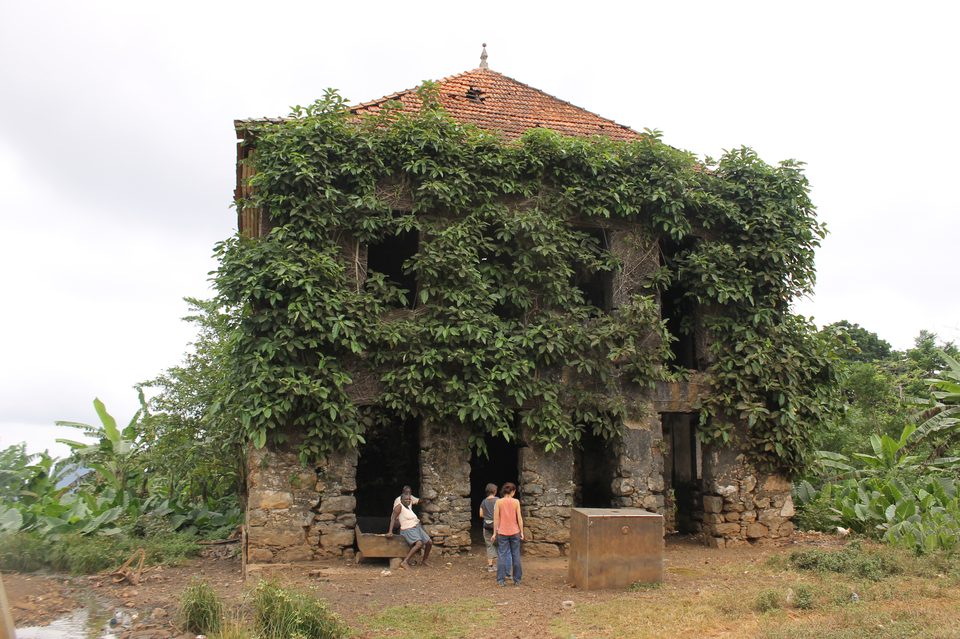
Roça San Joaquim, one of Príncipe's abandoned plantation houses.
Photograph: César J. Pollo · CC BY-SA 4.0
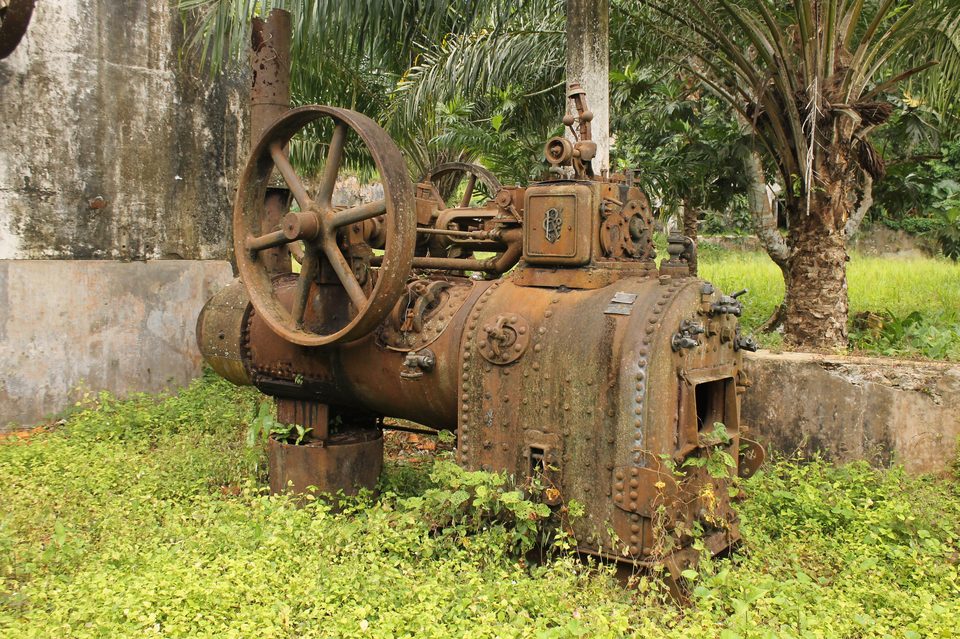
Old machinery at Roça Sundy.
Photograph: César J. Pollo · CC BY-SA 4.0
- Stand on the lawn at the old plantation house and look up. Then walk round the back.
- Walk into the forest in the south with a guide, and listen.
- Learn to tell the island’s own birds from the visitors. You will fail pleasantly.
- Eat chocolate made from cocoa grown on the island, slowly.
- Leave a spare day for the little plane. The weather decides, not you.
A line in a notebook. On 3 June 1919, five days after the eclipse and still on Príncipe, Arthur Eddington measured one of his clouded plates and wrote that it gave a result agreeing with Einstein. Sixteen photographs, a morning of rain, two usable stars, and one plate measured by hand on a cocoa estate — that is the whole of what the island contributed, and it was enough to put this small place into every account of how we know that gravity bends light.
Tally, in the marginOne plate, measured by hand, on a morning that was supposed to be ruined. I have never been so glad of an astronomer’s stubbornness, and I noticed that he wrote it down before he believed it.
Getting there
How to get there. Fly first to São Tomé, the capital island; most travellers from Europe and North America connect through Lisbon. From São Tomé International Airport, small scheduled aircraft cross to Príncipe Airport, three kilometres north of Santo António, in well under an hour. Príncipe has no international flights of its own, and the inter-island schedule is thin and changeable — book it with the international flight and leave a spare day at the end.
By sea there are irregular cargo and passenger boats between the islands, which are slow, weather-dependent and not to be relied on for a connection.
When to go. The island is wet all year, but June to September, the season locally called gravana, is the driest and coolest; July has the least rain at Santo António and October the most. Humidity is high in every month.
Getting around. Roads in the north are few and some are rough; a hired driver or the lodges’ own transport is the norm. Guided walks into the Obô Natural Park and boat trips along the coast are arranged locally.
Practical notes. Medical services are limited on both islands and there is no adequate trauma care; the State Department’s advice for the country is built around exactly that point, and travel insurance with evacuation cover is a sensible condition of going. Card acceptance is limited, so ask your lodge before you travel how best to pay, and bring cash. Check entry requirements for your passport before booking.
Mark this place
Common questions
What happened on Príncipe in 1919?
On 29 May 1919 the British astronomers Arthur Eddington and Edwin Cottingham photographed a total solar eclipse from Roça Sundy, a cocoa plantation on Príncipe, to test whether the Sun’s gravity bends starlight as Einstein’s general theory of relativity predicted. A second British team observed from Sobral in Brazil. The combined results, announced in London on 6 November 1919, supported Einstein and made him internationally famous.
Did clouds ruin Eddington’s eclipse photographs on Príncipe?
Largely, yes. A heavy thunderstorm broke over Príncipe on the morning of 29 May 1919 and the Sun was seen only through drifting cloud. Eddington’s team took sixteen plates; most could not be used because the stars were not visible, and the Príncipe result rested mainly on two stars. It gave a deflection of 1.61 seconds of arc, against Einstein’s predicted 1.75.
Was Eddington’s 1919 eclipse result biased?
It has been argued so, most widely in Collins and Pinch’s book The Golem, which questioned the exclusion of blurred Sobral data. A 1979 remeasurement of the Sobral plates at the Royal Greenwich Observatory supported the original conclusion, and the historian Daniel Kennefick, writing in Physics Today in 2009, judged the 1919 analysis sound. Definitive confirmation of the full deflection came from radio astronomy in the late 1960s.
Where is Roça Sundy?
Roça Sundy is a former cocoa plantation in the north-west of Príncipe, São Tomé and Príncipe, once the second-largest on the island. Arthur Eddington observed the 1919 total solar eclipse there. In 2019 a chocolate factory was built on the estate and the owner’s house became a hotel, which keeps a telescope and displays about the eclipse.
Why is São Tomé and Príncipe called the Chocolate Islands?
Because for a period in the early twentieth century São Tomé and Príncipe was the largest producer and exporter of cocoa in the world, from about 1905 until the Gold Coast overtook it in 1911. Cocoa had arrived from Brazil in 1819, and the first tree to mature is recorded on Príncipe in the 1820s. Cocoa remains the country’s leading export.
Why did Cadbury boycott São Tomé cocoa?
Because of the labour system on the islands’ plantations. Contract workers, called serviçais, were brought from Angola, Mozambique and Cape Verde under conditions that the journalist Henry Nevinson, in A Modern Slavery (1906), and a 1906 British Foreign Office report described as slavery under a new name. Cadbury began its boycott of São Tomé and Príncipe cocoa on 9 March 1909.
Is Príncipe a UNESCO site?
Príncipe is a UNESCO Biosphere Reserve, designated in 2012 and covering the entire island, its islets including the Tinhosas, and the surrounding sea. The designation was extended to São Tomé in 2025, making São Tomé and Príncipe the first country to be a biosphere reserve in its entirety. The island’s uninhabited south is protected as the Obô Natural Park, created in 2006.
How do you get to Príncipe?
By air via São Tomé. International flights reach São Tomé International Airport, most conveniently from Lisbon, and small scheduled aircraft continue to Príncipe Airport near Santo António in under an hour. Príncipe has no international commercial flights. Boats between the two islands exist but are irregular and weather-dependent.