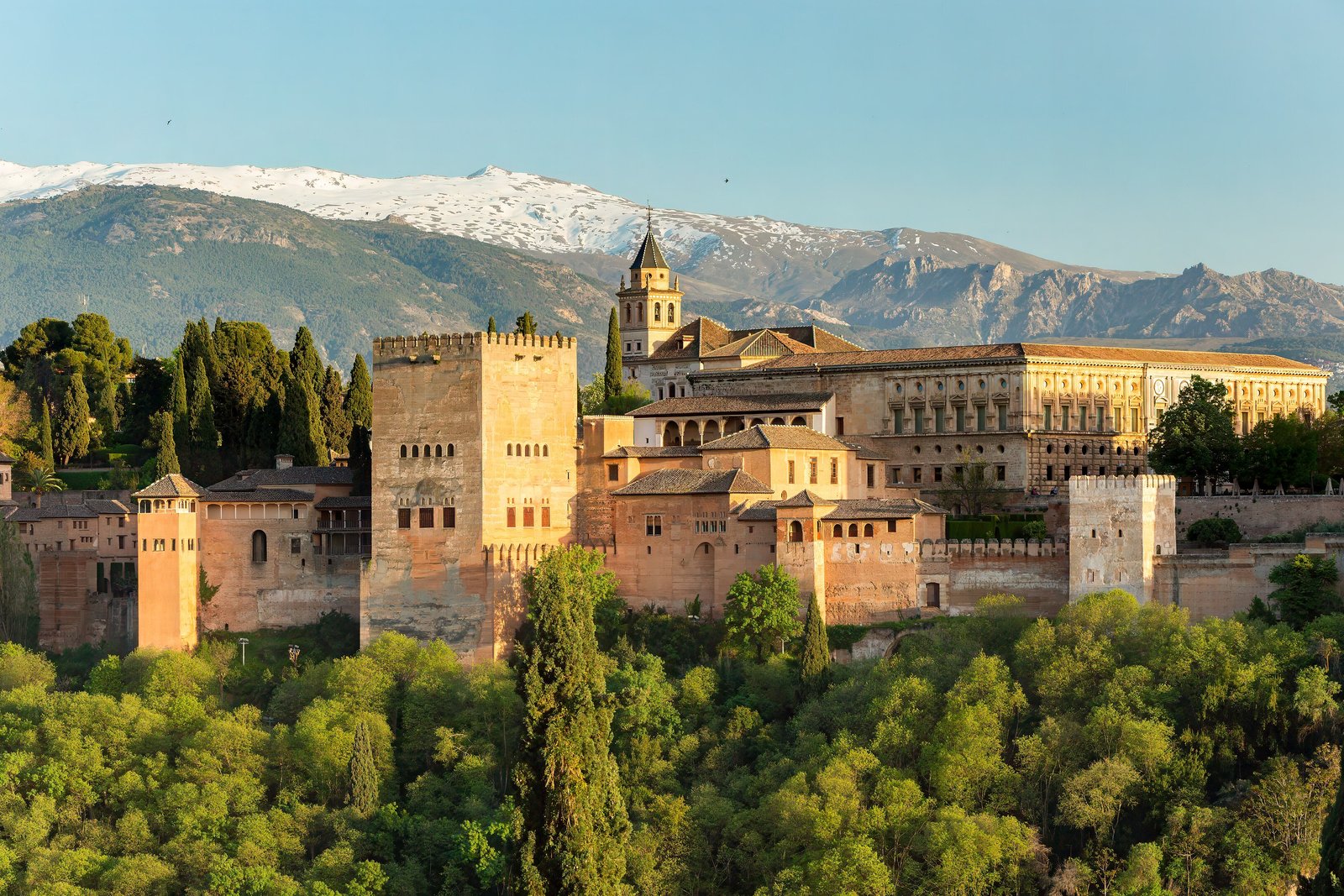

- Where
- Sabika hill above Granada,
Andalusia, southern Spain - Coordinates
- 37.1761° N
3.5881° W - Built
- From 1238; the main palaces
under Yusuf I and Muhammad V - Dynasty
- The Nasrids, the last Muslim
dynasty in Iberia, to 1492 - Status
- UNESCO World Heritage, 1984
- Entry
- Timed tickets for the
Nasrid Palaces; book ahead - Best visited
- Spring and autumn;
the first or last slot of the day
Climbed a hill of cypresses and running water in the heat, with snow on the mountains behind and church bells coming up from the city below. Inside, every wall was written on, carved so fine it looked like lace, and every courtyard had water talking in a channel. I tried to follow one pattern round a room with my finger, lost my place, and started again.
The short answer
The Alhambra is a palace and fortress complex on a hill above Granada, in Andalusia in southern Spain. Its name comes from the Arabic for “the red one”, after the colour of its walls. Muhammad I, founder of the Nasrid dynasty, began building in 1238, and the palaces that define it were built in the fourteenth century under Yusuf I and Muhammad V. The Nasrids were the last Muslim dynasty in Iberia; in January 1492 their last sultan surrendered Granada to Ferdinand and Isabella. The complex also holds the fortress of the Alcazaba, the Generalife gardens and a Renaissance palace begun for Charles V in 1527. UNESCO inscribed it in 1984.
Why it's worth knowing
Look closely at the carved plaster in the Nasrid palaces and much of what reads as pattern is writing. Some of it is the dynasty’s motto, repeated across the walls: And there is no victor but God. Much of the rest is poetry, composed by court poets, among them Ibn al-Jayyab, Ibn al-Khatib and Ibn Zamrak, and carved into the rooms it describes.
The unusual thing is the voice. In many of these poems the room speaks for itself, in the first person. The Patronato de la Alhambra, which manages the monument, publishes the poems of the Palace of the Lions room by room: the largest preserved poem in the Alhambra, twenty-four verses laid out symmetrically round the Hall of the Two Sisters, and a thirteen-verse poem framing the three windows of the Mirador de Lindaraja beyond it. The praise is not only for the room: in these poems the building’s beauty is offered up as tribute to the sultan who built it.
The Court of the Lions goes one step further. Its fountain is a marble basin carried on the backs of twelve marble lions, and round the basin’s rim run verses by Ibn Zamrak, taken from a much longer poem, that describe the palace, the fountain and how its water moves. A visitor can stand at the fountain and read, in translation, an account of the thing in front of them written by the poet of the court that built it. The building carries its own description, carved into the object described.
The field notes
Ibn Zamrak, and the court's poets
Ibn Zamrak lived from 1333 to 1393 and was poet and statesman at the court of Muhammad V, the sultan who built the Palace of the Lions. Some of his poems still decorate the Alhambra’s fountains as well as its walls.
The verses on the Lions fountain, according to the Patronato, belong to a poem of 146 verses by Ibn Zamrak that begins in the Hall of the Two Sisters. Carved round the rim, they describe the palace, the fountain and how it worked, and the Patronato’s researchers have used them to work out how the fountain was built and what it meant.
Because the inscriptions are in Arabic and many visitors cannot read them, the building’s most important layer is the one most often walked past. Guides and the monument’s own publications translate them, and reading one before entering a room changes what the room is.
Twelve lions, one basin, a long restoration
The twelve lions and the basin are carved from white marble from Macael, in Almería, and the basin from a single block. The basin once carried painted detail, since lost to centuries of cleaning.
In 1956 the historian Frederick Bargebuhr proposed that the lions came from an eleventh-century palace of the Jewish vizier Samuel ibn Naghrillah. Wikipedia’s account of the court records that the theory has since been challenged or refuted by many scholars, largely because the sculptures’ style matches fourteenth-century Nasrid work.
The Patronato restored the lions and the fountain between 2007 and 2010. While archaeologists worked on the courtyard, from 2010 to 2012, the twelve lions were shown in the crypt of the Palace of Charles V, until November 2011; the work finished in 2012 with the court repaved in Macael marble. The restoration won a European Heritage Award from Europa Nostra.
All seventeen? The symmetry question
A claim repeated in guidebooks and mathematics classrooms is that the Alhambra’s tilework contains all seventeen wallpaper groups, the complete set of ways a pattern can repeat across a flat surface. The claim is contested, and the disagreement is instructive.
Edith Müller’s 1944 doctoral thesis at Zürich reported eleven. In 1986 Branko Grünbaum, Zdenka Grünbaum and G. C. Shephard reported examples of at most thirteen. A year later R. Pérez-Gómez and J. M. Montesinos reported finding the missing groups. In a 2006 article in the Notices of the American Mathematical Society, Grünbaum challenged those findings and asked for the patterns to be classified in a consistent, well-explained way, by explicit criteria. Other researchers who take the colours of the tiles into account, and not only their shapes, report all seventeen.
So the fair statement is that the Alhambra’s patterns are extraordinarily rich, and that whether they contain all seventeen groups depends on the rules of counting, on which mathematicians disagree. Anyone who says flatly that it does, or that it does not, has chosen a side.
Ruin, a book, and repair
After 1492 the Alhambra passed to the Catholic Monarchs, and Charles V’s palace was begun in its midst in 1527 and left incomplete after 1637. Neglect followed. French troops occupying Granada from 1810 to 1812 did severe damage and blew up eight towers; José García is credited with disabling the remaining fuses.
Washington Irving’s Tales of the Alhambra, published in 1832 after he had lived in the palace, brought it international attention, and restoration followed through the nineteenth and twentieth centuries.
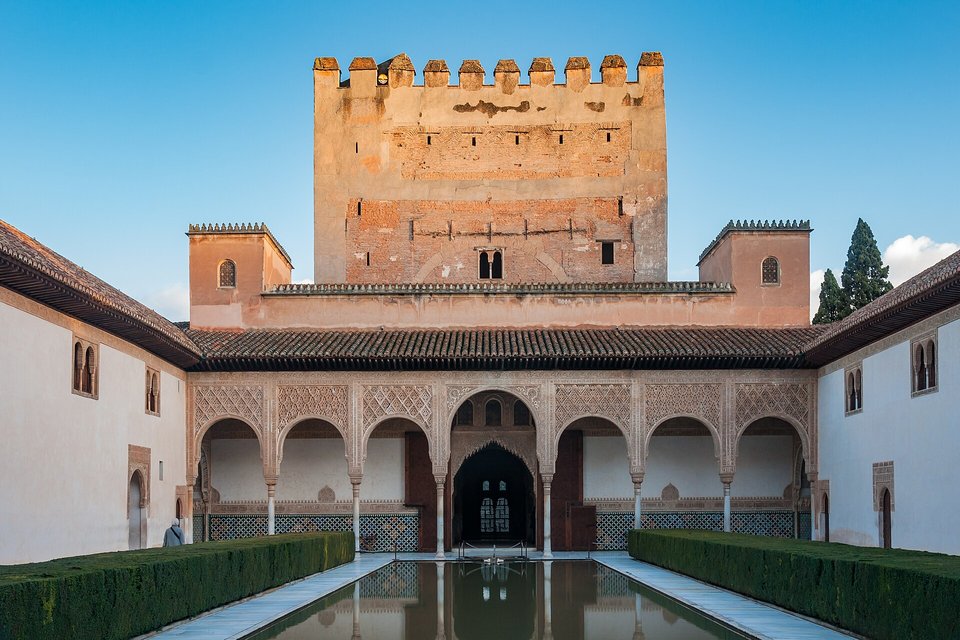
The Court of the Myrtles, its long pool facing the Comares Tower.
Photograph: CEphoto, Uwe Aranas · Granada Spain Alhambra-Palacio-de-Comares-01 · CC BY-SA 3.0
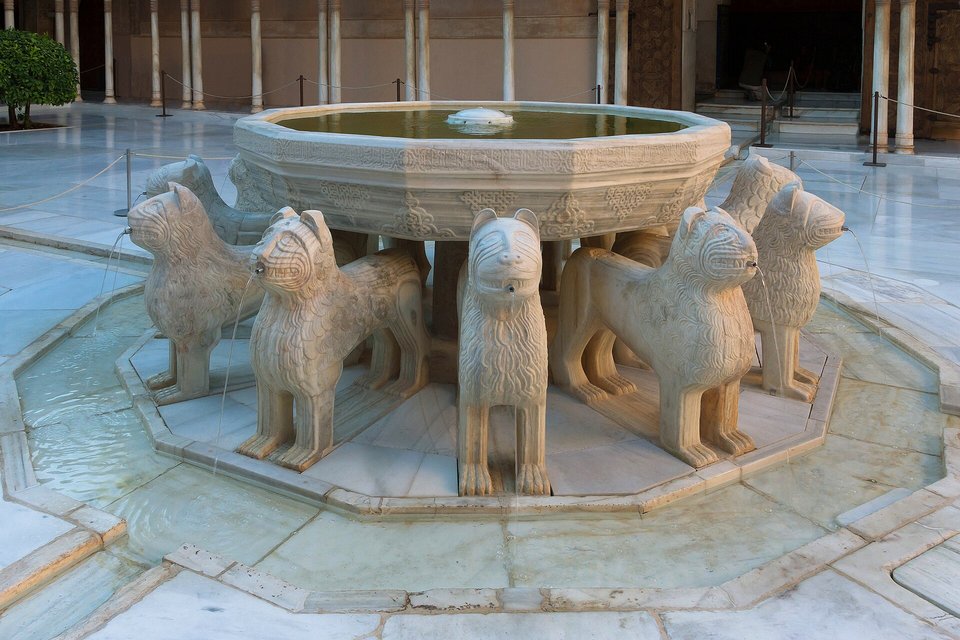
The Fountain of the Lions after its restoration: a twelve-sided basin carried by twelve lions.
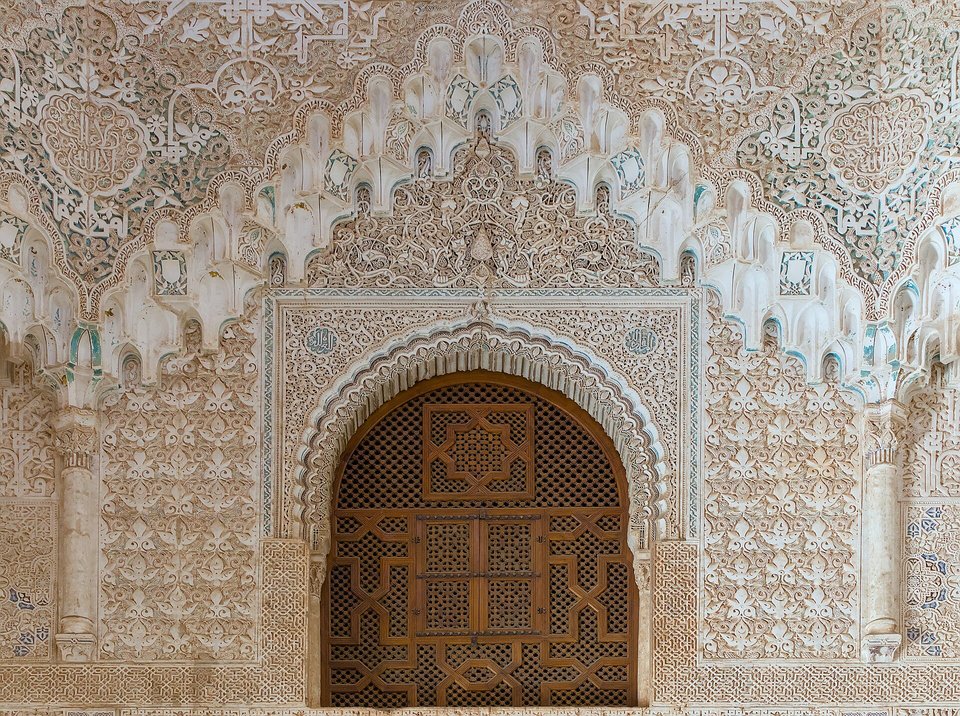
A window and carved plaster in the Hall of the Two Sisters, the room with the largest preserved poem in the palaces.
Photograph: Benjamin Smith / Wikimedia Commons · CC BY-SA 4.0
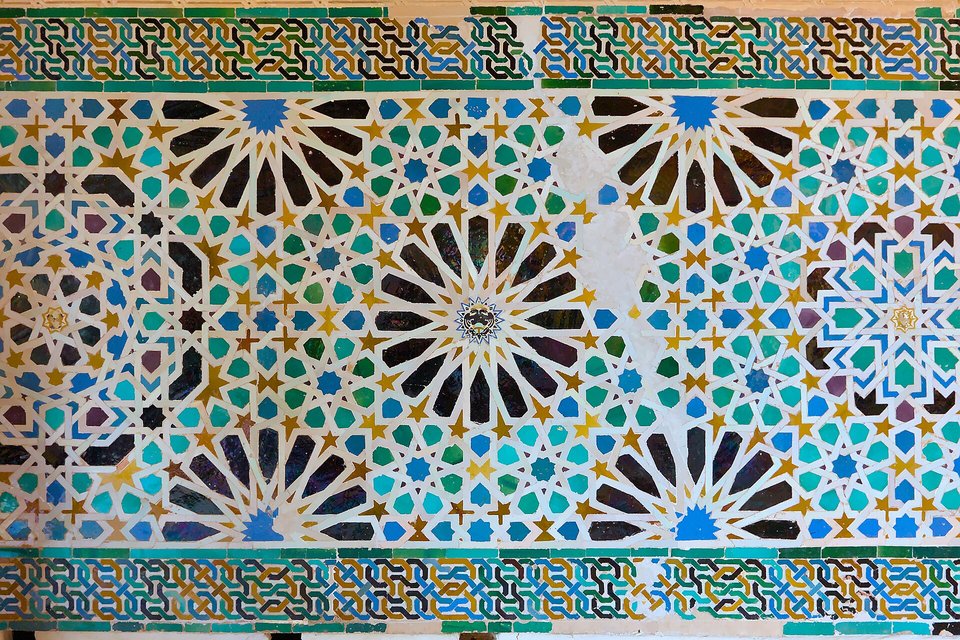
Geometric tilework in the Mexuar, the kind of pattern behind the argument over how many symmetry groups the Alhambra shows.
Photograph: Benjamin Smith / Wikimedia Commons · CC BY-SA 4.0
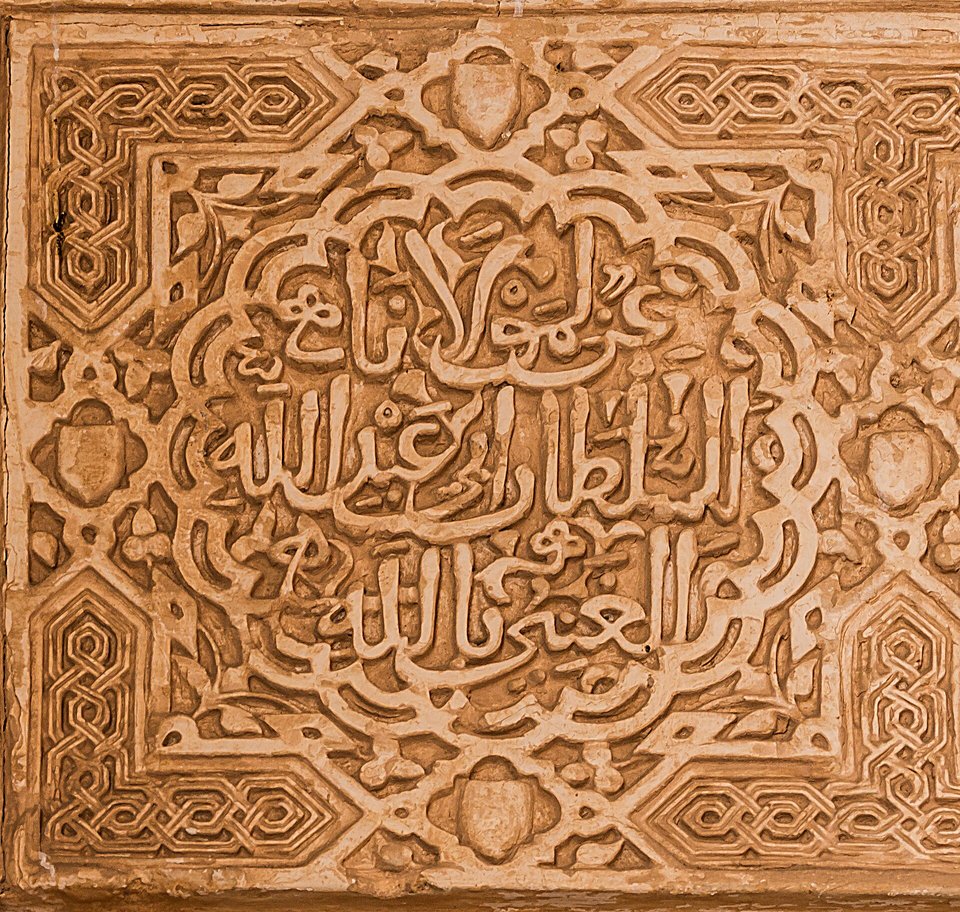
Carved stucco in the Patio del Cuarto Dorado: script written into the wall itself.
- Book the palace time before anything else, then plan the whole day around it.
- Read the walls as writing, not decoration. Some of it is prayer.
- Sit by the water in the gardens late in the day, and listen.
- Walk up the hill opposite at sunset and look back across at all of it.
- Follow one pattern all the way round a room. (Lost my place. Started again. Item retained, possibly for ever.)
The basin of the Fountain of the Lions. A twelve-sided basin of white Macael marble, 2.52 metres across and cut from a single block, carried on the backs of twelve marble lions in the courtyard of Muhammad V’s palace. Round its rim run verses by Ibn Zamrak describing the palace, the fountain and how it worked. The Patronato de la Alhambra restored it between 2007 and 2010. It is an object that carries its own description.
Tally, in the marginA fountain with its own description carved round the rim. I read the translation, looked up, and the water was doing exactly what it said. I have never felt so thoroughly expected.
Getting there
How to get there. Granada has a small airport; Málaga, on the coast, has many more international connections. Trains run to Granada from Madrid and other Spanish cities. From the city centre, the Alhambra is a steep walk up through the woods from Plaza Nueva, or a short ride on the city minibus that climbs to the entrance.
Book the palace entry first. Visits to the Nasrid Palaces are by timed ticket: each ticket carries a half-hour entry slot for the palaces, and if you miss it you cannot enter them that day. Visitor numbers are capped, and tickets for spring and holiday periods sell out weeks ahead. Buy through the Patronato de la Alhambra’s official ticket site, check the current conditions and prices there, and plan the rest of the day, the Alcazaba and the Generalife, around your slot.
When to go. Spring and autumn are the most comfortable; July and August in Granada are very hot. The first and last slots of the day are the least crowded.
For the view. Walk up through the Albaicín, the old quarter on the facing hill, to the Mirador de San Nicolás at sunset, and look back across the valley at the whole of it, with the Sierra Nevada behind.
Mark this place
Common questions
What is the Alhambra?
The Alhambra is a palace and fortress complex above Granada in Andalusia, Spain, built chiefly by the Nasrid dynasty, the last Muslim dynasty in Iberia, between 1238 and 1492. It includes the Nasrid palaces, the Alcazaba fortress, the Generalife gardens and the Renaissance Palace of Charles V. UNESCO inscribed it as a World Heritage Site in 1984.
What do the inscriptions in the Alhambra say?
Many of the Alhambra’s inscriptions repeat the Nasrid motto, “And there is no victor but God”. Many others are poems by court poets including Ibn al-Jayyab, Ibn al-Khatib and Ibn Zamrak, carved into the plaster of the rooms they describe, and in many of them the room speaks in the first person, praising itself and the sultan who built it.
What is written on the Fountain of the Lions?
The rim of the Fountain of the Lions in the Alhambra carries verses by the Nasrid court poet Ibn Zamrak, part of a 146-verse poem that, according to the Patronato de la Alhambra, begins in the Hall of the Two Sisters. The verses describe the palace, the fountain and how it worked, and they carry praise of Muhammad V, the sultan who built the palace.
Does the Alhambra contain all 17 wallpaper symmetry groups?
It is disputed. Edith Müller’s 1944 study reported 11 in the Alhambra; Grünbaum, Grünbaum and Shephard reported at most 13 in 1986; Pérez-Gómez and Montesinos reported finding the rest in 1987. In 2006 Branko Grünbaum challenged that result and called for classification by explicit criteria; counts that take tile colour into account reach 17.
How old are the lions of the Alhambra’s Fountain of the Lions?
Most scholars date the twelve marble lions of the Alhambra’s Court of the Lions to the fourteenth century and the reign of Muhammad V, on grounds of their Nasrid style. A 1956 theory by Frederick Bargebuhr that they came from an eleventh-century palace of the vizier Samuel ibn Naghrillah has since been challenged or refuted by many scholars.
When did the Alhambra fall?
In January 1492 the last Nasrid sultan of Granada surrendered the city and the Alhambra to the Catholic Monarchs, Ferdinand and Isabella, without a direct assault on the palace. The monarchs stayed at the Alhambra for several months, during which Christopher Columbus received their approval for his Atlantic voyage.
Do you need to book tickets for the Alhambra?
Yes, in practice. Visitor numbers to the Alhambra are capped, and entry to the Nasrid Palaces is by a timed ticket with a half-hour slot that cannot be moved on the day. Tickets sell out weeks ahead in spring and holiday periods. The official seller is the Patronato de la Alhambra y Generalife.
What did Washington Irving have to do with the Alhambra?
The American writer Washington Irving lived in the Alhambra and published Tales of the Alhambra in 1832. The book drew international attention to the neglected palace, which French troops had damaged in 1810 to 1812, and Wikipedia’s account credits it with prompting the restorations that followed.