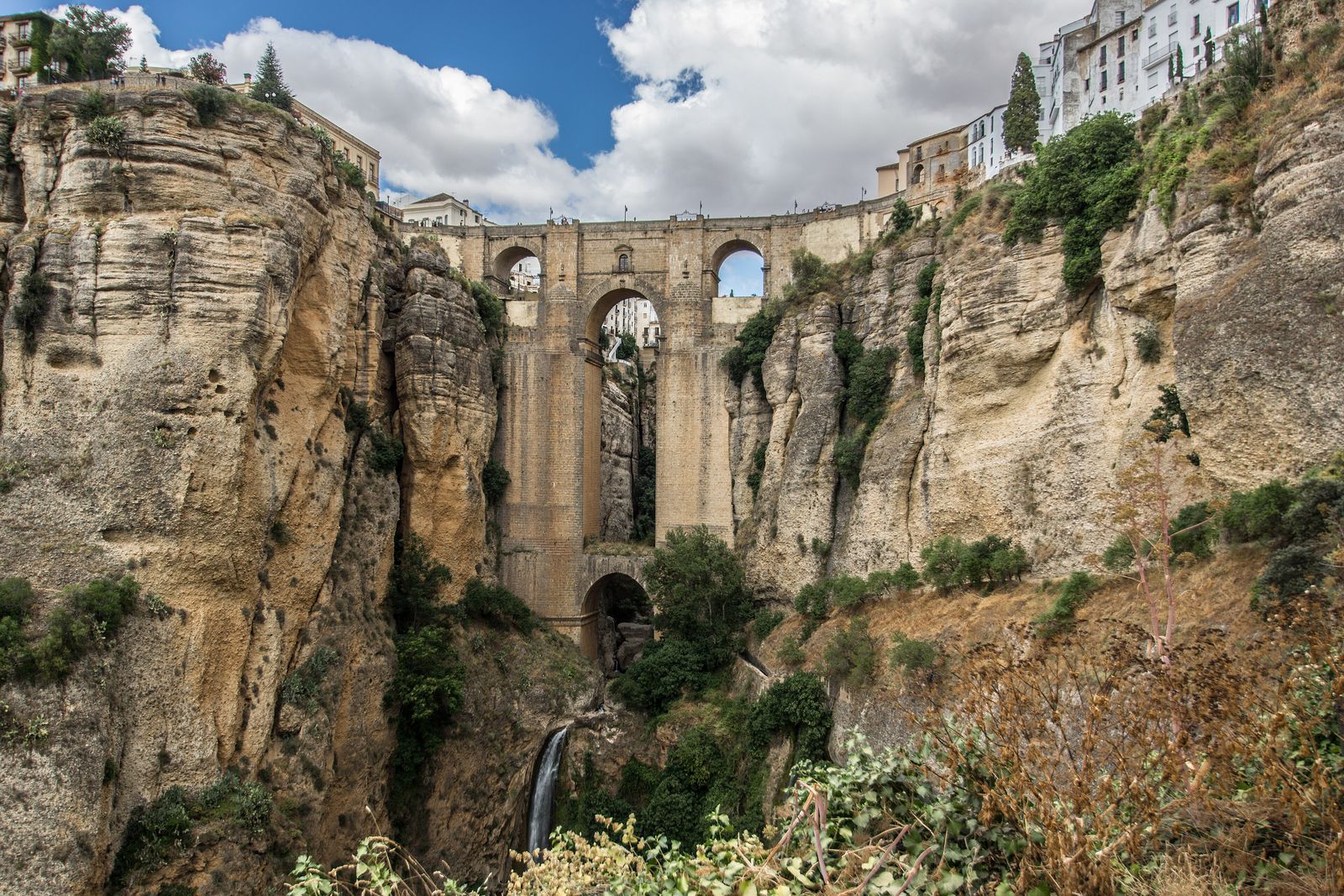

- Where
- Málaga province,
Andalusia, southern Spain - Coordinates
- 36.7410° N
5.1656° W - The gorge
- El Tajo, cut by the
Guadalevín; over 100 m deep - Puente Nuevo
- 98 m high; built of stone
from the floor of the gorge - Built
- 1751–1793 (Ronda’s tourist office);
Wikipedia gives from 1759 - Population
- 33,671 (2025)
- Best visited
- Spring and autumn
Came up through olive hills to a white town on a high rock, and the rock turned out to be split clean down the middle. A stone bridge held the halves together. I stood on it and looked straight down past my feet to a thread of river, with swifts screaming in and out of the cliff below me. I held the railing rather tightly and admired everything from there.
The short answer
Ronda is a town of 33,671 people (2025) in the province of Málaga, in Andalusia in southern Spain. It stands at about 750 metres on the Ronda plateau, and the Guadalevín river runs through it in a gorge more than 100 metres deep, El Tajo, which splits the town in two: the old town, La Ciudad, on one side and the newer Mercadillo quarter on the other. Three bridges cross the gorge: the Puente Romano, also called the Puente Árabe because its Roman foundations were rebuilt in the Arab period; the Puente Viejo, the Old Bridge; and the Puente Nuevo, the New Bridge, finished in 1793 and the tallest of the three. Ronda was a Nasrid town until the Crown of Castile took it in 1485. The same architect who designed the Puente Nuevo built the town’s bullring, which Wikipedia dates to 1784 and counts among the oldest in Spain.
Why it's worth knowing
The bridge that makes Ronda famous is made of the thing it crosses. Ronda’s tourist office records that the Puente Nuevo, 98 metres high, was built of blocks of stone extracted from the bottom of El Tajo, and that by joining the old town to the Mercadillo it let the town grow.
It was also a second attempt. According to the tourist office, the first bridge at this height was designed in 1735, in the reign of Philip V, as a single arch about 35 metres across, and was finished in only eight months; it collapsed, and about 50 people died. Wikipedia names its architects as José García and Juan Camacho and dates the collapse to 1741.
The replacement took decades. Ronda’s tourist office says work began in 1751 and ended in May 1793, in time for the town’s May fair, more than 40 years later; Wikipedia gives a start in 1759 and 34 years of work. Both name the architect as José Martín de Aldehuela, from Manzanera in Aragon; Wikipedia adds Juan Antonio Díaz Machuca as chief builder. The bridge has been called new for more than two centuries because it is the newest of the three.
The field notes
The room in the bridge
Above the central arch of the Puente Nuevo is a chamber, entered through a square building on the Plaza de España that was once a guardhouse. It now holds the Puente Nuevo Interpretation Centre, which tells the story of the bridge and of the gorge’s wildlife, plants and geology.
The chamber has had other uses. Wikipedia’s account says it served for a time as a prison, and that during the Spanish Civil War of 1936–1939 both sides are alleged to have used it to hold and mistreat prisoners, some of whom were killed by being thrown into the gorge. Ernest Hemingway’s novel For Whom the Bell Tolls describes the killing of Nationalist sympathisers thrown from cliffs in an Andalusian village, and is widely taken, Wikipedia says, to have been based on killings at El Tajo.
A staircase to the river
The Casa del Rey Moro, the House of the Moorish King, was never home to one: Wikipedia’s account dates the house to the eighteenth century and its gardens, by the French landscape designer Jean-Claude Forestier, to 1912. It does contain one piece of Ronda’s Moorish past, the so-called Water Mine, a flight of steps cut down through the cliff to the river.
Writers in the town
Rainer Maria Rilke spent three months at Ronda’s Hotel Reina Victoria, from December 1912 to February 1913, and his room is kept as a small museum. Two much-quoted lines in Spanish, about having found in Ronda the city of his dreams, come to us, as Wikipedia notes, from the hotel’s own publicity. Hemingway and Orson Welles spent summers in the old town.
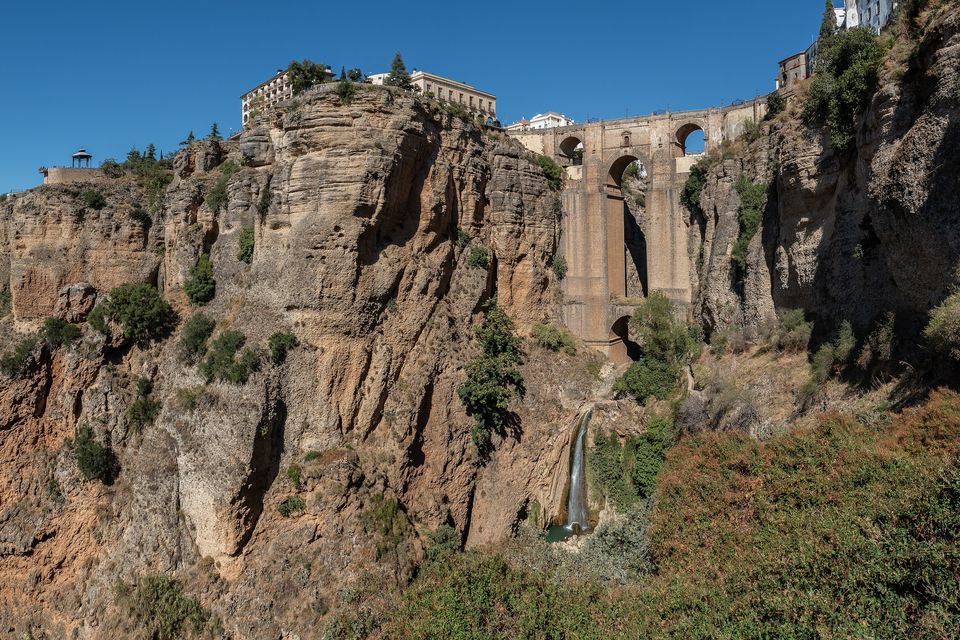
The Puente Nuevo and the gorge cliffs, October 2019.
Photograph: Tesla Delacroix · CC BY-SA 4.0 · cropped
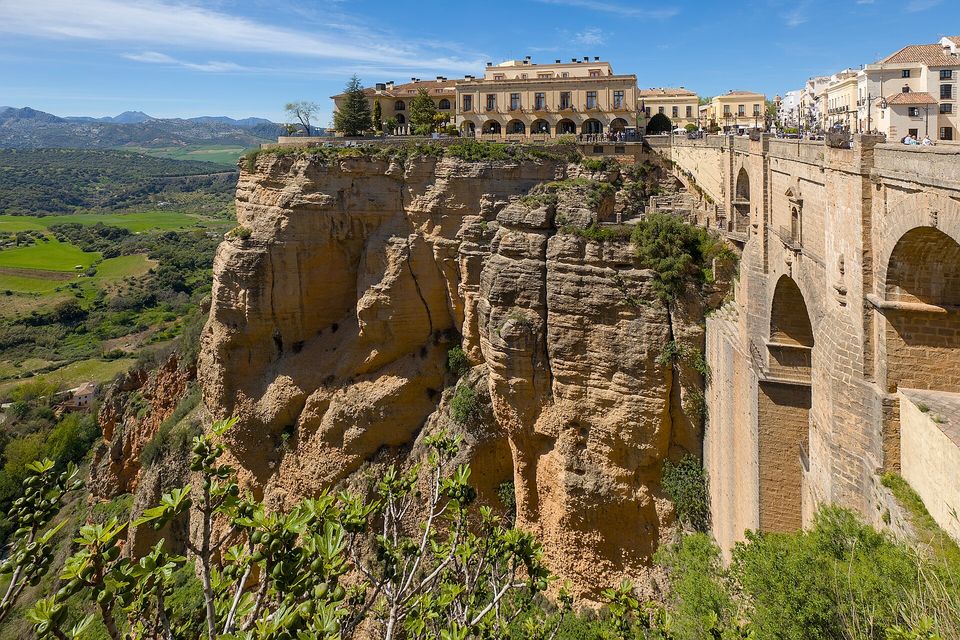
The Parador and the gorge rim from the Puente Nuevo, April 2024.
Photograph: Benjamin Smith / Wikimedia Commons · CC BY-SA 4.0
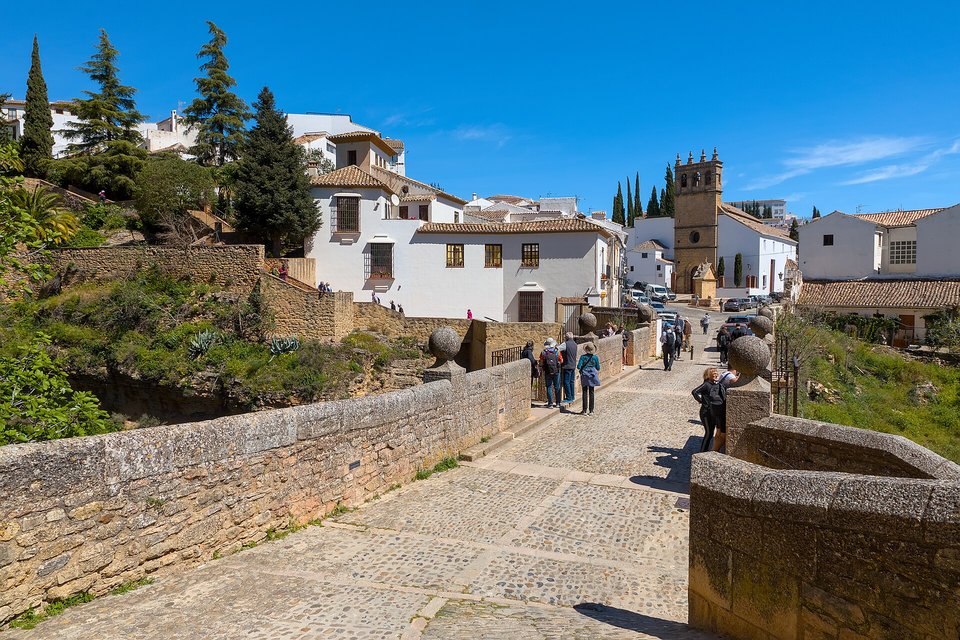
The Puente Viejo and the Calle Real in Ronda's old town, April 2024.
Photograph: Benjamin Smith / Wikimedia Commons · CC BY-SA 4.0
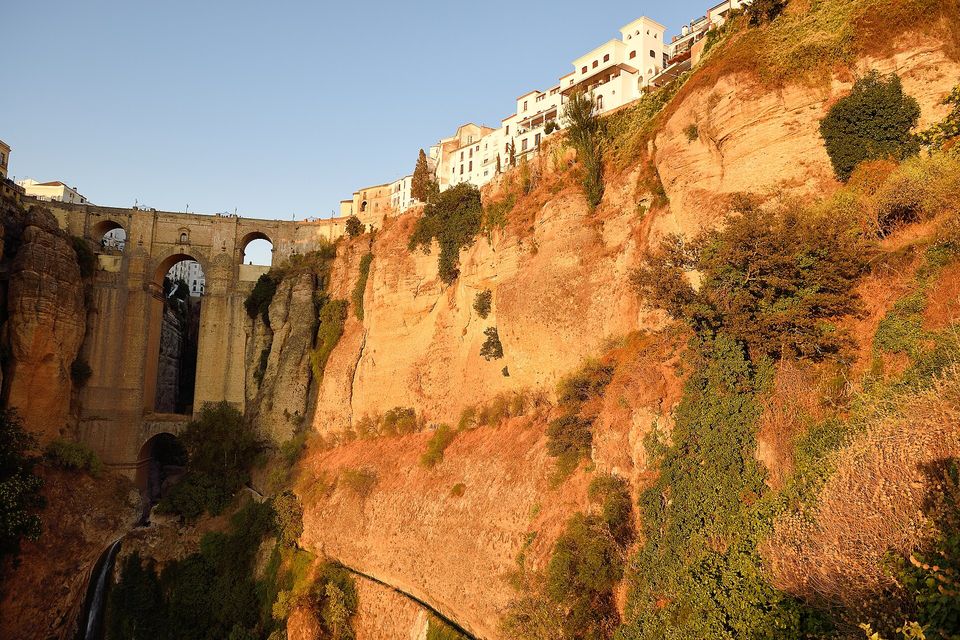
The bridge's arches and the gorge wall lit orange at sunset.
Photograph: Tim Adams · Puente Nuevo in Ronda Spain photographed in 2019 · CC BY 3.0
- Cross the bridge once in the morning and once at dusk. It is not the same bridge.
- Go down below the town and look back up. The bridge makes much more sense from underneath.
- Hold the railing, and give other people their turn at the best spot.
- Visit the room inside the bridge, read all of it, and come out quietly.
- Keep the list in your pocket on the bridge. (Took it out for the swifts and put it straight back for the drop. The list has no head for heights, and I have decided not to force it.)
A block of the Puente Nuevo’s stone. The bridge was built of blocks of stone extracted from the bottom of El Tajo, the gorge it spans, and raised 98 metres to join the two halves of the town. It was finished in 1793, on the line of an earlier bridge that had fallen. The bridge is made of the gorge it crosses.
Tally, in the marginThe river’s own stone, carried up and laid across the top. From underneath I could not tell where the cliff stopped and the bridge began, and I suspect the stone cannot either.
Getting there
How to get there. Ronda is on the railway from Algeciras, built in 1890–1892, with trains from Córdoba and, by Wikipedia’s account, a direct train from Madrid twice a day. By road it is reached on the A-374. The nearest large airports are Málaga and Seville.
The bridge. Walking across the Puente Nuevo is free. The Interpretation Centre inside it is entered from the Plaza de España; check the town’s tourism site for hours and the entry fee. Paths below the town give views of the bridge from underneath; ask at the tourist office for the current routes.
When to go. Spring and autumn are the most comfortable.
Safety. The United States has Spain at Level 2, exercise increased caution, because of terrorism and civil unrest, with no area-specific warnings for Andalusia. Keep to the railings at the gorge’s edge.
Mark this place
Common questions
How tall is the Puente Nuevo in Ronda?
Ronda’s tourist office gives the Puente Nuevo as 98 metres high. The bridge spans El Tajo, the gorge of the Guadalevín river, which Wikipedia describes as more than 100 metres deep, and joins Ronda’s old town to the Mercadillo quarter. It is the tallest of the three bridges across the gorge.
When was the Puente Nuevo built?
The Puente Nuevo in Ronda was finished in May 1793. Ronda’s tourist office says work began in 1751, making it more than 40 years in building; Wikipedia gives a start in 1759 and 34 years. The architect was José Martín de Aldehuela, and the bridge was built of stone cut from the bottom of the gorge.
Why is Ronda’s bridge called the New Bridge?
The Puente Nuevo, the New Bridge, is the newest of the three bridges that cross El Tajo gorge in Ronda. The others are the Puente Viejo, the Old Bridge, and the Puente Romano, or Puente Árabe, on Roman foundations rebuilt in the Arab period. The ‘new’ one was finished in 1793.
What happened to the first bridge at Ronda?
The first bridge across Ronda’s gorge at the height of today’s Puente Nuevo was designed in 1735 as a single arch and finished in about eight months. It collapsed, killing about 50 people, according to Ronda’s tourist office; Wikipedia dates the collapse to 1741. The Puente Nuevo was built to replace it.
Can you go inside the Puente Nuevo?
Yes. The chamber above the central arch of Ronda’s Puente Nuevo holds the Puente Nuevo Interpretation Centre, entered from the Plaza de España through a former guardhouse. It covers the building of the bridge and the gorge’s wildlife, plants and geology. Wikipedia records that the chamber was once used as a prison.
How deep is the gorge at Ronda?
El Tajo, the gorge that splits Ronda in two, is more than 100 metres deep; Wikipedia gives the chasm under the Puente Nuevo as 120 metres, while Ronda’s tourist office gives the bridge itself as 98 metres high. The gorge was cut by the Guadalevín river through the Ronda plateau, at about 750 metres above sea level.
Did Rilke live in Ronda?
The poet Rainer Maria Rilke stayed at the Hotel Reina Victoria in Ronda for three months, from December 1912 to February 1913, and his room is preserved as a small museum. The lines often quoted as his praise of Ronda, about finding the city of his dreams, come from the hotel’s publicity, as Wikipedia notes.
How do you get to Ronda?
Ronda, in Málaga province in Andalusia, is on the railway line from Algeciras, with trains from Córdoba and a direct service from Madrid twice a day, according to Wikipedia. By road it is reached on the A-374. The nearest large airports are Málaga and Seville.