Region
Europe & the North Atlantic
Old stone and cold water: castles and caves, pilgrim roads and island monasteries, glaciers and sea cliffs, in land that people have worked and built on for thousands of years.
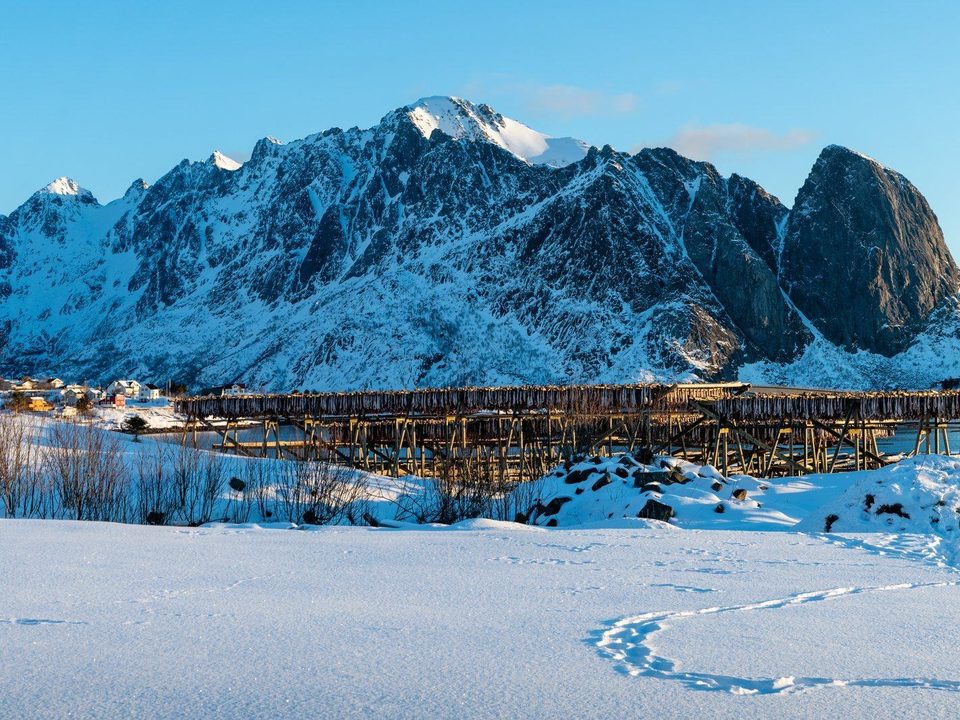
Lofoten. Photograph: Christoph Strässler, Loaded Drying Racks for Stockfish at Reine, Lofoten, Norway, CC BY-SA 2.0, cropped
Europe and the North Atlantic hold some of the oldest settled ground in the Field Guide. Skara Brae in Orkney is a Neolithic village; Þingvellir in Iceland is where a parliament met in a widening rift valley; at Meteora in Greece, monasteries stand on conglomerate pinnacles. Water has shaped much of the rest, from Venice and its lagoon to sea cliffs, glaciers and limestone caves. The landscapes run from High Arctic tundra and glacier in the north to Mediterranean islands north of Sicily. Some places sit in or beside towns; others need a boat and a quiet sea, and the day boats to St Kilda run from late April to August.
67 places in this region
 Skara BraeOrkney
A Neolithic village of stone houses with stone furniture, buried in sand for four and a half thousand years and exposed by the storm of 1850.
 The Wadden SeaFriesland / Lower Saxony / Southern Jutland
The largest unbroken tidal flat on Earth, where twice a day the North Sea withdraws far enough to walk across its floor to an island.
 The Aletsch GlacierValais
The longest ice in the Alps, and the valley wall it was buttressing, which began to move once the glacier thinned.
 Škocjan CavesDivača
A river vanishes into a plateau and resurfaces near the Adriatic. The route in between has never been fully mapped.
 PicoAzores, Portugal
Portugal's highest mountain in the mid-Atlantic, with UNESCO vineyards walled in black lava and whales off the old whaling coast.
 MykinesFaroe Islands
The westernmost Faroe: vast puffin colonies, the islands' only gannets, and a lighthouse across a sea gorge.
 ÞingvellirSouthern Region, Iceland
A parliament founded in 930 met for eight centuries on a valley floor that was steadily sinking and splitting beneath the argument.
 SvalbardSvalbard, Norway
Four months without a sunrise, more than forty nationalities free to move in, and the world's spare seeds sealed inside a mountain.
 Cappadocia & DerinkuyuNevşehir Province, Türkiye
Rock soft enough to carve and firm enough to hold a ceiling, so when armies came, whole communities went eight storeys down.
 LofotenNordland, Norway
Harbours that refuse to freeze at 68° north, and a thousand-year export trade built on one fish keeping an appointment.
 Plitvice LakesLika-Senj and Karlovac counties, Croatia
Sixteen lakes held back by dams that moss, algae and bacteria are still building, about 13 millimetres a year by the park’s own count.
 MeteoraThessaly, Greece
A river delta turned to stone and stood on end, with fourteenth-century monasteries on the flat bits.
 Upper SvanetiSamegrelo-Zemo Svaneti, Georgia
Stone towers built one per family, entered by a ladder you pulled up behind you: defences against invaders, and against the family next door.
 The Giant’s CausewayCounty Antrim, Northern Ireland
About 40,000 basalt columns stepping into the sea. They helped settle whether basalt comes from water or from volcanoes, and a tray of drying cornflour grows the same pattern.
 VeniceVeneto, Italy
The lagoon that protects Venice was kept a lagoon on purpose: for nearly two centuries the Republic dug new beds to carry rivers and their silt around it. Now the barrier faces the other way.
 NeuschwansteinSwabia, Bavaria, Germany
Built as one shy king's retreat from public life, closed to outsiders while he lived, and opened to the public seven weeks after he died. The throne it was built around was never made.
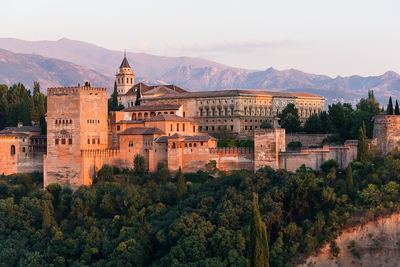 The AlhambraGranada, Andalusia, Spain
A palace whose rooms speak in the first person: the Alhambra's court poets wrote verses for the walls, and the Fountain of the Lions describes its own water. Its famous tile-symmetry claim is less settled.
 MaltaSiġġiewi, Malta
A temple whose doorway meets the equinox sunrise, a burial complex dug three levels into the rock, the Knights' fortress capital, and paired grooves in the limestone that still have no agreed date.
 Vatican CityVatican City, enclaved in Rome, Italy
The smallest country in the world meets Italy along a white stone line across St Peter's Square. By the 1929 treaty the square is the Vatican's, and on an ordinary day Italian police keep order in it.
 Santiago de CompostelaGalicia, Spain
A pilgrimage made since the ninth century, waymarked since 1984 by a parish priest's yellow arrows and proved with a book of stamps, ending at a granite cathedral in Galicia.
 Ephesusİzmir Province, Türkiye
One of the great ports of the Roman world, left inland by its own river. Ephesus moved more than once to follow a coastline that silt kept pushing west.
 RondaMálaga, Andalusia, Spain
A town on both lips of a gorge, joined by a bridge 98 metres high that was built of stone cut from the bottom of the gorge itself. It is called the New Bridge, and it was finished in 1793.
 PatmosDodecanese, Greece
In 1088 a Byzantine emperor granted a small Aegean island to a monk. He built a monastery with battlements above the harbour, and a white town grew up around its walls.
 Mont-Saint-MichelNormandy, France
A raised causeway nearly turned this tidal island into land. A dam that stores the sea and then lets it go, and a bridge on piles, are making it an island again on the biggest tides.
 StonehengeWiltshire, England
Everyone looks at Stonehenge’s standing stones. The six-tonne slab lying in the middle was traced in 2024 to north-east Scotland, at least 750 km away.
 PraguePrague, Czechia
Every hour a skeleton rings the bell on Prague’s astronomical clock. The legend of the clockmaker blinded for building it is told about a man who did not.
 GullfossSouthern Region, Iceland
A glacial river that turns and drops twice into a canyon. A farmer's daughter fought the plan to dam it and stands above it in stone; the lease itself died when the rent stopped.
 Our Lady of the RocksPerast, Bay of Kotor, Montenegro
An islet in the Bay of Kotor made of dropped stones and sunken ships, around a reef where, by tradition, seamen found an icon in 1452. Every July the town goes out and adds more.
 SarkBailiwick of Guernsey
A car-free island in the Bailiwick of Guernsey, where tractors and horses are the traffic and the sky is kept dark on purpose. Its two halves are joined by La Coupée, a railed road along a ridge high above the sea.
 St KildaOuter Hebrides, Scotland
A remote island group beyond the Outer Hebrides whose last 36 people left together in 1930. A street of stone houses, about 1,400 turf-capped cleits and Britain’s highest sea stacks remain, a long day-boat ride from Harris.
 AlicudiAeolian Islands, Sicily, Italy
The westernmost of the Aeolian Islands, north of Sicily: the cone of an extinct volcano where about 90 people live all year. There are no roads and no cars; stone stairways are the streets, and mules carry the shopping.
 Skellig Michael (Sceilg Mhichíl)County Kerry, Ireland
A twin-peaked rock in the Atlantic off County Kerry, where early medieval monks built beehive huts of dry stone on a ledge near the top. Permitted boats land a small number of visitors a day in summer, weather allowing; 618 stone steps lead up.
 HeimaeyVestmannaeyjar, South Iceland
The one inhabited island of Iceland’s Westman Islands. In 1973 a volcano opened at the edge of its town and buried hundreds of homes; the islanders pumped seawater onto the lava to save the harbour, and the island came out larger.
 Berlenga GrandeBerlengas Natural Reserve, Peniche, Portugal
A small pink-granite island off Peniche, Portugal, where the nature reserve lets in at most 550 visitors at a time. A 17th-century fort built from a ruined monastery sits on its own islet, reached by an arched bridge.
 Isle of SkyeHighland, Scotland
Scotland’s second-largest island, all peninsulas and sea lochs around the black peaks of the Cuillin. On its northern arm a vast landslip has left the rock towers of the Quiraing and the Old Man of Storr, and dinosaurs left their footprints on the shore.
 El HierroCanary Islands, Spain
The south-westernmost Canary Island: a steep volcanic island of more than 500 cones, with junipers bent flat by the trade winds and a vast bay left by an ancient collapse. For centuries many European maps counted longitude from here.
 LastovoDubrovnik-Neretva County, Croatia
One of the most remote inhabited islands of the Adriatic, closed to foreigners as a military zone until 1988. Its old town turns its back on the sea, its chimneys look like miniature minarets, and the archipelago is a nature park.
 Fair IsleShetland, Scotland
A small crofting island halfway between Shetland and Orkney, home to 44 people and one of Europe’s great bird observatories. It gave its name to a knitting pattern, and a ship of the Spanish Armada was wrecked on it in 1588.
 Ouessant and MolèneIroise Sea, Finistère, Brittany, France
France’s westernmost island and its small neighbour, off the tip of Brittany: treeless heath grazed by sheep in common, seals among the islets, and a sea so dangerous that lighthouses stand on its rocks in every direction.
 HallstattGmunden District, Upper Austria, Austria
A village of a few hundred people squeezed between an Austrian mountain lake and a cliff, above a salt mine worked since prehistory, whose Iron Age graves named an era and whose crowds of day visitors made it Austria’s best-known lesson in overtourism.
 Hill of CrossesŠiauliai District, Lithuania
A low mound in the flat farmland of northern Lithuania so covered in crosses, crucifixes and rosaries that no one has counted them in years: bulldozed by Soviet authorities and replanted by night each time, and still growing.
 MonsantoIdanha-a-Nova, Castelo Branco District, Portugal
A hill village in eastern Portugal whose granite houses squeeze between, beneath and into boulders the size of houses, one of them roofed by a single rock, below a ruined Templar castle and a clock tower crowned with a silver rooster.
 Salina TurdaTurda, Cluj County, Romania
A salt mine in Transylvania worked from the Middle Ages to 1932, whose vast chambers are now a show mine: a lake with rowing boats at the bottom of a bell-shaped pit, a Ferris wheel in the last chamber dug, and rooms for salt-air treatment.
 The Slea Head DriveDingle Peninsula, County Kerry, Ireland
A loop of about 48 kilometres from Dingle around the end of the Dingle Peninsula in County Kerry, through Irish-speaking villages and past an Iron Age fort, stone beehive huts, the Blasket Islands and the Gallarus Oratory; visitors are asked to drive it clockwise, because part of the cliff road is a single lane.
 The Atlantic Ocean RoadAverøy and Hustadvika, Møre og Romsdal, Norway
An 8.3-kilometre stretch of County Road 64 on Norway's west coast, carried from islet to islet over causeways and bridges along the exposed sea of Hustadvika; opened in 1989, toll-free since 1999, protected as cultural heritage, and part of a 36-kilometre Norwegian Scenic Route that runs on to the fishing village of Bud.
 Aurlandsfjellet, the Snow RoadAurland and Lærdal, Vestland, Norway
County Road 5627 between Lærdal and Aurland in western Norway: 47 kilometres over a high, barren plateau where snow lies most of the year, from fjord to fjord, ending at the Stegastein platform 650 metres above the Aurlandsfjord; closed in winter, except the stretch up to Stegastein.
 The TransfăgărășanArgeș and Sibiu counties, Romania
National road DN7C across the Făgăraș Mountains, Romania's highest, built by army engineers between 1970 and 1974: 151 kilometres from near Pitești to the Sibiu road, climbing to 2,042 metres by Bâlea Lake through the country's longest road tunnel; its high section is open only in summer, and only by day.
 The Grossglockner High Alpine RoadSalzburg and Carinthia, Austria
A toll road over the main ridge of the Alps between Bruck and Heiligenblut, opened in 1935: 48 kilometres and 36 bends to the Hochtor at 2,504 metres, with branches to a viewpoint over Austria's highest mountain and the Pasterze glacier; open from early May to early November.
 The Furka PassUri and Valais, Switzerland
A road pass at 2,429 metres between Realp in Uri and Gletsch in Valais, on the watershed between the Mediterranean and the North Sea, past the shuttered Hotel Belvédère and the Rhone Glacier, parts of which are covered in white blankets every summer; closed in winter, when a car train runs through the mountain beneath it.
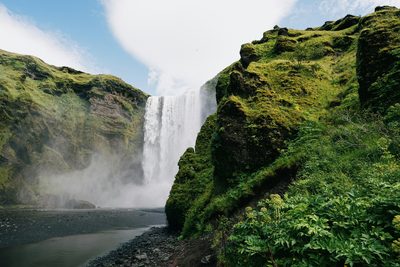 Iceland’s South CoastSouth Region, Iceland
The drive along Route 1 below Iceland’s southern glaciers: Seljalandsfoss, which you can walk behind, Skógafoss and its legend of a hidden chest, and the black sand of Reynisfjara, where a warning light now tells visitors how far towards the waves to go.
 Amalfi CoastProvince of Salerno, Campania, Italy
Thirteen towns stacked up the cliffs above the Gulf of Salerno, south of Naples, joined by a 40-kilometre cliff road and a footpath called the Path of the Gods, with lemons on terraces cut into the mountain and a harbour town that once ran a sea republic.
 Lake BledUpper Carniola, Slovenia
A small alpine lake in the Julian Alps of Slovenia with a church on an island, reached by wooden pletna boats whose rowers have held a special right since 1740 and by a stair of 99 stone steps, under a castle on a cliff.
 ZermattVisp district, Valais, Switzerland
A village in the Swiss Alps closed to petrol and diesel cars, reached by train from Täsch, under the Matterhorn, with a rack railway climbing to 3,089 metres and a slow panoramic train that runs from here to St. Moritz over 291 bridges.
 DubrovnikDubrovnik-Neretva County, Croatia
A walled sea city on the southern Adriatic that was the capital of its own republic for 450 years, chose a new rector every month, and carved a motto about liberty over a fortress gate; rebuilt after an earthquake in 1667 and a siege in 1991.
 São MiguelAzores, Portugal
The largest island of the Azores, mid-Atlantic, where a crater lake comes in two colours, the ground at Furnas is hot enough that restaurants bury their stew in it every morning, and Europe’s oldest surviving tea plantation is still at work.
 SintraLisbon District, Portugal
A town in the misty hills west of Lisbon where a king consort built a red and yellow palace on a summit, a millionaire sank a well you walk down by a spiral stair, and a king had a ceiling painted with magpies to quiet the gossip.
 RovaniemiLapland, Finland
The capital of Finnish Lapland, just south of the Arctic Circle, where a white line marks where the circle lay in 1865, the town was rebuilt after 1944 on a plan shaped like a reindeer’s head, and the sun stays up for thirty days in summer.
 The Ring of KerryIveragh Peninsula, County Kerry, Ireland
A circular route of 179 kilometres round the Iveragh Peninsula in County Kerry, from Killarney’s lakes and Ireland’s first national park to an Iron Age stone fort and a Gold Tier dark-sky reserve; every tour coach drives it anticlockwise, and opinions differ on which way a car should go.
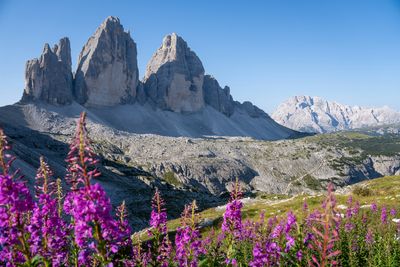 The DolomitesVeneto, Trentino and South Tyrol, Italy
A range of pale rock towers in north-east Italy that turns pink and red at sunset, named after the rock a French mineralogist described in 1791, where the valleys round the Sella still speak Ladin and the ridges still hold the trenches of the First World War.
 Cinque TerreProvince of La Spezia, Liguria, Italy
Five villages of coloured houses on a cliff coast in Liguria, joined by a footpath and a railway, below hillsides terraced for vines, a World Heritage Site since 1997, where floods tore through two of the villages in 2011 and a lovers’ path closed by a rockslide took more than a decade to reopen.
 GeirangerfjordStranda, Møre og Romsdal, Norway
A 15 km arm of the sea in western Norway between near-vertical mountains, where the Seven Sisters fall 410 metres opposite the Suitor, old goat farms sit on ledges far above the water, and a cracked mountainside on the fjord it branches from is watched for a slide that could send a wave to the village in about ten minutes.
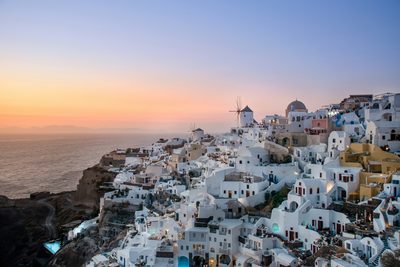 SantoriniCyclades, South Aegean, Greece
A crescent of island round a flooded volcano in the Aegean, where white villages line the top of cliffs more than 300 metres high, and a Bronze Age town lies preserved under the ash of an eruption of about 3,600 years ago.
 DoñanaHuelva and Seville, Andalusia, Spain
A vast marsh at the mouth of the Guadalquivir, behind moving dunes and stone pines, where waterbirds from across Europe spend the winter, in numbers that rise and fall with the rain.
 MývatnSuður-Þingeyjarsýsla, north Iceland
A spring-fed lake in the lava fields of north Iceland, ringed with small steep craters, where midges feed the ducks and, by its Ramsar record, virtually Europe’s whole breeding population of Barrow’s goldeneye nests.
 Bempton CliffsEast Riding of Yorkshire, England
White chalk cliffs on the Yorkshire coast where, from spring to late summer, around half a million seabirds crowd the ledges, puffins and gannets among them, along a level cliff-top path.
 OttenbyÖland, Kalmar County, Sweden
The southern tip of Öland, where birds following the island south stop before the open Baltic, and an observatory beside Sweden’s tallest lighthouse has been ringing them since 1946.
 Ria FormosaAlgarve, Portugal
A tidal lagoon behind a chain of sandy barrier islands on Portugal’s Algarve coast, where waders winter on the mudflats, little terns nest in the dunes and salt pans, and Audouin’s gulls crowd one island.
About this hub
Nearby on the shelf
- Sacred & ancient places (collection, 36)
- Waterfalls (collection, 12)
- The whole map
Know somewhere that belongs here?
Each place page names its sources and the date it was checked.
Photo credits for the thumbnails
- Skara Brae: Photograph: Ekrem Canli, CC BY-SA 4.0
- The Wadden Sea: Photograph: SimonWaldherr, CC BY 4.0, cropped
- The Aletsch Glacier: Photograph: Andrew Bossi, 3623 - Aletschgletscher und Mönch viewed from Eggishorn, CC BY-SA 2.5, cropped
- Škocjan Caves: Photograph: yeung ming, Škocjan, CC BY 2.0, cropped
- Pico: Photograph: Navin75, Pico Mountain, CC BY-SA 2.0
- Mykines: Photograph: Stefan Wisselink, Mykines, CC BY 2.0, cropped
- Þingvellir: Photograph: Olga Ernst, CC BY-SA 4.0, cropped
- Svalbard: Photograph: Bernt Rostad, Adventfjorden, Svalbard, CC BY 2.0, cropped
- Cappadocia & Derinkuyu: Photograph: Aquinoxmedia, CC BY-SA 4.0, cropped
- Lofoten: Photograph: Christoph Strässler, Loaded Drying Racks for Stockfish at Reine, Lofoten, Norway, CC BY-SA 2.0, cropped
- Plitvice Lakes: Photograph: Tesla Delacroix, CC BY-SA 4.0
- Meteora: Photograph: Giles Laurent, CC BY-SA 4.0
- Upper Svaneti: Photograph: Jaba1977, CC BY-SA 4.0, cropped
- The Giant’s Causeway: Photograph: Chmee2, Giant's Causeway (14), CC BY 3.0, cropped
- Venice: Photograph: Henrique Ferreira via Unsplash, Unsplash licence
- Neuschwanstein: Photograph: Tauno Räsänen and Simo Räsänen, Neuschwanstein Castle from Marienbrücke, 2011 May, CC BY-SA 3.0
- The Alhambra: Photograph: Jebulon, CC0, cropped
- Malta: Photograph: Martin Furtschegger, Blick vom Marsamxett Harbour auf Valletta. - panoramio, CC BY 3.0, cropped
- Vatican City: Photograph: Fabio Fistarol via Unsplash, Unsplash licence, cropped
- Santiago de Compostela: Photograph: Fernando Pascullo, CC BY-SA 4.0
- Ephesus: Photograph: Benh LIEU SONG, Ephesus Celsus Library Façade, CC BY-SA 3.0, cropped
- Ronda: Photograph: Pedro J Pacheco, El Tajo de Ronda (3), CC BY-SA 3.0 ES
- Patmos: Photograph: Francesco Bini, CC BY-SA 4.0, cropped
- Mont-Saint-Michel: Photograph: Lynx1211, CC BY-SA 4.0
- Stonehenge: Photograph: Ankit Sood via Unsplash, Unsplash licence
- Prague: Photograph: Uoaei1, CC BY-SA 4.0
- Gullfoss: Photograph: Pierre-Selim Huard, CC BY 4.0, cropped
- Our Lady of the Rocks: Photograph: Jocelyn Erskine-Kellie, Church of Our Lady of the Rocks, CC BY 2.0
- Sark: Photograph: Clemensfranz, Sark Coupee, CC BY-SA 3.0
- St Kilda: Photograph: Chris Lloyd, St Kilda - Hirta - Village Bay from The Gap, CC BY 2.0, cropped
- Alicudi: Photograph: Carsten Steger, CC BY-SA 4.0, cropped
- Skellig Michael (Sceilg Mhichíl): Photograph: NoNameIsLeft, CC BY-SA 4.0
- Heimaey: Photograph: Szilas, Public domain
- Berlenga Grande: Photograph: Alexey Komarov, CC BY 4.0
- Isle of Skye: Photograph: RB Photo, The Quiraing, Isle of Skye, Scotland, CC BY 2.0, cropped
- El Hierro: Photograph: Javier Sánchez Portero, El Sabinar - panoramio (1), CC BY-SA 3.0, cropped
- Lastovo: Photograph: Dijana Župan, CC BY-SA 4.0
- Fair Isle: Photograph: Kognos, CC BY-SA 4.0, cropped
- Ouessant and Molène: Photograph: Stephane Lesbats (Ifremer), CC BY 4.0
- Hallstatt: Photograph: Dimitry Anikin, CC0, cropped
- Hill of Crosses: Photograph: yeowatzup, Hill of Crosses, Lithuania, CC BY 2.0
- Monsanto: Photograph: Alvesgaspar, CC BY-SA 4.0, cropped
- Salina Turda: Photograph: DimiTalen, CC0, cropped
- The Slea Head Drive: Photograph: Gareth James, On the Slea Head Drive - geograph.org.uk - 6121237, CC BY-SA 2.0, cropped
- The Atlantic Ocean Road: Photograph: Ernst Vikne, Storseisundet Bridge 2, CC BY-SA 2.0, cropped
- Aurlandsfjellet, the Snow Road: Photograph: G.Lanting, P1000439SneeuwwegLaerdalAurland, CC BY 3.0, cropped
- The Transfăgărășan: Photograph: Robert Anders, Transfăgărășan I, CC BY 2.0
- The Grossglockner High Alpine Road: Photograph: Dimitry Anikin, CC0, cropped
- The Furka Pass: Photograph: Joris Egger, Furkapass-Strasse und Rhonegletscher, CC BY-SA 3.0, cropped
- Iceland’s South Coast: Photograph: NIR HIMI via Unsplash, Unsplash licence, cropped
- Amalfi Coast: Photograph: Rafael Peier via Unsplash, Unsplash licence, cropped
- Lake Bled: Photograph: Arnaud Steckle via Unsplash, Unsplash licence
- Zermatt: Photograph: Ondrej Pudiš via Unsplash, Unsplash licence, cropped
- Dubrovnik: Photograph: Martin Falbisoner, CC BY-SA 4.0, cropped
- São Miguel: Photograph: Navin75, Lagoa do Fogo, CC BY-SA 2.0, cropped
- Sintra: Photograph: Dmitry Voronov via Unsplash, Unsplash licence
- Rovaniemi: Photograph: Paul Raillard via Unsplash, Unsplash licence
- The Ring of Kerry: Photograph: Jean Carlo Emer via Unsplash, Unsplash licence
- The Dolomites: Photograph: Michael Hutter via Unsplash, Unsplash licence
- Cinque Terre: Photograph: Rafael Peier via Unsplash, Unsplash licence
- Geirangerfjord: Photograph: rheins, Geirangerfjord Viewed from Skageflå Farm - 2013.08, CC BY 3.0, cropped
- Santorini: Photograph: Massimiliano Morosinotto via Unsplash, Unsplash licence
- Doñana: Photograph: Rameylauren, CC BY-SA 4.0
- Mývatn: Photograph: Richard Dorran via Unsplash, Unsplash licence
- Bempton Cliffs: Photograph: Tony Williams via Unsplash, Unsplash licence
- Ottenby: Photograph: Max Böhme via Unsplash, Unsplash licence
- Ria Formosa: Photograph: Markus Kammermann via Unsplash, Unsplash licence