The short answer
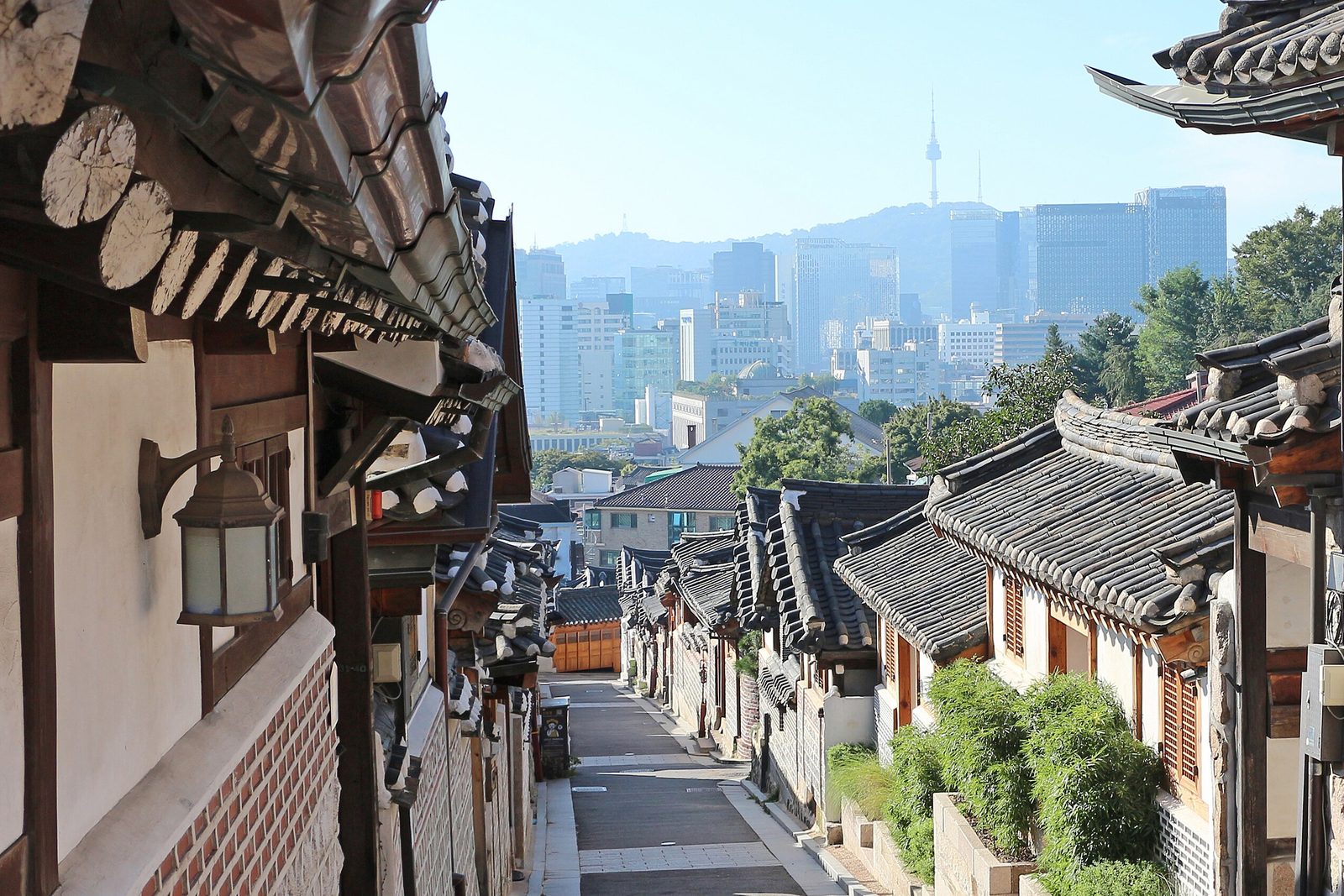
Bukchon Hanok Village is a neighborhood of traditional houses in central Seoul, between Gyeongbokgung Palace, Changdeokgung Palace and Jongmyo Shrine. Its name means “north village”, because it lies north of the Cheonggyecheon Stream and Jongno. The houses are hanok, wood-framed Korean homes with tiled roofs, packed shoulder to shoulder along narrow lanes on a hillside. It is a living neighborhood, not a museum. To protect the residents, its busiest lanes welcome tourists by day only.
From Tally’s diary
Narrow lanes climbing a hill between curved gray roofs, wooden gates shut tight, and at the bottom of every slope a glimpse of glass towers. Somebody's washing hung over a wall. I lowered my voice without being asked, and so did everyone I passed. At the top I turned around, and the old roofs went down the hill ahead of me, one behind another, into the busy city.
Why it's worth knowing
A neighborhood of nobles. Bukchon sits on the south-facing slope below Bugaksan Mountain, a lucky site by the old rules of pungsu, Korea’s feng shui. It is warm in winter, drains well and looks out toward Namsan. Under the Joseon kingdom it was home to royal relatives, high officials and noble families. A household register of 1906 counted 10,241 people here, and nearly half of them were nobles or government officials.
The builder and the dictionary. In the 1920s and 1930s Seoul was growing fast under Japanese rule, and there was a shortage of homes. Housing companies bought big estates in Bukchon and filled them with medium-sized hanok. The best remembered of those builders is Jeong Se-gwon. His houses let Korean families keep living in the heart of the city. He used the profits to support the Korean Language Society, including its work on a Korean dictionary in the 1930s, when the colonial government was suppressing the language. A history hall in Bukchon has told his story since 2021.
Old houses, new tricks. The hanok of the 1930s were traditional houses built for modern city life. Glass doors closed in the wooden-floored hall, sheets of galvanized iron extended the eaves, and standard timber from a mill let the builders work fast. Many hanok were pulled down for apartment blocks in the 1990s. In 2001 the city began a voluntary system to register and repair them, and in 2009 the Bukchon project won a UNESCO Asia-Pacific Heritage Award.
The field notes
Ten to five
Bukchon became so popular that crowds filled its lanes from early morning until late at night, with noise, litter and people stepping through private gateways. Jongno District made it a special management area under Korea’s tourism law, to protect the residents’ right to a home. Since 1 March 2025, tourists may visit the red zone along Bukchon-ro 11-gil only between 10 a.m. and 5 p.m. Lingering to sightsee or take photos outside those hours can bring a fine of ₩100,000, after a warning first. Residents, their families, customers of local shops and people simply passing through are not affected. Since the start of 2026, chartered tour buses have also been barred from a 1.4-mile (2.3 km) stretch of the neighborhood’s roads. Residents say the lanes are quieter, though some shopkeepers miss the evening trade.
Eight views
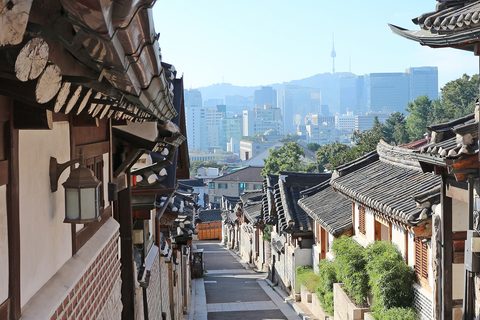
The hillside is a lookout over old Seoul, and the city has picked out eight favorite views of Bukchon. The best of them looks down the slope, roof behind roof, toward Changdeokgung Palace and the towers of the modern city. Workshops in the village teach tea ceremony, folk painting, knotting, paper craft and cloisonné.

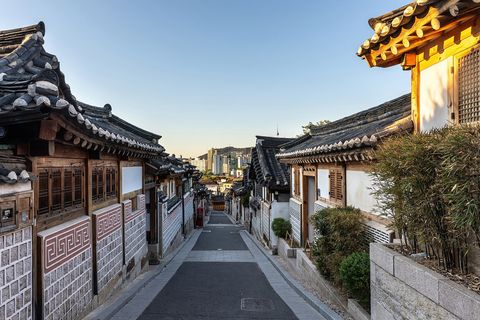
June 2024Bukchon-ro 11-gil at sunrise, warm light on the eaves.
Photograph: Basile Morin, CC BY-SA 4.0, cropped

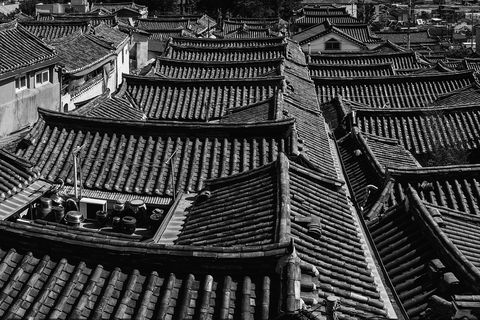
June 2017Rows of hanok tile roofs stepping down the hill, in black and white.
Photograph: Stevenliuyi, CC BY-SA 4.0, cropped
- Come in the middle of the day, and be gone by teatime. The lanes go back to the people who live in them.
- Talk the way you would in a library. (Whispered for an hour. Then could not stop.)
- Photograph the roofs, not the doorways. There is somebody behind each one.
- Sit down somewhere and learn to tie one knot properly. (Learned half of one. It holds.)
- Walk to the top of the lanes and look back. (Looked back four times. Every time there were more roofs.)
A relic from Bukchon

Relic, entry 368A residential areaRed zone: no visits 5 p.m. to 10 a.m.
A wooden gate, shut. Two plain timber leaves under a little tiled roof of their own. Bukchon is a neighborhood people live in, and in the lanes of its red zone, visitors have to be gone from five in the evening until ten the next morning.
Tally, in the marginI stood in front of it for some time, admiring the grain, before it occurred to me that a gate is mostly a polite way of saying not now. I said good evening to it and went quietly down the hill.
Getting there
- 1
Anguk Station
The main road, Bukchon-ro, runs up through the neighborhood from Anguk Station.
- 2
Up the slope
The village is on a hill, so most of the lanes slope.
- ✓
How to get there. Bukchon is in Jongno District, in the heart of Seoul. The main road, Bukchon-ro, runs up through the neighborhood from Anguk Station toward Samcheong Park. The village is on a hill, so most of the lanes slope, though the surfaces are generally even. Accessible restrooms are at the Gahoe-dong Community Service Center, the Bukchon Traditional Culture Center and Bukchon Binkwan.
When to go. Daytime visits are welcome, every day of the week. Outside the busiest lanes there are no set hours, but the residents ask for quiet at all times.
Being a good guest. The Seoul city government asks visitors to remember that Bukchon is a residential area. The houses are homes, and the gates and doorways are private.
Mark this place
The passport stamp for this place.
Common questions
What are the visiting hours at Bukchon Hanok Village?
10 a.m. to 5 p.m. in the red zone. The busiest lanes of Bukchon Hanok Village in Seoul, along Bukchon-ro 11-gil, are open to tourists only in those hours; sightseeing there outside them can bring a ₩100,000 fine, after a warning.
Why does Bukchon limit visiting hours?
Because people live there. Bukchon Hanok Village is a residential neighborhood, and Jongno District made it a special management area to protect residents from crowds and noise early in the morning and late at night.
What is a hanok?
A traditional Korean house. The hanok of Bukchon in Seoul are wood-framed homes with tiled roofs, and many of them are city hanok from the 1920s and 1930s, with glass doors and galvanized iron eaves.
Where is Bukchon Hanok Village?
In central Seoul, between two palaces. Bukchon lies in Jongno District between Gyeongbokgung Palace, Changdeokgung Palace and Jongmyo Shrine, and its main road runs up from Anguk Station.
Who was Jeong Se-gwon?
The builder of much of Bukchon. Jeong Se-gwon built many of Bukchon’s urban hanok in the 1920s and 1930s and used the profits to support the Korean Language Society’s dictionary work under Japanese colonial rule.
Can tour buses go into Bukchon?
Not chartered ones. Since the start of 2026, chartered tour buses have been barred from a 1.4-mile (2.3 km) stretch of Bukchon’s roads in Seoul, every day of the year; commuter, school and village buses still run.
Photographs on this page
Tap a photograph to see it full size.
Photograph: Bernard Gagnon, CC0, cropped
Photograph: Basile Morin, CC BY-SA 4.0, cropped
Photograph: Stevenliuyi, CC BY-SA 4.0, cropped




