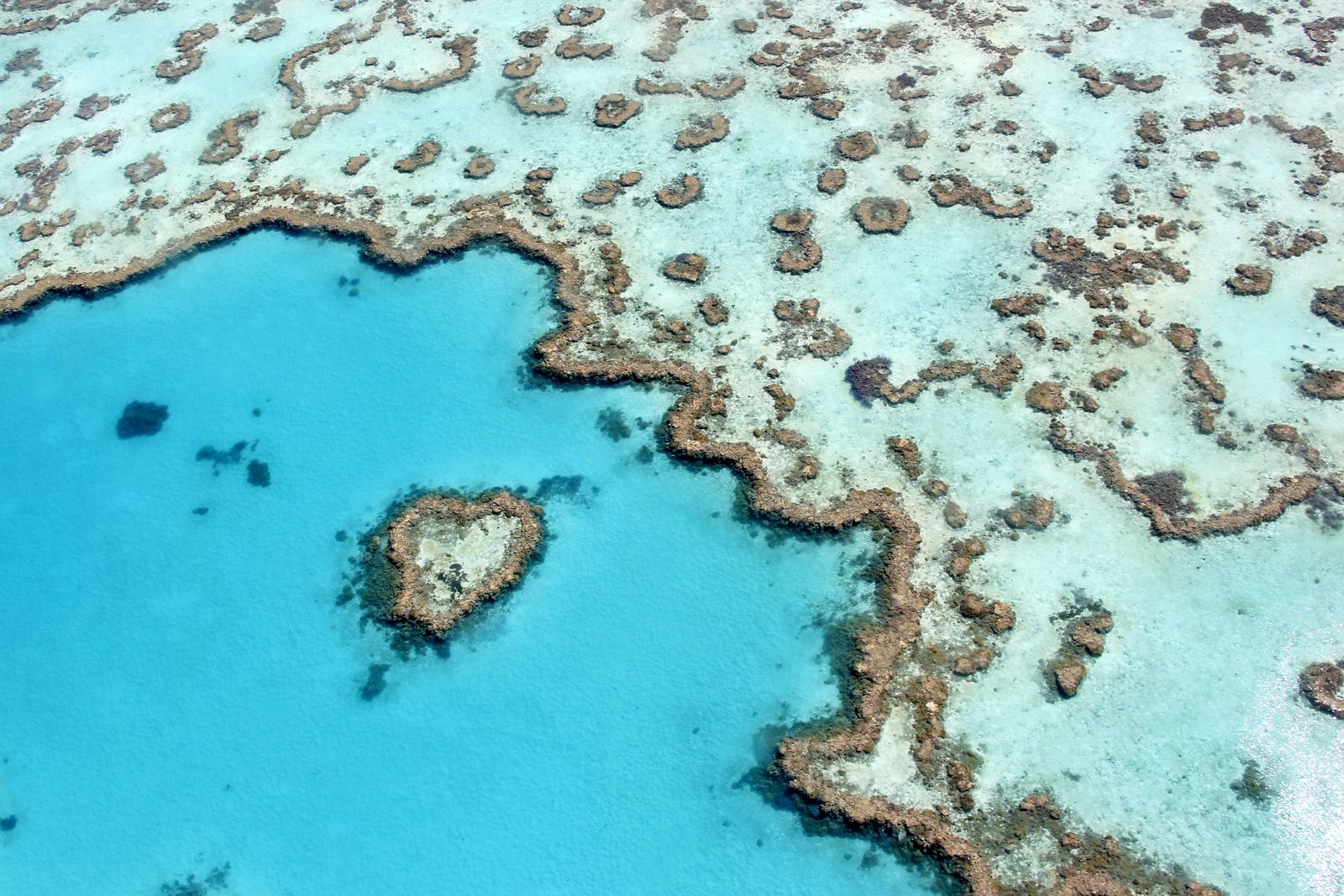

- Where
- The Coral Sea, off Queensland
north-east Australia - Coordinates
- 18.2871° S
147.6992° E - Size
- More than 2,900 reefs
marine park 344,400 km² - Length
- More than 2,300 km
Torres Strait to Lady Elliot Island - Status
- Marine park 1975
UNESCO World Heritage 1981 - Sea Country
- More than 70 Traditional Owner groups
- Best visited
- June–October
outside the marine stinger season
Out by boat for a long time from a hot green coast, until the sea went from green to turquoise with dark shapes underneath. Everyone was handed a full-length suit against the stingers, so we all went in looking like the same thin, cheerful spy. Below, a whole town of colour, and a turtle that looked up at me as though I were the newest thing there.
The short answer
The Great Barrier Reef is the world’s largest coral reef system: more than 2,900 separate reefs and about 900 islands strung for more than 2,300 kilometres along the coast of Queensland, in north-east Australia, from Torres Strait in the north to Lady Elliot Island in the south. The Great Barrier Reef Marine Park Authority, which manages it, gives the marine park an area of 344,400 square kilometres and counts the reef as about ten per cent of the world’s coral reef ecosystems. It has been protected under the Great Barrier Reef Marine Park Act since 1975 and was inscribed as a World Heritage Site in 1981. The Authority describes it as Sea Country for more than 70 Traditional Owner groups. Most visitors reach it by boat from Cairns, Port Douglas or Airlie Beach.
Why it's worth knowing
A reef is the kind of thing that seems to stay put. The Great Barrier Reef is better understood as the latest position of something that moves.
In 2010 an international drilling expedition, Integrated Ocean Drilling Program Expedition 325, sailed from Townsville and cored 34 boreholes at 17 sites along the outer edge of the continental shelf, in water 42 to 167 metres deep. What it brought up was reef that had died long ago. In 2018 a team led by Jody Webster of the University of Sydney published what the cores showed in Nature Geoscience: in the past 30,000 years the reef suffered five reef-death events. Two came when the sea fell and left it exposed to the air. Three came when the sea rose faster than the corals could grow, and drowned it.
Each time, the reef came back somewhere else. As the sea fell towards its lowest level, about 20,500 to 20,700 years ago, the reef moved seaward down the slope; as the shelf flooded and the ocean warmed over the next ten thousand years, it moved back landward, at between 0.2 and 1.5 metres a year according to the University of Sydney. The last of the five deaths, hastened by heavy sediment about 10,000 years ago, is the one that led to the reef’s establishment in its modern position. The reef a visitor swims over is young: Wikipedia, citing the Marine Park Authority, dates the start of the living structure to about 9,000 years ago, grown on the platforms of older reefs.
The same research limits the comfort that offers. The authors found the reef resilient to large environmental change in the past but highly sensitive to increased sediment and poor water quality, and the university’s summary leaves open whether that resilience will be enough for the present worldwide decline of coral reefs.
People watched some of this happen. Nick Reid and Patrick Nunn collected Aboriginal stories from 21 places around Australia’s coast that tell of the sea rising over land that had been dry. One, from the Yidindji people of the Cairns area, remembers Fitzroy Island joined to the mainland and Green Island four times its present size, and linguists working along the Queensland coast recorded stories of ancestors living on the coast “where the Great Barrier Reef now stands”. Reid and Nunn argue, in Australian Geographer in 2016, that such stories plausibly refer to events more than 7,000 years ago, when the sea reached its present level. That dating is their argument, not a settled result.
The field notes
Inside a drill core
Expedition 325 ran from 11 February to 7 April 2010, working from a vessel chartered for the job rather than a permanent drill ship, and returned to Townsville with cores of fossil coral and coralline algae from beneath the shelf edge. The University of Sydney counts more than 50 research papers from 40 institutions in 12 countries built on them.
The cores show a reef that was never simply growing upward. It grew where the water was the right depth, died when the sea left it or outran it, and restarted on the nearest suitable ground. The deeper history is older still: the Marine Park Authority, as Wikipedia reports it, puts the earliest evidence of complete reef structures here at about 600,000 years ago.
A navigator's word
The reef was named from a ship’s deck, as an obstacle. On 11 June 1770 James Cook’s Endeavour ran aground on a shoal south of present-day Cooktown and took seven weeks to repair. Matthew Flinders, who mapped the reef in more detail in 1802, used “barrier reef” for any reef that kept a sailing ship, or the waves of the open sea, from reaching the coast, and “Barrier Reefs” for the collection of them. The name stuck to the whole system.
For the people who had been fishing and travelling these waters long before either ship, it was not a barrier but Sea Country, which is how the Marine Park Authority describes it today.
Heat
The pressure on the reef now is warm water. The Australian Institute of Marine Science, which surveys the reef every year, lists mass bleaching events documented by full-scale surveys in 1998, 2002, 2016, 2017, 2020, 2022, 2024 and 2025. The 2025 event was the sixth since 2016, and the second time the reef had bleached in consecutive years.
The Institute’s 2025/26 report found coral cover stable or slightly higher across all three regions, which it reads as the start of recovery from 2024: 16 per cent of surveyed reefs declined, 56 per cent showed no net change and 28 per cent increased. It adds that keeping healthy coral populations will depend on limiting future warming and on the reef having time to recover between disturbances.
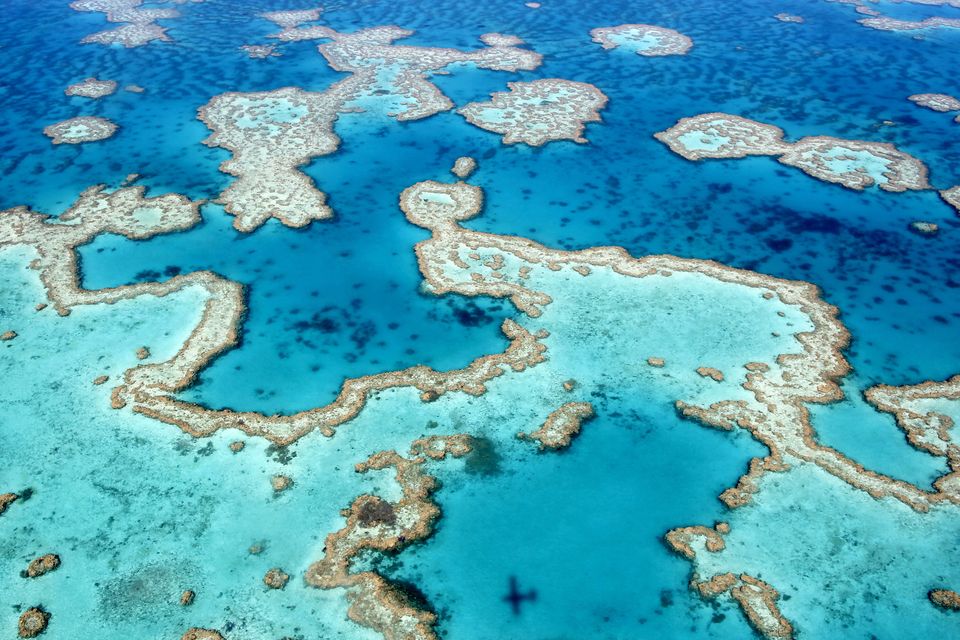
Reef flats and channels near Airlie Beach from the air, October 2018.
Photograph: Ayanadak123 · CC BY-SA 4.0 · cropped
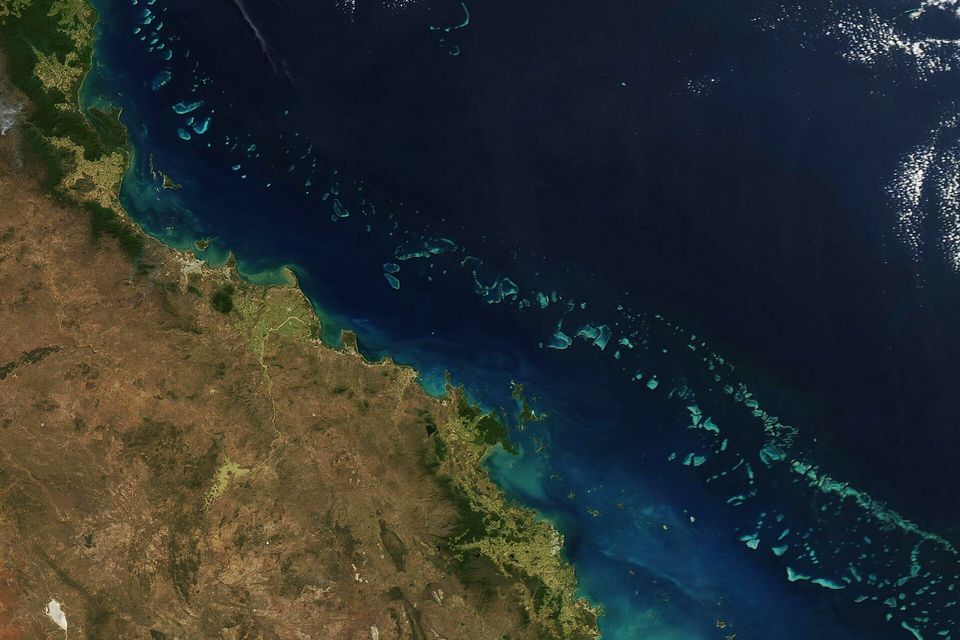
Reefs strung along the Queensland coast, seen by NASA’s Aqua satellite (MODIS), 19 August 2023.
Satellite image: NASA MODIS Land Rapid Response Team · Public domain · cropped
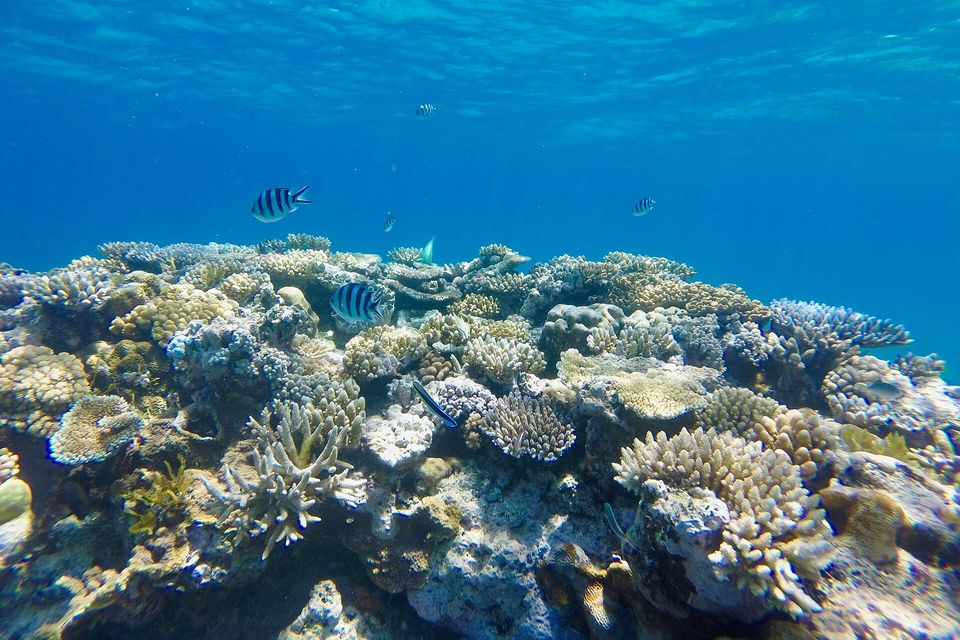
Hard corals and reef fish on the Great Barrier Reef, photographed in January 2013.
Photograph: Lukem99 · CC BY-SA 4.0 · cropped
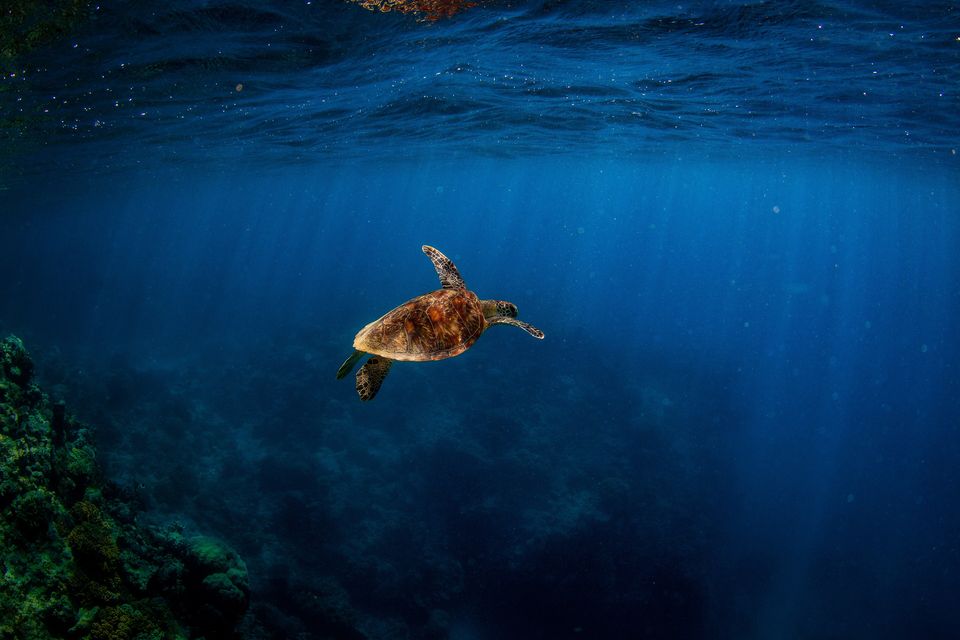
A green turtle (Chelonia mydas) swimming up for a breath at the Great Barrier Reef, April 2021.
Photograph: Ppmh21 · CC BY-SA 4.0
- Wear the stinger suit. Nobody looks good in it, and everybody looks the same.
- Touch nothing, stand on nothing, and let the fish decide how close.
- If the people whose sea this is are telling its stories on the boat, listen before you swim.
- Ask whether the coral is expected to let go while you are here, then ask again, hopefully.
- See all of it. (Revised at the first stop to: see this part properly. Item retained, in a smaller size.)
One night of the year. On a few nights after the full moons of October, November and December, depending on the reef, the corals of the Great Barrier Reef spawn together: millions of bundles of eggs and sperm rise through the dark water in clouds of pink, yellow and orange, like snow falling upward. At the surface they break apart and fertilise, and the larvae drift for days or weeks before settling to start new colonies. It happens mostly at night, it is predicted rather than scheduled, and most visitors, who go out by day, will never see it. It is also, one larva at a time, how a reef moves.
Tally, in the marginThe whole place let go on the same night, by the moon, without anyone saying a word. I was looking at my torch at the time, and next year I intend to look at the water.
Getting there
How to get there. The busiest gateways are Cairns and Port Douglas in the north and Airlie Beach, for the Whitsunday Islands, further south; Townsville is the base for the central reef. Day boats run out to the outer reef, and island resorts and liveaboard boats allow longer stays. Commercial tour tickets include the Marine Park Authority’s environmental management charge, a per-person, per-day charge the operator collects and passes on to the Authority.
When to go. Queensland’s marine stinger season, when box jellyfish and Irukandji are most active and numerous, runs from November to May, and the Queensland Government notes that stingers are present in tropical waters all year. The Queensland Government advises wearing a full-body lycra suit; do so in any month. Stinger nets at some beaches keep out box jellyfish but not the much smaller Irukandji.
On the water. Ask which reef the boat is visiting that day; across a system this size, conditions and coral cover differ from one reef to the next. Do not touch or stand on coral, and take nothing from the reef.
Book ahead. Outer-reef day trips, island stays and liveaboards in the dry season and school holidays. If you want to be in the water on a spawning night, ask operators about their predictions for the nights after the October, November and December full moons, and treat any prediction as a hope.
Mark this place
Common questions
What is the Great Barrier Reef?
The Great Barrier Reef is the world’s largest coral reef system: more than 2,900 separate reefs and about 900 islands along more than 2,300 kilometres of the Queensland coast in north-east Australia. The Great Barrier Reef Marine Park covers 344,400 square kilometres. It became a marine park in 1975 and a UNESCO World Heritage Site in 1981.
How old is the Great Barrier Reef?
The living Great Barrier Reef is young. Wikipedia, citing the Great Barrier Reef Marine Park Authority, dates the start of the present reef structure to about 9,000 years ago, grown on the platforms of older reefs. The Authority puts the earliest evidence of complete reef structures on the site at about 600,000 years ago.
Has the Great Barrier Reef died before?
Yes. Cores drilled along the shelf edge by Integrated Ocean Drilling Program Expedition 325 in 2010 show five reef-death events on the Great Barrier Reef in the past 30,000 years, according to a 2018 Nature Geoscience study led by Jody Webster of the University of Sydney: two when falling sea level exposed it and three when rising sea level drowned it. Each time it re-established itself by moving across the shelf.
Is the Great Barrier Reef dying?
The Great Barrier Reef is under heavy pressure from warming water. The Australian Institute of Marine Science has documented mass bleaching in 1998, 2002, 2016, 2017, 2020, 2022, 2024 and 2025. Its 2025/26 survey found coral cover stable or slightly higher across the reef’s three regions, the start of recovery from 2024, and says the reef’s future depends on limiting further warming.
When does coral spawn on the Great Barrier Reef?
Once a year, on one to six nights after the full moons of October, November and December. According to the Great Barrier Reef Marine Park Authority, corals on inshore reefs usually spawn after the first October full moon and those on outer reefs in November or December. Spawning happens mostly at night, and the exact nights are predicted rather than fixed.
Who are the Traditional Owners of the Great Barrier Reef?
The Great Barrier Reef Marine Park Authority describes the reef as Sea Country for more than 70 Traditional Owner groups of Aboriginal and Torres Strait Islander peoples, whose connections to it the Authority dates back more than 60,000 years. The Yidindji people of the Cairns area, for example, have a story remembering Fitzroy Island joined to the mainland.
When is the best time to visit the Great Barrier Reef?
The months outside Queensland’s marine stinger season, which runs from November to May, carry a lower risk of box jellyfish and Irukandji stings on the Great Barrier Reef, though the Queensland Government notes stingers are present all year and advises wearing a full-body lycra suit.
How do you get to the Great Barrier Reef?
By boat or plane from the Queensland coast. The busiest gateways to the Great Barrier Reef are Cairns and Port Douglas in the north and Airlie Beach for the Whitsunday Islands; Townsville serves the central reef. Commercial tour tickets include the Marine Park Authority’s per-person, per-day environmental management charge.