Region
Oceania & the Pacific
Remote islands and atolls, ancient dry country, young volcanic ground, and the marae and stone figures of the peoples who crossed the open ocean between them.
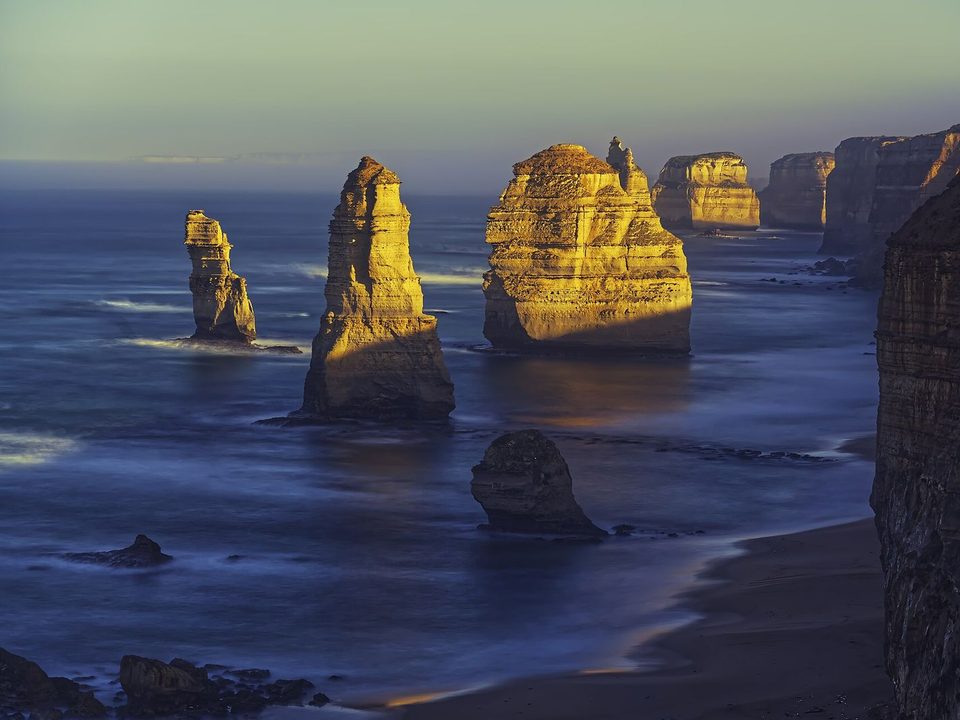
The Twelve Apostles. Photograph: Christopher Harriot, ApostleS, CC BY 2.0, cropped
Oceania and the Pacific cover open ocean, scattered islands and the dry interior of Australia. Many of the places are islands: coral atolls such as Fakarava in French Polynesia, high volcanic islands, and islands that hold the stone works of the peoples who crossed the ocean, among them Nan Madol, a city of stone built on a reef off Pohnpei. Australia adds the Great Barrier Reef, salt lakes and stony desert, and at Coober Pedy many residents live in underground dugouts. New Zealand adds the active volcanic plateau of Tongariro and fiords on the South Island. Getting there ranges from a half-hour ferry to a handful of flights a week to some atolls.
Start with five
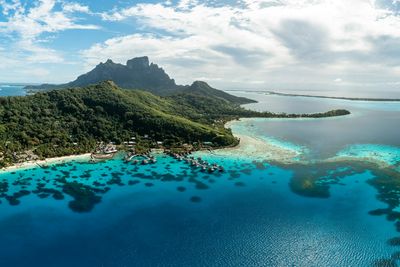 Bora BoraD · Leeward Islands, Society Islands, French Polynesia
Photograph: Fabien Bellanger via Unsplash, Unsplash licence, cropped
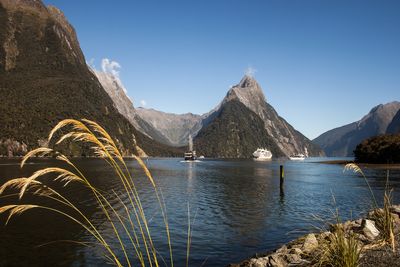 Milford Sound / PiopiotahiB · Fiordland, Southland, New Zealand
Photograph: Szilas, Public domain
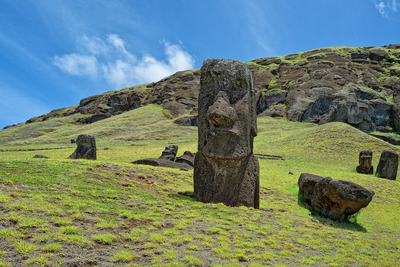 Easter IslandD · Isla de Pascua Province, Valparaíso Region, Chile
Photograph: Otávio Nogueira, Fabrica de Moais-13, CC BY 2.0, cropped
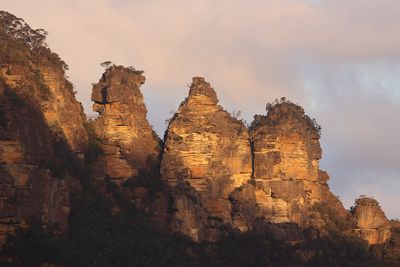 The Blue MountainsA · New South Wales, Australia
 AitutakiD · Southern Group, Cook Islands
Photograph: Tom Ackroyd, CC BY-SA 4.0, cropped
46 places in this region
Grouped by the letters on the map.
Australia 16 places
 Lord Howe IslandNew South Wales, Australia
An island capped at 400 guests at a time, with the world's southernmost coral reef and Ball's Pyramid, a 560-metre sea stack, next door.
 Coober PedySouth Australia
The opal capital of the world solved the desert sun by moving underground: homes, churches, hotels, and a golf course with no grass at all.
 Hamelin PoolShark Bay, Western Australia
Microbes have built rock here since before anything could eat them. They survive because the water is twice as salty as the sea.
 PurnululuEast Kimberley, Western Australia
Beehive domes striped orange and black, standing only because a living skin of bacteria binds sandstone that would otherwise fall apart.
 Kati Thanda–Lake EyreFar North, South Australia
A salt pan most of the time. When floodwater finally arrives from Queensland, pelicans appear in their tens of thousands, and nobody knows how they know.
 The Great Barrier ReefQueensland, Australia
The world's largest reef system has died five times in 30,000 years, stranded as the sea fell and drowned as it rose, and survived each time by moving. The reef you swim over is less than 10,000 years old.
 The Twelve ApostlesPort Campbell National Park, Victoria, Australia
Named for tourists, never twelve, and now seven: the stacks were carved in the last few thousand years, and the only extra Apostles anyone has found stand drowned offshore.
- The Blue MountainsNew South Wales, Australia
Not mountains but a sandstone plateau cut into gorges, blue because of its eucalypts and World Heritage-listed for them. One canyon hid a tree known only from fossils until 1994.
 The PinnaclesNambung National Park, Western Australia
Thousands of limestone pillars in yellow sand north of Perth, called a desert where it rains most winters. In 2024 iron nodules on the pillars were used to date them.
 Horizontal FallsKimberley, Western Australia
Two narrow gaps in a range of hills on the Kimberley coast, where tides of up to about ten metres heap the sea up on one side and pour it through. To the Dambimangari it is Garaan-ngaddim, a powerful, sacred place.
 Maria IslandTasmania, Australia
A mountainous island off the east coast of Tasmania, all of it national park, where wombats graze between the brick buildings of a World Heritage convict station and sandstone cliffs are stained in swirls of orange.
 Christmas Island (Indian Ocean)Territory of Christmas Island, Australia
An Australian territory in the Indian Ocean, nearer Java than Perth, two-thirds of it national park. At the start of each wet season, red land crabs leave the forest in their millions to spawn in the sea, and roads close to let them cross.
 Norfolk IslandExternal territory of Australia
A small Australian island in the South Pacific where convicts built a stone town beside a reef lagoon, and where descendants of the Bounty mutineers, resettled from Pitcairn in 1856, still speak a creole of their own under the island’s tall pines.
 Lake MungoMungo National Park, New South Wales, Australia
A dry lake in the outback of New South Wales whose crescent of wind-carved dunes, the Walls of China, held burials made more than 40,000 years ago, among the oldest ritual burials known, on the country of the Paakantyi, Mutthi Mutthi and Ngiyampaa peoples.
 Wineglass Bay and FreycinetEast coast, Tasmania, Australia
A peninsula of pink granite peaks on Tasmania’s east coast, in a national park founded in 1916, where a path climbs over a saddle to a lookout above Wineglass Bay, a curve of white sand once worked by shore whalers and first named Thouin Bay by a French expedition.
 The DaintreeFar North Queensland, Australia
Tropical rainforest in Far North Queensland that runs from the mountain tops to the sea, home of the southern cassowary, bowerbirds and riflebirds, and jointly managed with its Traditional Owners, the Eastern Kuku Yalanji.
New Zealand 9 places
 KaikōuraCanterbury, New Zealand
A deep-sea canyon starts almost at the beach, so sperm whales feed year-round within sight of a town whose name means 'eat crayfish'.
 TongariroCentral North Island, New Zealand
Three sacred volcanoes given to the Crown in 1887 to stop them being sold, and the first cultural landscape ever inscribed on the World Heritage List.
 RakiuraSouthland, New Zealand
No stoats, so the kiwi feed in daylight, which is how kiwi used to be everywhere. Also the southernmost Dark Sky Sanctuary on Earth.
- Milford Sound / PiopiotahiFiordland, Southland, New Zealand
So much rain falls here that fresh water floats on the sea like a lid, and deep-sea black coral grows within a diver's reach. The boats pass right over it.
 Aoraki / Mount CookCanterbury, New Zealand
Measured at 3,764 metres for a century, New Zealand's highest mountain lost ten metres in a night in 1991 and thirty more since. To Ngai Tahu it is an ancestor, not a summit.
 Chatham IslandsChatham Islands, New Zealand
A windswept archipelago about 800 km east of New Zealand’s South Island that keeps its own clock, 45 minutes ahead. It is home to the Moriori, its first people, and to the black robin, once down to five birds.
 Aotea / Great Barrier IslandHauraki Gulf, Auckland, New Zealand
A big, hilly island at the edge of the Hauraki Gulf, 100 km from Auckland, with no mains power: its people live on sun and wind. Most of it is conservation land, and its night sky earned it the world’s first island dark-sky sanctuary.
 Waitomo Glowworm CavesWaitomo, King Country, Waikato, New Zealand
A limestone cave in New Zealand’s North Island where a guide pulls a boat in silence along an underground stream beneath a ceiling of glowworms, on land returned in 1990 to the descendants of the man who first led visitors through it.
 QueenstownOtago, South Island, New Zealand
A resort town on New Zealand’s longest lake, whose water quietly rises and falls every 27 minutes, near the old gold-rush bridge where commercial bungy jumping began, and served by a coal-fired lake steamer launched in 1912.
North Pacific 7 places, north of the equator
 Nan MadolPohnpei, Federated States of Micronesia
Around a hundred artificial islets walled with basalt columns stacked like logs, on a reef off Pohnpei. The coral inside its first tomb dates it to about 1180.
 KīlaueaHawaiʻi Volcanoes National Park, Island of Hawaiʻi, United States
After its summit collapsed in 2018, Kīlauea's crater filled with groundwater. The lake grew for seventeen months, until lava broke in one December night in 2020 and boiled it off in about ninety minutes.
 Rock IslandsKoror State, Palau
Hundreds of green limestone islands in a turquoise lagoon, many worn away at the waterline into mushrooms, with a lake of golden jellyfish among them. Every visitor signs a promise to Palau's children before they are let in.
 KiritimatiLine Islands, Kiribati
A huge raised coral atoll in the middle of the Pacific, its lagoon fading into salt flats, with seabird colonies once counted in the millions and bonefish on the flats. It keeps the world’s farthest-forward clock.
 Haleakalā National ParkMaui, Hawaiʻi, United States
The summit of Maui’s great volcano, 10,023 feet up, where a reservation buys a place at sunrise above the clouds, a summit valley of cinder cones turns out not to be a crater, and a silver plant grows that is found nowhere else.
 Diamond HeadOʻahu, Hawaiʻi, United States
The brown crater at the eastern end of Waikīkī, made in a single eruption about 300,000 years ago, with a 1908 Army trail of switchbacks, stairs and a lit tunnel to a four-storey lookout hidden in its summit.
 Hawaiʻi Volcanoes National ParkIsland of Hawaiʻi, United States
Two of the world's most active volcanoes still building an island, with Mauna Loa, the largest active volcano on Earth, rising 30,000 feet from the sea floor, and Kīlauea, the home of Pele.
South Pacific 14 places, south of the equator
 FakaravaTuamotu Archipelago
A UNESCO Biosphere Reserve atoll whose southern pass holds hundreds of grey reef sharks stacked in the current, visible even to snorkellers.
 The MarquesasMarquesas Islands
Vertical volcanic islands with no reef to soften the Pacific, monumental stone tiki, and two famous graves above Atuona.
- Bora BoraLeeward Islands, Society Islands, French Polynesia
Visitors still land on an airstrip US forces built on a reef islet in 1943 for a wartime fuel base, then cross the lagoon by boat. For years it was French Polynesia's only international airport.
 TaputapuāteaRaiatea, Leeward Islands, French Polynesia
On Raiatea, a marae at the centre of an old alliance of islands. UNESCO records that stones were carried from it to found marae of the same name elsewhere.
 MooreaSociety Islands, French Polynesia
The jagged island facing Tahiti, whose native tree snails were lost in the wild, bred in zoos and carried home, each with a dot of paint. The ones found without a dot were born there.
- Easter IslandIsla de Pascua Province, Valparaíso Region, Chile
Hundreds of stone ancestors that Rapa Nui stories say walked to their places. Two archaeologists roped a replica and walked it, and the argument over how is not quite over. You visit with a local guide.
 FunafutiFunafuti, Tuvalu
The capital of Tuvalu, on a ring of coral islets so narrow that the airport runway is also the town's playing field. A few flights a week come in from Fiji, by daylight only; in between, the runway belongs to football, volleyball and bicycles.
 Togo ChasmEast coast, Niue
A chasm in the raised coral on Niue's east coast, reached through rainforest, a field of jagged coral and a long ladder, with a floor of sand and coconut palms. Niue was the first whole country certified as a dark sky place.
 OfuAmerican Samoa
A two-mile beach and a clear coral reef under steep green ridges in American Samoa’s Manu’a Islands: the smallest unit of the only US national park south of the equator, on land the Park Service leases from villages.
 Savai’iSavai’i, Samoa
Samoa’s largest island, a shield volcano reached by ferry from Upolu. From 1905 to 1911 lava from Mount Matavanu ran through villages on the north coast; at Sale’aula a church still stands with the lava inside it.
 ‘Eua‘Eua Division, Tonga
Tonga’s high island, just across from Tongatapu: pushed up from the sea floor rather than built by a volcano, with a rainforest national park on its eastern cliffs and humpback whales offshore in the winter months.
 TaveuniCakaudrove Province, Fiji
Fiji’s third-largest island, a long rainforested volcano crossed by the 180th meridian. Its mountains hold a crater lake and the tagimoucia, the national flower, which grows wild nowhere else; its reefs and waterfalls draw divers and walkers.
- AitutakiSouthern Group, Cook Islands
An ‘almost atoll’ in the Cook Islands: a hilly main island and 15 small islets round a pale lagoon of 50 to 74 square kilometres, where TEAL’s flying boats on the Coral Route set down in the 1950s and passengers went ashore for breakfast and a swim.
 National Park of American SamoaAmerican Samoa
Rainforest from the mountaintops to the shore on three volcanic islands in the South Pacific, with coral reefs, two kinds of fruit bat that plant the forest, and Samoan villages that welcome visitors on their own terms.
About this hub
Nearby on the shelf
- Australia & New Zealand (collection, 25)
- French Polynesia (collection, 5)
- The whole map
Know somewhere that belongs here?
Each place page names its sources and the date it was checked.
Photo credits for the thumbnails
- Fakarava: Photograph: Fanny98716, CC BY-SA 4.0
- The Marquesas: Photograph: Monster4711, CC BY-SA 4.0, cropped
- Kaikōura: Photograph: Whale Watch Kaikoura / Destination Kaikōura via Destination Kaikoura, CC BY 4.0
- Lord Howe Island: Photograph: HeijiD, CC BY-SA 4.0, cropped
- Coober Pedy: Photograph: Peter Myers via Flickr, The Strange Town of Coober Pedy, CC BY 2.0, cropped
- Hamelin Pool: Photograph: Halooch, History - panoramio - Halooch, CC BY 3.0, cropped
- Purnululu: Photograph: W. Bulach, CC BY-SA 4.0
- Tongariro: Photograph: Follash, CC BY-SA 4.0, cropped
- Rakiura: Photograph: Jake Osborne, Ruggedy Mountains, CC BY-SA 2.0, cropped
- Kati Thanda–Lake Eyre: Photograph: Stephan Ridgway, Lake Eyre North Panorama 2014, CC BY 2.0, cropped
- Nan Madol: Photograph: Pkkj, CC BY-SA 4.0
- The Great Barrier Reef: Photograph: Ayanadak123, CC BY-SA 4.0, cropped
- The Twelve Apostles: Photograph: Christopher Harriot, ApostleS, CC BY 2.0
- Aoraki / Mount Cook: Photograph: Pseudopanax, Public domain
- Kīlauea: Photograph: Janice Wei, NPS via Flickr, Public domain (PD-USGov, US National Park Service)
- Taputapuātea: Photograph: Octave Fargier, CC BY 4.0, cropped
- Moorea: Photograph: Balou46, CC BY-SA 4.0, cropped
- The Pinnacles: Photograph: Calistemon, CC BY-SA 4.0, cropped
- Horizontal Falls: Photograph: Reefpix (Pete Heatherwick), CC BY-SA 4.0
- Rock Islands: Photograph: Luka Peternel, CC BY-SA 4.0
- Funafuti: Photograph: Davidarfonjones, Northern Funafuti, CC BY-SA 3.0
- Togo Chasm: Photograph: Pseudopanax, Public domain, cropped
- Maria Island: Photograph: Christopher Harriot, Painted Cliffs, CC BY 2.0
- Chatham Islands: Photograph: Kristina D.C. Hoeppner, Wharekauri Beach, CC BY-SA 2.0, cropped
- Ofu: Photograph: National Park Service, Public domain (PD-USGov, US National Park Service), cropped
- Christmas Island (Indian Ocean): Photograph: Raphael Bick via Unsplash, Unsplash licence
- Savai’i: Photograph: Sarah Kelemen, Mu Pagoa Waterfall - Savai'i - Samoa, CC BY 2.0, cropped
- ‘Eua: Photograph: Boris T. Johnson via Flickr, 'Eua 4, CC BY-SA 2.0, cropped
- Taveuni: Photograph: Barry Peters, Taveuni, Fiji looking toward Matagi, CC BY 2.0, cropped
- Aotea / Great Barrier Island: Photograph: LBM1948, CC BY-SA 4.0, cropped
- Kiritimati: Photograph: Alchap7493, CC BY 4.0, cropped
- Norfolk Island: Photograph: Grant Charsley via Unsplash, Unsplash licence
- Waitomo Glowworm Caves: Photograph: Karora, Public domain, cropped
- Lake Mungo: Photograph: Caroline Jones, CC0, cropped
- Haleakalā National Park: Photograph: Tevin Trinh via Unsplash, Unsplash licence, cropped
- Diamond Head: Photograph: Eric Tessmer via Flickr, Diamond Head Hawaii Aerial, CC BY 2.0, cropped
- Queenstown: Photograph: Sarah Precious via Unsplash, Unsplash licence, cropped
- Wineglass Bay and Freycinet: Photograph: Tim Hart via Unsplash, Unsplash licence
- The Daintree: Photograph: David Clode via Unsplash, Unsplash licence, cropped
- Hawaiʻi Volcanoes National Park: Photograph: NPS / Pono Christianson, Public domain, cropped
- National Park of American Samoa: Photograph: NPS, Public domain, cropped