
- Where
- The walled city of Jaipur
Rajasthan, India - Coordinates
- 26.9239° N
75.8267° E - Built
- 1799, for Maharaja Sawai Pratap Singh
architect Lal Chand Ustad - Storeys
- Five
the top three one room deep - Windows
- 953 (Rajasthan Tourism)
or 365 (state booking portal) - Status
- Part of Jaipur City
UNESCO World Heritage, 2019 - Open
- 9:00–18:30
on Jaipur’s composite ticket
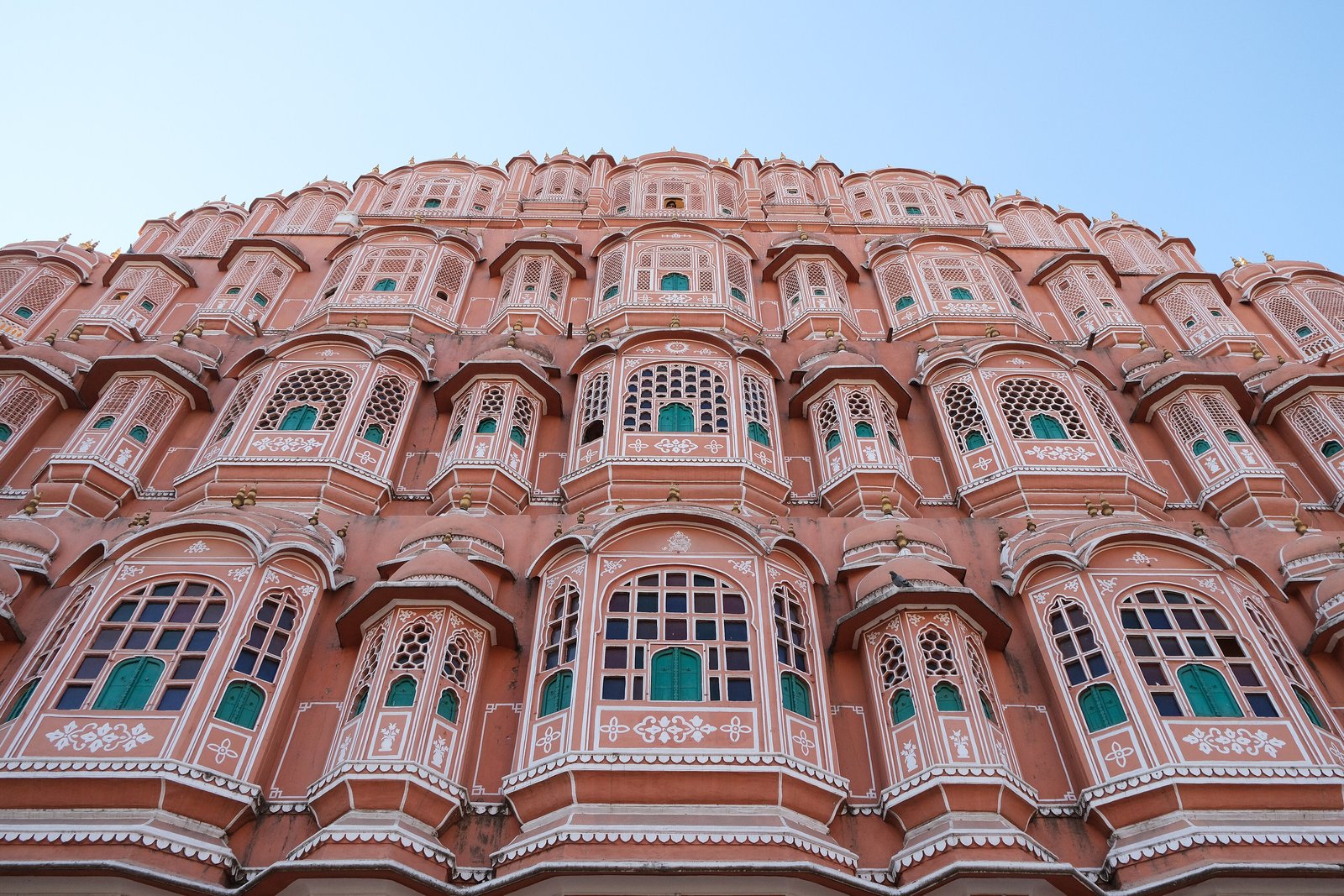
Pink walls, a street loud with scooters and horns, and above the shops a tall, thin front of pinkish stone made entirely of little windows, like a honeycomb standing on its edge. Inside there were ramps instead of stairs. At the top I looked down through a small carved screen at the whole street going by, and nobody looked up. I have rarely felt so well hidden.
The short answer
The Hawa Mahal, the “Palace of the Winds”, stands in the walled city of Jaipur, the capital of Rajasthan in north-western India, on the edge of the City Palace. Rajasthan Tourism dates it to 1799 and credits it to Maharaja Sawai Pratap Singh, with the architect Lal Chand Ustad. Built of red and pink sandstone, it is a pyramidal building of five storeys whose street face is a mass of small projecting windows with carved screens. Wikipedia records that it extends the zenana, the women’s quarters, of the City Palace, and that its name is Persian for “wind palace”. UNESCO names it among the iconic monuments of Jaipur City, inscribed on the World Heritage List in 2019.
Why it's worth knowing
The Hawa Mahal is famous for its front, and its front is the point of it. Rajasthan Tourism says the purpose of the building was to let the ladies of the royal family and the court watch the busy streets of the bazaar below from its many jharokhas, its projecting latticed windows, without being seen themselves. This was how the life of the street, and its processions, reached women who were meant to see it without being seen by it.
Britannica describes it the same way, as built as an extension of the women’s chambers of the City Palace and intended as a viewing screen. Behind the celebrated face the building is shallow: Wikipedia’s account says the top three floors are the width of a single room, and that the back, facing the courtyard, is plain, with pillared chambers and little decoration. Visitors come in from that side, through a door from the City Palace direction, not from the street.
So the celebrated view of the Hawa Mahal is, in effect, the outside of a very large window. The latticework had a second use that Wikipedia records: it let the breeze through, and the moving air kept the rooms behind it cooler in the Rajasthan summer.
The field notes
How many windows?
It depends whom you ask, even within the same government. Rajasthan Tourism, the state’s tourism department, gives the façade 953 jharokhas; Wikipedia gives the same figure and says the name derives from them. The state’s official booking portal for monuments describes an 87-foot, five-storey pyramid with 365 windows. Wikipedia puts the height at about 15 metres, roughly 50 feet. None of these sources says how it counted, and a lattice of windows within windows can be counted more than one way.
The booking portal also names the five storeys, from the bottom: Sharad Mandir, Ratan Mandir, Vichitra Mandir, Prakash Mandir and Hawa Mandir. The upper floors are reached not by stairs but by ramps. Rajasthan Tourism says the façade was designed to resemble the crown of Krishna, the maharaja’s deity.
The processions
Rajasthan’s official tourism pages describe a passage joining the Hawa Mahal to the City Palace, used by the royal women to watch the Teej, Gangaur and other processions in the streets. The same department’s festival pages describe both processions setting out from the City Palace today, through the bazaars of the old city, with palanquins, bullock carts and folk performers. The windows still look down on the route.
The king who built it, and the city around it
Sawai Pratap Singh, by Wikipedia’s account, came to the throne of Jaipur at 14 in 1778 and ruled until his death in 1803; he wrote poetry under the pen name Brijnidhi and patronised painters, and the Hawa Mahal is what he is known for. His grandfather’s city was younger than a century when it was built: UNESCO gives Jaipur’s founding as 1727, by Sawai Jai Singh II, on a grid plan with colonnaded bazaar streets meeting at large public squares, the chaupars.
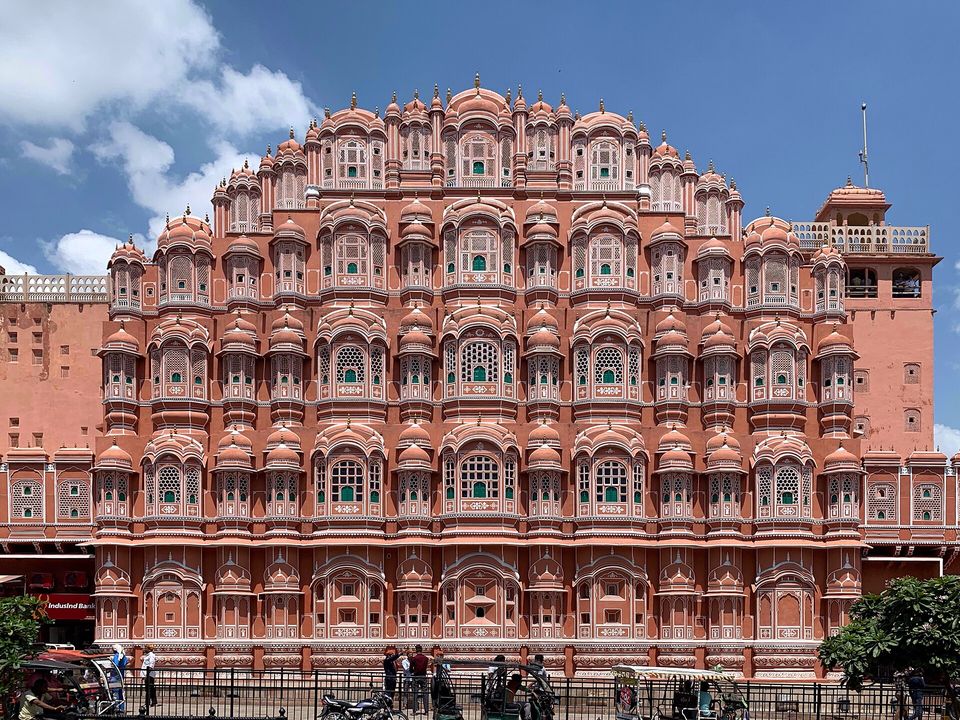
The whole east front over the bazaar street, July 2022.
Photograph: Chainwit. · CC BY-SA 4.0
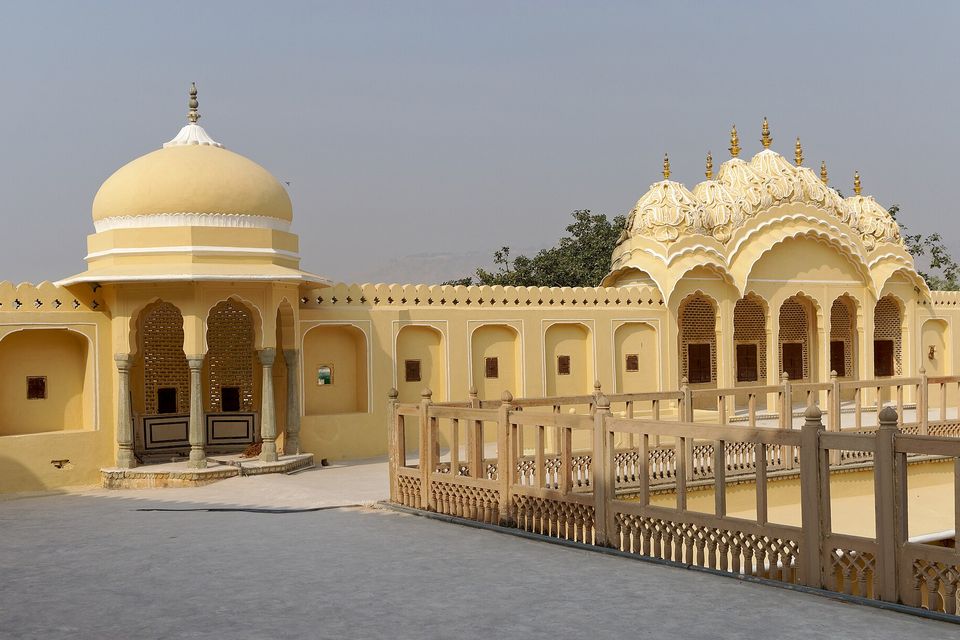
Domed pavilions on the upper court behind the facade, December 2019.
Photograph: Jakub Hałun · CC BY-SA 4.0 · cropped
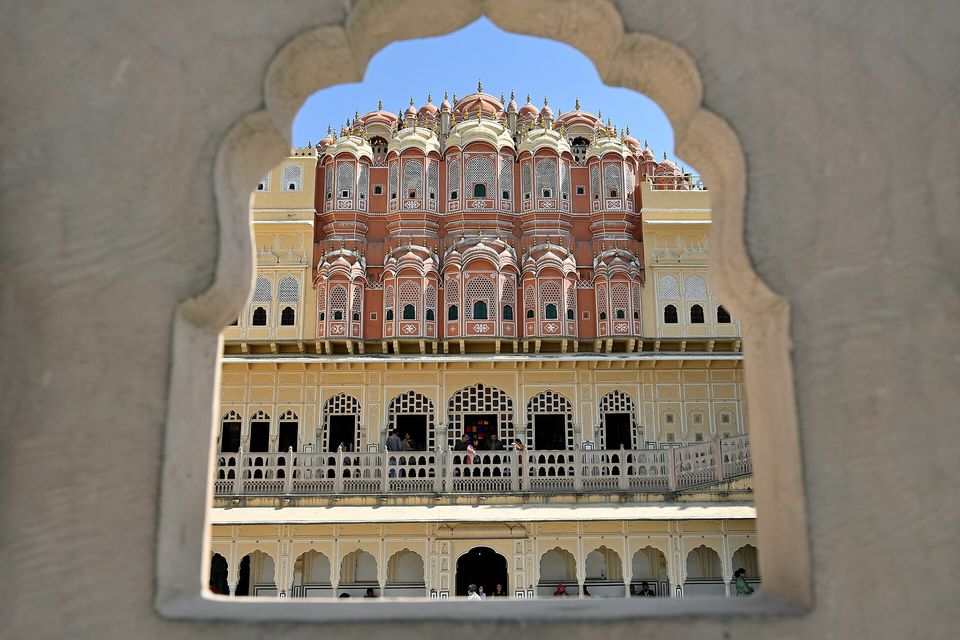
The Hawa Mahal's upper storeys framed by a scalloped window, February 2023.
Photograph: Sharvarism · CC BY-SA 4.0
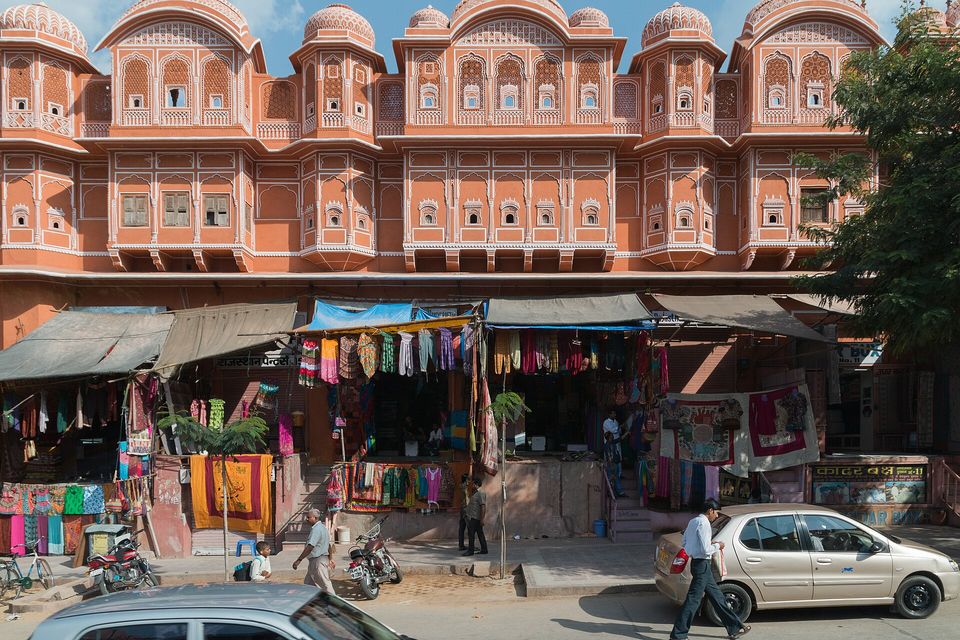
Cloth shops in the Hawa Mahal bazaar, under the pink arcades of the old city, October 2013.
Photograph: Daniel Villafruela · Jaipur-Hawa Mahal Bazaar-20131016 · CC BY-SA 3.0
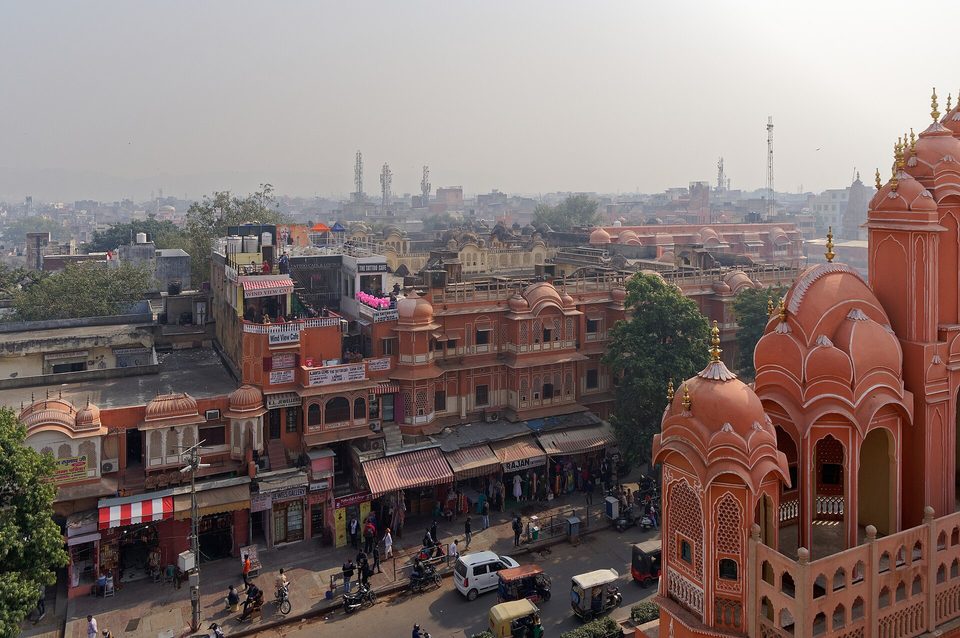
Looking down on the bazaar street from the Hawa Mahal, its own domed windows at right, December 2019.
Photograph: Jakub Hałun · CC BY-SA 4.0
- Look at the front first from across the street, early, before the traffic, then go round the back and in.
- Climb to the top by the ramps, slowly, and stop at every level to look out.
- Stand at one of the little windows and watch the street for a while without taking a picture.
- Think, at the window, about who stood there before you.
- Count the windows. (Lost count halfway up, started again from the top, lost it lower down. My number now sits on the list somewhere between the two official ones, and is very comfortable there.)
A jharokha. One of the small projecting windows of the façade, closed by a carved stone screen with openings too small to see through from the street and large enough to see out of from inside. There are hundreds of them, and the state’s own two counts, given above, disagree. Each was a place for one person to stand and watch the city without the city watching back. From inside, visitors can still stand at one and look down on the bazaar.
Tally, in the marginA window made for seeing without being seen, and I spent my first morning on the wrong side of it, waving. Nobody waved back, which I now understand was the whole idea.
Getting there
How to get there. Jaipur International Airport, in the southern suburb of Sanganer, is about 11 km from the Hawa Mahal in a straight line (this entry’s measurement). The building stands on a bazaar street of the walled city, close to the City Palace; the street face is seen from the road, and the entrance is round the back.
Opening and tickets. Rajasthan’s official pages give opening hours of 9:00 to 18:30. The Hawa Mahal is included in the state’s composite ticket for Jaipur’s monuments, which also covers Amber Palace, Jantar Mantar, the Albert Hall, Nahargarh Fort and several gardens; tickets are sold through the state’s official booking portal. Check current hours and prices there before you go.
When to go. Early, for the street face, and then from inside, for the view down through the screens. Teej and Gangaur bring processions through the old city; check Rajasthan Tourism’s festival calendar for the dates in a given year.
What to book ahead. Nothing essential; the composite ticket can be bought online in advance.
Safety. The United States has India at Level 2, exercise increased caution, because of crime and terrorism, in an advisory reissued on 16 June 2025. It names tourist sites among the places where violent crimes, including sexual assault, happen, and advises not travelling alone, especially for women. Its do-not-travel areas are Jammu and Kashmir (except eastern Ladakh), the India–Pakistan border, parts of central and eastern India, and Manipur; Jaipur is not named, and the Pakistan border is more than 350 km away (this entry’s measurement).
Mark this place
Common questions
What is the Hawa Mahal?
The Hawa Mahal, or Palace of the Winds, is a five-storey building of red and pink sandstone in the walled city of Jaipur, Rajasthan, India. Built in 1799 for Maharaja Sawai Pratap Singh and designed by Lal Chand Ustad, it extends the women’s quarters of the City Palace, and its street face is a honeycomb of small latticed windows.
Why was the Hawa Mahal built?
The Hawa Mahal in Jaipur was built so that the women of the royal household and the court could watch the life of the street below, and its festival processions, from behind latticed windows without being seen. Rajasthan Tourism gives this as the building’s main purpose, and Britannica describes it as intended as a viewing screen.
How many windows does the Hawa Mahal have?
Official figures for the Hawa Mahal’s windows disagree. Rajasthan Tourism, the state tourism department, gives 953 jharokhas, the latticed projecting windows of the façade, and Wikipedia gives the same number. The Rajasthan government’s official booking portal for monuments describes the building as having 365 windows.
How tall is the Hawa Mahal?
The height of the Hawa Mahal in Jaipur is given differently by different sources. The Rajasthan government’s official booking portal describes an 87-foot, five-storey structure; Wikipedia gives about 15 metres, roughly 50 feet. Both agree that it has five storeys and that the upper floors are only one room deep.
What does Hawa Mahal mean?
Hawa Mahal means “wind palace”, from Persian, and the building in Jaipur is usually called the Palace of the Winds in English. Wikipedia connects the name to the breeze that passes through its many small latticed windows, which kept the rooms behind them cooler in summer.
Can you go inside the Hawa Mahal?
Yes. Visitors enter the Hawa Mahal in Jaipur from the back, on the City Palace side, not from the famous street face, and climb to the upper floors by ramps rather than stairs. Rajasthan’s official pages give opening hours of 9:00 to 18:30, and entry is included in the state’s composite ticket for Jaipur’s monuments.
Is the Hawa Mahal a UNESCO World Heritage Site?
The Hawa Mahal is part of a World Heritage Site: UNESCO inscribed Jaipur City, Rajasthan, the walled city founded in 1727 by Sawai Jai Singh II, on the World Heritage List in 2019, and names the Hawa Mahal among its iconic monuments with the City Palace, Jantar Mantar and the Govind Dev temple.
Who built the Hawa Mahal?
Maharaja Sawai Pratap Singh of Jaipur had the Hawa Mahal built in 1799, and Rajasthan Tourism names the architect as Lal Chand Ustad. Pratap Singh, the grandson of Jaipur’s founder Sawai Jai Singh II, ruled from 1778 to 1803 and, by Wikipedia’s account, also wrote poetry under the pen name Brijnidhi.