
- Where
- Central Samarkand
Uzbekistan - Coordinates
- 39.6547° N
66.9756° E - The name
- ‘Place of sand’
in Persian - Madrasas
- Ulugh Beg 1417–1420
Sher-Dor and Tilya-Kori, 17th century - The minaret
- Began to lean 1918
straightened by Shukhov 1932 - Status
- UNESCO World Heritage 2001
Samarkand – Crossroad of Cultures - Advisory
- Uzbekistan Level 1
exercise normal precautions
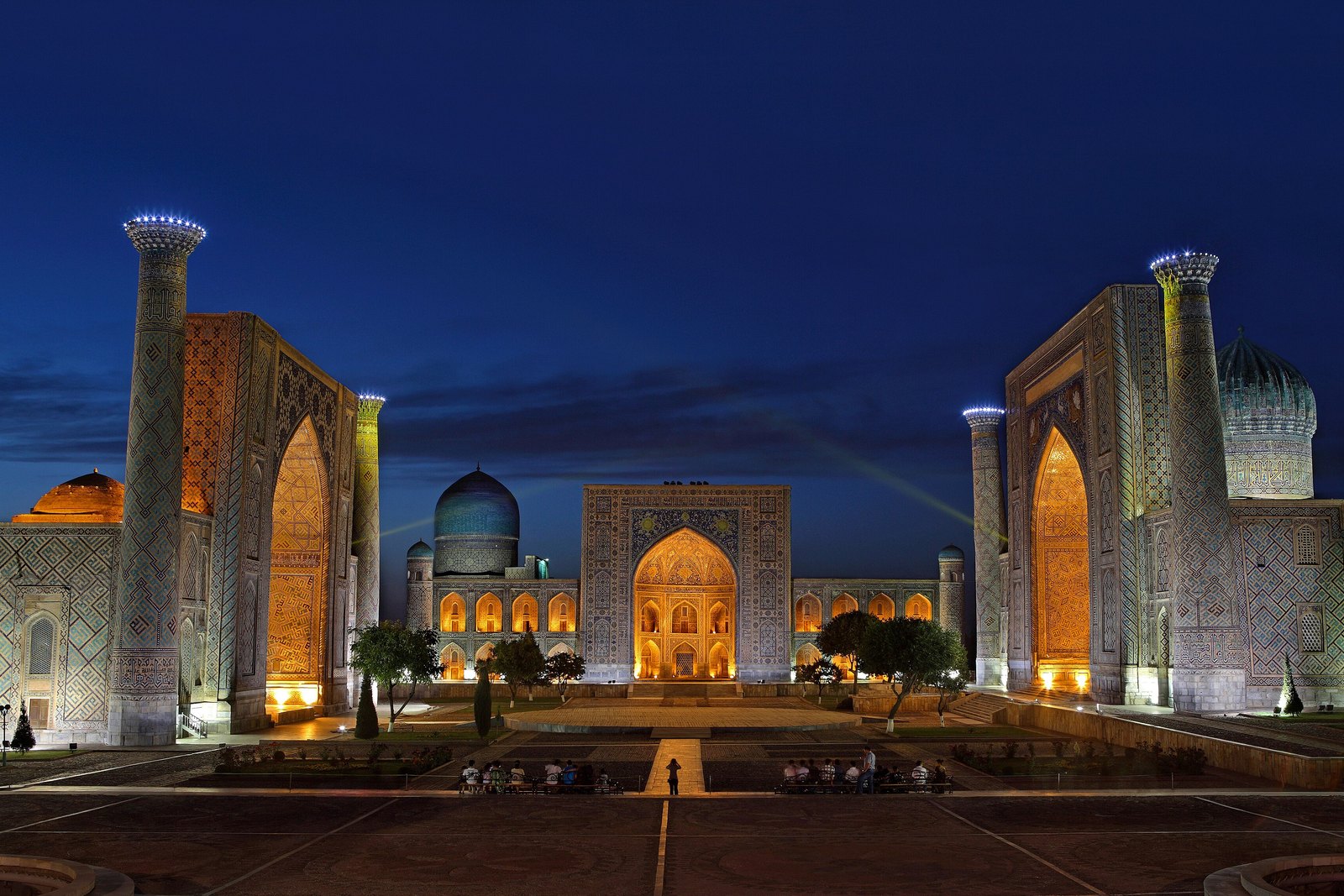
Came out of a quiet street into a great open square with huge gateways facing each other across it, every surface blue and turquoise and gold, slim towers at the corners. Over one arch, striped cats chased deer, each with a smiling sun on its back. The paving was still warm after dark. I sat on the steps until the tiles stopped glowing, then stayed in case they started again.
The short answer
The Registan is the old central square of Samarkand, in the Zarafshan valley of Uzbekistan, and the name, by Wikipedia’s account, means “place of sand” in Persian. Three madrasas, Islamic colleges, frame it on three sides. The oldest, on the west, was built by Ulugh Beg, grandson of Timur, governor of Samarkand and an astronomer, between 1417 and 1420 (Wikipedia’s article on the madrasa itself gives 1421). Facing it stands the Sher-Dor Madrasa, begun in 1619 by Wikipedia’s account, or 1616 by the Leiden University Iran–Turan project’s, and finished in 1636 for the city’s ruler Yalangtush Bahadur; between them, on the north, the Tilya-Kori Madrasa of 1646–1660, which also served as one of the city’s principal mosques. UNESCO inscribed Samarkand – Crossroad of Cultures in 2001, naming Registan Square among the ensembles that shaped Islamic architecture from the Mediterranean to the Indian subcontinent.
Why it's worth knowing
The minarets did not all stay up on their own. Elena Paskaleva, a heritage historian at Leiden University, records in the International Institute for Asian Studies’ newsletter and the university’s Iran–Turan project that in the autumn of 1918 the north-eastern minaret of the Ulugh Beg Madrasa began to tilt. Samarkand’s chief architect, Mikhail Mauer, started the first project to save it in 1920. After a decade of preparation, in 1932, the Moscow engineer Vladimir Shukhov straightened it.
Shukhov was not a restorer. Wikipedia describes him as a pioneer of structural analysis who designed the world’s first hyperboloid structures, among them the Shukhov radio tower in Moscow of 1922, as well as gridshells, oil reservoirs and pipelines, and an early oil-cracking process patented in 1891. In Wikipedia’s list of his works, the Samarkand minaret comes last, as his final engineering job; he was then in his late seventies.
So one of the straight lines of the Registan is an engineer’s correction. The work went on after him: by Paskaleva’s account the south-eastern minaret was straightened in 1965 by the engineer E. M. Gendel, from drawings made in the 1950s by E. O. Nelle.
The field notes
An astronomer’s college
Ulugh Beg, who ruled Samarkand from 1409 in the Iran–Turan project’s dating and was briefly emperor from 1447 to 1449, was above all a scholar of the stars, and Wikipedia records that he taught at his own madrasa. Its great entrance portal faces the square, with a minaret at each corner of the building, and its tilework is scattered with stars: Wikipedia describes tessellated “constellations” on the façade that reflect its founder’s astronomy.
Tigers on a madrasa
The Sher-Dor’s name refers to the beasts over its portal: two striped big cats, tiger or lion, each chasing a deer with a human-faced sun rising on its back. Wikipedia notes that such figures are unusual on a religious building in Islamic art, which generally avoids depicting living creatures, and dates a lion-and-sun panel on the building to 1627.
Gold inside
The Tilya-Kori was both a college and, for a long time, one of the city’s most important mosques. Its prayer hall is covered in gilding and dense floral and geometric painting.
How much of it is old
What a visitor sees is partly a reconstruction, and the Registan’s restorers have said so. Leiden’s Iran–Turan project records that Boris Zasypkin began restoring the Sher-Dor in 1925, working with local craftsmen and reusing original brick and locally made alabaster; that later Soviet campaigns rebuilt parts of all three madrasas in reinforced concrete; and that in 1982 the square was presented to the Soviet public in its presumed former glory. Paskaleva describes how much engineering effort went into keeping the original minarets upright.
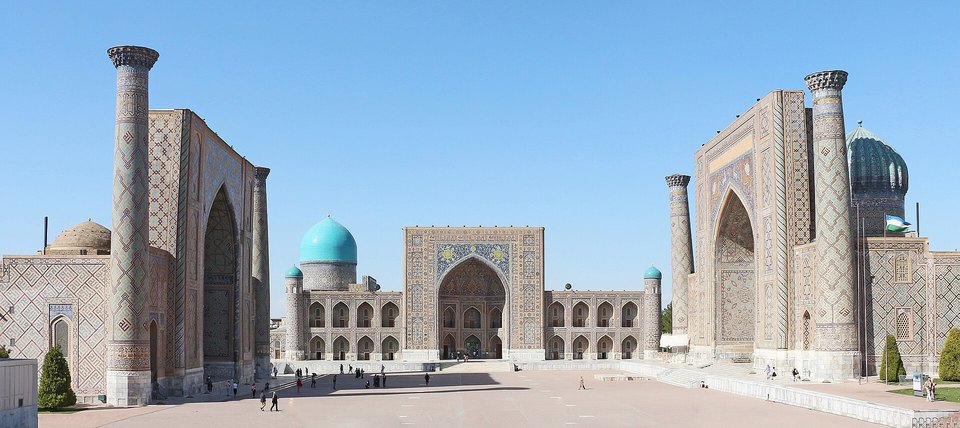
The Registan by day: the Ulugh Beg Madrasa (left), Tilya-Kori (centre) and Sher-Dor (right).
Photograph: Bernard Gagnon · CC0
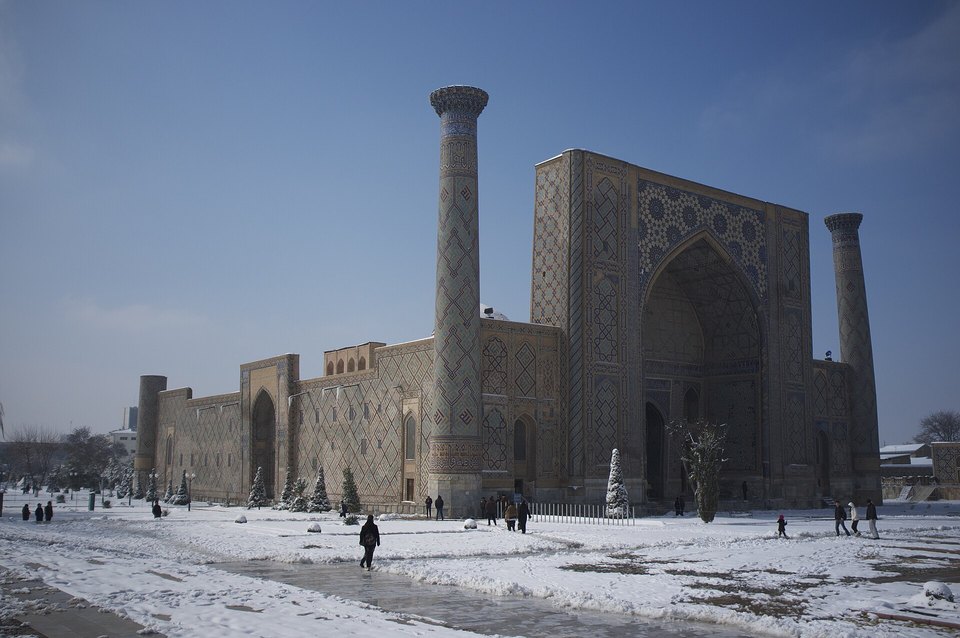
The Ulugh Beg Madrasa (1417–1420) under snow, March 2013.
Photograph: Aleksandr Zykov · Registan, Samarkand (8590133506) · CC BY-SA 2.0
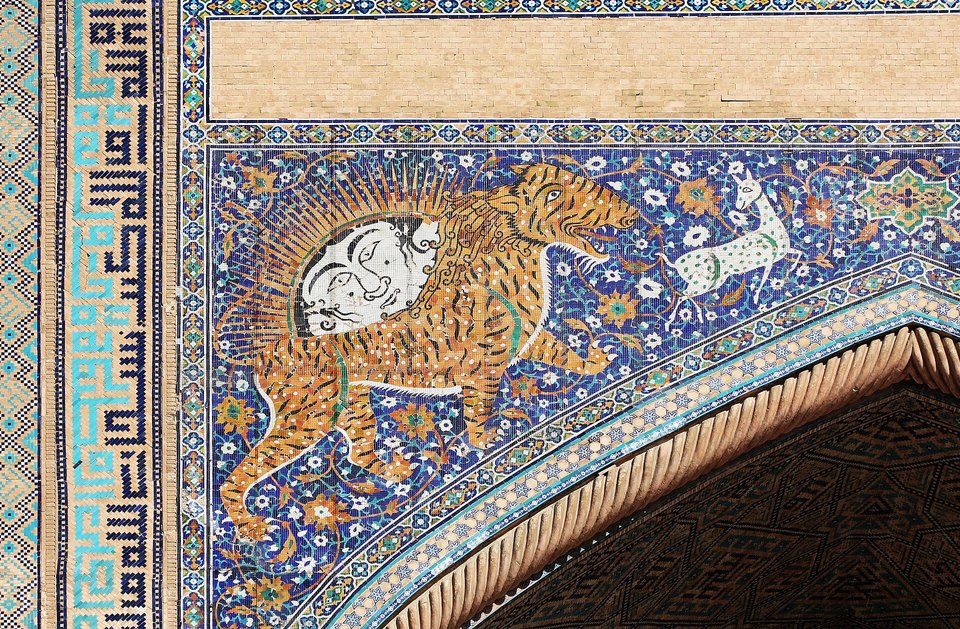
The striped cat over the Sher-Dor portal, a human-faced sun rising on its back, chasing a white deer.
Photograph: Bernard Gagnon · CC0
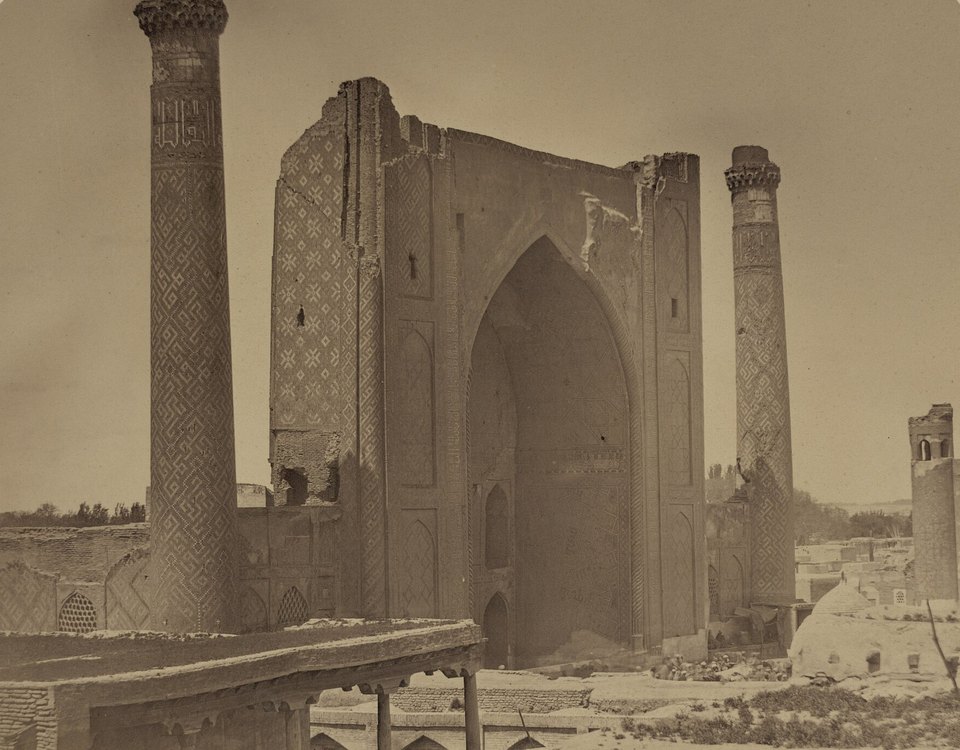
The Ulugh Beg Madrasa's main (east) front in disrepair, both front minarets standing, from the Turkestan Album of 1871–1872; photograph by N. V. Bogaevsky (historic photograph).
Photograph: N. V. Bogaevskii, Turkestan Album (Library of Congress) · Public domain · cropped
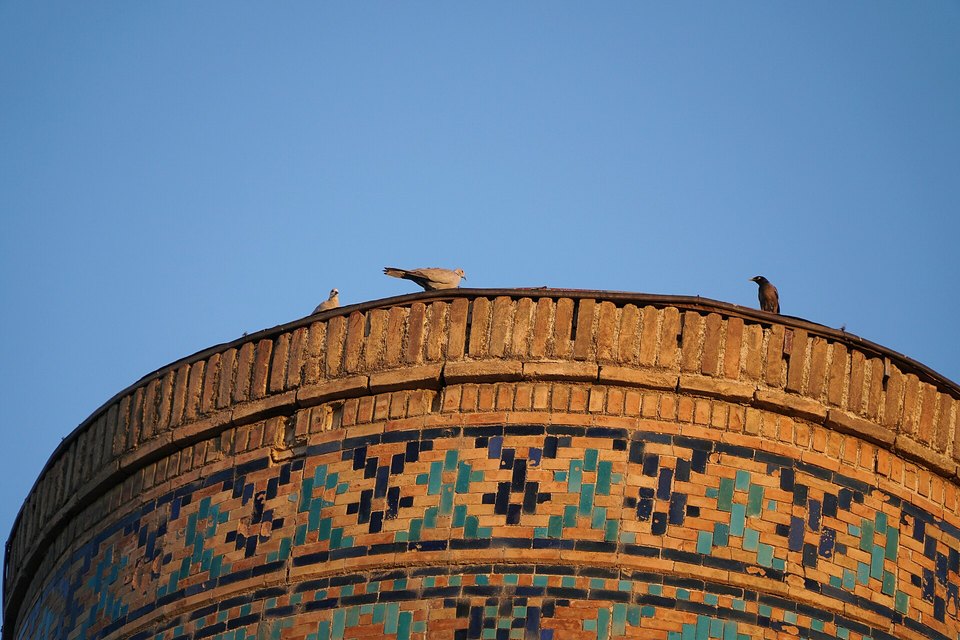
Birds on the tiled rim of one of the Registan's towers, July 2018.
Photograph: Adam Harangozó · CC BY-SA 4.0
- Dress for a mosque before you arrive, and keep your voice down in the courtyards and the prayer hall.
- Come in the morning and again at dusk, and decide which square you prefer.
- Find the striped cats over the gateway, and look for the faces on their backs.
- Stand under the tower that was put straight again, and try to see where it was ever crooked.
- Look at everything once, properly. (Looked at one gateway for an hour. The rest moved to next visit, and the visit after that.)
The straightened minaret. The north-eastern minaret of the Ulugh Beg Madrasa, one of four at the corners of the oldest building on the Registan. It began to lean in the autumn of 1918; after a decade of work, begun by Samarkand’s chief architect Mikhail Mauer, the Moscow engineer Vladimir Shukhov stood it upright in 1932, as his last engineering job. It looks exactly like the minarets that never moved, which is the point.
Tally, in the marginA tower that leaned and was set straight again, so well that the only evidence is the story. I have walked right round it and must report that it is perfectly straight, which I gather was the whole job.
Getting there
How to get there. Samarkand is on Uzbekistan’s high-speed line from Tashkent, whose Afrosiyob trains Wikipedia records as taking about two hours and eight minutes from Tashkent as of 2013; the city also has its own airport. The Registan is in the centre of the city.
Inside the madrasas. Entry arrangements and prices for the madrasas change, so check the national tourism site, uzbekistan.travel, before you go; this entry does not give them.
How to be there. These are historic religious buildings, and the Tilya-Kori was built as a mosque. Dress modestly, keep your voice down in the courtyards and the prayer hall, and ask before photographing anyone.
When to go. Come twice, in the morning and at dusk. Uzbekistan’s tourism site notes festivals held through the year.
Safety. The State Department has Uzbekistan at Level 1, exercise normal precautions, and calls it generally a safe destination for U.S. travellers. There are no area warnings.
Mark this place
Common questions
What does Registan mean?
Registan means “place of sand” in Persian, by Wikipedia’s account. It is the name of the old central square of Samarkand, Uzbekistan, framed on three sides by the Ulugh Beg, Sher-Dor and Tilya-Kori madrasas, built between 1417 and 1660.
Who straightened the minaret on the Registan?
The Moscow engineer Vladimir Shukhov straightened the north-eastern minaret of the Ulugh Beg Madrasa on Samarkand’s Registan in 1932. It had begun to lean in the autumn of 1918, according to Leiden University’s Elena Paskaleva, and the work took a decade of preparation. Wikipedia lists it as Shukhov’s last engineering work.
Who was Vladimir Shukhov?
Vladimir Shukhov (1853–1939) was a Russian engineer who designed the world’s first hyperboloid structures, including the Shukhov radio tower in Moscow of 1922, as well as gridshells, oil reservoirs and pipelines. His final engineering work, by Wikipedia’s account, was stabilising a minaret of the Ulugh Beg Madrasa in Samarkand, straightened in 1932.
When were the Registan madrasas built?
The Ulugh Beg Madrasa on Samarkand’s Registan was built between 1417 and 1420 (one Wikipedia article gives 1421); the Sher-Dor Madrasa between 1619, or 1616 in Leiden University’s account, and 1636; and the Tilya-Kori Madrasa between 1646 and 1660. The Sher-Dor and Tilya-Kori were built for Yalangtush Bahadur, ruler of Samarkand.
Why are there tigers on the Sher-Dor Madrasa?
The Sher-Dor Madrasa on Samarkand’s Registan takes its name from the striped big cats over its portal, each chasing a deer with a human-faced sun on its back. Wikipedia notes that living creatures are unusual on Islamic religious buildings, and dates a lion-and-sun panel on the madrasa to 1627.
Is the Registan original or restored?
Both. The Registan’s three madrasas in Samarkand date from 1417 to 1660, but Leiden University’s Iran–Turan project records Soviet restoration from 1925, straightening of two leaning minarets in 1932 and 1965, and later rebuilding of parts of all three madrasas in reinforced concrete, with the square presented in its presumed former glory in 1982.
Is the Registan a UNESCO World Heritage Site?
Yes. The Registan is part of Samarkand – Crossroad of Cultures, which UNESCO inscribed in 2001. UNESCO’s inscription names Registan Square, with the Bibi-Khanum Mosque, among the Samarkand ensembles that played a seminal role in the development of Islamic architecture from the Mediterranean to the Indian subcontinent.
Is it safe to visit Samarkand?
The United States has Uzbekistan at Level 1, exercise normal precautions, its lowest advisory level, and describes the country as generally a safe destination for U.S. travellers, with no area-specific warnings. Samarkand is on the high-speed railway from Tashkent.