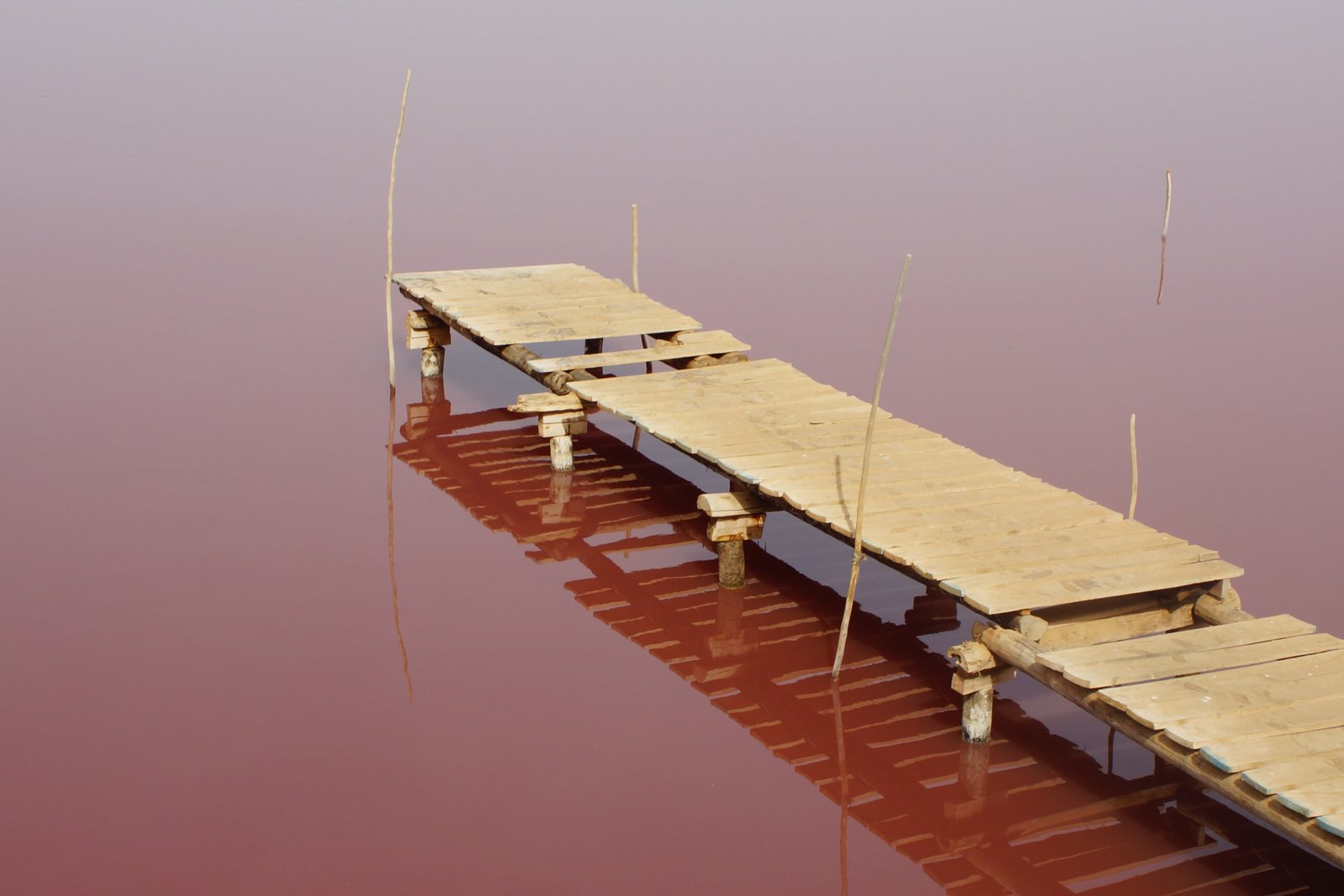

- Where
- Behind the dunes
north-east of Dakar, Senegal - Coordinates
- 14.8389° N
17.2344° W - Size
- About 3 km²; up to 3 m deep
(UNESCO Tentative List) - Colour
- The alga Dunaliella salina
(NASA Earth Observatory) - Lost and regained
- Green after the 2022 floods
pink again by March 2025 - Status
- UNESCO Tentative List
since 18 November 2005 - Advisory
- Senegal Level 1
Walked over a bank of sand with the sea booming behind it, and there was the lake, pink as the inside of a shell. Wooden boats sat low in the water, heavy with salt, and men stood waist-deep beside them, working it loose from the bottom. Women carried it up the bank to white heaps along the shore. They were working, so I watched from the dune.
The short answer
Lac Rose, known on maps as Lake Retba, is a shallow salt lake in Senegal about 35 kilometres north-north-east of Dakar, by the description on Senegal’s entry on the UNESCO World Heritage Tentative List, where it has stood since 18 November 2005. NASA’s Earth Observatory places it about a kilometre of beach from the Atlantic. The tentative-list description gives it about 3 square kilometres in four named sections, a maximum depth of 3 metres, salt exploited and exported through the region since the 1970s, and a place as the finish of the Paris-Dakar rally. Its colour ranges, in that description’s words, from mauve to scarlet pink.
Why it's worth knowing
The pink is alive, and it is conditional. NASA’s Earth Observatory explains that the colour comes from Dunaliella salina, a single-celled green alga that tolerates very salty water; under stress, from high salinity or intense sunlight, it produces protective carotenoids, including orange-red beta-carotene. The Earth Observatory gives the lake as usually pinkest in the dry season, November to June, when the sun is persistent and the salt concentrated, and fading in the wet season, July to October, when cloud cuts the light and rain freshens the water.
The wet season of 2022 was far wetter than usual. The Earth Observatory records torrential rain in August and September, deadly flooding, and floodwater that breached the lake’s bank in September, washed away the salt mounds harvesters had piled on the shore, and turned the lake dark blue-green. Diluted water is no stress to the alga, and the pink went. Le Figaro Nautisme reported in March 2025 that the lake’s depth had risen from 2 metres to 6, and that in 2023 local traders and hoteliers rented a pump to draw the water down, at a cost of several million CFA francs, before the state took the work over.
By March 2025 the pink was back. Senegalese press reports carried by AllAfrica that month, and Le Soleil’s own report from the shore, described the lake pink again and the visitors returning. Senegal’s national press agency, APS, later reported researchers at Cheikh Anta Diop University in Dakar attributing the return to the alga proliferating again under the high salinity and high temperatures of the dry season. Because the colour depends on the rains of each year, it is worth checking recent reports before making a journey for it.
The field notes
The salt, and the people who raise it
Salt is the lake’s work. The Senegalese site Au Sénégal describes the division of it: men, in the water up to the waist, break loose the crust of salt deposited on the bottom and load it into pirogues, and women carry it ashore, where it is heaped along the banks, and then treat and sell it. The harvesters protect their skin from the brine with shea butter, by Wikipedia’s account, which gives the lake’s salinity as up to 350 grams per litre in the dry season.
How many people do this work, and how much salt they raise, is reported differently from source to source, and this entry gives no tonnage. El Hadji Sow, a researcher at Cheikh Anta Diop University, wrote in The Conversation in 2024 that the lake’s artisanal salt working involves between 1,500 and 3,000 people; Wikipedia gives up to 3,000 harvesters, men and women from across West Africa. NASA’s Earth Observatory says the harvest runs to thousands of tonnes a year, used locally for cooking and preserving food and exported to neighbouring countries.
The finish line
For decades the Paris-Dakar rally ended its crossing of the Sahara on the lake’s shore. The 2008 edition was cancelled on 4 January 2008 over security threats in Mauritania, and from 2009 the Dakar rally moved to South America; it has run in Saudi Arabia since 2020. The Africa Eco Race, founded in 2009 after the move, still finishes at Lac Rose: its 2026 edition set out from Tangier on 25 January and reached the lake on 7 February 2026. In 2021 the lake also hosted a round of the Extreme E electric off-road series, by Wikipedia’s account.
A new town on the shore
A new district is being built beside the lake. The Ville Verte du Lac Rose, a project of Senegal’s General Delegation for the Promotion of Urban Poles (DGPU) with the Egyptian group Casa Orascom, covers 216 hectares, 90 of them reserved for green space, according to the pan-African agency APA. Local residents have protested, citing a lack of consultation and risks to the environment; Casa Orascom and the DGPU answered, in Le Soleil, that no filao trees had been cut or burned, that the existing forest would be kept and strengthened, and that public access to the ocean would stay open. APS put the question in its headline: promise of development, or threat to an emblematic site.
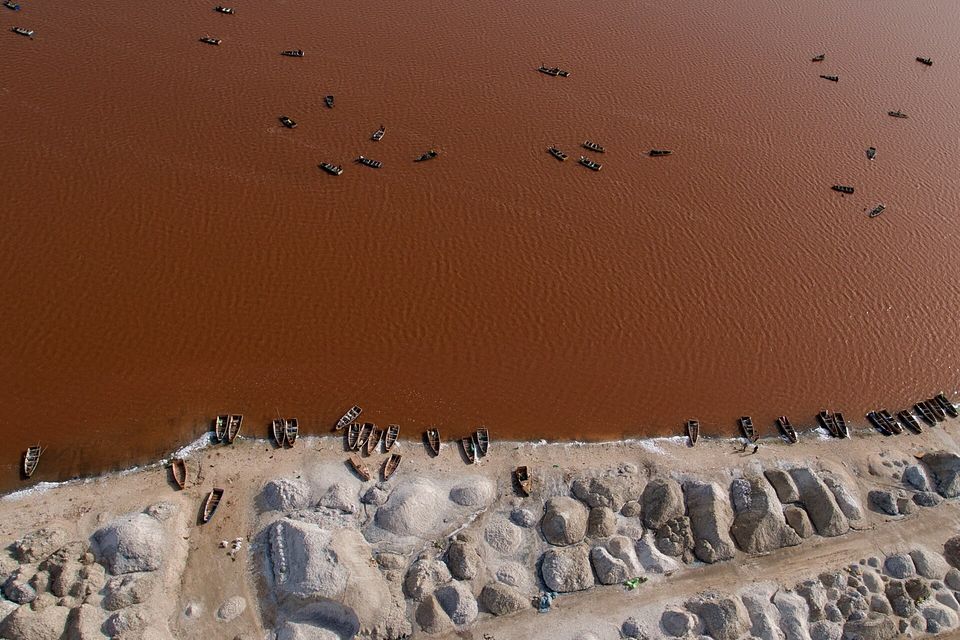
From above: pirogues on the red-brown lake and heaps of harvested salt along the shore, July 2011 (kite aerial photograph).
Photograph: Jeff Attaway · Salt Boats · CC BY 2.0 · cropped
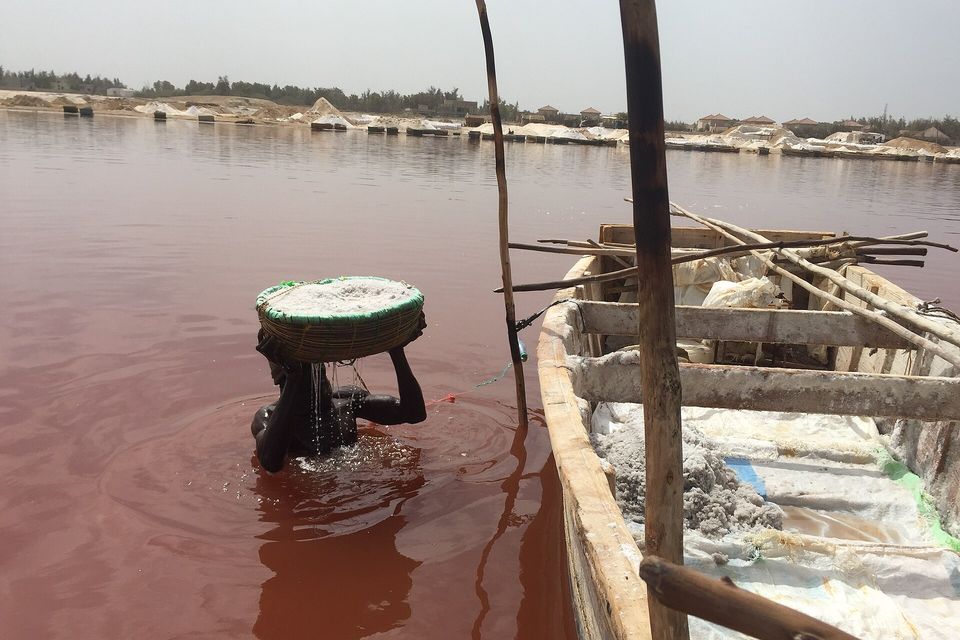
A harvester carries a basket of salt from the lake bed to the pirogue, February 2020.
Photograph: Pitele · CC BY-SA 4.0 · cropped
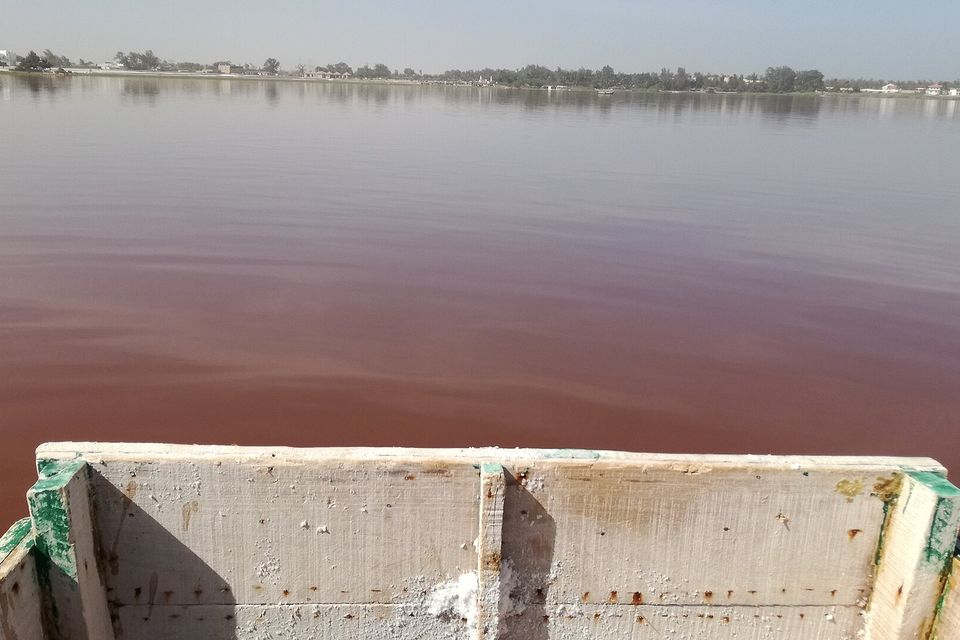
Out on the lake in a pirogue, the water rose-brown to the far shore, December 2019.
Photograph: DebyDB93 · CC BY-SA 4.0 · cropped
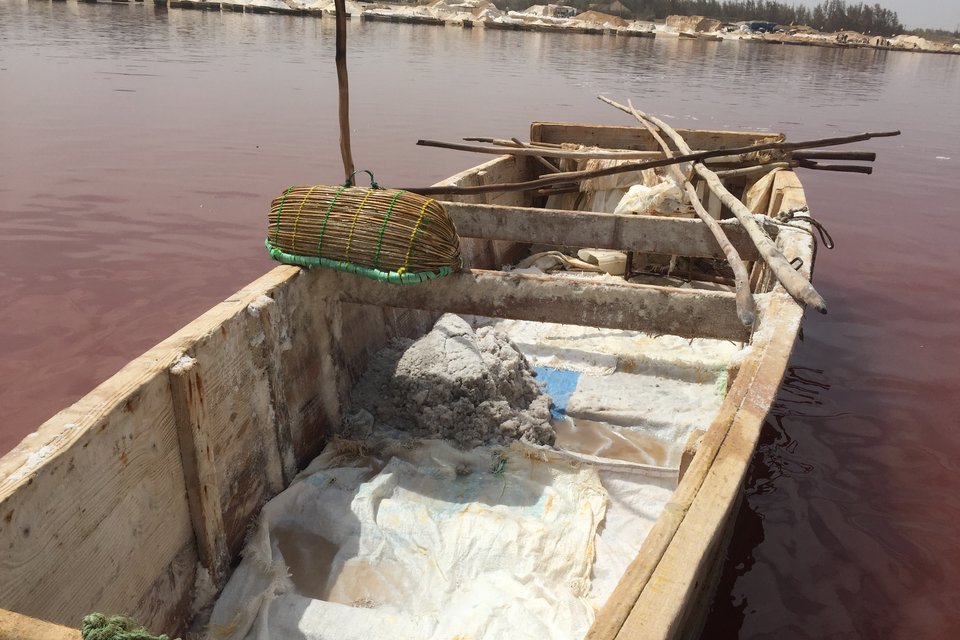
A pirogue loaded with wet salt on the lake, February 2020.
Photograph: Pitele · CC BY-SA 4.0 · cropped
- Come in the dry months, and ask in town what colour it is this week before you set out.
- Ask before you photograph anybody at work, and take no for an answer.
- Buy your salt from the people who raised it.
- Float if you are offered a swim, and keep the water out of your eyes.
- Decide exactly what shade of pink it is. (Wore a pencil down to a stub. Every shade I wrote down was right for about a minute.)
A handful of salt from the heaps on the shore. Along the banks of Lac Rose stand low mounds of salt, each raised from the lake bed by hand: broken loose from the bottom, loaded into wooden pirogues and carried ashore. The heaps are the harvest, and somebody’s income; in September 2022 floodwater breached the lake’s bank and washed the harvesters’ mounds away.
Tally, in the marginA handful of salt from the woman who carried it up the bank. It has grown heavier with every step of the way home, which I take to be the salt making a point, and a fair one.
Getting there
How to get there. Lac Rose is reached by road from Dakar, about 35 kilometres away. Senegal’s international flights land at Blaise Diagne International Airport, east of Dakar. At the lake, Le Soleil’s report on its return describes pirogue rides on the water and camel and quad-bike rides over the dunes.
When to go. Come in the dry season, which NASA’s Earth Observatory gives as November to June, for the colour. It fades in the wet season, July to October, and depends on each year’s rain, so check recent reports before travelling for it.
At the lake. The salt harvesters are at work. Ask before photographing anyone, and buy salt from the people who raise it rather than photographing them for free. NASA’s Earth Observatory describes visitors floating in the lake’s buoyant water, which it calls saltier than the Dead Sea.
Safety. The State Department has Senegal at Level 1, exercise normal precautions, and calls it generally a safe destination. It advises increased caution only in the Casamance region, in the far south, because of crime and landmines. Mauritania, which is at Level 3, begins at the Senegal River about 150 kilometres north of the lake by this entry’s measurement; the areas of Mauritania under its Do Not Travel warning are far beyond that.
Mark this place
Common questions
Why is Lac Rose pink?
Lac Rose, or Lake Retba, in Senegal is pink because of Dunaliella salina, a single-celled alga that tolerates very salty water. NASA’s Earth Observatory explains that under high salinity or intense sunlight the alga produces protective carotenoids, including orange-red beta-carotene, which colour the lake.
Is Lac Rose still pink?
Lac Rose turned dark blue-green after floods diluted it in 2022, as NASA’s Earth Observatory recorded, and Senegalese press reports described it pink again by March 2025. Senegal’s press agency APS reported researchers at Cheikh Anta Diop University attributing the return to the alga Dunaliella salina multiplying again in the salty, hot dry season. Its colour fades every wet season and depends on each year’s rain.
Where is Lac Rose?
Lac Rose, also called Lake Retba, is in Senegal, about 35 km north-north-east of Dakar, in a hollow behind the coastal dunes and about a kilometre of beach from the Atlantic Ocean. It covers about 3 km² and is at most about 3 metres deep in normal years.
When is the best time to see Lac Rose pink?
NASA’s Earth Observatory gives Lac Rose in Senegal as usually pinkest in the dry season, November to June, when sunlight is persistent and the salt concentrated, and fading in the wet season, July to October. Because the 2022 floods turned it green until 2025, it is worth checking recent reports before travelling.
How is salt harvested at Lac Rose?
At Lac Rose in Senegal, men standing in the lake up to the waist break loose the salt crust on the bottom and load it into wooden pirogues, and women carry it ashore, where it is heaped along the banks, then treat and sell it, as the site Au Sénégal describes. The harvesters protect their skin from the brine with shea butter. NASA’s Earth Observatory puts the harvest at thousands of tonnes a year.
Did the Dakar Rally finish at Lac Rose?
Yes. Lac Rose was the finish of the Paris-Dakar rally until the 2008 edition was cancelled over security threats in Mauritania and the rally moved to South America in 2009. The Africa Eco Race, founded in 2009, still finishes there; its 2026 edition reached Lac Rose on 7 February 2026.
Can you float in Lac Rose?
Yes. Lac Rose in Senegal is salty enough for people to float easily; NASA’s Earth Observatory describes its salt concentration as surpassing the Dead Sea’s. The salt harvesters who work in it protect their skin with shea butter, and visitors should keep the water out of their eyes.
Is Lac Rose a UNESCO World Heritage Site?
Not yet. Lac Rose has been on Senegal’s UNESCO World Heritage Tentative List since 18 November 2005, the list of sites a country intends to consider nominating. It has not been inscribed on the World Heritage List.