The short answer
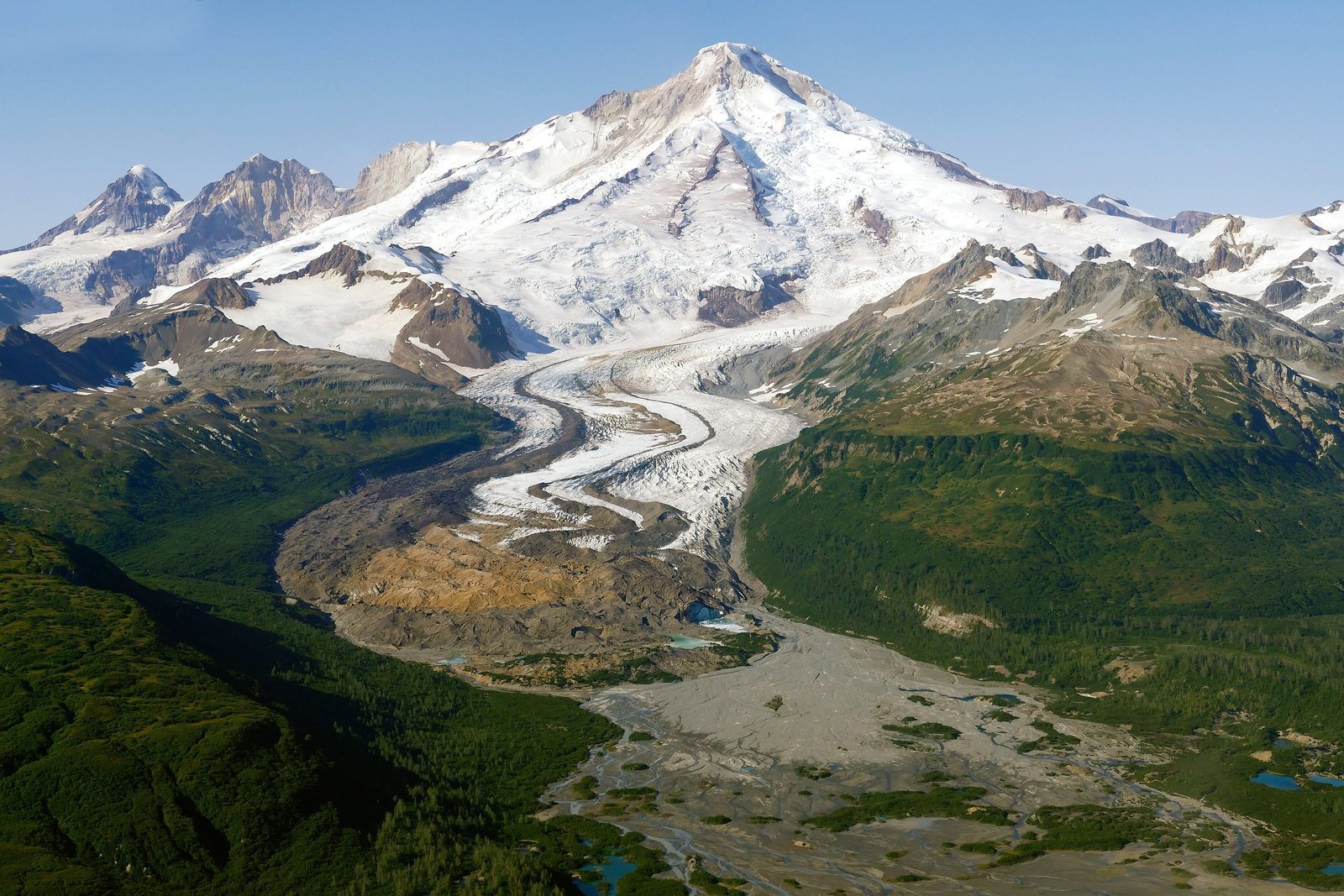
Lake Clark National Park and Preserve covers 4 million acres of the Alaska Peninsula in south-west Alaska, about 120 air miles south-west of Anchorage across Cook Inlet, and is one of the most remote units of the national park system. The communities in and around it are not connected to Alaska’s road system, so visitors come by small plane. From the salt marshes and sedge meadows of the Cook Inlet coast, where brown bears feed, the park climbs over snowy volcanoes and the Chigmit Mountains to glacier-fed lakes, of which Lake Clark is the largest. The Dena’ina people have called it Qizhjeh Vena, “place where people gather lake”, for thousands of years.
From Tally’s diary
The little plane set down on the lake and taxied to a beach, and the quiet came in through the door before I did. Up the bank stood a small log house with a door that swung on wooden hinges, every piece fitted by hand. I knocked, out of habit. Nobody answered, but it felt as though somebody very nearly had.
Why it's worth knowing
Volcanoes on the skyline. On December 15, 1989, a Boeing 747 flew into a thin cloud of ash from Redoubt Volcano, and one by one its engines stopped: the ash melted into a glassy coating that clogged the turbines. The jet fell 18,000 feet in eight minutes. With 6,000 feet and three minutes left, the coating cooled and cracked, and the pilots restarted the engines; nobody was hurt, and the repairs cost $80 million. Redoubt has erupted at least 30 times in the last 10,000 years, most recently in 2009, when more than 385 flights were cancelled or turned away. Its neighbour Iliamna steams regularly but has had no confirmed eruption in recorded history.
Salmon country. Sockeye salmon are the heart of this country. Besides the fish caught by local families, the Bristol Bay commercial fleet harvests around 20 million sockeye a year, the world’s largest and most valuable sockeye fishery. Lake Clark’s own sockeye spawn in glacier-clouded water and have adapted to it; park scientists have found 18 spawning grounds nobody knew about, where about 65 per cent of the lake’s sockeye spawn. In autumn the rivers and lakes are busy with bears, bald eagles and wolves feasting on the run. For the Dena’ina, who have lived here for more than a thousand years, the sockeye are about much more than food.
Bears with right of way. On the Lake Clark coast the bears have first claim to the best fishing holes, clamming spots and sedge meadows, and there are designated bear-viewing sites at Chinitna Bay, where visitors are many. In June, during the mating season, a boar walking with a bow-legged, “cowboy” swagger is showing the others who is in charge. Getting there is part of the story: at Silver Salmon Creek planes land on the beach, and at Crescent Lake they need floats.
The field notes
Qizhjeh
For about 900 years a Dena’ina village thrived on the shores of the lake: Qizhjeh, “a place where people gather”, written in English as Kijik. People came from all around the region to trade there, and its firewood, salmon runs, hunting and fishing supported the village all year. In 1902 its people fell sick in a flu-measles epidemic. Qizhjeh is a National Historic Landmark now, and in recent summers it has hosted Quk’ Taz’un, “The Sun Is Rising”, an outdoor learning camp where Dena’ina students learn from the knowledge of their ancestors.
A cabin, by hand
Proenneke first came to Upper Twin Lake in 1962, as the guest of his friends Spike and Hope Carrithers, and he later harvested spruce there and, in 1968, began to build. It is neither the first nor the largest cabin built in the Alaskan bush, but it stands out for the craftsmanship, and for the fact that he filmed every stage. He built his food cache on 9-foot poles to keep bears out, with a ladder he made from local materials. He tried to grow a moss roof, but the Twin Lakes air was too dry for moss, so for thirty years he kept adding moss, earth and grass seed until it made a thin mat of all three. The cabin is open to visitors in summer.
Turquoise water
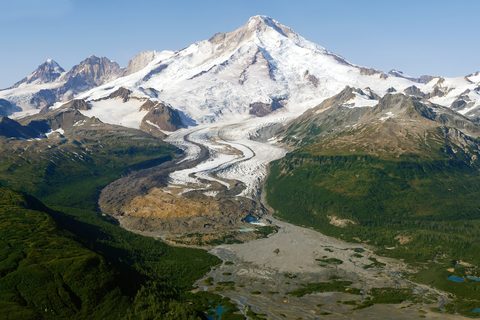
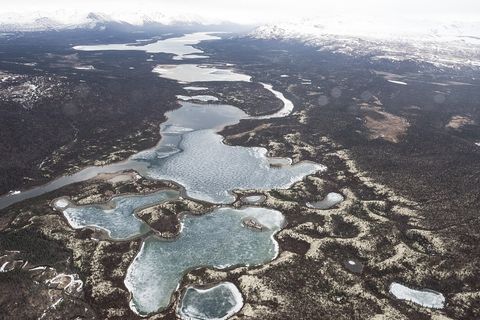
Many of the glaciers left behind by the last ice age still hang in the mountains around Lake Clark. Their meltwater carries a very fine silt, called glacial flour, that stays suspended in the water, and it gives the rivers and lakes their milky turquoise colour. The lake usually begins to freeze in November and melts in April, and whether a plane can land on floats or on skis depends on the ice.

May 2018Frozen lakes and forest from the air in spring.
Photograph: NPS / Dev Dharm Khalsa, Public domain, cropped
- Get off the little plane with dignity. (Got off. Stepped straight into the lake. Dignity is overrated in the wilderness.)
- Watch a bear dig for clams. (Watched, from a long way off. It was much better at it than I would have been, and far less fussy.)
- Make something with my own hands. (Made a spoon. It is mostly a stick. I am very proud of it.)
- Listen to how quiet it is. (Listened. Heard my own ears. Heard a bird. Heard the bird think about it.)
- By the old gathering place I sat on a log for a while and said nothing at all. It still felt like somebody’s.
A relic from Lake Clark National Park and Preserve
Relic, entry 340Carved and fitted by handFragile now, and repaired
The wooden hinges of Proenneke’s cabin door. The handmade Dutch door swings on hinges he carved from wood and locks with a wooden lock, all fitted by hand with tools he had mostly made himself. They are fragile now and have been repaired. Proenneke built the cabin from spruce he cut himself, and filmed the whole of its construction.
Tally, in the marginA wooden hinge, carved, I imagined, on a long winter evening by somebody with nowhere he would rather be. I opened the door and closed it again, slowly, just to hear it. It made almost no sound at all, which seemed exactly right.
Getting there
- 1
From Anchorage
Air taxis fly about 120 air miles from Anchorage, across Cook Inlet.
- 2
From Homer
Homer is 65 air miles away.
- 3
To the cabin
Floatplanes land on Upper Twin Lake, just over an hour from Anchorage.
- ✓
How to get there. Lake Clark is north of Katmai National Park, about 120 air miles south-west of Anchorage and 65 air miles north-west of Homer, and the only way in is by air (or on foot from elsewhere in the park). Air taxis that hold permits to fly in the park leave from Anchorage, Homer and other towns; crossing Cook Inlet, their rules require three miles of visibility and gliding distance to the shore. Port Alsworth, home of the park’s field office and a visitor center, has two privately owned airstrips that charge other planes a ramp fee, so some air taxis decline to land there. The flight to Upper Twin Lake for Proenneke’s cabin is just over an hour from Anchorage, or about 30 minutes from Port Alsworth; in summer it needs a plane on floats, because there are no suitable runways or beaches for wheels.
When to go. Lake Clark usually freezes in November and thaws in April, and planes switch between floats, skis and wheels with the ice and snow. The bears’ mating season is in June, and the salmon run brings bears, eagles and wolves to the rivers in autumn.
What to arrange ahead. Every trip starts with finding an air taxi with the right equipment for the place and the season; prices depend on group size, plane and distance. From April 15 to September 30, camping within two miles of Twin Lakes is limited to 21 days a year in all, and food in the backcountry is kept in bear-resistant containers, which can be borrowed in Port Alsworth.
Safety. The State Department’s travel advisories cover other countries, so none applies here. The Alaska Volcano Observatory reports the current activity of Redoubt and Iliamna, and the park’s conditions page carries closures.
Mark this place
The passport stamp for this place.
Common questions
How do you get to Lake Clark National Park?
Only by small plane, or on foot from elsewhere in the park. Lake Clark National Park and Preserve is not on Alaska’s road system; air taxis fly in from Anchorage, about 120 air miles away, and from Homer.
Who was Dick Proenneke?
The man who built a cabin by hand and lived in it for thirty years. Richard Proenneke began his log cabin on Upper Twin Lake, in Lake Clark National Park, in 1968, using hand tools he largely made himself, and filmed the whole process.
Can you visit Proenneke's cabin?
Yes, in summer. Visitors fly to Upper Twin Lake in Lake Clark National Park on floatplanes, just over an hour from Anchorage, and the cabin is open to them during the summer season.
Are there bears at Lake Clark?
Yes, brown and black bears. On the Cook Inlet coast of Lake Clark National Park brown bears feed in the sedge meadows and clam beds, with designated viewing sites at Chinitna Bay and popular spots at Silver Salmon Creek and Crescent Lake.
What volcanoes are in Lake Clark National Park?
Redoubt and Iliamna. Redoubt, in Lake Clark National Park, has erupted at least 30 times in 10,000 years, most recently in 2009; Iliamna steams regularly but has no confirmed eruption in recorded history.
Why is the water in Lake Clark turquoise?
Because of glacial flour. Meltwater from the glaciers around Lake Clark carries a very fine silt that stays suspended in the water, giving the lakes and rivers of Lake Clark National Park their turquoise colour.
What does Qizhjeh Vena mean?
“Place where people gather lake.” Qizhjeh Vena is the Dena’ina name for Lake Clark, the largest lake in Lake Clark National Park and Preserve, and Qizhjeh was a Dena’ina village on its shore for about 900 years.
Photographs on this page
Tap a photograph to see it full size.
Photograph: NPS / Buck Mangipane, Public domain, cropped
Photograph: NPS / Dev Dharm Khalsa, Public domain, cropped




