
- Where
- Just east of Manaus,
Amazonas, Brazil - Coordinates
- 3.1367° S
59.9047° W - The rivers
- The dark Rio Negro and
the pale, muddy Solimões - Side by side
- More than 6 km unmixed
(Ministry of Tourism) - The name
- Below it, Brazil calls
the river the Amazonas - Currents
- Negro about 2 km/h;
Solimões 4–6 km/h - Heritage
- Listing approved by IPHAN’s
council, November 2010
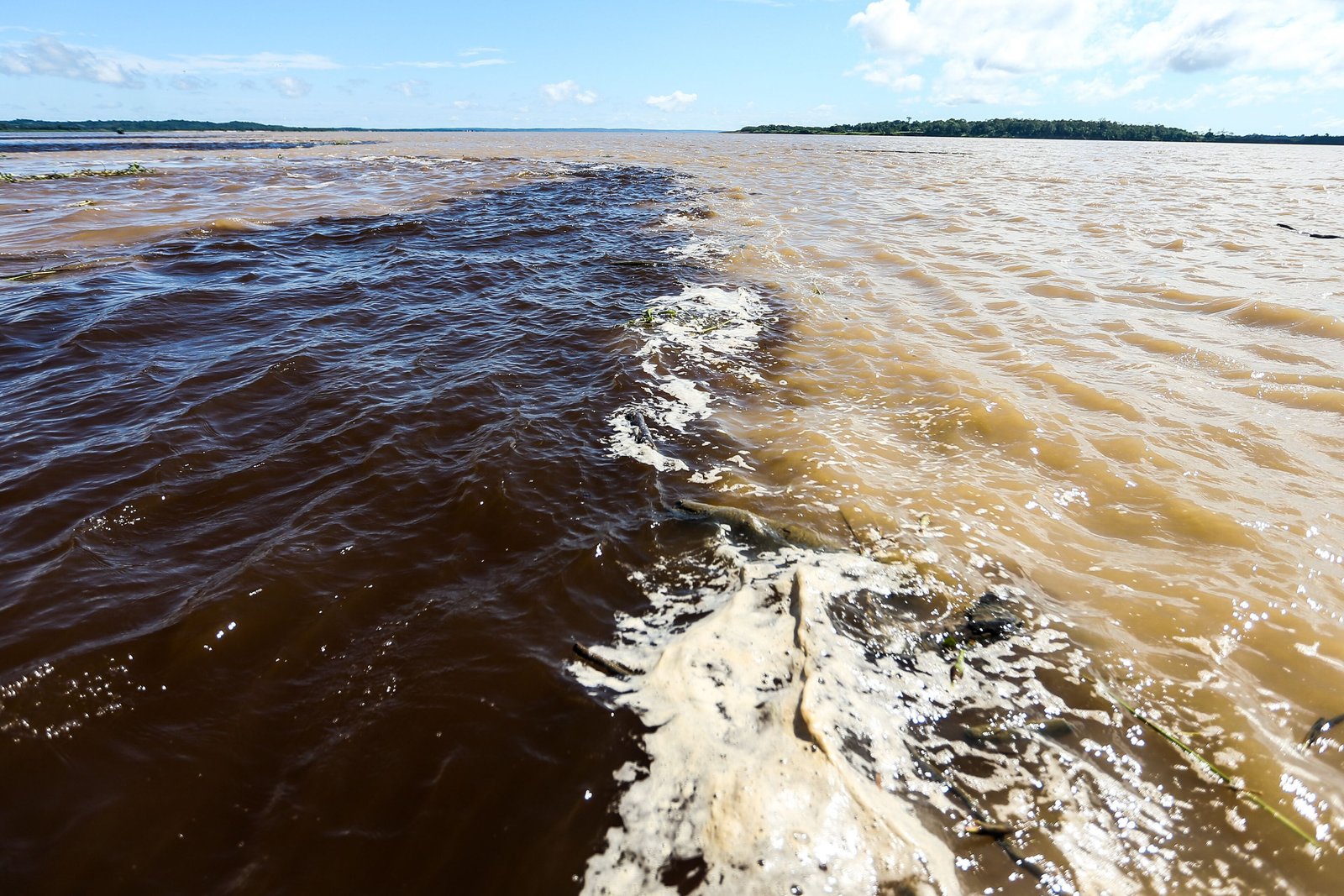
Hot and wet before breakfast, in a city in the middle of the forest with a pink opera house in it. A little boat took me out on a river the colour of strong tea, and then there was a line: black on one side, milky brown on the other, running ahead without blurring. I put a hand in each. One was warmer. I shall not say which.
The short answer
The Meeting of the Waters, Encontro das Águas in Portuguese, is the confluence of the Rio Negro and the Solimões a few kilometres east of the centre of Manaus, the capital of the Brazilian state of Amazonas. In Brazil, the main stem of the Amazon is called the Solimões above this point; below it, as Brazil’s Ministry of Tourism puts it, the river comes to be called the Amazonas. A NASA caption for a photograph taken from the International Space Station in July 2004 describes the largest river on the planet forming here. The two rivers flow side by side without mixing for more than 6 kilometres, in the Ministry of Tourism’s figure; Wikipedia gives a further 60 kilometres before they are fully mixed. The advisory council of IPHAN, Brazil’s national heritage institute, approved the site’s listing as national heritage in November 2010.
Why it's worth knowing
The two rivers look like different substances because they carry different things. NASA’s caption for the 2004 space-station photograph explains it: the Solimões is tan with the vast quantity of sediment eroded from the Andes, while the Negro drains low forest where little rock is being worn away, so it carries almost no mud, and organic matter from the forest floor stains it the colour of black tea. Wikipedia’s account of the Negro attributes the dark colour to humic acids from vegetation that has not fully broken down.
Why they do not simply blend is where the accounts part. Brazil’s Ministry of Tourism puts it down to differences of temperature, density and current, and in its figures the Negro moves at about 2 km/h and the Solimões at 4 to 6 km/h. On temperature, the accounts disagree. NASA’s Earth Observatory describes the Solimões as the cooler, denser and faster river and the Negro as the warmer and slower; a Ministry of Tourism article calls the Negro’s water warm and the Solimões’s cold; Wikipedia gives the Negro 28 °C and the Solimões 22 °C. Another Ministry of Tourism article gives the same two figures the other way round, 22 °C for the Negro and 28 °C for the Solimões.
Every account agrees that the rivers differ in speed and in what they carry, and that the line holds for kilometres. Only one gives the warmer river as the Solimões, and it is contradicted by another page from the same ministry.
The field notes
Where the Amazon gets its name
Brazil does not use the name Amazonas for the whole river. Upstream of Manaus, from the triple border with Peru and Colombia, the main stem is the Solimões, which Wikipedia describes as flowing some 1,600 to 1,700 kilometres through a floodplain 40 to 80 kilometres wide; even above the confluence, it is already the largest river in the world by volume. The Rio Negro, which joins it here, is the largest left-bank tributary of the Amazon and, in Wikipedia’s description, the largest blackwater river in the world, rising in Colombia. Below their meeting the river is the Amazonas.
A river that rises ten metres
The line is drawn on a river that moves up and down with the seasons. Radar images taken from the space shuttle Endeavour on 12 April and 3 October 1994, published by NASA’s Jet Propulsion Laboratory, show far more flooded forest around Manaus in April than in October, following what JPL describes as the annual rise and fall of about 10 metres of the Amazon.
Heritage, contested
IPHAN, Brazil’s national heritage institute, reported that its Advisory Council for Cultural Heritage, meeting in Rio de Janeiro on 4 and 5 November 2010, approved the listing of the Meeting of the Waters, citing the exceptional character of the phenomenon and its high landscape value; IPHAN describes a stretch of more than 10 kilometres in which the two rivers can be seen side by side. Press reports archived by the Instituto Socioambiental tie the listing to the fight over a proposed port terminal nearby, Porto das Lajes, and a report from August 2011 in the same archive says a federal injunction obtained by the Amazonas state government had suspended IPHAN’s decision and that the Ministry of Culture had not ratified it. This entry could not establish the listing’s legal standing since then.
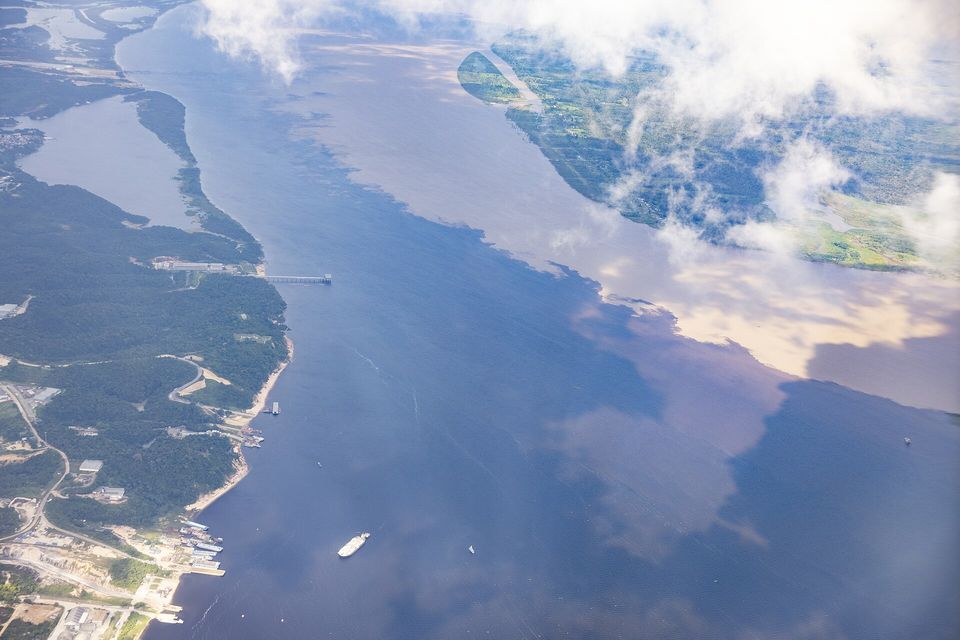
The Negro and the Solimões meeting below Manaus, seen from the air, February 2022.
Photograph: Arne Müseler / arne-mueseler.com · Amazonas - rio negro · CC BY-SA 3.0 DE
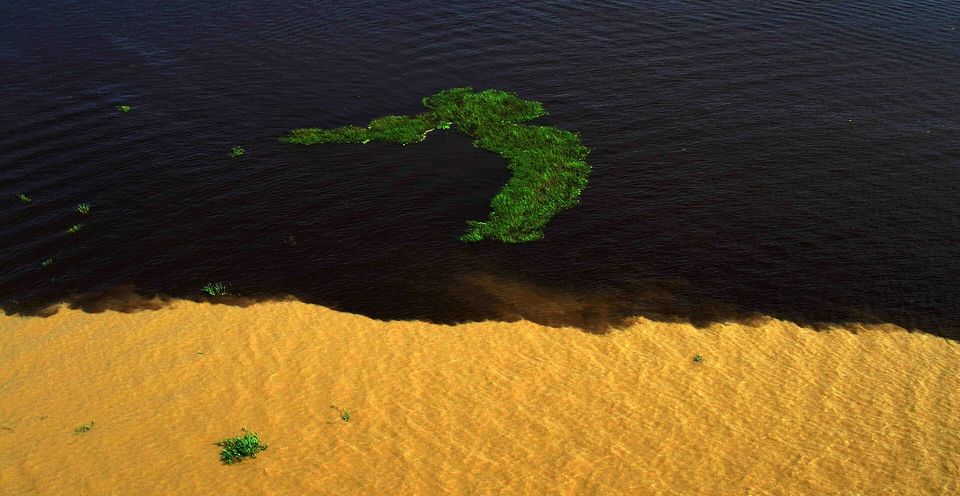
The line between the rivers from the air, with floating plants on the dark Negro, February 2018.
Photograph: Ana Claudia Jatahy / Ministério do Turismo (MTur Destinos, Flickr) · Public Domain Mark (Flickr, MTur Destinos)
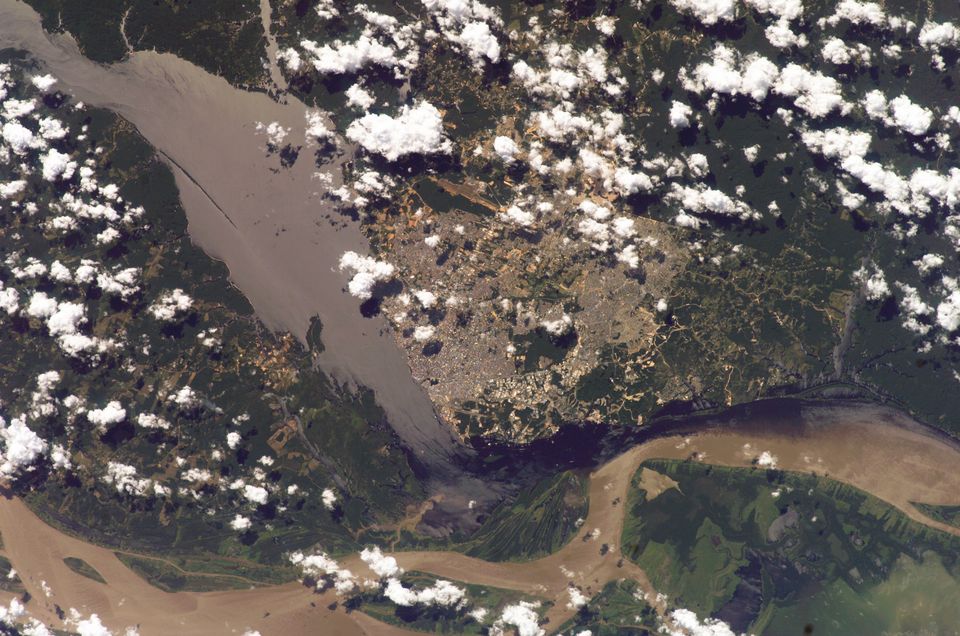
The dark Rio Negro meeting the tan Solimões beside Manaus, seen from the International Space Station, 20 July 2004 (astronaut photograph).
Astronaut photograph: NASA (ISS crew photograph ISS009-E-15488) via NASA Image and Video Library · Public domain
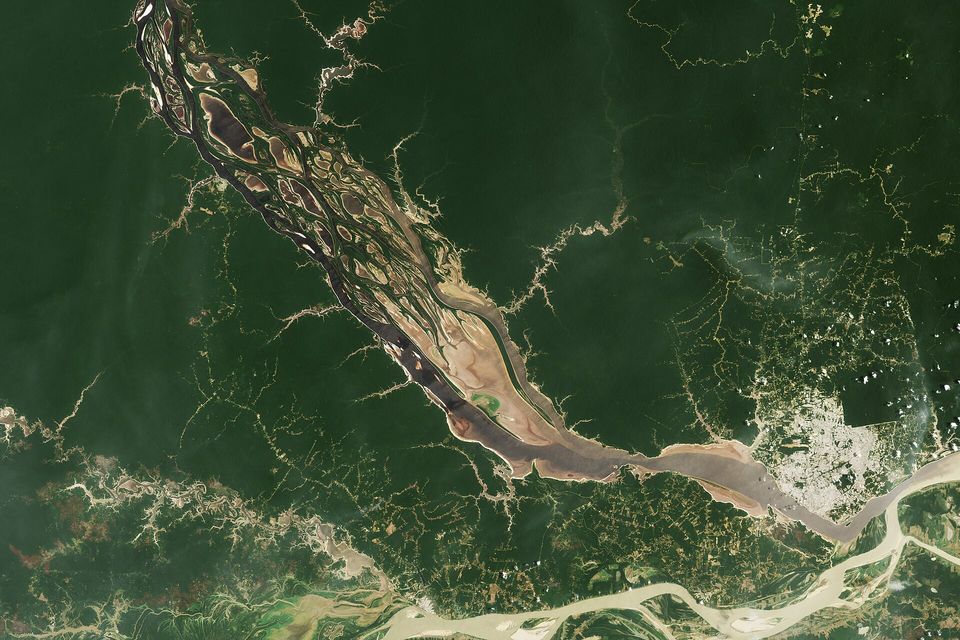
The Rio Negro parched by the 2023 drought above Manaus, with the pale Solimões across the bottom, 3 October 2023 (Landsat satellite image).
Satellite image: NASA Earth Observatory (image by Wanmei Liang, using Landsat data from the U.S. Geological Survey) · Public domain
- Take the ordinary ferry across at least once, with the people who cross it for work, and give them the good seats.
- Go out early, before the heat settles on the river.
- Put a hand in each river, and keep your opinion of which is warmer to yourself.
- Stay a night in the city and go to whatever is on at the pink opera house.
- Decide which river you prefer, and write it down. (Changed my mind at every bend, and have ruled the page into two columns that are not speaking.)
Two jars of river, filled either side of the line. Below Manaus the black-tea water of the Rio Negro and the pale brown water of the Solimões run side by side in the same channel, unmixed, for more than 6 kilometres. A jar from the black side holds water with almost no mud in it, stained dark by organic matter from the forest floor; a jar from the brown side holds sediment worn from the Andes. Both rivers are there for anyone who takes a boat out from Manaus, or the ordinary ferry across.
Tally, in the marginTwo jars on the windowsill, one like strong tea and one like milky coffee, and neither has shown the slightest interest in the other. I had assumed the line would give up once I got them indoors. It seems I have brought the argument home.
Getting there
How to get there. Manaus, the gateway, has an international airport. Most visitors see the Meeting of the Waters on a boat trip from the city: the Ministry of Tourism describes speedboat tours run by local agencies. The cheapest way across, the ministry notes, is the ferry that runs from the Ceasa port in Manaus to the far bank of the Solimões for the BR-319 highway, crossing the confluence on the way.
When to go. The river is high in the first half of the year and low in the second: NASA’s radar images of April and October 1994 show far more flooded forest in April. Go out in the morning, before the heat.
How to be there. On a small boat, wear the life jacket you are offered. On the public ferry, remember that it is how people get to work.
Safety. The United States has Brazil at Level 2, exercise increased caution, because of crime and kidnapping. Its Do Not Travel areas are anywhere within 160 kilometres of Brazil’s land borders, which lie more than 400 kilometres from Manaus by our measurement; informal housing developments such as favelas, at any time, even on guided tours; and Brasília’s satellite cities at night. The advisory warns of drinks being drugged and of robberies on public buses.
Mark this place
Common questions
Why don’t the Rio Negro and the Solimões mix?
At the Meeting of the Waters near Manaus, Brazil, the Rio Negro and the Solimões run side by side for kilometres because they differ in speed, density and temperature, in the explanation Brazil’s Ministry of Tourism gives: the Negro flows at about 2 km/h and the Solimões at 4 to 6 km/h. NASA’s Earth Observatory adds that turbulent eddies eventually mix them into the Amazon.
How far do the Rio Negro and the Solimões run side by side?
Brazil’s Ministry of Tourism says the Rio Negro and the Solimões run side by side without mixing for more than 6 kilometres below Manaus. IPHAN, the national heritage institute, describes a stretch of more than 10 kilometres where both can be seen, and Wikipedia gives a further 60 kilometres before the two are fully mixed.
Why is the Rio Negro black?
The Rio Negro in Brazil is dark because it carries almost no sediment and is stained by organic matter from the forest floor, according to a NASA caption for a 2004 International Space Station photograph of its meeting with the Solimões at Manaus. Wikipedia attributes the tea colour to humic acids from vegetation that has not fully broken down.
Is the Meeting of the Waters where the Amazon begins?
It is where the name Amazonas begins in Brazil. Brazil’s Ministry of Tourism says that once the Solimões meets the Rio Negro near Manaus, it comes to be called the Amazonas; upstream in Brazil the main stem is the Solimões. The water itself comes from much further away, and NASA describes the Solimões as carrying sediment eroded from the Andes.
Which river is warmer at the Meeting of the Waters, the Negro or the Solimões?
The accounts disagree. NASA’s Earth Observatory, a Brazilian Ministry of Tourism article and Wikipedia describe the Rio Negro as the warmer river at its meeting with the Solimões near Manaus, and Wikipedia gives 28 °C against 22 °C. Another Ministry of Tourism article gives the same two figures the other way round.
How do you visit the Meeting of the Waters?
The Meeting of the Waters is seen by boat from Manaus, in Brazil’s Amazonas state. Brazil’s Ministry of Tourism describes speedboat tours run by local agencies, and notes that the ferry from the Ceasa port in Manaus to the far bank of the Solimões, for the BR-319 highway, crosses the confluence on its way.
Is the Meeting of the Waters protected?
IPHAN, Brazil’s national heritage institute, reported that its advisory council approved the listing of the Meeting of the Waters near Manaus on 4 and 5 November 2010, for the phenomenon’s exceptional character and landscape value. A press report of August 2011 said a federal injunction obtained by the Amazonas state government had suspended the decision; its standing since is not established here.
Can you see the Meeting of the Waters from space?
Yes. An Expedition 9 crew member photographed the confluence of the Solimões and the Rio Negro at Manaus, Brazil, from the International Space Station in July 2004, and NASA’s caption describes the tan and black rivers meeting there. NASA’s Terra satellite also imaged it on 23 July 2000.