
- Where
- Above Hohenschwangau, near Füssen,
Bavaria, south Germany - Coordinates
- 47.5576° N
10.7498° E - Built
- From 1869; unfinished
at the king’s death in 1886 - Designed
- Christian Jank, stage painter;
Eduard Riedel, architect - Visitors
- More than 1.3 million a year;
up to about 6,000 a day in summer - Status
- UNESCO World Heritage, 2025,
with three other Ludwig palaces - Best visited
- First tours of the morning;
autumn and winter are quieter
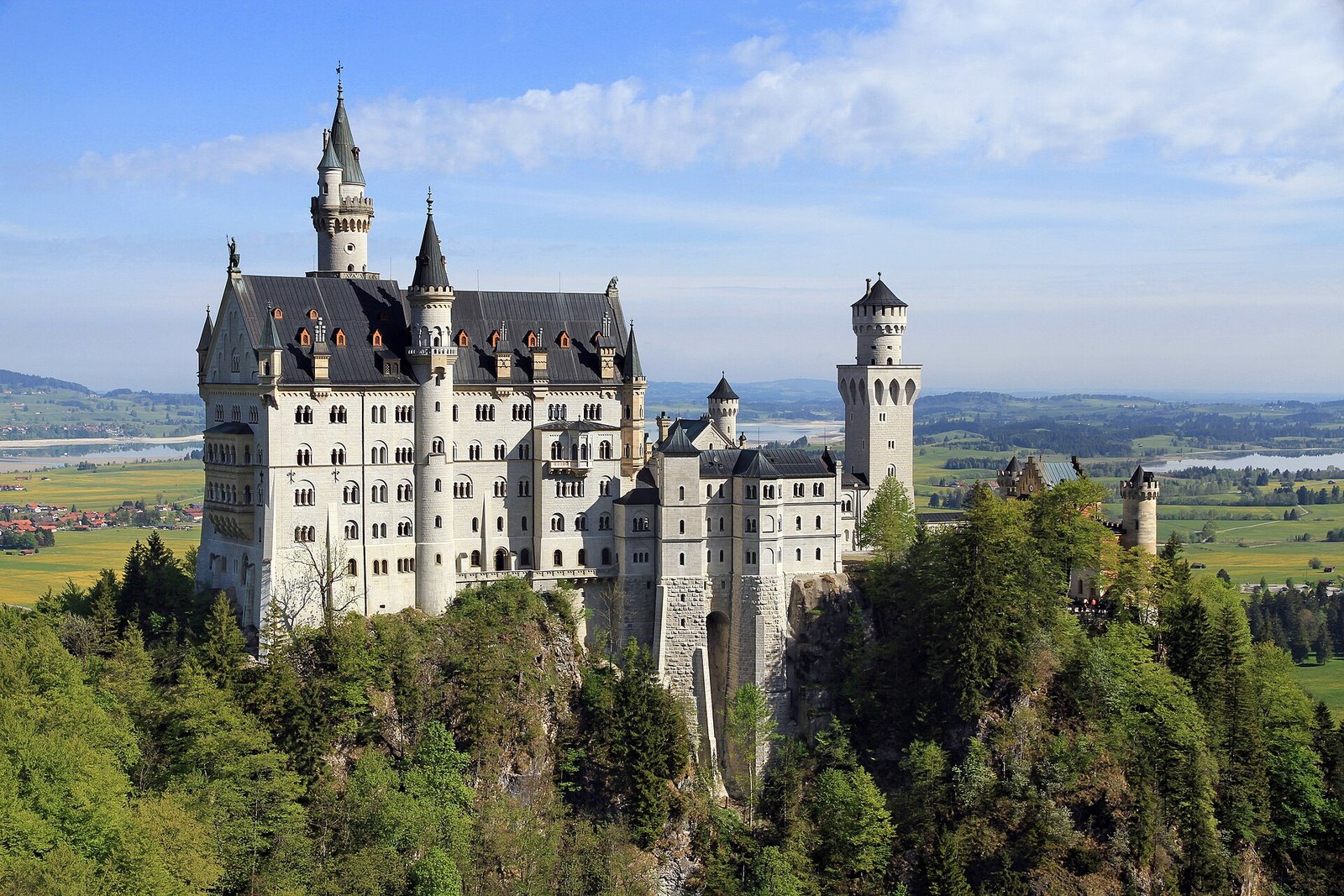
Walked up through beech woods in a crowd, round a bend, and there it was on its crag above the trees: white towers and pointed roofs, the picture off every biscuit tin. Stood on an iron bridge over a gorge, a waterfall underneath, to look back at it. Inside, the rooms got quieter the further in I went, and I caught myself whispering, as if someone still lived there.
The short answer
Neuschwanstein is a nineteenth-century palace built to look like a medieval castle, on a crag above the Pöllat gorge in the foothills of the Bavarian Alps, near the village of Hohenschwangau and the town of Füssen. King Ludwig II of Bavaria had the foundation stone laid on 5 September 1869 and moved into the still unfinished main building in 1884. He died in June 1886, and the palace opened to paying visitors that summer. Only about fifteen rooms were ever completed. More than 1.3 million people visit a year, and in July 2025 UNESCO inscribed it, with Linderhof, Herrenchiemsee and the King’s House on the Schachen, as the Palaces of King Ludwig II of Bavaria.
Why it's worth knowing
The Bavarian Palace Administration, which runs the castle, puts the story in two sentences on its own site: the shy king had built the castle in order to withdraw from public life, and seven weeks after his death it was opened to the public, so that vast numbers of people came to view his private refuge. No outsider, the same administration says, was ever allowed to enter it during his lifetime; it opened on 1 August 1886.
That is the thing to hold on to when you are standing in the queue. A castle that millions photograph was designed to be looked out of, by one man, unobserved. Ludwig first stayed in its finished rooms in May 1884 and was arrested there in June 1886; his time in it was short, though the figure of 172 days often given for it could not be traced to the Palace Administration. The opening was ordered by the Prince Regent, Luitpold.
The design was theatre from the start. The first drawings were made by Christian Jank, a stage painter, and the architect Eduard Riedel turned them into a building; Georg von Dollmann and then Julius Hofmann took over the works. The medieval look was the brief, not the history: behind the walls the palace had central heating, running warm water, toilets that flushed automatically, telephone lines and electric bells for the servants.
So a building made for one man’s privacy became the public’s shared picture of a fairy-tale castle, and its value to the world turned out to be exactly the thing he built it to avoid: being seen.
The field notes
A king, a debt, a lake
Ludwig’s building projects ran him deep into debt: by 1885 he owed about 14 million marks and had borrowed heavily from his family. The castle alone cost about 6.2 million gold marks.
In June 1886 a commission of psychiatrists, led by Bernhard von Gudden, declared him unfit to rule. None of them had examined him. He was taken from Neuschwanstein after midnight on 12 June, and the next day he and Gudden were found dead in the shallow water of Lake Starnberg. The death was officially ruled a suicide by drowning; the circumstances have been disputed ever since, and this entry does not take a side.
The rooms that were finished
Of the rooms planned for the palace, about fifteen were completed. The guided tour takes in the finished ones: the king’s apartments, the Throne Hall and the Singers’ Hall among them. Much of the rest of the building is shell.
The Throne Hall is the clearest example. Its apse was meant to hold the king’s throne. The throne was never made, and it still is not there.
The bridge over the gorge
The classic view of Neuschwanstein is from the Marienbrücke, the Queen Mary’s Bridge, which crosses the Pöllat gorge behind the castle above a waterfall. Ludwig’s father, Maximilian II, had a wooden bridge built there in the 1840s; in 1866 Ludwig replaced it with iron. It is named after Queen Marie, Ludwig’s mother. It was restored in 1984. It closes in winter when ice and snow make it unsafe.
It is the viewpoint for the classic photograph, and it is where the visitor stands to see the building the way its owner never did: from the outside.
Everyone's castle
Neuschwanstein is regularly named as a model for Disneyland’s Sleeping Beauty Castle, which opened in 1955; Wikipedia states it as an inspiration, and accounts of the Disneyland design credit the artist Herb Ryman, who had visited Neuschwanstein. This entry has not traced the claim to a Disney primary document and rests nothing on it.
What can be counted is the crowd. More than 61 million people had visited by 2008. The present figure is more than 1.3 million a year, with as many as 6,000 a day in summer, which is why entry is by timed ticket and guided tour only.
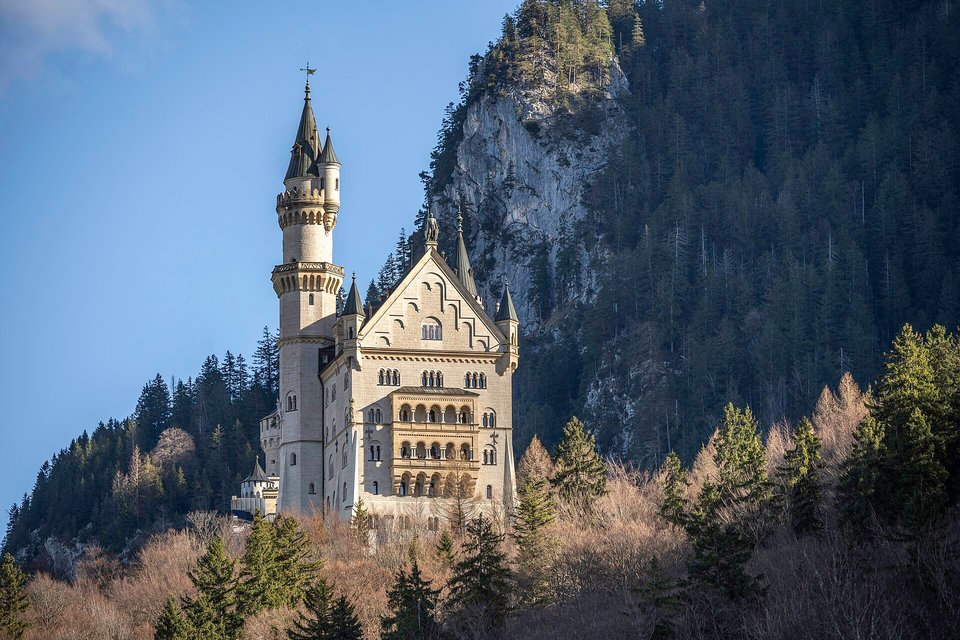
The castle from the valley in February, its tall tower catching the low sun.
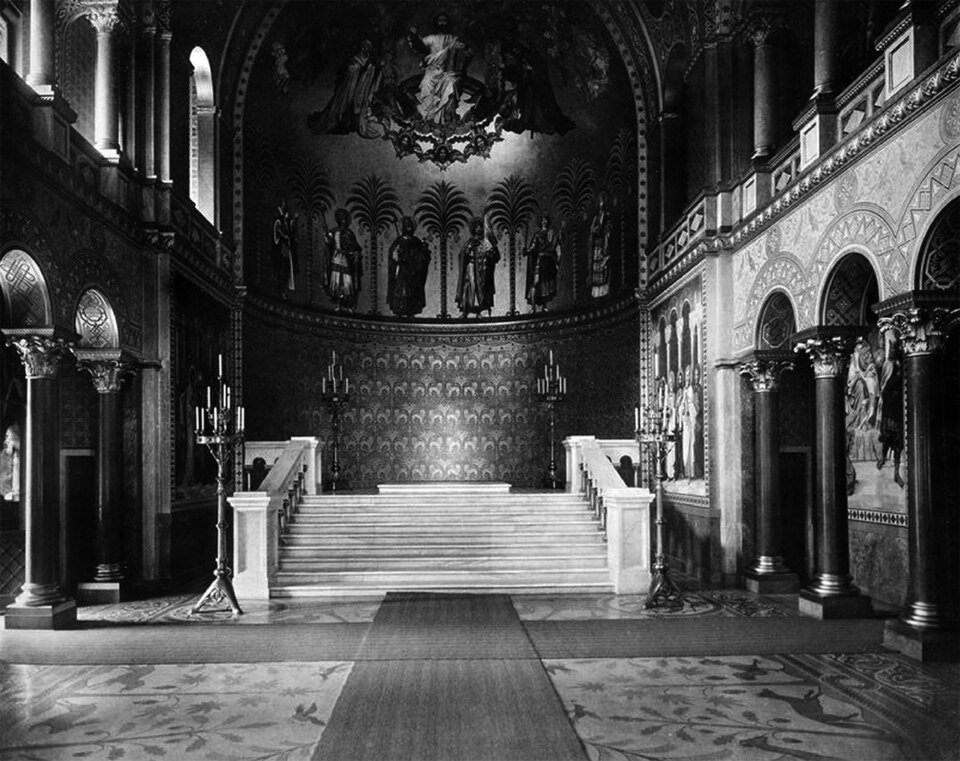
The Throne Hall in a photograph of 1900: the steps and the apse are there, and the throne was never made.
Photograph: Verlag Franz Hanfstaengl · Public domain
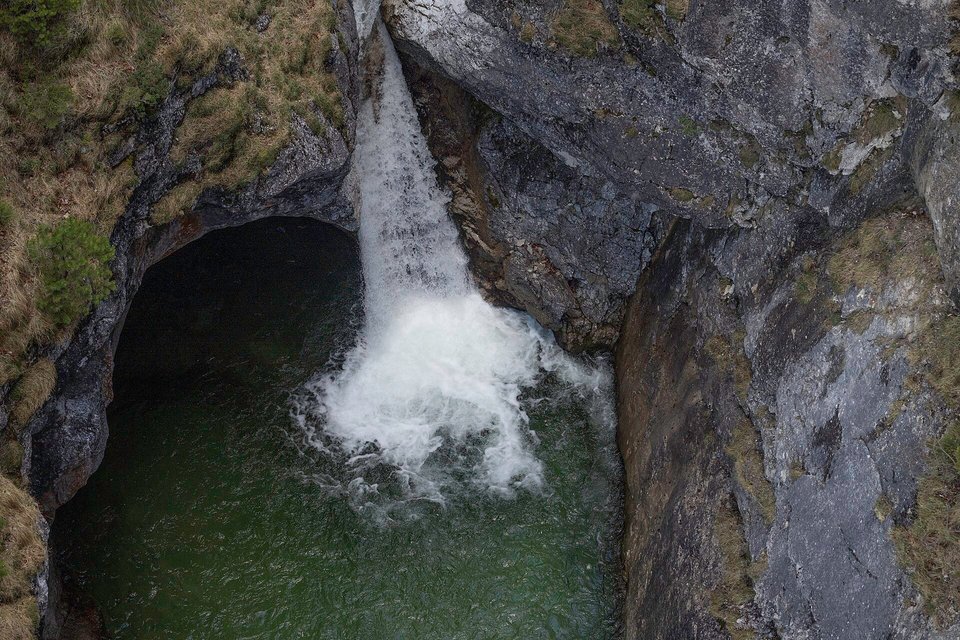
The Pöllat falling through its gorge below the castle.
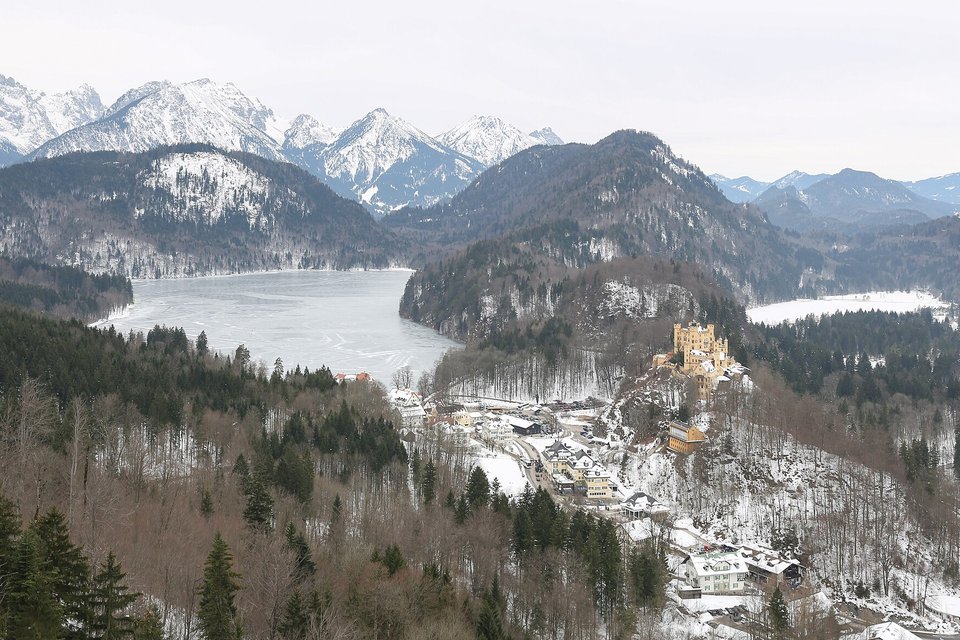
Hohenschwangau castle and the Alpsee in winter, in the valley below Neuschwanstein.
Photograph: Diego Delso · CC BY-SA 4.0 · cropped
- Buy the tour ticket before you come. The hill is not the place to find out.
- Walk up through the woods, and stop at the bend where it first appears.
- Stand on the bridge once, look back, and then give your place to the next person.
- Speak quietly in the rooms. It was somebody’s.
- Admire it from far away, then close, then from far away again. (The list now holds the same castle several times. Item retained.)
A throne that was never made. The Throne Hall at Neuschwanstein was built around one object: at its far end, an apse was prepared to hold the king’s throne. Ludwig II died in 1886 before it was completed, and no one made it afterwards. The apse is there. The room is finished around an empty space.
Tally, in the marginA room built entirely around a chair, and no chair. I admired the whole ceiling before I noticed, and after that I could not see anything else.
Getting there
How to get there. Neuschwanstein stands above the village of Hohenschwangau, near Füssen in the Allgäu, south-west Bavaria, close to the Austrian border. From Munich, the usual route is a regional train to Füssen and a local bus to Hohenschwangau, or the drive. From the village the castle is an uphill walk of 30 to 40 minutes, about a kilometre and a half; a shuttle bus and horse-drawn carriages cover part of the way, and both leave a final walk to the entrance.
Book ahead. The interior can be seen only on a guided tour with a timed ticket, sold by the Hohenschwangau ticket centre and online through the Bavarian Palace Administration. Summer and holiday tours sell out; buy before you travel, and allow enough time from the village to reach the castle for your slot.
When to go. Take the first tours of the morning, or come outside the summer peak. Autumn colour and winter snow both suit it. The Marienbrücke closes when ice and snow make it unsafe, so a winter visit may not include the classic view.
Nearby. Hohenschwangau Castle, where Ludwig spent his childhood summers, faces it across the valley, and the Alpsee lies below.
Mark this place
Common questions
Why was Neuschwanstein built?
Ludwig II of Bavaria built Neuschwanstein as a private retreat. The Bavarian Palace Administration, which manages the castle, says the shy king built it in order to withdraw from public life. Work began with the foundation stone on 5 September 1869, and Ludwig moved into the unfinished palace in 1884.
When did Neuschwanstein open to the public?
On 1 August 1886, seven weeks after Ludwig II died on 13 June 1886, according to the Bavarian Palace Administration, which manages the castle. No outsider had been allowed in during the king’s lifetime. The Prince Regent Luitpold ordered the opening. More than 1.3 million people now visit a year.
How long did Ludwig II live at Neuschwanstein?
Not long. According to the Bavarian Palace Administration, Ludwig II first stayed in the finished rooms of Neuschwanstein in May 1884, while the rest was unfinished, and was arrested there on 12 June 1886, the day before his death in Lake Starnberg. A figure of 172 days is often quoted but could not be traced to the Palace Administration. Only about fifteen of the palace’s rooms were finished.
Who designed Neuschwanstein?
Neuschwanstein’s first designs were drawn by Christian Jank, a theatre stage painter, and turned into a building by the architect Eduard Riedel. Georg von Dollmann took over the works in 1874 and Julius Hofmann in 1884. The medieval-looking palace had central heating, running warm water, automatically flushing toilets and telephone lines.
Is Neuschwanstein the Disney castle?
No. Neuschwanstein is a nineteenth-century palace in Bavaria. Disneyland’s Sleeping Beauty Castle, opened in 1955, is a separate building; Wikipedia names Neuschwanstein as an inspiration for it, and accounts of its design credit the artist Herb Ryman, who had visited the Bavarian castle.
Is Neuschwanstein a UNESCO World Heritage Site?
Yes. On 12 July 2025 UNESCO inscribed Neuschwanstein, with Linderhof, Herrenchiemsee and the King’s House on the Schachen, as the Palaces of King Ludwig II of Bavaria, a single World Heritage property built for Ludwig between 1868 and 1886.
Why is there no throne in Neuschwanstein’s Throne Hall?
Because it was never made. The apse of Neuschwanstein’s Throne Hall was designed to hold Ludwig II’s throne, but the king died in 1886 before it was completed, and none was installed afterwards. About fifteen rooms of the palace were finished in all.
How do you get into Neuschwanstein?
Only on a guided tour with a timed ticket, sold by the ticket centre in Hohenschwangau and online through the Bavarian Palace Administration. Neuschwanstein receives up to about 6,000 visitors a day in summer, so tours sell out. The castle is an uphill walk of 30 to 40 minutes above Hohenschwangau, near Füssen.