
Part of Canada
- Where
- North shore of the St. Lawrence
on Cap Diamant - Coordinates
- 46.8123° N
71.2079° W - Founded
- 3 July 1608
(Samuel de Champlain) - Ramparts
- 4.6 km long
(Parks Canada) - Saved by
- Lord Dufferin
governor general 1872–1878 - UNESCO
- Historic District of Old Québec
3 December 1985 - Advisory
- Canada Level 1
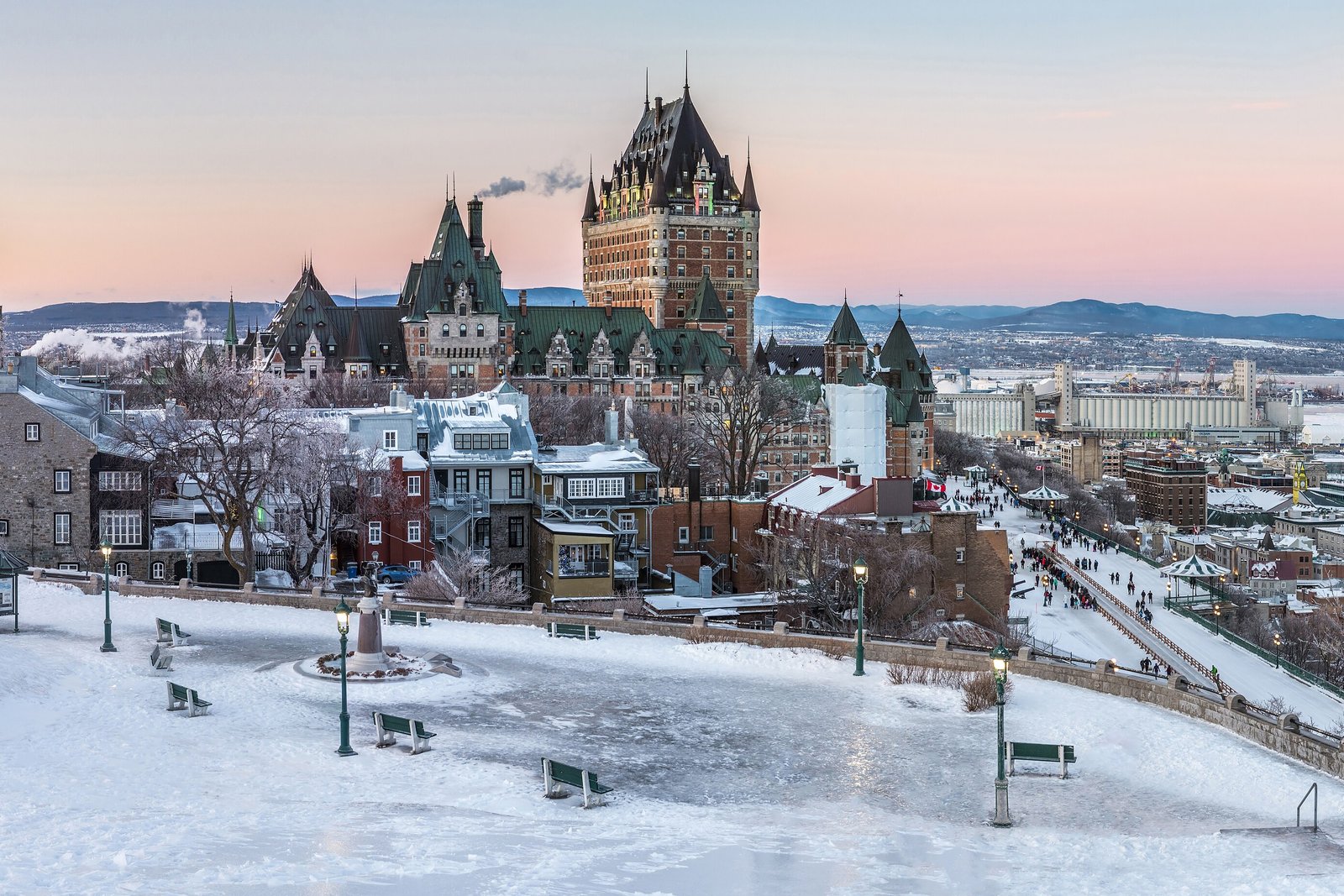
A gate in a stone wall, and on the other side a street climbing so steeply that the houses stood on each other’s shoulders. Silver roofs, icicles as long as my arm, a wooden promenade on the edge of a cliff and, far below, a wide grey river carrying ice past a ferry that did not seem bothered. I stayed out until my ears gave up.
The short answer
Quebec City, officially Québec, is the capital of the province of Quebec, on the north shore of the St. Lawrence River where the river narrows. Samuel de Champlain founded a French settlement there on 3 July 1608, on the site of a long-abandoned St. Lawrence Iroquoian village called Stadacona, according to Wikipedia; the city had 549,459 people at the 2021 census, and French is the only mother tongue of 90.6 per cent of them. Its historic district, Old Québec, has two parts: the Upper Town on top of the cliff of Cap Diamant, inside the ramparts, and the Lower Town at its foot around Place Royale. UNESCO inscribed the district on 3 December 1985 and describes Québec as the only North American city to have preserved its ramparts, with the bastions, gates and defensive works that still surround it; Parks Canada says the same. Wikipedia’s wording is narrower: the only fortified city north of Mexico whose walls still exist.
Why it's worth knowing
The walls are there because a city changed its mind. Québec was the principal military stronghold of colonial Canada, and Parks Canada dates its defence system from 1608 to 1871. In 1871 the British garrison left. By the City of Québec’s own account, residents then began getting rid of what they considered pointless obstacles: the Porte Saint-Louis was the first part of the fortifications to be removed, followed by three more of the five narrow gates that controlled the way into the city.
Lord Dufferin, appointed governor general of Canada in 1872, arrived with the demolition already under way. The city’s account says he considered the fortifications one of its architectural gems and sent for an Irish architect, a specialist in rebuilding medieval military works, to draw up a plan to save and embellish them. Parks Canada calls it an early example of urban heritage conservation. The bargain was practical: residents wanted easier movement between the old town and the new, so the gates were rebuilt wider, as decorative arches, and new gates would let a walkway run all the way round the top of the walls.
So the walls are old and the gates are not. Parks Canada gives the current Porte Saint-Louis as built between 1878 and 1881 and the Porte Saint-Jean between 1938 and 1939; Parks Canada itself rebuilt the Prescott Gate in 1983 to carry the walkway over the Côte de la Montagne. Québec’s tourism office dates the Kent Gate, cut through the wall at the end of Rue Dauphine, to the same work that began on the new Porte Saint-Louis in 1878.
The field notes
A terrace older than the hotel
The broad boardwalk along the cliff edge, the Terrasse Dufferin, was built under Dufferin’s direction and named for him; Wikipedia records its inauguration on 28 June 1879 by his successor, the Marquess of Lorne, and Princess Louise. Parks Canada notes that it is older than the Château Frontenac, the railway hotel designed by Bruce Price that has stood over it since 1893. Beneath the boards lie the remains of the Saint-Louis forts and the Château Saint-Louis, the residence of the French and then the British governors, visible through skylights in the terrace. At its southern end, a toboggan slide dating from about 1898 runs every year during the winter carnival.
The fortress on the hill
The Citadelle, the fortress on the highest part of Cap Diamant, was built between 1819 and 1831 to plans by the British military engineer Elias Walker Durnford, who, Parks Canada says, designed it to withstand a long siege on its own. Wikipedia describes it as still a Canadian Forces installation and an official residence of the governor general. Beyond it lie the Plains of Abraham, where in 1759 the British took the city from France.
Two towns and a staircase
The Upper and Lower Towns are joined by stairways, one of them called the Escalier casse-cou, the breakneck stairs, and by a funicular from the Terrasse Dufferin down to Rue du Petit-Champlain, by Wikipedia’s account. Place Royale in the Lower Town is the site of Champlain’s first settlement; its church, Notre-Dame-des-Victoires, was begun in 1687. Parks Canada gives the ramparts as 4.6 kilometres long and says that when they really defended the town the defensive works were more than 75 metres wide.
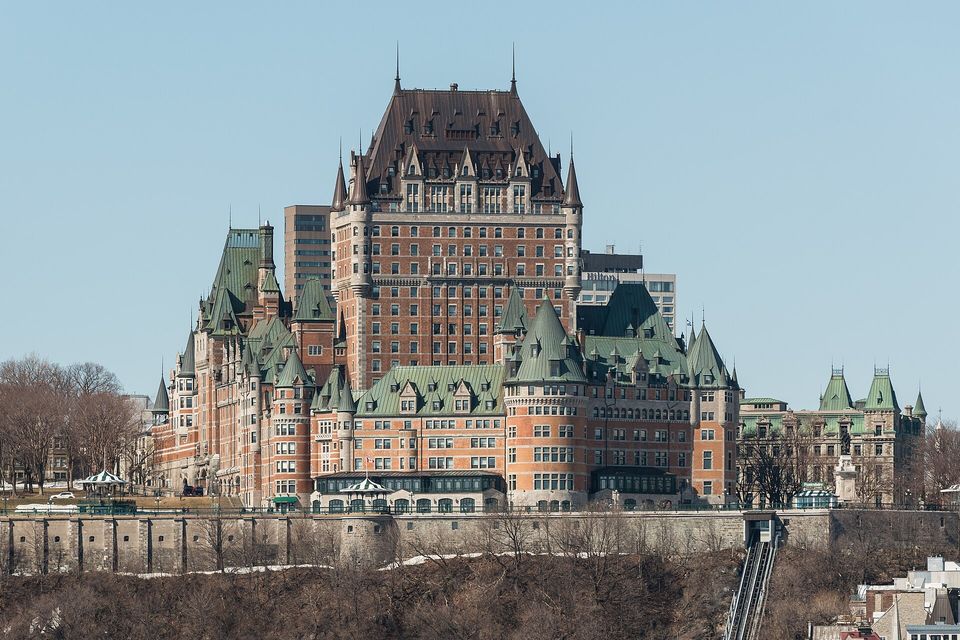
Château Frontenac on the edge of the cliff above the St Lawrence, with the funicular at right, seen from Lévis in April 2017.
Photograph: DXR · CC BY-SA 4.0 · cropped
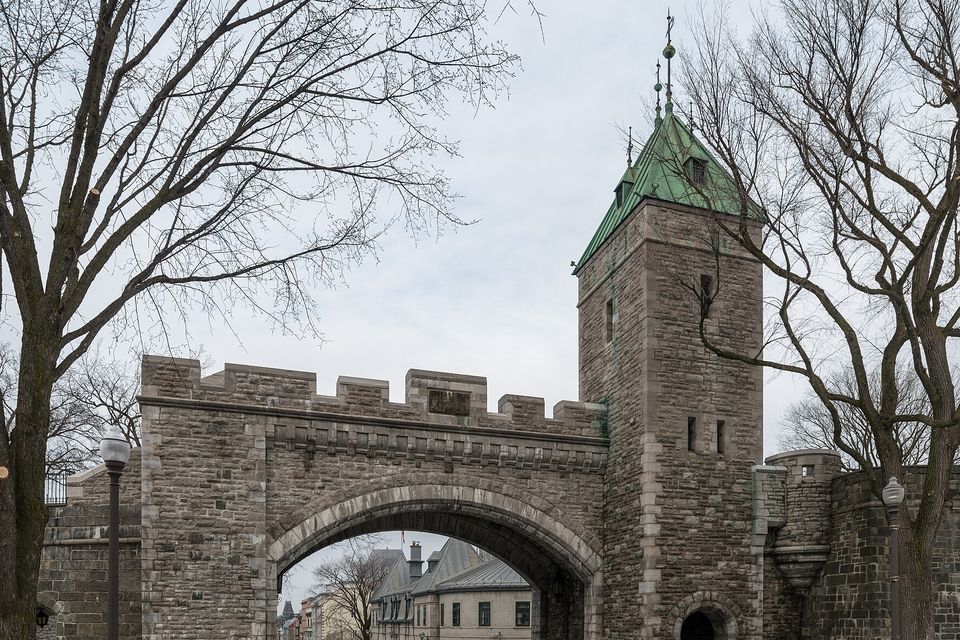
Porte Saint-Louis, built between 1878 and 1881 as a wider, decorative gate after the city chose to keep its walls, April 2017.
Photograph: DXR · CC BY-SA 4.0 · cropped
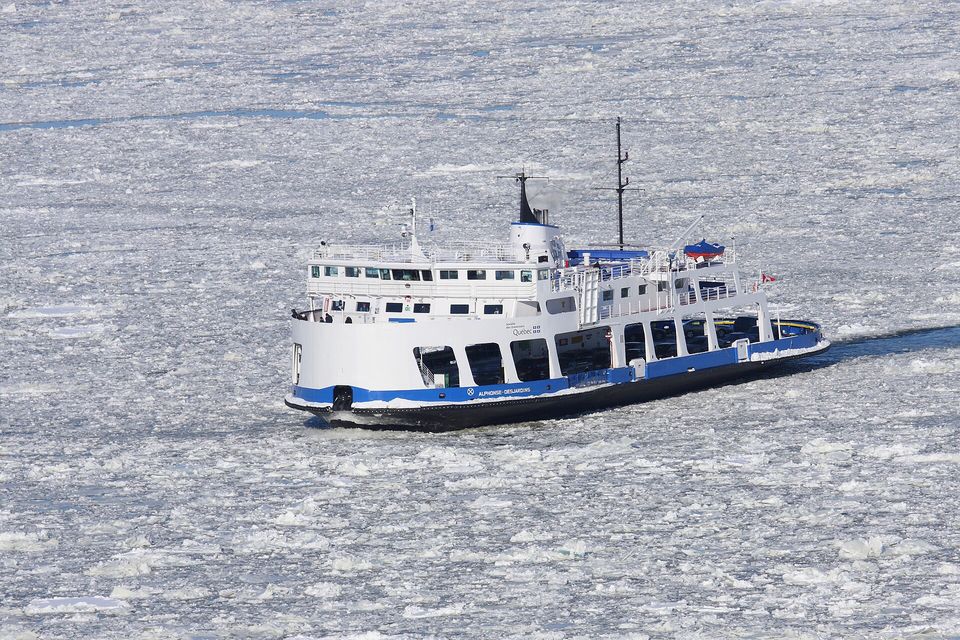
The Lévis ferry crossing the ice-filled St. Lawrence below the city, March 2011.
Photograph: Cephas · Alphonse-Desjardins · CC BY-SA 3.0
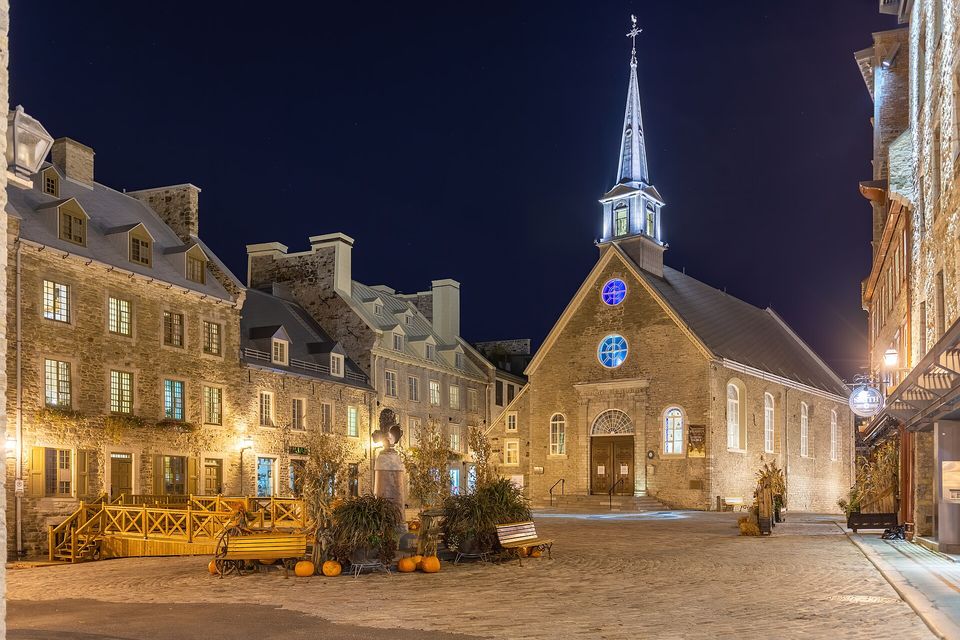
Place Royale in the Lower Town at night, with the church of Notre-Dame-des-Victoires, begun in 1687.
- Walk the walls from end to end, and go through every gate twice, once in each direction.
- Say good morning in the language of the street before anything else, and let them see you tried.
- Go down the stairs with the alarming name and come back up on the little railway, without shame.
- Cross the river on the ferry and look back at the cliff with the whole old town sitting on top of it.
- Write the list indoors, beside a radiator. Out on the terrace the pencil stopped working, and so, shortly afterwards, did I.
The Porte Saint-Louis. A stone gate where Rue Saint-Louis passes through the walls, one of the main ways between the old town and the new. The first gate on the spot was the first piece of the fortifications that residents pulled down after the British garrison left in 1871. The one standing there now was built between 1878 and 1881 under Lord Dufferin’s plan, wide enough for the traffic that had wanted the old one gone and handsome enough that nobody would want this one gone again. It guards nothing; the walkway along the walls passes over it.
Tally, in the marginA gate built for a city that had nothing left to keep out, so it only ever learned the half of the job that lets people in. I have met doormen like that, and they are always the best ones.
Getting there
How to get there. Québec’s Jean Lesage International Airport is about 16 km from the old town, by Wikipedia’s figure. VIA Rail runs regular trains from Montréal, via Drummondville, to the Gare du Palais at the foot of the Upper Town. A ferry crosses the St. Lawrence to Lévis on the south shore, and the old town is best seen on foot.
The walls. Stairs lead up onto the walkway along the top of the ramparts, and Parks Canada runs the Fortifications of Québec National Historic Site, with guided tours in season. Check its pages for current hours and fees.
When to go. Summer for the walls and the terrace; late January to mid-February for the winter carnival, when, by Wikipedia’s account, the toboggan slide on the Terrasse Dufferin is running.
Safety. The State Department has Canada at Level 1, exercise normal precautions, with no area-specific warnings.
Mark this place
Common questions
Is Quebec City the only walled city in North America?
UNESCO and Parks Canada describe Québec as the only city in North America to have preserved its ramparts, together with its bastions, gates and defensive works. Wikipedia puts it more narrowly, as the only fortified city north of Mexico whose walls still exist. The ramparts of Old Québec are 4.6 km long, by Parks Canada’s figure.
Who saved the walls of Quebec City?
Lord Dufferin, governor general of Canada from 1872 to 1878, stopped the demolition of Québec’s fortifications, which had begun after the British garrison left in 1871. By the City of Québec’s account he sent for an Irish architect to plan their preservation, and Parks Canada calls it an early example of urban heritage conservation.
How old are the gates of Quebec City?
Most of the gates in Québec’s walls are younger than the walls themselves. Parks Canada dates the present Porte Saint-Louis to 1878–1881 and the Porte Saint-Jean to 1938–1939, and Parks Canada rebuilt the Prescott Gate in 1983. The older, narrower gates were pulled down in the 1870s to ease traffic.
When was Quebec City founded?
Samuel de Champlain founded a French settlement at Québec on 3 July 1608, on the site of the abandoned St. Lawrence Iroquoian village of Stadacona. It is one of the oldest European settlements in North America, and its Place Royale, in the Lower Town, marks the site of Champlain’s first building.
When did Old Quebec become a World Heritage Site?
UNESCO inscribed the Historic District of Old Québec as a World Heritage Site on 3 December 1985. The district includes the Upper Town on Cap Diamant, inside the ramparts, and the Lower Town at the foot of the cliff; the province had declared it a historic district in 1963.
What is the Terrasse Dufferin?
The Terrasse Dufferin is a boardwalk along the cliff edge in Québec’s Upper Town, built under Governor General Lord Dufferin and inaugurated on 28 June 1879. Parks Canada notes it is older than the Château Frontenac beside it. The remains of the Saint-Louis forts and governors’ château lie beneath it.
How do you get from Montreal to Quebec City?
VIA Rail runs regular trains from Montréal to Québec’s Gare du Palais, below the Upper Town, by way of Drummondville. Québec’s Jean Lesage International Airport is about 16 km from the old town, and a ferry links the city with Lévis across the St. Lawrence.
Is Quebec City safe to visit?
The U.S. State Department has Canada at Level 1, exercise normal precautions, its lowest level, with no area-specific warnings (advisory reissued 11 June 2025).