
Part of Canada
- Where
- Rocky Mountains of Alberta,
west of Calgary - Coordinates
- 51.1784° N
115.5708° W - Area
- 6,641 km²;
began as a 26 km² reserve - Founded
- Hot Springs Reserve 1885;
Rocky Mountains Park 1887 - Resident
- Banff Springs snail,
endangered, in fewer than five springs - Status
- UNESCO World Heritage, 1984,
Canadian Rocky Mountain Parks - Best visited
- June to September for lakes;
winter for snow
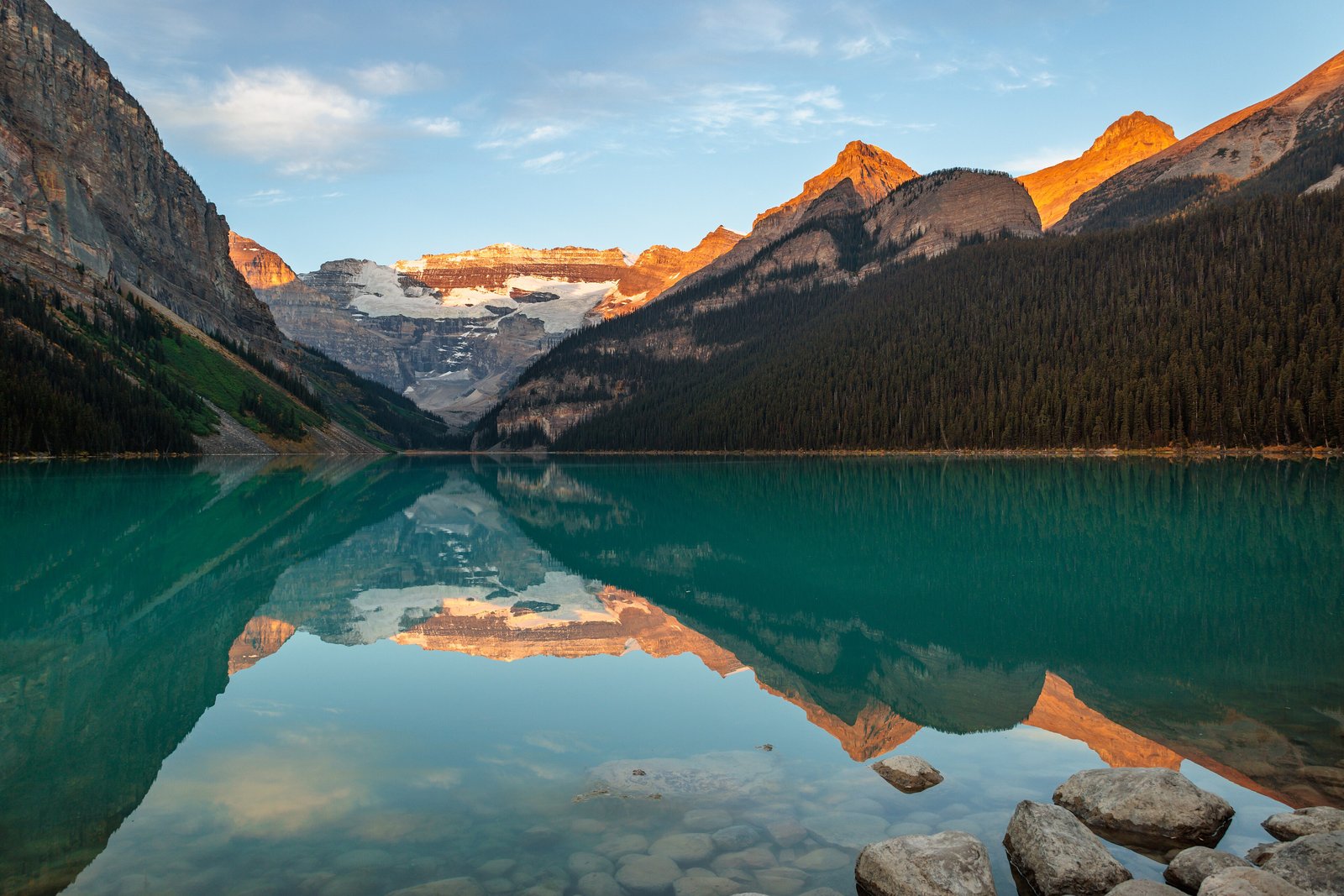
A town of wooden shops under grey mountains with snow on their shoulders, and a deer the size of a horse eating the grass outside the post office. Sat in a hot pool on a mountainside while it snowed on my head. Then a lake so green and blue it looked lit from underneath, and I forgot to take my hands out of my pockets.
The short answer
Banff National Park covers 6,641 square kilometres of the Rocky Mountains in Alberta, beginning about 110 kilometres west of Calgary, with the towns of Banff and Lake Louise inside it. Parks Canada calls it Canada’s first national park. It grew from a 26-square-kilometre Hot Springs Reserve set aside in 1885 around the Cave and Basin springs, which the Rocky Mountains Park Act of 23 June 1887 enlarged to 665 square kilometres. With Jasper, Yoho, Kootenay and three provincial parks it forms the Canadian Rocky Mountain Parks World Heritage Site, inscribed in 1984. The park lies in Treaty 7 territory, and Parks Canada records that the lands and waters were used for millennia by Indigenous peoples for sustenance, ceremony, trade and travel.
Why it's worth knowing
Canada’s national parks started as an argument about who owned a bath.
In 1883 two brothers, William and Tom McCardell, and a fellow Canadian Pacific Railway worker, Frank McCabe, wrote to the government claiming the hot springs at what is now the Cave and Basin. Parks Canada’s account is that the government, which needed revenue to finish the railway and saw what medicinal waters could do for tourism, denied the claim. Other claimants appeared, the dispute went legal, and in 1885 the government settled it by reserving 26 square kilometres around the springs. Two years later the reserve became Rocky Mountains Park, the first national park in Canada.
The water that started it all is now off limits. The Cave and Basin is the main home of the Banff Springs snail, Physella johnsoni, listed as Endangered under the Species at Risk Act. The federal species assessment confines it to the upper reaches of fewer than five thermal springs on Sulphur Mountain, most of the surviving snails at the Cave and Basin, and names soaking, swimming, trampling and dipping hands and feet as threats recorded at every site. Since 2002 a superintendent’s order has closed the springs and their outflow streams at the Cave and Basin to entry. The bath that people fought to own in 1883 now belongs, in effect, to a snail with a shell no longer than 11 millimetres.
People who want to soak still can: the Banff Upper Hot Springs, about five kilometres away on the same mountain, is a public pool run by Parks Canada.
The field notes
The snail
The Banff Springs snail is a small aquatic snail with a globe-shaped shell that coils to the left, up to about 11 millimetres long in living animals by the federal status report’s measurements. It lives only in the warm water of the springs and their outflow streams. Snails as small as three millimetres can already breed.
Its threats are local and physical: people climbing into the springs, and the springs themselves drying. The federal assessment notes that springs have run dry more often in recent years and links this to climate change. Parks Canada fences and signs the habitat, watches it, and prosecutes under the Canada National Parks Act when people go in; the recovery report for 2018 to 2022 records fewer incursions and fewer prosecutions as awareness has grown.
The cave, the basin and the pool
The Cave and Basin is the lowest of a group of sulphur springs on the flank of Sulphur Mountain, heated from an estimated three kilometres down. Wikipedia’s account says the railway workers first climbed down into the cave through its skylight on a felled tree; a tunnel was driven in for visitors in 1886. A bathhouse followed, then a naturally heated swimming pool, and the pools stayed open to swimmers for most of the twentieth century. Wikipedia gives both 1992 and 1994 for their final closure. The buildings are now the Cave and Basin National Historic Site, with exhibits on the springs and the park.
From 1915 to 1917 the Cave and Basin was also the site of an internment camp. During Canada’s first national internment operations, from 1914 to 1920, immigrants from countries at war with Canada, many of them Ukrainian, were held in camps, and Parks Canada records that the Banff camp moved from Castle Mountain to the Cave and Basin in November 1915 and closed in July 1917. Wikipedia records that internees built many of the early structures at the site. A Parks Canada exhibit beside it tells their story.
Whose mountains
Parks Canada places the park within the territories of Treaties 6, 7 and 8 and the Métis homeland, with its main part in Treaty 7, signed in 1877 by the Siksika, Piikani and Kainai of the Blackfoot Confederacy, the Stoney Nakoda and the Tsuut’ina. It describes the Cave and Basin as a sacred and spiritual place where people have gathered for generations and where ceremonies are still held.
The park’s founding closed the land to them. Parks Canada records that hunting by Indigenous peoples was prohibited from 1890, and that together with other federal policies this kept them from travelling, harvesting and practising their culture in the park; Wikipedia records the Stoney Nakoda being removed from it between 1890 and 1920. Since 2018 the Banff Indigenous Advisory Circle, made up of the Treaty 7 Nations and the Métis Nation, has advised Parks Canada.
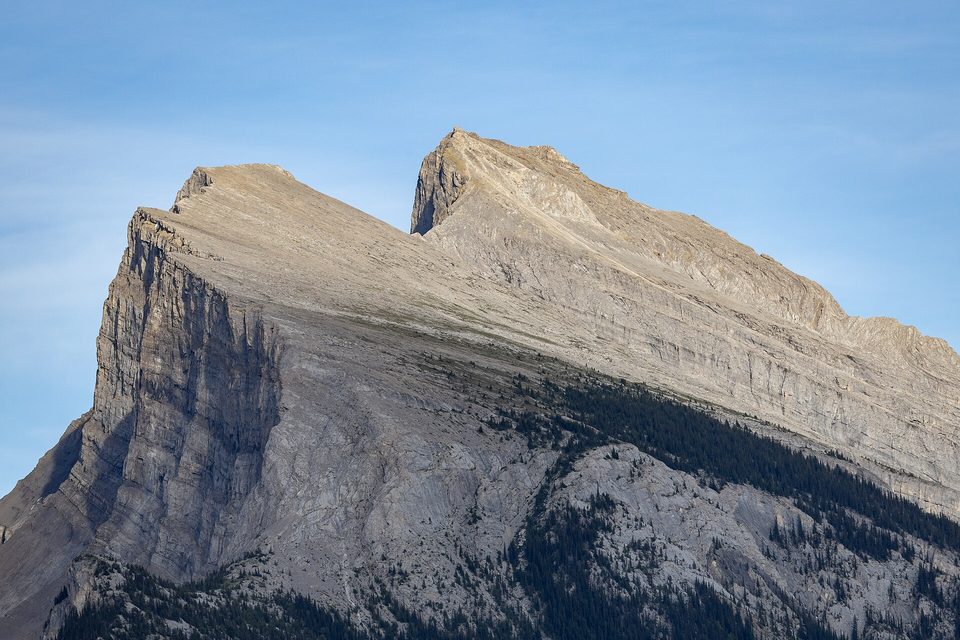
Mount Rundle from the Vermilion Lakes viewpoint, July 2025.
Photograph: Chris Woodrich · CC BY-SA 4.0 · cropped
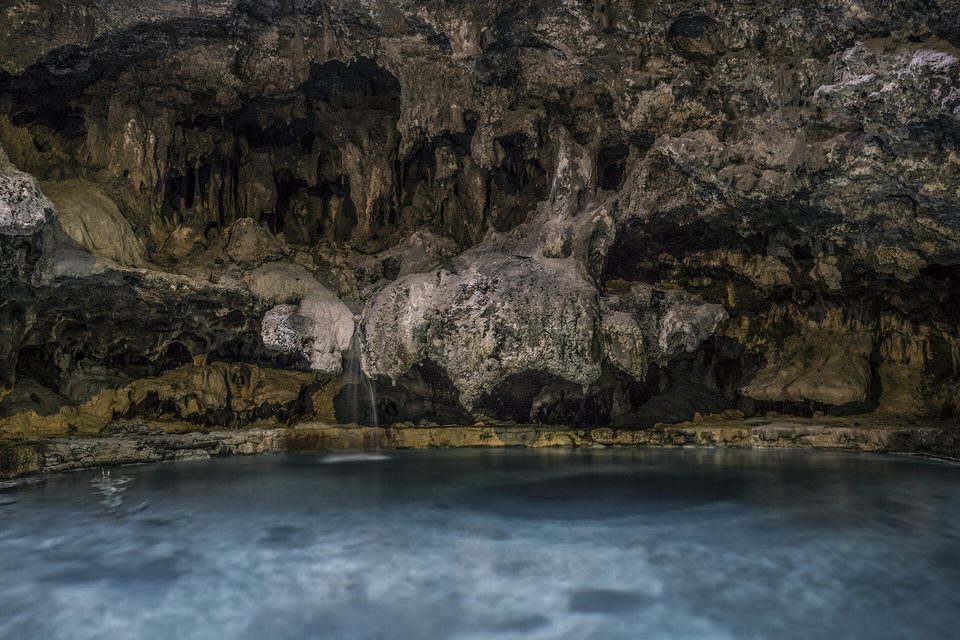
Inside the Cave and Basin, where three railway workers claimed the hot springs in 1883.
Photograph: Sovernigo · CC BY-SA 4.0 · cropped
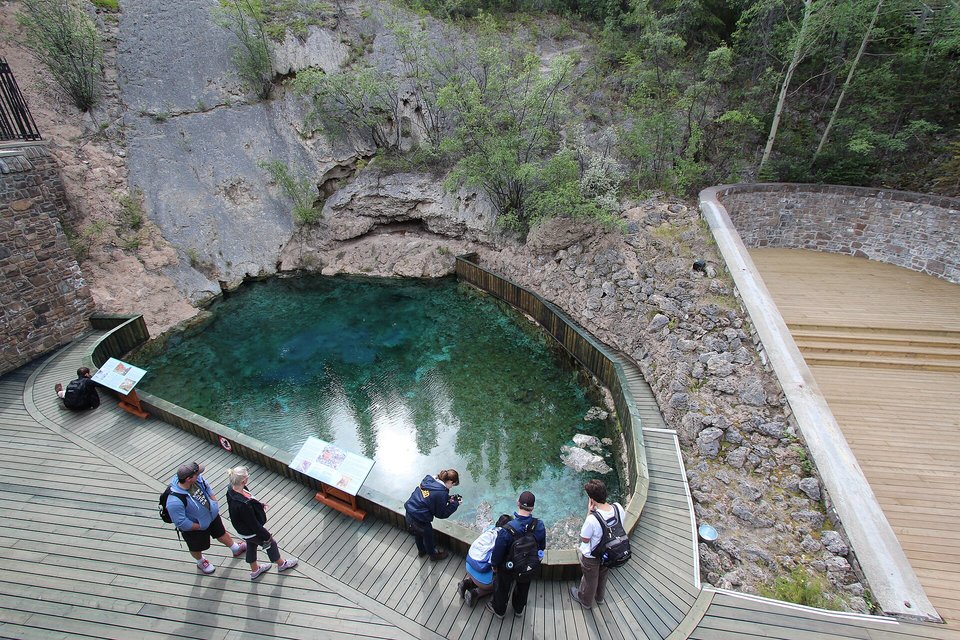
The Basin, the natural hot spring at the Cave and Basin where the endangered Banff Springs snail lives; bathing is prohibited, August 2013.
Photograph: davebloggs007 · Cave and Basin Banff Alberta the birthplace of parks Canada (9534328912) · CC BY 2.0
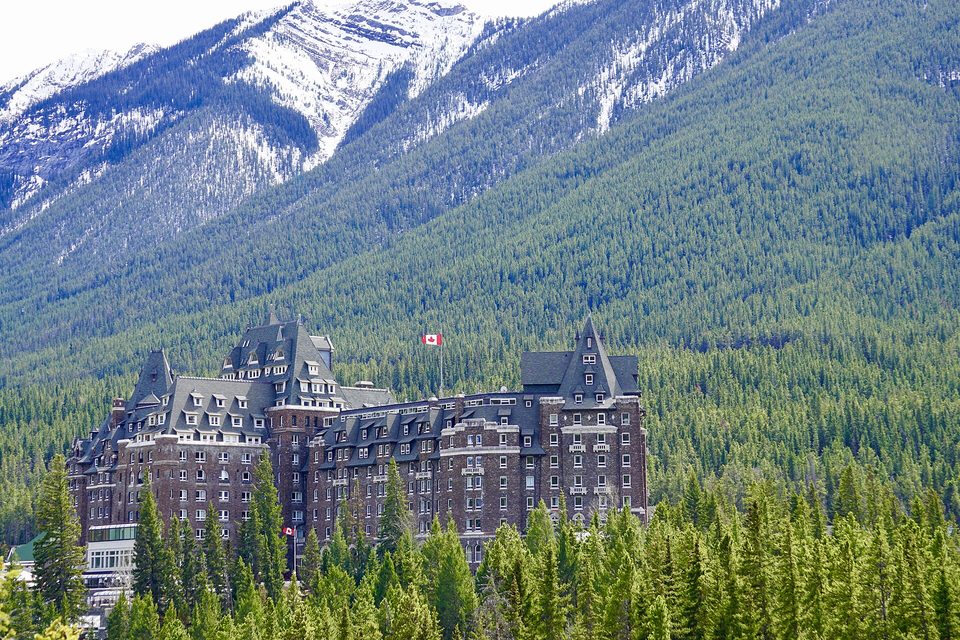
The Fairmont Banff Springs hotel, May 2017.
Photograph: Dylannother · CC BY-SA 4.0 · cropped
- Get to the lake at first light, before anybody else wakes it up.
- Soak in the pool that allows soaking, and leave the other springs to their residents.
- Give the big deer the whole lawn. They are not ornaments.
- Find out whose mountains these were before they were a park, and say thank you in their direction.
- Pick a favourite lake. (Revised at the next lake to: one favourite per day. Revised again before lunch.)
A Banff Springs snail. A small snail, its shell no longer than 11 millimetres and coiling to the left, living in the warm outflow of a handful of sulphur springs on Sulphur Mountain and nowhere else on Earth. Most of the survivors are in the springs at the Cave and Basin, the place where Canada’s national parks began, and the whole spring system there is closed to people for their sake. You will probably not see one. The water where they live is the water railway workers tried to claim in 1883.
Tally, in the marginA warm pool people once fought to own, and now nobody may dip so much as a finger in it, for the sake of a snail the size of a crumb. I had been admiring the mountains all morning.
Getting there
How to get there. Calgary International Airport is the usual gateway. The town of Banff is about 128 kilometres west of Calgary by the Trans-Canada Highway, which runs on through the park to Lake Louise and into British Columbia. Everyone stopping in the park needs a Parks Canada pass, daily or the annual Discovery Pass.
Lake Louise and Moraine Lake. Moraine Lake Road is closed to personal vehicles all year. From 1 June to 12 October 2026, Parks Canada shuttles run from the Lake Louise Park and Ride every 30 minutes; every seat must be reserved, and reservations opened on 15 April 2026, with more seats released two days before each departure. Licensed commercial operators also run to Moraine Lake.
The springs. The Cave and Basin National Historic Site, at the edge of the town, is open to visitors, but the springs and their streams are closed to entry to protect the snail. Soaking is at the Banff Upper Hot Springs, a public pool on Sulphur Mountain.
When to go. The Moraine Lake shuttle season, June to mid-October, is a fair guide to when the high lakes are open, and midsummer is the busiest time. Winter brings skiing and frozen lakes. Elk and bears are wild at every season: keep the distances Parks Canada posts.
Mark this place
Common questions
Why is Banff Canada's first national park?
Because of a dispute over hot springs. In 1883 Canadian Pacific Railway workers William and Tom McCardell and Frank McCabe claimed the Cave and Basin springs at Banff; the government refused and, in 1885, reserved 26 square kilometres around them. The Rocky Mountains Park Act of 23 June 1887 enlarged the reserve to 665 square kilometres as Rocky Mountains Park, Canada’s first national park, now Banff National Park.
Can you swim at the Cave and Basin in Banff?
No. The springs and outflow streams at the Cave and Basin National Historic Site in Banff have been closed to entry by a superintendent’s order since 2002, to protect the endangered Banff Springs snail, which lives there and in only a few other springs on Sulphur Mountain. Visitors who want to soak can use the Banff Upper Hot Springs, a public pool run by Parks Canada.
What is the Banff Springs snail?
The Banff Springs snail, Physella johnsoni, is a small aquatic snail with a left-coiling shell up to about 11 millimetres long, found only in fewer than five thermal springs on Sulphur Mountain in Banff National Park, most of them at the Cave and Basin. It is listed as Endangered under Canada’s Species at Risk Act; people entering the springs and springs drying are its main threats.
Do you need a reservation to see Moraine Lake in Banff?
Yes, in effect. Moraine Lake Road in Banff National Park is closed to personal vehicles all year. From 1 June to 12 October 2026 Parks Canada runs shuttles from the Lake Louise Park and Ride, and every seat must be reserved; licensed commercial operators are the other way in. Parks Canada opened 2026 reservations on 15 April and releases more seats two days before departure.
Whose land is Banff National Park on?
Parks Canada places Banff National Park within the territories of Treaties 6, 7 and 8 and the Métis homeland, with most of it in Treaty 7, signed in 1877 by the Siksika, Piikani and Kainai, the Stoney Nakoda and the Tsuut’ina. Indigenous hunting in the park was banned from 1890. The Banff Indigenous Advisory Circle has advised Parks Canada since 2018.
What happened at the Cave and Basin during the First World War?
During Canada’s first national internment operations of 1914 to 1920, the internment camp for Banff National Park moved from Castle Mountain to the Cave and Basin in November 1915 and closed in July 1917, according to Parks Canada. Internees, many of them Ukrainian immigrants, built some of the park’s early structures. A Parks Canada exhibit beside the Cave and Basin tells their story.
How big is Banff National Park?
Banff National Park covers 6,641 square kilometres of the Rocky Mountains in Alberta, according to Wikipedia. It began in 1885 as a reserve of 26 square kilometres around the Cave and Basin hot springs and became Rocky Mountains Park, 665 square kilometres, in 1887. It is part of the Canadian Rocky Mountain Parks World Heritage Site, inscribed by UNESCO in 1984.
Do you need a pass to visit Banff?
Yes. Everyone stopping in Banff National Park needs a Parks Canada pass, either a daily pass or the annual Discovery Pass, which also covers Jasper, Kootenay, Yoho and several other national parks. The town of Banff is inside the park, about 128 kilometres west of Calgary on the Trans-Canada Highway.