The short answer
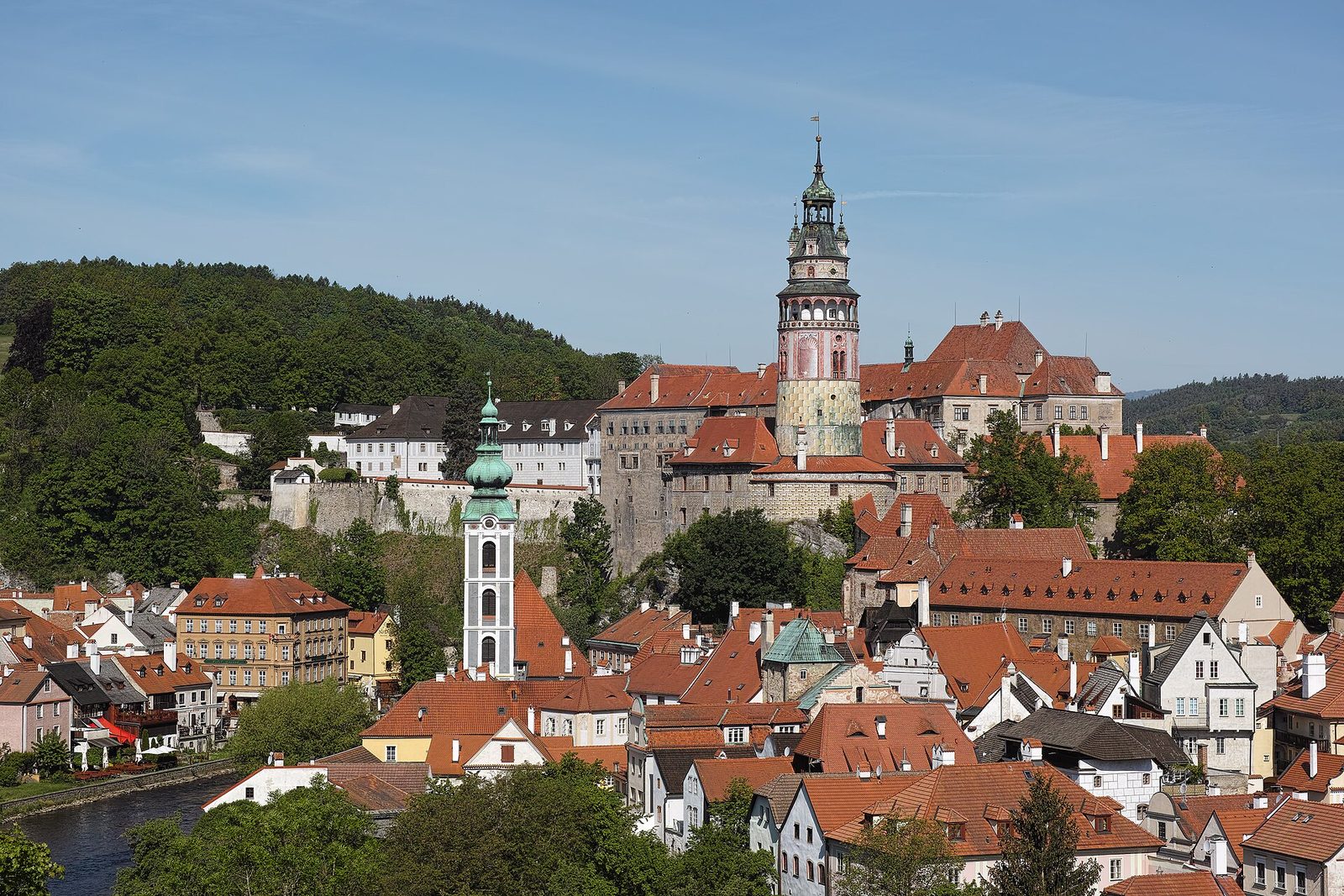
Český Krumlov is a small historic town in South Bohemia, in the south of Czechia, about 112 miles from Prague. It sits in the S-shaped meanders of the Vltava River, at the foot of the Blanský Forest, under a castle on a rocky promontory. About 300 listed buildings crowd its compact center, with Gothic, Renaissance and Baroque houses, many of them painted. The town has been a UNESCO World Heritage Site since 1992.
From Tally’s diary
The river came around the town in a great slow loop and then, having apparently forgotten something, came round it again. Red roofs packed tight inside the bend, and high over all of it a tall painted tower that I took at first for a wedding cake. Boats drifted under the walls with people singing in them. Somewhere below a bridge, a bear was asleep.
Why it's worth knowing
The lords of the five-petaled rose. The Lords of Krumlov founded the first Gothic castle here before 1250, under a coat of arms with a five-petaled rose. Their cousins the Rosenbergs inherited it in 1302 and made it their seat for three centuries. Under them the castle became a Renaissance palace and the town took most of the shape it still has. The last Rosenberg, Petr Vok, sold the estate to Emperor Rudolf II in 1602. The Eggenbergs came next, then the Schwarzenbergs in 1719, who gave the town its Baroque look. Since the 19th century almost nothing has changed except the loss of the town walls and gates.
A theater that never threw anything away. At the end of the 17th century the Eggenbergs built a theater inside the castle. It survives with its original building, orchestra pit, stage and machinery, and with hundreds of costumes, sets, props, lighting and librettos. It is the best-preserved Baroque theater in Europe. It is shown only on guided tours in the warmer months, and used for performances only at selected festivals.
The towerest of all towers. The round Castle Tower rises six stories over the river, on a narrow rock between the first and second courtyards. It began in the 13th century, gained an arcaded gallery at the top in 1581 and was covered in painted murals in 1590. Its bell is dated 1406. The writer Karel Čapek called it “the towerest of all towers”. A climb of 162 steps reaches the gallery and the view of the whole town.
The field notes
Bears in the moat
The Rosenbergs liked to claim kinship with the great Italian family of Orsini, whose name sounds like orsa, Italian for she-bear. So bears hold up the Rosenberg coat of arms on the castle walls. Real bears have lived in the moat below the castle bridge, on and off, since at least 1707, when four were kept there. Today the moat is home to Marie Terezie, Polyxena and Vilém. Early on Christmas Eve, their keeper and his helpers fill the moat with small trees hung with fruit and sweets, and at about ten the bears are let out to their feast.
The magic table
The castle is a whole small town of its own, with forty buildings, five courtyards and about 17 acres (7 hectares) of gardens. In the garden stands the Bellaria, a Rococo summer house. Under it is a Baroque kitchen with two 18th-century lifts. One carried food up three floors to the hall. The smaller one, called the “magic table”, brought dishes up to be arranged before they went in to dinner.

September 2011The river bend and the old town from the castle terrace.
Photograph: Jorge Valenzuela A, Cesky Krumlov 080, CC BY-SA 3.0, cropped

March 2010The Castle Tower close up: painted panels, an arcaded gallery, a clock and gilded weather vanes.
Photograph: Txllxt TxllxT, CC BY-SA 4.0

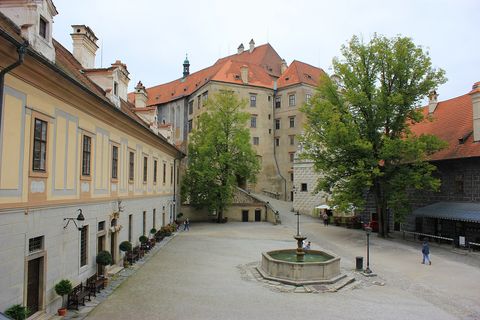
September 2011A castle courtyard with its fountain.
Photograph: Jorge Valenzuela A, Cesky Krumlov 117, CC BY-SA 3.0
- Climb the painted tower and pick out your own window from the top. (Picked out several. None of them was mine. Kept them all.)
- Greet the bears quietly from the bridge. It is their home, and they did not send for visitors.
- Find the old theater and listen hard for the machinery. (Heard nothing. Felt watched by the scenery.)
- Stay the night. The lanes are a different town once the tour buses have gone home.
- Watch the boats come around the bend from the castle wall. (One came around twice. I think it was lost. I think it was happy.)
A relic from Český Krumlov

Relic, entry 369A five-petaled roseHeld up by bears
The Rosenberg rose. A five-petaled rose on a silver shield, held up on either side by a bear. The rose was the sign of the lords of Rosenberg, and their castle is decorated with it.
Tally, in the marginI had walked under several of them before I noticed the bears holding them up. They had been at it for a very long time, and nobody had thought to thank them, so I did.
Getting there
- 1
By bus
Buses from Prague take about three hours, some changing at České Budějovice.
- 2
By train
The train from Prague takes four to five hours, with a change at České Budějovice.
- 3
The last leg
From České Budějovice the last leg takes about 45 minutes.
- ✓
How to get there. Český Krumlov is about 112 miles (180 km) from Prague and 14 miles (22 km) from České Budějovice. Buses from Prague take about three hours, some direct and some changing at České Budějovice. By train, the journey from Prague takes four to five hours with a change at České Budějovice, and the last leg takes about 45 minutes. Linz, in Austria, is about 43 miles (70 km) away.
When to go. The castle’s guided tours and the Baroque Theater open from spring to fall. The Castle Tower, the Castle Museum and the castle courtyards are open all year.
Getting around. The historic center is compact, with the castle high above it. The town information center on the main square, Svornosti Square, gives out free maps.
Mark this place
The passport stamp for this place.
Common questions
Why is it called Český Krumlov?
Because of the river’s bend. The name Krumlov comes from the German “Krumme Aue”, a crooked meadow, after the S-shaped loops of the Vltava in which Český Krumlov stands.
Are there really bears at Český Krumlov Castle?
Yes. Bears have lived in the moat of Český Krumlov Castle on and off since at least 1707, a tradition tied to the Rosenbergs’ claimed kinship with the Orsini family. Today’s bears are Marie Terezie, Polyxena and Vilém.
How far is Český Krumlov from Prague?
About 112 miles, or three hours by bus. Český Krumlov is 112 miles (180 km) south of Prague; trains take four to five hours with a change at České Budějovice.
When did Český Krumlov become a World Heritage Site?
On December 4, 1992. Český Krumlov was one of the first three towns in Czechia added to the UNESCO World Heritage List, for its almost unchanged historic townscape.
What is the Baroque Theater at Český Krumlov?
A 17th-century theater that survived complete. The Baroque Theater at Český Krumlov Castle keeps its original stage, orchestra pit, machinery, sets and costumes, and is seen on guided tours from May to October, except Mondays.
How big is Český Krumlov Castle?
The second-largest castle complex in Czechia. Český Krumlov Castle has forty buildings around five courtyards and about 17 acres of gardens, and has been a National Cultural Monument since 1989.
How many steps are in the Český Krumlov Castle Tower?
162. The painted Castle Tower of Český Krumlov, six stories tall, is climbed by 162 steps to a gallery added in 1581, and is open all year with a Castle Museum ticket.
Who were the Rosenbergs?
The lords of Český Krumlov for three centuries. The Rosenberg family, with its five-petaled rose, inherited Český Krumlov in 1302 and held it until Petr Vok sold it to Emperor Rudolf II in 1602.
Photographs on this page
Tap a photograph to see it full size.
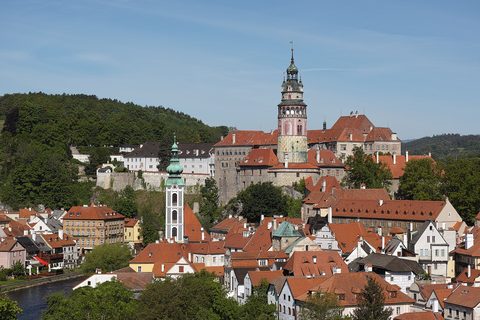
Photograph: Xth-Floor, CC BY-SA 4.0, cropped
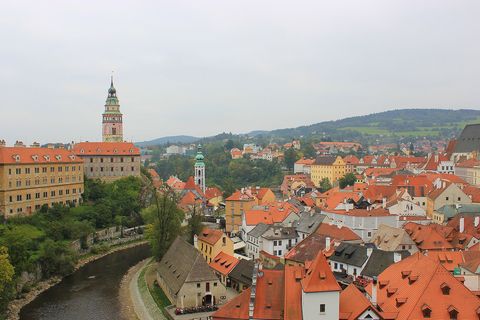
Photograph: Jorge Valenzuela A, Cesky Krumlov 080, CC BY-SA 3.0, cropped
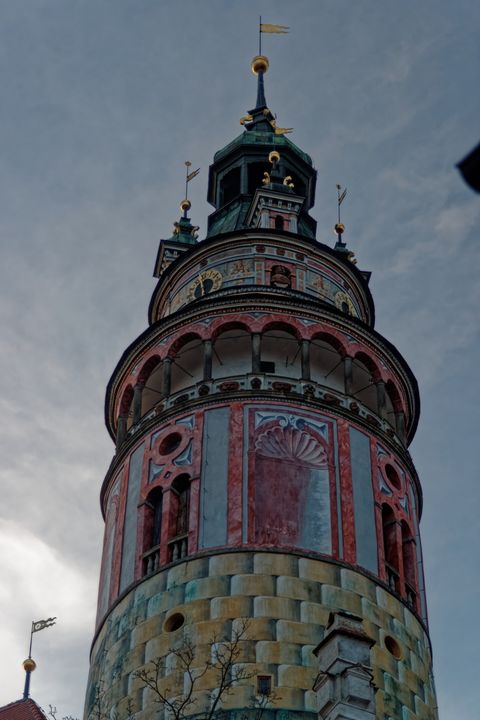
Photograph: Txllxt TxllxT, CC BY-SA 4.0
Photograph: Jorge Valenzuela A, Cesky Krumlov 117, CC BY-SA 3.0




