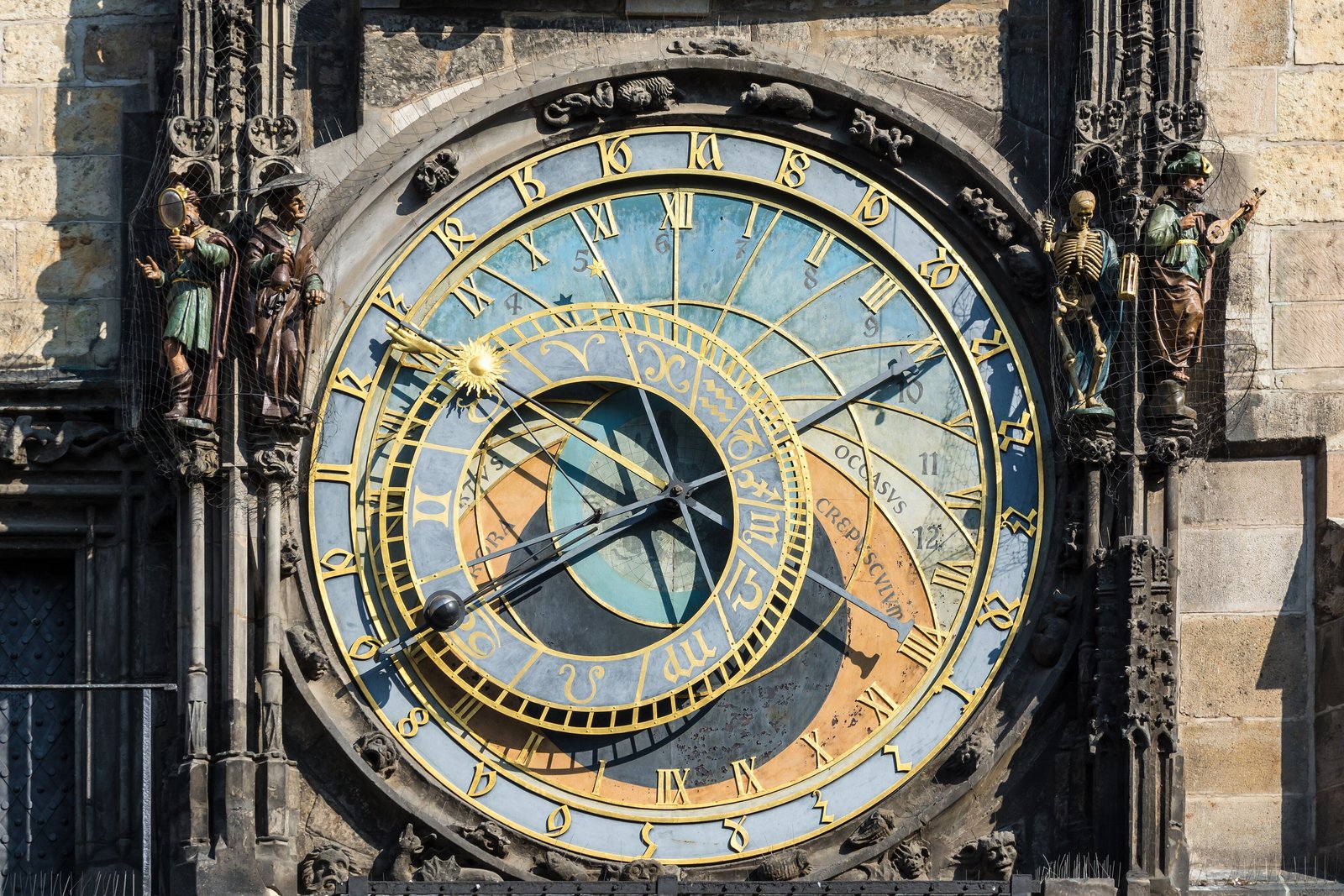

- Where
- Old Town Hall, Old Town Square
Prague 1 - Coordinates
- 50.0870° N
14.4209° E - First recorded
- 9 October 1410
(per Wikipedia) - Makers
- Mikuláš of Kadaň
Jan Šindel - The show
- Hourly, 9:00–23:00
(Prague City Tourism) - Town hall
- Established 1338
(Prague City Tourism) - Advisory
- Czechia Level 1
A square of painted housefronts and dark spiky spires, cobbles underfoot, and a crowd all facing one old tower as the hour came round. A little skeleton pulled a bell rope. Two small windows opened and carved figures went by in a slow procession, and a gold bird crowed at the end. Everyone clapped and hurried off. I bowed to the skeleton, since nobody else had.
The short answer
Prague is the capital of the Czech Republic, on the Vltava, and its Old Town Square has been the heart of the Old Town since the Middle Ages; the historic centre has been a UNESCO World Heritage Site since 1992. On the Old Town Hall, established in 1338, the Gothic tower carries the Orloj, the astronomical clock: an astronomical dial showing the Sun and Moon against the sky, a calendar dial beneath it, and, every hour from 9:00 to 23:00 by Prague City Tourism’s account, a procession of the twelve apostles in two windows above. Prague City Tourism names its makers as the royal clockmaker Mikuláš of Kadaň and the university astronomer Jan Šindel, in 1410.
Why it's worth knowing
Prague’s best-known legend belongs to this clock. In the version retold by the novelist Alois Jirásek, and told again on the city’s own tourism site, the councillors had the clockmaker Master Hanuš blinded so that he could never build a finer clock for another city. Hanuš took his revenge by reaching into the mechanism and stopping it, and in Wikipedia’s telling nobody could make it go again for a hundred years.
The records tell a different story. Wikipedia’s account, following the historian Zdeněk Horský, gives the first written mention of the clock as 9 October 1410, and its makers as Mikuláš of Kadaň and Jan Šindel. Jan Růže, called Hanuš, worked on the clock around the end of the fifteenth century; Prague City Tourism says he perfected the mechanism. The idea that he built it came from a report written by the clockmaker Jan Táborský after a repair in 1552, which Horský showed rested on a misreading of the records. Wikipedia calls the attribution to Hanuš a historical mistake. The legend blinded the man who improved the clock, not the men who made it.
The clock has had a harder century than the legend. On 8 May 1945, during the Prague uprising, German armoured vehicles fired on the Old Town Hall; the hall burned, and with it the clock’s wooden figures and the calendar dial then on the tower. Josef Mánes’s original calendar painting of 1865–66 had already been moved to the city museum, where it still is. The machinery was repaired and the Orloj ran again from 1948.
The field notes
What the figures are doing
Beside the dial stand four figures that Wikipedia describes as things despised when the clock was made: Vanity with a mirror, a miser with a bag of gold, Death as a skeleton, and a fourth figure standing for earthly pleasures. On the hour Death rings his bell and the others shake their heads, unready to go. Then the windows above open and the apostles pass, and a gilded rooster, added in 1865–66, crows.
A Moon that turns itself
The Moon on the astronomical dial is a hollow sphere 130 millimetres across, half light and half dark, that travels round the dial and turns to show the phase. The clock’s specialist site, orloj.eu, explains that a hidden weight inside it, pulled down by gravity as the Moon goes round, turns the sphere by two teeth a day, so that it passes through every phase in a lunar month, and says Prague’s solution differs from every other known. Wikipedia dates the mechanism, probably, to the mid-seventeenth century, by a maker nobody has named.
Crosses in the pavement
In front of the Old Town Hall, crosses are set into the paving. They mark the execution on 21 June 1621 of twenty-seven leaders of the Bohemian revolt against the Habsburgs, three lords, seven knights and seventeen burghers, after the Battle of White Mountain. By Wikipedia’s account the crosses were laid during the repairs to the town hall after the Second World War, and some Czechs will not step on them, out of respect.
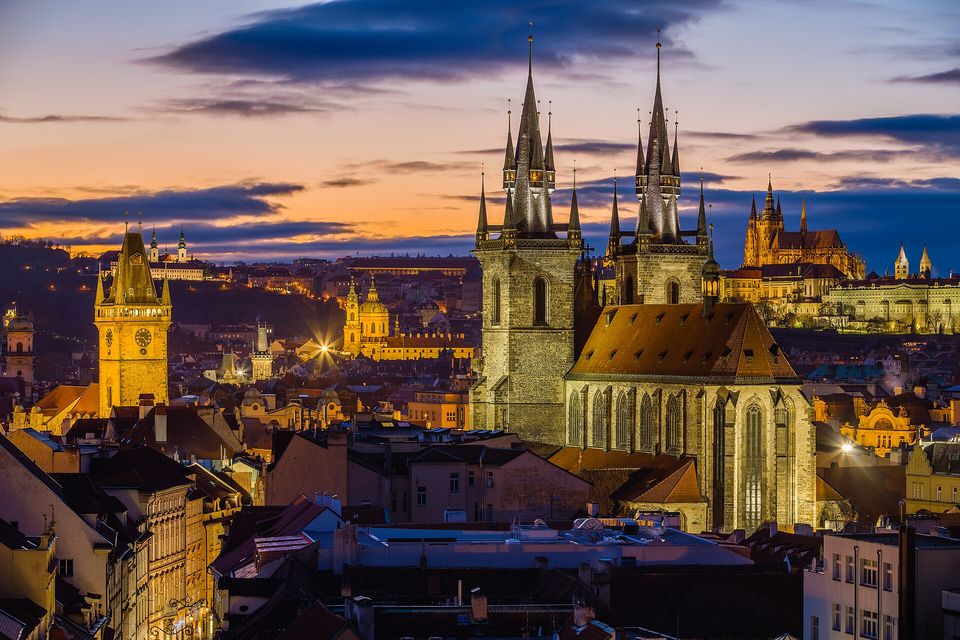
Old Town at blue hour: the Old Town Hall tower at left, the spires of Our Lady before Týn, and the castle on the hill, November 2013.
Photograph: Jiuguang Wang · Prague from Powder Tower 01 · CC BY-SA 2.0
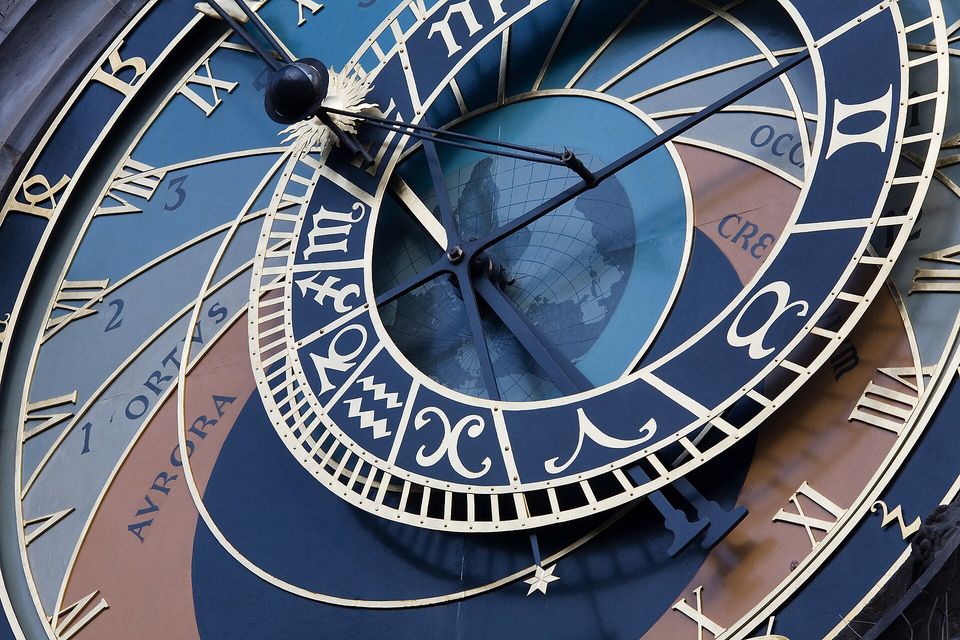
Close in on the dial a day after the new moon, September 2008: the Moon sphere, turned almost wholly dark, rides beside the gilt Sun.
Photograph: Jorge Royan / www.royan.com.ar · The Prague Astronomical Clock in Old Town - 8559 · CC BY-SA 3.0
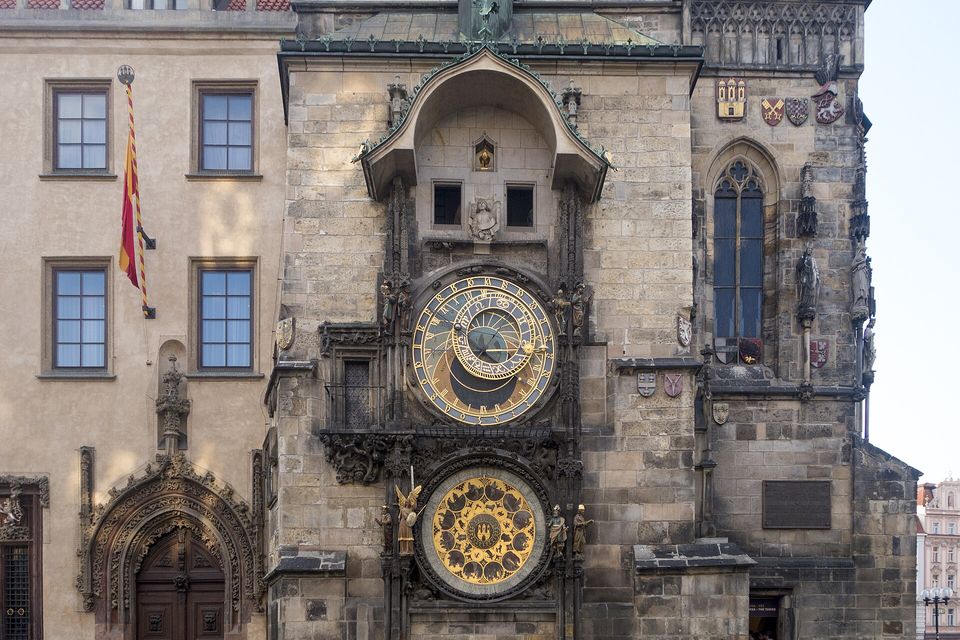
The whole Orloj on the Old Town Hall tower: the apostles' windows, the astronomical dial and the calendar dial below.
Photograph: Jerzy Strzelecki · Prague Astronomical Clock 02b(js) · CC BY-SA 3.0 · cropped
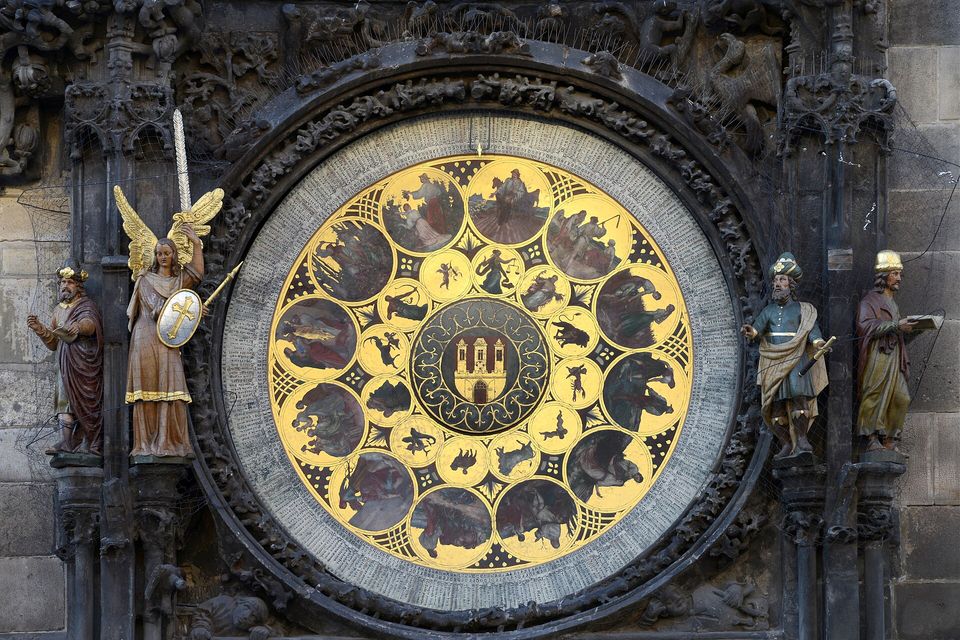
The calendar dial beneath the clock, painted with the months (a copy; Josef Mánes's original of 1865–66 is in the Prague City Museum).
Photograph: Alvesgaspar · CC BY-SA 4.0 · cropped
- Be under the tower on the hour. (Arrived on the hour in the wrong square. The clock very kindly did it all again an hour later.)
- Watch the hour once from the crowd, then once from the far side of the square, where you can see all the faces watching it.
- Find the crosses in the paving in front of the old town hall, and step round them, not on them.
- Stay after the crowd goes and look at the big dial until some of it begins to make sense. Some of it will not, and that is allowed.
- Go up the tower and look down on the roofs, and be back on the square in time for the next hour.
The Moon on the Orloj. A hollow sphere about thirteen centimetres across, half silvered and half black, riding round the astronomical dial on its own arm. Inside it a hidden weight, pulled down by gravity as the Moon travels round, turns the sphere two teeth a day, so that it shows the phase of the Moon in the sky: new, waxing, full and back again. It was probably made in the seventeenth century, by someone nobody has named. On the hour, the crowd below is watching the skeleton.
Tally, in the marginWhile everyone watched the skeleton, the moon went on quietly turning itself by its own weight, and nobody clapped. I have clapped for it now, from the far side of the square, a little late.
Getting there
How to get there. Old Town Square is in the pedestrian heart of Prague’s Old Town, between Wenceslas Square and Charles Bridge, and most visitors reach it on foot. The Old Town Hall’s visitor route takes in the chapel, the historic halls, the underground rooms and the tower; there is a lift to the top, and Prague City Tourism describes the route as barrier-free.
When to go. The apostles appear every hour from 9:00 to 23:00, by Prague City Tourism’s account, and the square is crowded on the hour all day. Prague City Tourism is the only official ticket seller for the Old Town Hall and gives half-price admission in the first hour after opening each day. At Christmas and Easter, markets fill the square.
Safety. The State Department has Czechia at Level 1, exercise normal precautions, with no area notes. Its neighbours Austria, Poland and Slovakia are also Level 1, and Germany Level 2.
Mark this place
Common questions
Who built the Prague astronomical clock?
The Prague astronomical clock was made by the royal clockmaker Mikuláš of Kadaň and the astronomer Jan Šindel, a professor at the Prague university; it is first recorded on 9 October 1410. The clockmaker Jan Růže, called Hanuš, worked on it around the end of the fifteenth century, and Prague City Tourism says he perfected its mechanism.
Is the story of the blinded clockmaker of Prague true?
The story that Prague’s councillors blinded Master Hanuš so he could never build another astronomical clock is a legend, retold by Alois Jirásek. Wikipedia, following the historian Zdeněk Horský, says the belief that Hanuš built the clock is a historical mistake that came from a 1552 repair report; the clock existed by 1410.
When does the Prague astronomical clock show happen?
The procession of the twelve apostles on Prague’s astronomical clock runs every hour, from 9:00 to 23:00 by Prague City Tourism’s account. On the hour the skeleton of Death rings a bell, the apostles pass two windows above the dial, and a gilded rooster crows.
What does the skeleton on the Prague astronomical clock do?
The skeleton on Prague’s astronomical clock represents Death. On the hour it rings a bell, and the figures beside it, representing vanity, greed and earthly pleasures, shake their heads as if unready to go. Then the procession of the apostles begins in the windows above.
How does the Moon work on the Prague astronomical clock?
The Moon on Prague’s astronomical clock is a hollow sphere 130 mm across, half light and half dark. According to orloj.eu, a hidden weight inside it, pulled by gravity as the Moon travels round the dial, turns it two teeth a day so that it shows every phase through a lunar month. Wikipedia dates the mechanism to about the mid-seventeenth century.
What are the crosses in Prague’s Old Town Square?
The crosses set in the paving in front of Prague’s Old Town Hall mark the execution on 21 June 1621 of twenty-seven leaders of the Bohemian revolt against the Habsburgs: three lords, seven knights and seventeen burghers. By Wikipedia’s account they were laid after the Second World War, and some Czechs avoid stepping on them.
Was the Prague astronomical clock damaged in the Second World War?
Yes. On 8 May 1945, during the Prague uprising, German armoured vehicles fired on the Old Town Hall. The hall burned, together with the clock’s wooden figures and the calendar dial then on the tower. The mechanism was repaired and the clock ran again from 1948.
Can you go up the Old Town Hall tower in Prague?
Yes. The Old Town Hall’s visitor route includes the tower as well as the chapel, the historic halls and the underground rooms, with a lift to the top. Prague City Tourism is the only official ticket seller and offers half-price admission in the first hour after opening each day.