The short answer
Dinosaur Provincial Park lies in the valley of the Red Deer River in south-eastern Alberta, about 30 miles (48 km) north-east of the city of Brooks. Its badlands of striped clay and sandstone hold one of the world’s most complete records of the late Cretaceous, about 75 million years ago, with over 50 species of dinosaur and about 450 other kinds of fossil life. UNESCO inscribed it as a World Heritage Site in 1979. Most of the park is a natural preserve that visitors enter only on guided bus tours and hikes; trails, fossil displays and a visitor center lie outside it.
From Tally’s diary
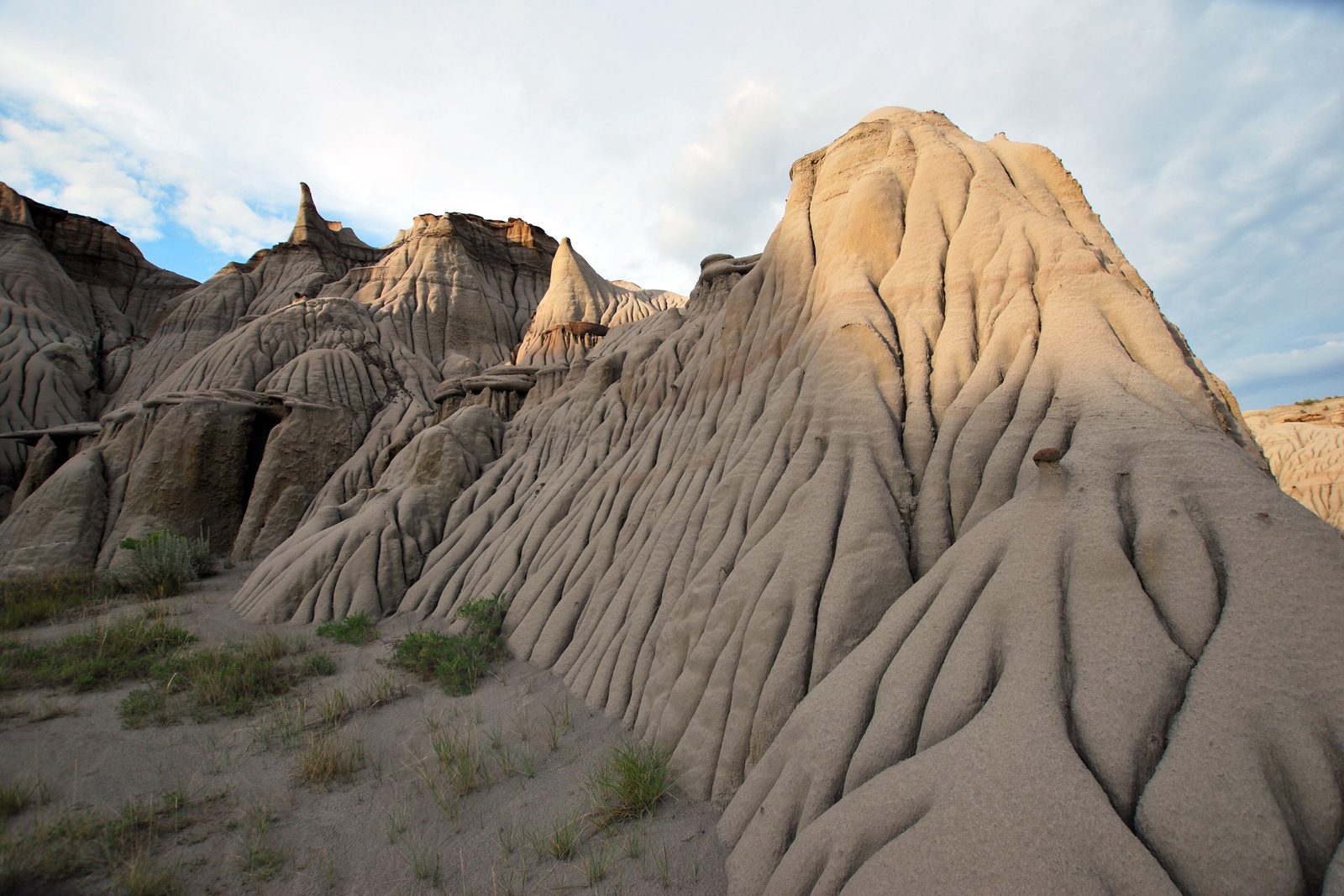
The prairie went on flat and gold, and then the ground simply fell away into a maze of striped gray and tawny hills, carved into chimneys and toadstools, with a green river winding through cottonwoods at the bottom. It was baking. A guide held out a brown stone and said what it used to be, and I looked at it for a long time.
Why it's worth knowing
A coastal swamp on the prairie. Seventy-five million years ago, what is now eastern Alberta was a low-lying coastal plain at the edge of a large, shallow sea, with a climate rather like northern Florida’s today. Forests of sycamore and magnolia, ferns and mosses fed small mammals. About 60 miles (100 km) east, the warm Bearpaw Sea held sharks and marine reptiles, and flying reptiles with wings wider than a small plane patrolled the sky. When animals died in the river channels and on the mud flats, their bones were buried by new layers of sand and mud. Pressure, a lack of oxygen and seeping minerals turned them into fossils, down to impressions of teeth and skin.
The valley the ice opened. For tens of millions of years the fossils lay buried. Then, at the end of the last ice age, about 13,000 years ago, glacial ice scraped off the upper layers of rock. Huge floods of meltwater cut deep into the soft sandstone and mudstone beneath and carved the Red Deer River valley. The hoodoos, mesas and coulees left behind hold the greatest concentration of late-Cretaceous dinosaur fossils yet found on Earth. Rain and runoff are still at work, slowly carving the badlands, and the clay turns extremely slippery when it is wet.
A preserve you enter with a guide. To protect the fossils and the fragile ground, most of the park is closed to anyone without a guide. Interpretive bus tours and hikes run from May to October, with many tours a day in July and August, and they often sell out. One hike leads through the badlands to the Centrosaurus Bonebed, a world-famous dig where hundreds of horned dinosaurs have been found. Nobody digs on the tours, but fossils found in the field are passed round to touch. On guided excavations, visitors work beside a paleontological technician on a real dig for the Royal Tyrrell Museum’s research.
The field notes
Bone hunters since the 1880s
Skeletons from these badlands stand in museums in 30 cities around the world. The hunt began in 1884, when Joseph Tyrrell’s survey for the Geological Survey of Canada drew attention to the Red Deer River valley, and in 1888 Thomas Weston became the first person to explore and publish on the stretch that is now the park. Since 1985 the biggest collection from the park has been kept at the Royal Tyrrell Museum of Palaeontology, near Drumheller, which still runs the summer field research. Every research project or collection in the park needs a permit.
John Ware’s cabin
John Ware was born into slavery on a South Carolina plantation around 1845. In 1882 he rode north on a cattle drive and stayed. He became famous across the young Canadian prairies as a horseman who could break in wild horses, respected for his skill and his straightforward honesty. In 1892 he married Mildred Lewis in Calgary. In 1900 the family moved 300 head of cattle to the Red Deer River, and John built a cabin from spruce logs that came drifting down from sawmills upstream. The spring flood of 1902 destroyed it, and he rebuilt on higher ground beside what is now Ware Creek. In the spring of 1905 Mildred died of pneumonia, and that September John was killed when his horse tripped and fell on him. His funeral was the largest the young city of Calgary had ever seen. His cabin, saved by local people in the 1950s and restored by Parks Canada, stands in the park and opens in season.
Cottonwoods by the river
Not everything here is old bone. Along the river, tall cottonwoods form a shady canopy over willow, saskatoon, rose and buffaloberry, and this narrow strip, the smallest habitat in the park, holds the greatest concentration of life. About 160 kinds of bird have been seen in the park. Warblers, woodpeckers and waterfowl are easy to watch in the groves in May and June, and golden eagles and prairie falcons ride the air above the badlands. Pronghorn graze the prairie on the rim, and coyotes are more often heard than seen.

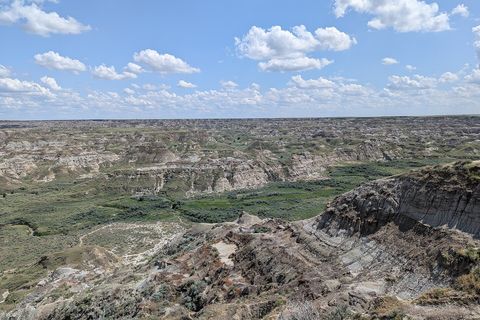
June 2025The valley from the rim: layered badlands and the green river bottom.
Photograph: Hirgax, CC BY-SA 4.0, cropped

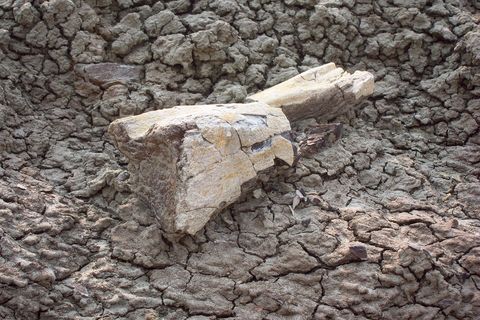
August 2015A fossil bone weathering out of cracked mudstone.
Photograph: Mariko Ishikawa (Natulive Canada), CC BY-SA 4.0, cropped

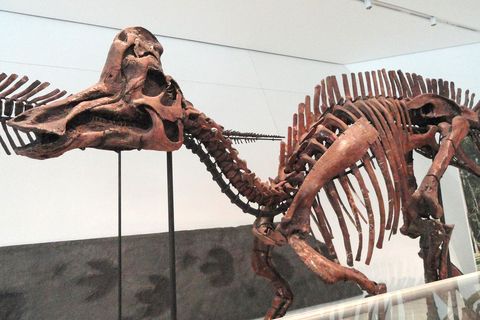
November 2011A Corythosaurus skeleton from the park, mounted at the Royal Ontario Museum.
- Go down into the striped hills behind somebody who knows the way. (Followed so closely I trod on her shadow twice. She was very kind about it.)
- Hold something very old with both hands. (Did. My hands have felt slightly more important ever since.)
- Look at every hillside as if it might be looking back. (One was. It had teeth.)
- Stop at the old log cabin by the creek and stay a while.
- Listen at dusk for the coyotes. (Heard them. They were having a far more interesting evening than I was, and said so at length.)
A relic from Dinosaur Provincial Park

Relic, entry 363About 75 million years oldEvery piece goes back
A piece of fossil bone, passed from hand to hand. On the guided hikes through the badlands of Dinosaur Provincial Park nobody digs, but fossils found in the field are handed round to touch. This is bone from an animal that lived on a warm coastal plain about 75 million years ago, buried in river sand and mud and turned to stone by pressure and seeping minerals. When the hike is over, every piece goes back.
Tally, in the marginIt was handed to me so casually that I very nearly put it in my pocket with the pencil. I handed it back with both hands and a small bow, which seemed the least I could do for something that old.
Getting there
- 1
From Brooks
From Brooks, Highway 873 runs north about 7 miles to Highway 544.
- 2
The turn for P.R. 130
The turn north onto P.R. 130 is at the closed Dinosaur Country Store.
- 3
Into the valley
The road runs down the hill to the visitor center and campground.
- ✓
How to get there. Dinosaur Provincial Park is not at Drumheller: the nearest city is Brooks, on the Trans-Canada Highway. From Brooks, Highway 873 runs north about 7 miles (11 km) to Highway 544, which runs east about 9 miles (14 km) toward Patricia. The turn north onto P.R. 130 is at the closed Dinosaur Country Store, which has a dinosaur statue. Many GPS programs do not show P.R. 130. After about 3 miles (5 km), a four-way stop leads east along the Little Sandhill Creek coulee for about 9 miles (15 km). The road reaches a viewpoint at the park entrance, then runs down the hill to the visitor center and campground. The nearest fuel is at Brooks or Duchess. The Royal Tyrrell Museum at Drumheller is about 124 miles (200 km) away, roughly two and a half hours by road.
When to go. Guided tours and programs run from May to October, busiest in July and August, and they often sell out. The campground is reservable, and busiest on weekends in May and June and all through July and August.
Safety. Daytime temperatures in July and August can reach 95°F (35°C). Prairie rattlesnakes, black widow spiders and scorpions live in the badlands, and the clay is extremely slippery after rain. The park’s advisories page carries current closures.
Mark this place
The passport stamp for this place.
Common questions
Is Dinosaur Provincial Park near Drumheller?
Not very. Dinosaur Provincial Park is about 30 miles (48 km) north-east of Brooks, Alberta, and about 124 miles (200 km) from Drumheller and the Royal Tyrrell Museum, roughly two and a half hours by road.
How many dinosaurs have been found in Dinosaur Provincial Park?
More than 150 complete skeletons. Over a century of digging in Dinosaur Provincial Park has turned up more than 150 complete dinosaur skeletons from over 50 dinosaur species, plus bone beds and about 450 other kinds of fossil life.
How old are the fossils in Dinosaur Provincial Park?
About 75 million years old. The fossils of Dinosaur Provincial Park date from the late Cretaceous, when Alberta was a warm coastal plain beside the inland Bearpaw Sea.
Is Dinosaur Provincial Park a World Heritage Site?
Yes. UNESCO inscribed Dinosaur Provincial Park, in Alberta, as a World Heritage Site in 1979, for its badlands and for the number and variety of its Cretaceous dinosaur fossils; the listing was extended in 1992.
Can you explore Dinosaur Provincial Park on your own?
Partly. Visitors can walk the park’s public trails and fossil displays on their own, but most of Dinosaur Provincial Park is a natural preserve entered only on guided tours and hikes.
Can you dig for dinosaur bones at Dinosaur Provincial Park?
Only on a guided excavation. Dinosaur Provincial Park runs paid guided digs with a paleontological technician, contributing to the Royal Tyrrell Museum’s research; removing or disturbing fossils otherwise is prohibited under Alberta’s Historic Resources Act.
Who was John Ware?
A famous Alberta rancher. John Ware, born into slavery in South Carolina around 1845, came north on a cattle drive in 1882 and became renowned as a horseman. He spent the last five years of his life at a cabin now preserved in Dinosaur Provincial Park.
Photographs on this page
Tap a photograph to see it full size.
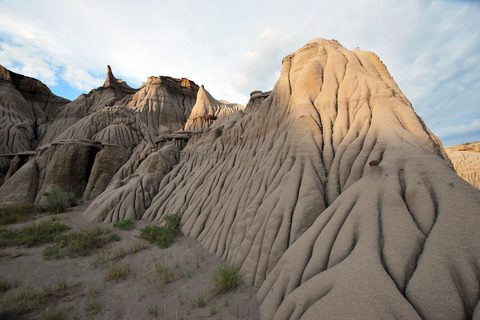
Photograph: Kscott.dav, CC BY-SA 4.0, cropped
Photograph: Hirgax, CC BY-SA 4.0, cropped
Photograph: Mariko Ishikawa (Natulive Canada), CC BY-SA 4.0, cropped