
- Where
- Near the mouth of the Thu Bồn,
central Vietnam - Coordinates
- 15.877° N
108.326° E (the bridge) - Status
- UNESCO World Heritage,
1999 - Old town
- 30 ha, with a buffer
zone of 280 ha (UNESCO) - Timber buildings
- 1,107, by UNESCO’s
count - Since 2025
- A ward of the city
of Da Nang - Floods
- In the rainy season,
roughly September to January
Evening, still warm, and lanterns of every colour strung across narrow streets of low yellow houses with dark wooden fronts. Little boats on the brown water carried candles in paper cups. I crossed a small covered bridge of old wood with a shrine inside and a carved animal at each end. One was a monkey. I bowed to it on the way in, and again on the way out.
The short answer
Hội An is an old river port near the mouth of the Thu Bồn River in central Vietnam; Da Nang’s international airport is about 28 kilometres to the north. UNESCO inscribed Hội An Ancient Town in 1999 as an exceptionally well-preserved example of a South-East Asian trading port dating from the 15th to the 19th century, and counts 1,107 timber-frame buildings in its 30 hectares, among them shops and homes, pagodas and family chapels, an open market and a ferry quay. The town’s heritage centre adds the assembly halls of its Chinese merchant communities and the small covered bridge known as the Japanese Bridge. Westerners knew the port as Faifo. It was a city of Quảng Nam province until Vietnam’s 2025 administrative reform, and Wikipedia records that since 16 June 2025 Hội An has been a ward of the city of Da Nang.
Why it's worth knowing
Most old ports survive by being rebuilt. Hội An survived by being abandoned. Wikipedia’s account of the town, citing Vietnamese historians, says that in the 19th century the estuary narrowed and the river channel silted, so that large ships could no longer dock, while the Nguyễn court’s restrictions on Western trade diminished the port further, and after Da Nang became a French concession in 1888 many of the Chinese merchants moved there. ICOMOS, the heritage body that evaluated the town for UNESCO, put the consequence in a sentence: its decline in the later 19th century ensured that it has retained its traditional urban tissue to a remarkable degree.
The river that took the trade away still comes back. Hội An sits low on the delta, and UNESCO lists annual flooding among the pressures on the property. In November 1999, weeks before the inscription, floods damaged both Hội An and Huế, and UNESCO’s emergency assistance paid for rehabilitation there. In late October 2025 the streets were under water again; VnExpress reported that the Thu Bồn at Hội An peaked at 5.62 metres, 0.14 metres above the historic flood of 1964. Wikipedia’s account of the town’s architecture describes its narrow, deep shophouses as built to suit the harsh climate and frequent flooding, and the town’s heritage centre reported, as VietnamPlus carried it, that about 30 of its listed monuments had deteriorated after the 2025 floods, nine of them critically.
The field notes
The bridge with a temple on it
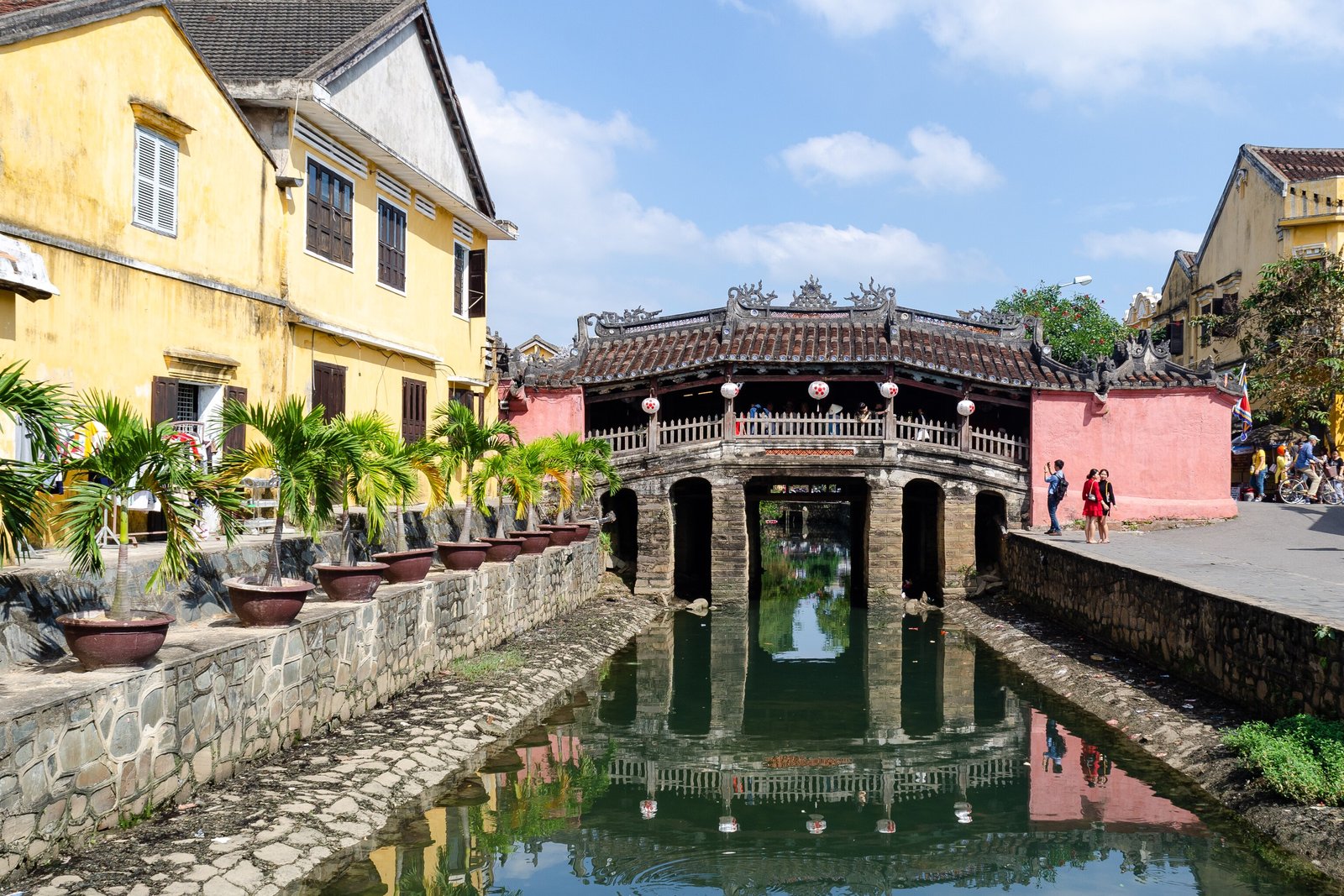
The Japanese Bridge, Chùa Cầu, is a covered wooden footbridge about 18 metres long over a small tributary of the Thu Bồn, with a small temple built onto its upstream side. Wikipedia’s account says it is traditionally dated to 1593, when Japanese merchants began building it, though the evidence is inconclusive; it appears as the “Hội An Bridge” on a map of 1630. The temple honours the god of the north, Trấn Võ Bắc Đế, whom Hội An’s heritage centre describes as a protective deity of the land. In 1719 the lord Nguyễn Phúc Chu named it Lai Viễn Kiều, the bridge for guests from afar, and a red plaque with that name hangs over the temple door. Repeated renovations have left, in Wikipedia’s words, few traces of Japanese architecture, and the bridge has appeared on Vietnam’s 20,000-đồng note since 2006.
At each end stand carved animals: dogs at one end and monkeys at the other. The explanations disagree. The town’s heritage centre says records have the building begun in a year of the dog and finished in a year of the monkey. Wikipedia, citing a Vietnamese source of 2008, reports the reverse order as one hypothesis, and a legend that the bridge was built to hold down a giant catfish, head in Japan, tail in the Indian Ocean and body under Vietnam, whose thrashing causes earthquakes and floods.
The bridge was taken apart and restored between 28 December 2022 and 3 August 2024, a project of 19 months. The next year’s floods went through it: VnExpress photographed peeling walls and damage beneath the deck, and the 2025 flood level marked on the wooden wall by the temple gate.
Lantern nights
On the 14th night of each lunar month, when the moon is full, the old town turns off its electric lights and lights its lanterns. Vietnam’s national tourism site describes the custom, and says lanterns have been made in Hội An for more than 400 years. Wikipedia’s account of the town says the Full Moon Festival in its current form has been organised by the town government since 1998, on the proposal of the Polish conservation architect Kazimierz Kwiatkowski, who worked for years on Hội An and the nearby temples of Mỹ Sơn.
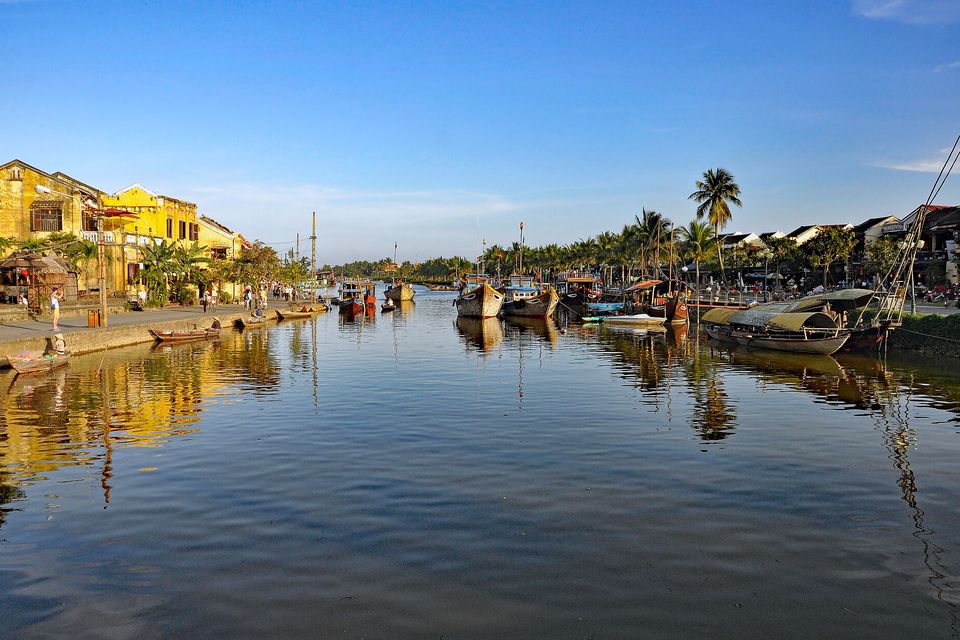
The Thu Bồn River at Hội An in late afternoon, with wooden boats moored along the quay, 2015.
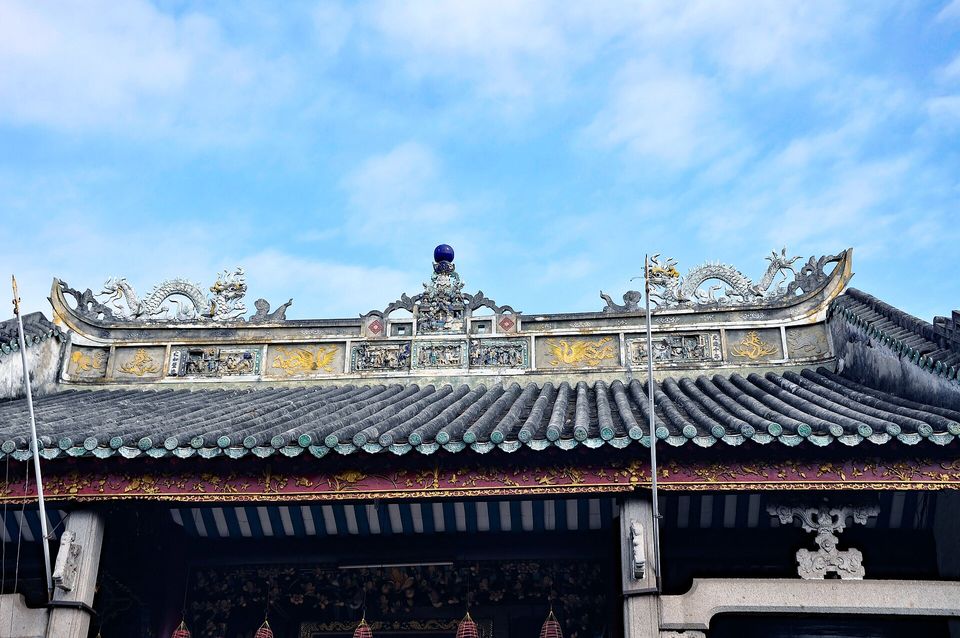
Ceramic dragons along the roof ridge of the Cantonese Assembly Hall, one of Hội An's Chinese assembly halls, 2015.
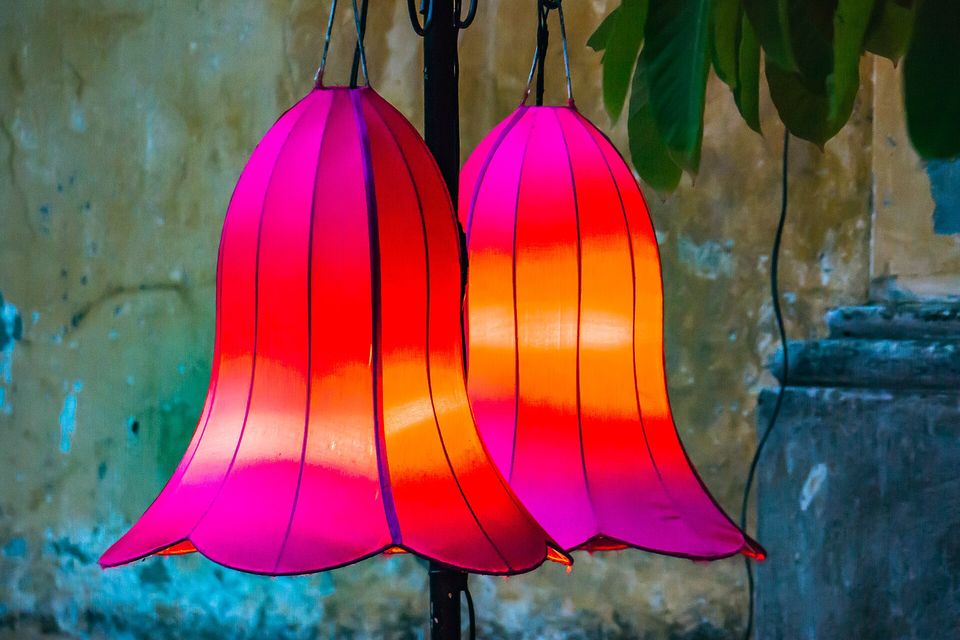
Silk lanterns lit against a weathered wall in Hội An, June 2017.
Photograph: Edgardo W. Olivera · Farolitos, Hoi An, Vietnam · CC BY 2.0 · cropped
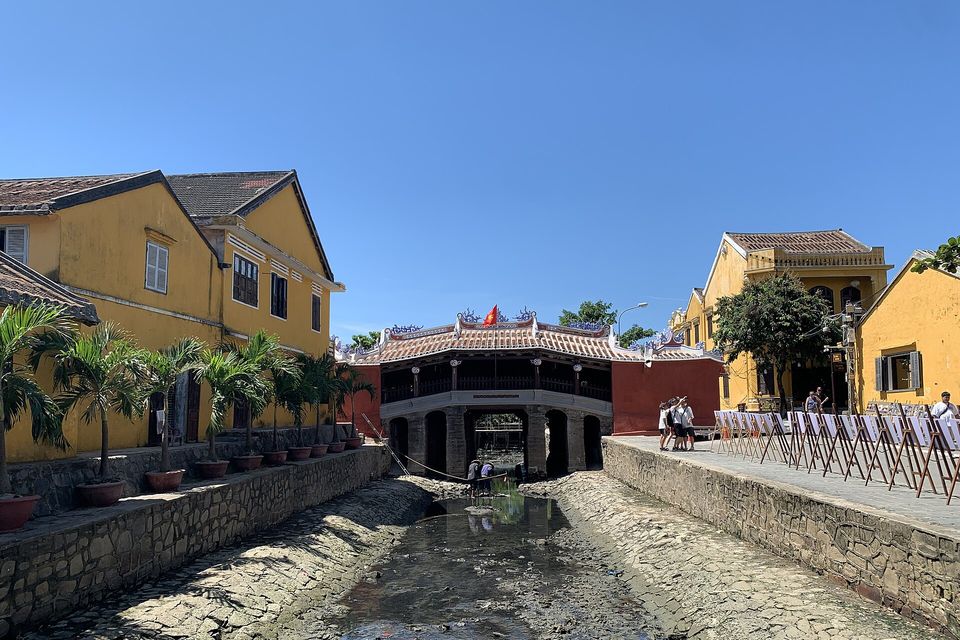
Chùa Cầu in August 2024, just after its restoration, with the canal below drained low.
Photograph: Chainwit., via Wikimedia Commons · CC BY 4.0 · cropped
- People live and pray in these houses. Ask before you step over a threshold, and never photograph someone at an altar.
- Walk the old streets early, before the shops open, and listen to the town wake up.
- In the wet months, ask about the water before you book, and again on the morning you arrive.
- Cross the little bridge twice: once in daylight, and once under the lanterns.
- Buy one lantern only. (Bought one, and a small one to read the list by, which is how the list got longer.)
The dog and the monkey of the Japanese Bridge. Carved animals stand at the two ends of Chùa Cầu, Hội An’s covered wooden bridge: dogs at one end and monkeys at the other, each with an incense bowl in front: one pair for the year of the dog and one for the year of the monkey, the two years between which the bridge was built. A legend has the pair keeping down a giant catfish that shakes the earth. Nobody disputes that they are there.
Tally, in the marginA dog at one end and a monkey at the other, keeping the bridge between them. As a monkey myself I bowed to the monkey and only nodded to the dog, and I have been worrying about the dog ever since.
Getting there
How to get there. The nearest airport is Da Nang International, about 28 kilometres north; Wikipedia gives the drive as about 40 minutes. There are regular cars and buses from Da Nang. The old town is small and best walked.
Tickets. Hội An’s heritage centre publishes the current entrance-ticket rules on its own site. The rules for charging visitors simply to walk the old streets have changed more than once; VietnamPlus reported a plan to charge being suspended after public objections in 2023. Check the current arrangement before you go.
When to go, and the floods. Wikipedia gives Hội An’s rainy season as September to January, with heavy rain that can cause floods; the damaging floods of 1999 and 2025 both came in October and November. At the time of writing, the 2025 floods were the most recent, and the old town was under water for days. If you travel in the autumn, check the river forecast and local notices before you go, and again on the day. The dry, milder months are roughly February to May.
How to be there. The old town is lived in, and UNESCO counts family chapels among its buildings. Ask before stepping inside or photographing anyone at prayer. The bridge carries a working temple; VnExpress has reported a visitor turned away from it over revealing clothing, so cover up to cross.
Safety. The United States has Vietnam at Level 1, exercise normal precautions, with no area-specific warnings. The advisory notes petty crime in tourist areas and unexploded ordnance at construction sites, and says the landmine risk is low in towns and tourist destinations.
Mark this place
Common questions
Why is Hoi An so well preserved?
Because it declined. Hội An, in central Vietnam, was an international trading port from the 15th to the 19th century; in the 19th century its river channel silted and trade moved to Da Nang. ICOMOS, evaluating it for UNESCO in 1999, wrote that its decline in the later 19th century ensured that it retained its traditional urban tissue to a remarkable degree.
When was Hoi An Ancient Town made a World Heritage Site?
UNESCO inscribed Hội An Ancient Town, in central Vietnam, on the World Heritage List in 1999, as an exceptionally well-preserved example of a South-East Asian trading port of the 15th to 19th centuries. The property covers 30 hectares with a 280-hectare buffer zone and, by UNESCO’s count, 1,107 timber-frame buildings.
Does Hoi An flood?
Yes, most years. Hội An lies low near the mouth of the Thu Bồn River in central Vietnam, and UNESCO lists annual flooding among the pressures on the old town. In late October 2025, VnExpress reported the Thu Bồn at Hội An at 5.62 metres, 0.14 metres above the historic 1964 flood. The floods of 1999 and 2025 both came in October and November.
Why is it called the Japanese Bridge in Hoi An?
The covered wooden bridge in Hội An, Chùa Cầu, is traditionally said to have been begun by Japanese merchants in 1593, though Wikipedia’s account calls the evidence inconclusive. It was named Lai Viễn Kiều, the bridge for guests from afar, by Nguyễn Phúc Chu in 1719, and later renovations left few traces of Japanese architecture.
Why are there dogs and monkeys on the Japanese Bridge?
The statues of dogs and monkeys at the two ends of Hội An’s Japanese Bridge are explained in more than one way. Hội An’s heritage centre says records have the bridge begun in a year of the dog and finished in a year of the monkey; Wikipedia, citing a Vietnamese source of 2008, gives the reverse order as a hypothesis, alongside a legend of a giant earthquake-causing catfish.
Is Hoi An part of Da Nang now?
Yes. Under Vietnam’s 2025 administrative reform, Hội An, formerly a city of Quảng Nam province, became a ward of the city of Da Nang; Wikipedia dates the change to 16 June 2025. The ward includes Hội An Old Town and the islands of Cẩm Nam and Cẩm Kim.
What is the Hoi An full moon lantern festival?
On the 14th night of each lunar month, Hội An’s old town switches off its electric lights and lights its lanterns. Vietnam’s national tourism site says lanterns have been made in the town for more than 400 years; Wikipedia says the festival in its present form has been organised by the town since 1998, on the proposal of the Polish architect Kazimierz Kwiatkowski.
How do you get to Hoi An?
Most visitors fly to Da Nang International Airport, about 28 kilometres north of Hội An, and drive or take a bus for about 40 minutes. The old town is compact and walkable, and Hội An’s heritage centre publishes the current entrance-ticket rules.