
- Where
- Limpopo and Mpumalanga,
north-eastern South Africa - Coordinates
- 24.0000° S
31.5000° E - Size
- Nearly 2 million hectares;
about 360 km north to south - Created
- Sabi reserve 1898; national park
1926 (birthday 31 May) - Named for
- Paul Kruger, Transvaal president
(his role is disputed) - Managed by
- South African National Parks
(SANParks) - The rule
- Gates open and close by the sun;
stay in your vehicle
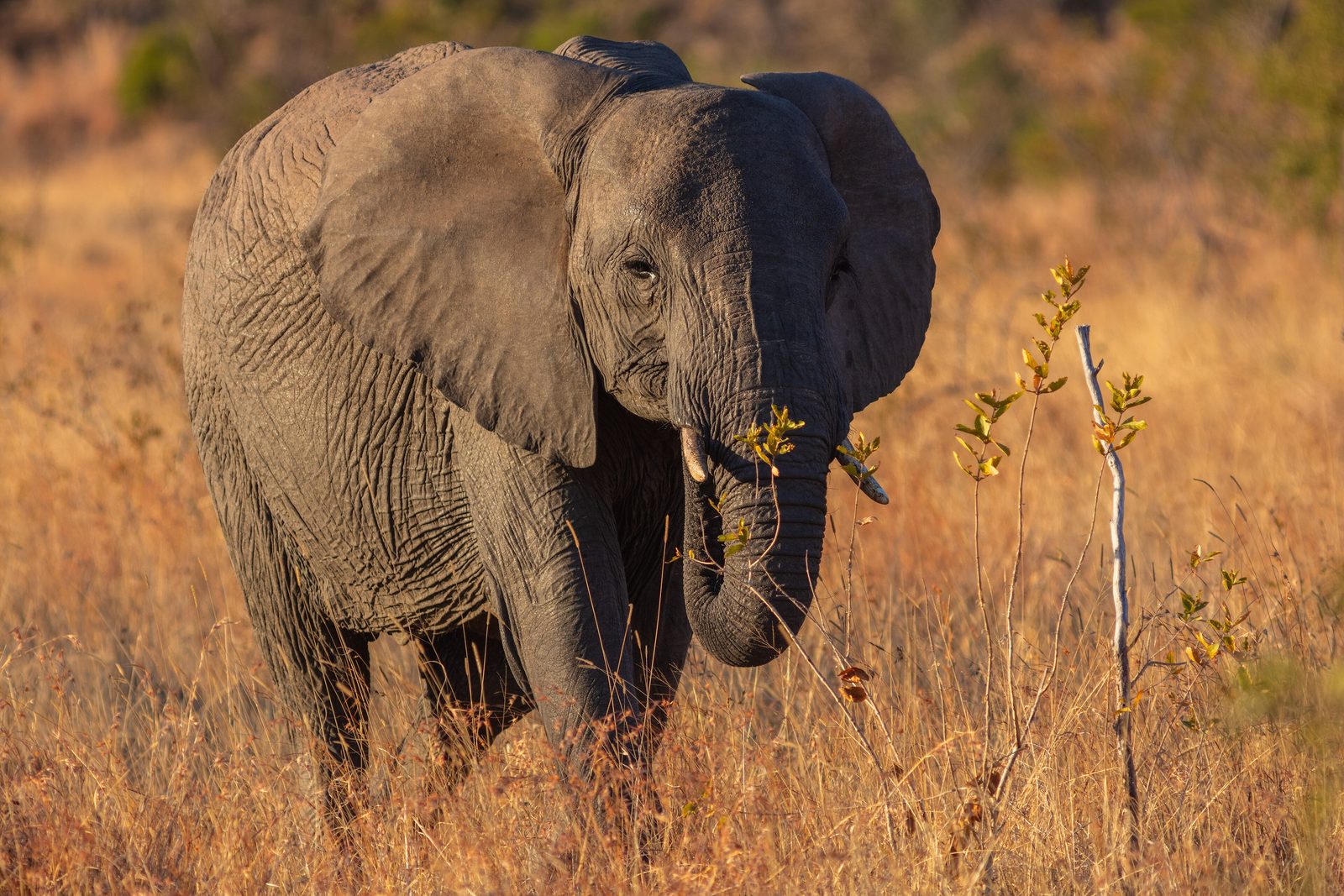
Queued at the gate before sunrise with everyone else, then drove slowly along a tarred road through thorn trees and dry grass, stopping wherever another car had stopped. An elephant crossed in no hurry at all. Back through the fence before the gate shut, with smoke from cooking fires and something grunting down by the river. Nobody asked what I had seen. Everyone told me what they had.
The short answer
Kruger National Park is a wildlife reserve of nearly 2 million hectares in north-eastern South Africa, in the Limpopo and Mpumalanga provinces, running about 360 kilometres from north to south along the border with Mozambique. It is managed by South African National Parks, SANParks, and its headquarters and largest camp is Skukuza. It began as the Sabi Game Reserve, proclaimed by the South African Republic under President Paul Kruger in 1898, between the Sabie and Crocodile rivers. In 1926 the National Parks Act joined the Sabi and Shingwedzi reserves, with farmland in between, into South Africa’s first national park, and named it after Kruger. Since 2002 it has been part of the Great Limpopo Transfrontier Park with parks in Mozambique and Zimbabwe. SANParks describes it as a park where the diversity of life meets historical and archaeological sites.
Why it's worth knowing
A park that has just celebrated its centenary has not settled who founded it. SANParks’ own heritage pages name three founders: Paul Kruger, who proclaimed the Sabi reserve on 26 March 1898; Piet Grobler, the Minister of Lands who took the National Parks Bill through parliament in 1926; and James Stevenson-Hamilton, the reserve’s first warden. The name went to the first.
In 1994 the historian Jane Carruthers published “Dissecting the myth: Paul Kruger and the Kruger National Park” in the Journal of Southern African Studies. As the article’s summary puts it, the assumption that the park was named for Kruger to commemorate his interest in conservation is inaccurate: Kruger lagged behind public opinion on wildlife and had to be pushed into proclaiming the reserve. Wikipedia’s account of the naming adds that the name was proposed by a judge, J. A. J. de Villiers, and championed behind the scenes by English-speaking naturalists to win Afrikaner support for the park; Grobler, the minister, was Kruger’s great-grandnephew.
The argument did not end there. In 1996 the same journal published Hennie Grobler’s reply, “Dissecting the Kruger myth with blunt instruments”, which argued that Kruger’s contribution to conservation is historical fact, and that Carruthers had not allowed for how little he could force through the Volksraad, the republic’s parliament. Carruthers answered in the same issue with “Defending Kruger’s honour?”. This entry reports both positions; it does not settle them.
Even the birthday is a choice. SANParks has explained that historians recognise 1898 as the park’s birth year, but that no exact date could be found in the Volksraad records, so it uses 31 May, the day the National Parks Act was passed in 1926. Wikipedia’s account says the bill was introduced in May and passed on 11 June. The centenary was launched at Skukuza on 30 May 2026, with an address by President Cyril Ramaphosa.
The field notes
The man who swept clean
James Stevenson-Hamilton, an Irish-born British army officer, became warden of the Sabi reserve in 1902 and retired in 1946, after 44 years. SANParks’ heritage page says he was known as “Skukuza”, he who sweeps clean. Wikipedia’s account gives the Tsonga nickname as meaning the man who turned everything upside down, for his ban on hunting, and cites the missionary-ethnographer Henri-Alexandre Junod as saying it also reflected how the Tsonga people felt after he evicted them from the reserve. The camp at Sabi Bridge, now the park’s headquarters, was renamed Skukuza in his honour.
The statues
A bust of Paul Kruger on a stone plinth stood at the Paul Kruger Gate, above the Sabie River, with busts of Stevenson-Hamilton and Grobler at Skukuza. In a media release of July 2003, SANParks said that these statues, all erected in 1976, would be relocated to a safe place in Skukuza; its then chief executive, Mavuso Msimang, said they added no value to conservation while acknowledging the three men’s role, and that the park’s creation was steeped in controversy. SANParks’ heritage pages still describe the Kruger statue and a founders’ statue. This entry could not confirm where each stands in 2026.
Whose land the north is
The park’s northernmost wedge, the Pafuri triangle between the Limpopo and Luvuvhu rivers, was the home of the Makuleke people. SANParks records that they were dispossessed in 1969, when the government removed them, and Wikipedia gives about 1,500 people moved south so that the land could be joined to the park. In 1998 the Makuleke were one of the first communities in democratic South Africa to win back land, and the first to recover land inside a formally protected park.
They chose not to resettle it. Under the settlement the Makuleke region is a contractual park: SANParks manages the conservation, a joint management board runs the region, and the community, through its communal property association, decides what commercial activity happens there. SANParks says the 50-year agreement is reviewed after 20 years, and that income from the lodges built on the land has helped electrify three villages and build a school.
A park on a timetable
Kruger is, for most of its visitors, a place to drive. Its gates open and close at set times that change from month to month with the daylight, and everyone must be inside a fenced camp or out of the park by closing. SANParks says latecomers are refused entry at the gates, and late arrivals at the rest camps are warned and, if they offend again, fined. Visitors must stay in their vehicles except in designated areas, keep every part of themselves inside the car, and keep to 50 km/h on tarred roads and 40 km/h on gravel.
The fence around the whole park is more recent than the rule. Wikipedia’s account says fencing began along the Crocodile River in 1959, reached the western and northern boundaries in 1960, and then the Mozambique border; in 2002 the fences on the Mozambique side were dropped to create the transfrontier park. Wikipedia lists poaching, development along the boundaries, drought and mining among the threats the park faces.
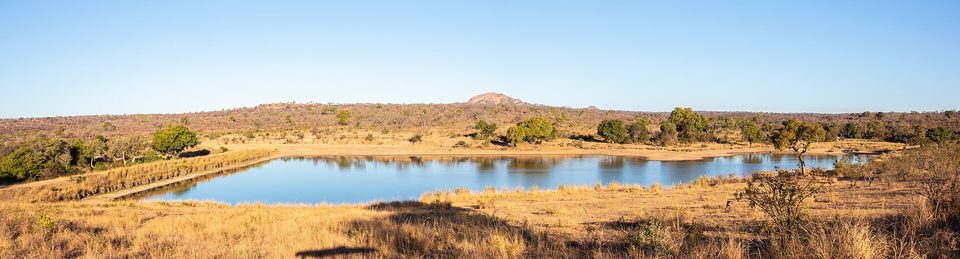
A waterhole at Mestel Dam, looking south-east to the granite dome of Shabeni hill, in the dry winter of July 2018.
Photograph: Diego Delso, delso.photo · CC BY-SA 4.0
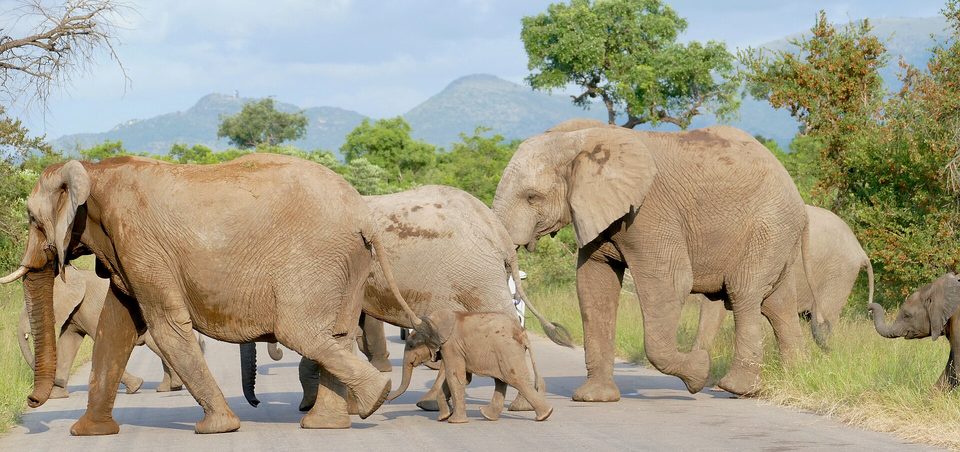
An elephant family crossing the S110 tar road east of Berg-en-Dal, March 2023.
Photograph: Bernard Dupont · Savanna Elephants (Loxodonta africana) family crossing the road ... (52727265347) · CC BY-SA 2.0
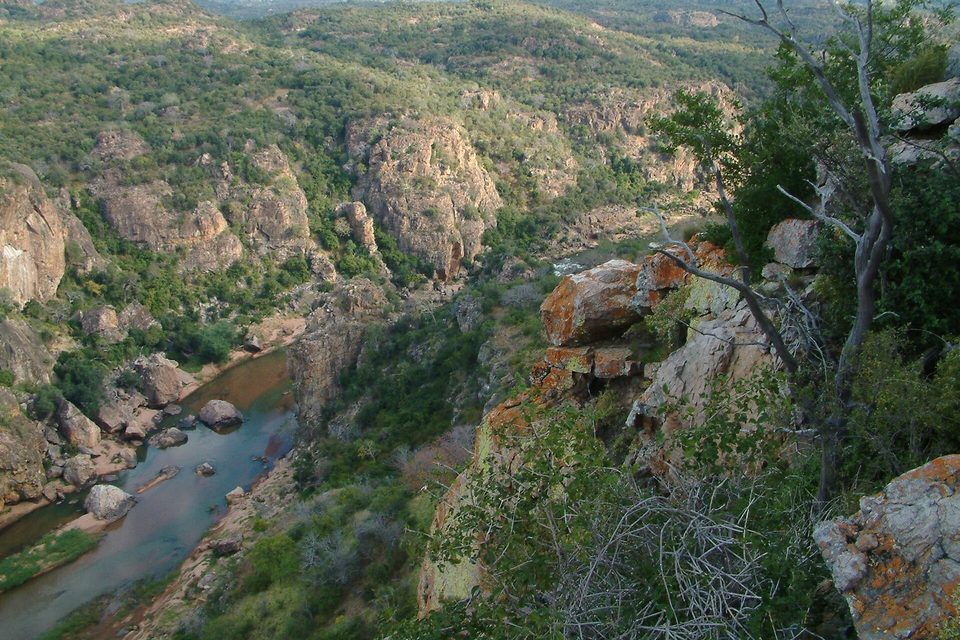
The Luvuvhu River in Lanner Gorge, in the Makuleke region at the park’s northern tip, 2007.
Photograph: Profberger · Makuleke4 · CC BY 2.5 · cropped
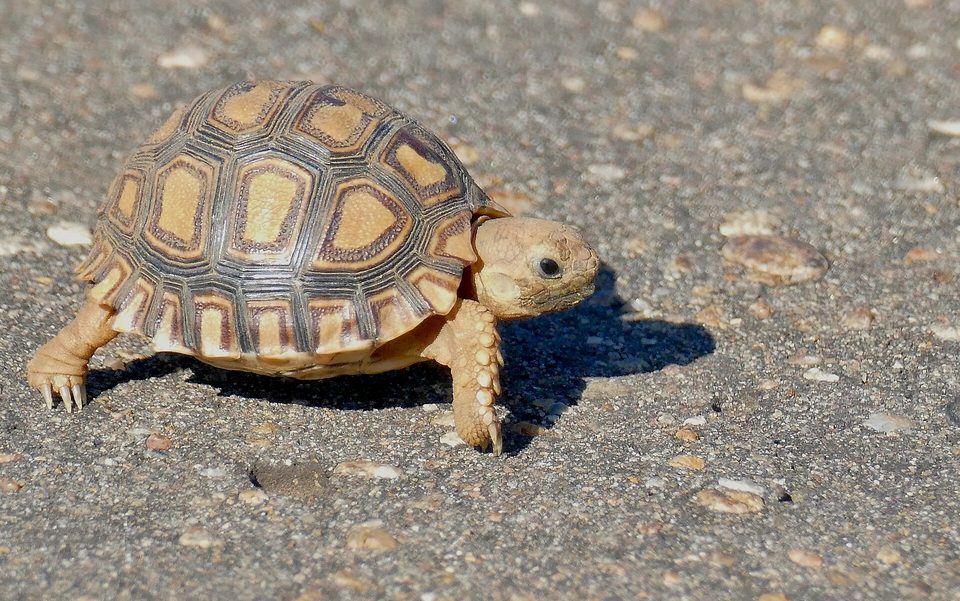
A young leopard tortoise crossing the H1-6 south of Shingwedzi, March 2023.
Photograph: Bernard Dupont · Leopard Tortoise (Stigmochelys pardalis) juvenile crossing the road ... (52764073719) · CC BY-SA 2.0
- Stay in the car, even when the car is the least interesting thing for miles.
- Drive slower than you think you need to. Then slower again.
- Ask whose land the far north is, and listen to the whole answer.
- Keep an eye on the gate times the way other people keep an eye on the sky.
- See every one of the famous big animals. (Missed one. Substituted a tortoise of great personal dignity, now entered on the list in capitals.)
A park gate. Every entrance gate to Kruger, and the gate of every fenced rest camp inside it, opens and closes at set times that SANParks publishes month by month, earlier and later as the days lengthen and shorten. By closing, every visitor has to be inside a fenced camp or out of the park; latecomers are turned away at the gates, and repeat late arrivals at the camps are fined. The gate keeps the sun’s timetable, and so does everyone who passes through it.
Tally, in the marginA gate that shuts when the sun says so, whatever is still out there to be seen. On the first evening I raced it back; by the third I was keeping its hours in my notebook too, and the list has never been so well rested.
Getting there
How to get there. SANParks lists daily flights from Johannesburg to Skukuza Airport inside the park, to Phalaborwa and Hoedspruit near its western edge, and to Kruger Mpumalanga International Airport between Nelspruit and White River, with flights to Skukuza from Cape Town as well. Many visitors drive from Johannesburg. The park has nine entrance gates.
Plan around the gates. Gate times change month by month and SANParks asks visitors to confirm them before arriving. Latecomers are refused entry. The United States’ advisory separately advises against driving outside metropolitan areas at night, so plan the drive in to arrive in daylight. In busy holiday periods SANParks has applied daily quotas at the gates.
When to go. SANParks describes winter, roughly April to September, as traditionally the best time for game viewing: the bush thins and animals gather at rivers and waterholes. Summer, October to April, is hot, and is the rainy season.
Health. Kruger is in a malaria area. SANParks says the risk is usually low, highest from November to April, and advises visitors to take prophylaxis chosen with a doctor, to cover up with long sleeves and trousers, to use a repellent containing DEET and to sleep behind screens or under a net.
Safety. The United States has South Africa at Level 2, exercise increased caution, because of crime, terrorism, civil unrest and kidnapping. The advisory names no area warning for the park; it advises against driving outside metropolitan areas at night and against displaying signs of wealth.
Mark this place
Common questions
Why is it called Kruger National Park?
Kruger National Park is named after Paul Kruger, president of the South African Republic, who proclaimed its forerunner, the Sabi Game Reserve, in 1898. The name was given when the reserve became a national park in 1926. The historian Jane Carruthers argued in 1994 that Kruger’s conservation role was a myth; Hennie Grobler rebutted her in 1996.
How old is Kruger National Park?
Kruger National Park turned 100 in 2026. South African National Parks dates its birthday to 31 May 1926, the day it gives for the passing of the National Parks Act, because no exact date for the 1898 Sabi Game Reserve was found in the Transvaal parliament’s records. SANParks’ heritage pages give 26 March 1898 for Kruger’s proclamation of the reserve.
Did Paul Kruger found Kruger National Park?
Historians disagree. SANParks names Paul Kruger as one of three founders, with the minister Piet Grobler and the warden James Stevenson-Hamilton. In the Journal of Southern African Studies in 1994, Jane Carruthers argued that Kruger lagged behind public opinion and had to be pushed into proclaiming the reserve; Hennie Grobler replied in 1996 that his contribution was historical fact.
How big is Kruger National Park?
South African National Parks gives Kruger National Park as nearly 2 million hectares, in the Limpopo and Mpumalanga provinces of north-eastern South Africa. Wikipedia gives it as about 360 kilometres long from north to south and about 65 kilometres wide on average, running along the border with Mozambique; since 2002 it has been part of the Great Limpopo Transfrontier Park.
Can you get out of your car in Kruger National Park?
Only in designated areas. South African National Parks requires visitors in Kruger National Park to stay in their vehicles except at designated places such as camps and picnic sites, to keep every part of their body inside the vehicle, and to keep to 50 km/h on tarred roads and 40 km/h on gravel roads.
What time do the Kruger gates close?
Kruger National Park’s gate times change from month to month with the daylight, and South African National Parks publishes them for each gate and asks visitors to confirm them before arriving. Everyone must be in a camp or out of the park by closing time; latecomers are refused entry at the gates, and late arrivals at rest camps are warned and fined if they offend again.
Who are the Makuleke?
The Makuleke are a community whose land, the Pafuri triangle at the northern tip of Kruger National Park, was taken by South Africa’s government in 1969. In 1998 the land was returned to them, the first successful land claim inside a formally protected area. They chose to keep it as a contractual park, managed for conservation with SANParks and earning income from tourism lodges.
Is there malaria in Kruger National Park?
Yes. South African National Parks says Kruger National Park is in a malaria area, although the risk is usually low, and is highest from November to April. It advises visitors to take antimalarial prophylaxis chosen with a doctor, to cover up, to use a repellent containing DEET, and to sleep behind closed screens or under a mosquito net.