The short answer
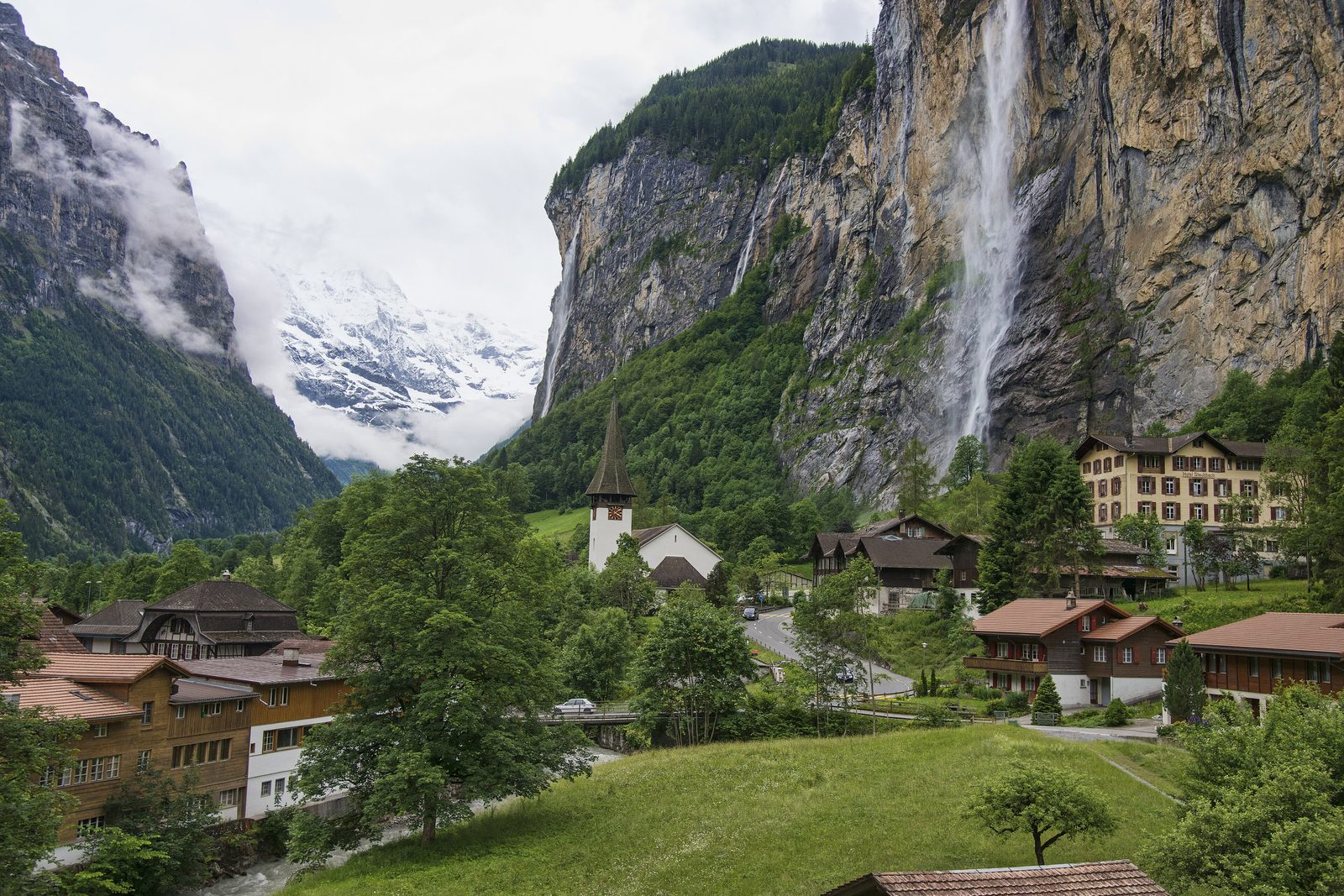
Lauterbrunnen is a village in the Bernese Oberland of Switzerland, a short train ride south of Interlaken. It lies at 2,608 feet in a trough-shaped valley between towering rock faces, and 72 waterfalls plunge down those walls. The municipality also takes in the villages of Wengen, Mürren, Gimmelwald, Stechelberg and Isenfluh. Wengen and Mürren, up on the shelves above, are car-free. Part of the valley lies within the Swiss Alps Jungfrau-Aletsch UNESCO World Heritage Site.
From Tally’s diary
The valley floor was flat and green, and the walls went straight up on both sides, and water came off the top of them wherever I looked. Some of it was so fine it never seemed to land at all. Cowbells, somewhere above. A blue and yellow train went by with faces pressed to every window. I got thoroughly wet without once being rained on.
Why it's worth knowing
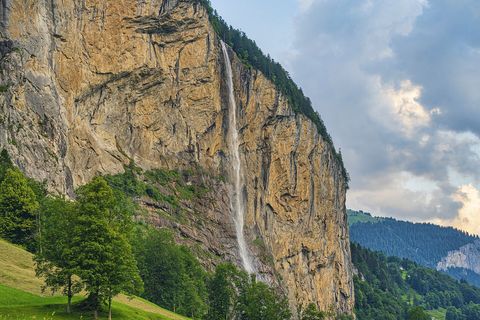
A waterfall that turns to dust. The Staubbach Falls, beside the village, are the highest free-falling waterfall in Switzerland. On the way down the water breaks into fine, dust-like spray, which is how it got its name: Staub is German for dust. It inspired Goethe’s poem “Song of the Spirits over the Waters”. The falls are at their strongest in spring and early summer, when snowmelt feeds them.
Ten waterfalls inside a mountain. Up the valley, the Trümmelbach drains the huge glacier walls of the Eiger, Mönch and Jungfrau, a catchment half covered in snow and ice. It does not fall down the outside of the cliff. It has cut its way through the inside, in a chain of ten waterfalls that are the only glacial waterfalls in Europe inside a mountain open to visitors. A lift in a tunnel takes visitors up to them. On hot summer days and after thunderstorms, up to 5,300 gallons of water a second pour through the gorge, with about 22,000 tons of rubble a year.
A village that learned to welcome. The name was written down in 1240, in a letter, as in claro fonte. That means “at the clear spring”, and the name probably comes from the waterfalls: lauter Brunnen, “many springs”, or lautere Bäche, “clear streams”. From the middle of the 18th century, writers such as Albrecht von Haller, Rousseau, Goethe and later Byron sent Europe’s travelers into the Alps, and many of them came to this valley. Early visitors slept in the vicarage, at the Steinbock inn or in a farmer’s hayloft. Today, on a busy day, up to 25,000 visitors arrive in a village of about 2,400 people.
The field notes
Tolkien’s walk
In 1911, aged 19 and about to go up to Oxford, J. R. R. Tolkien toured the Swiss Alps with a small party on foot, sleeping out and eating simply. He passed through the Lauterbrunnen valley. Long afterward he remembered that the party was about the size of Bilbo’s and had much the same kind of adventures, including a narrow escape. The steep walls, hidden depths and falling water of the valley are often seen in Rivendell, the elves’ refuge in The Lord of the Rings. Whether any one valley gave Tolkien Rivendell can never quite be proved, and Lauterbrunnen is very happy to be in the running.
Sedan chairs and summer sledges
Tourism created whole new jobs in the valley. Families hired out horses and mules. Porters carried guests in sedan chairs up to the Schilthorn or the Kleine Scheidegg. Boys even offered summer toboggan rides from Mürren down to Lauterbrunnen. The composer Felix Mendelssohn, a keen painter, came often and made the oldest known drawing of Wengen.
The hotelier and the falls
For a long time it was the waterfalls, not the peaks, that brought people here. Christian von Almen built the Hotel Staubbach beside the church, with its view of the falls, and helped pay for the telegraph line into the valley. In his last years he bought the land up to the Trümmelbach gorge to open it to visitors. His son Fritz opened the first two falls in 1886, and the Hotel Trümmelbach followed two years later.

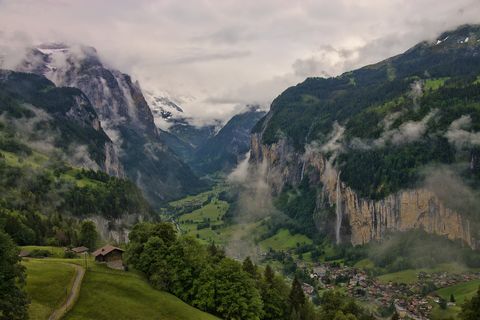
July 2012The valley from above, with the falls on the right-hand cliff.
Photograph: chensiyuan, CC BY-SA 4.0

June 2020The Staubbach Falls thinning to spray before it reaches the trees.
Photograph: PantaRhei, CC BY-SA 4.0

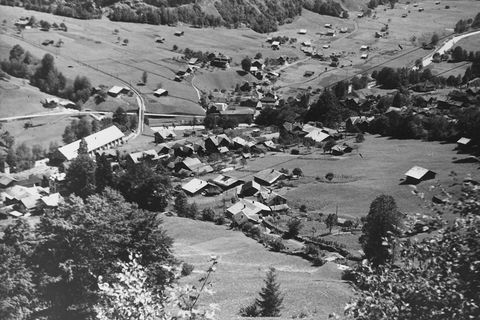
The village and the valley floor in 1935, seen from the Mürren railway.
Photograph: Leo Wehrli, 1935 (ETH-Bibliothek Zürich, Bildarchiv), CC BY-SA 4.0, cropped
- Walk the valley floor from one end to the other and stop at every waterfall. (Gave up stopping. Started waving instead.)
- Go inside the mountain where the water is loudest, and hold on to your hat. (Held on. The hat held on too. We are closer now.)
- Leave the car somewhere else and come up by train. The road is narrow, and the village needs it more than I do.
- Try to describe the tall waterfall in one sentence. (Used four. Not one of them was dry.)
- Look up for a whole minute without walking into anything. (Nearly.)
A relic from Lauterbrunnen

Relic, entry 367Comes down in autumnFor finding cows in fog
A cowbell. A big bell on a wide leather strap. On the summer pastures above the valley, cows wear them so their farmers can find them at night or in fog, and in autumn the herds come down decked in bells and flowers.
Tally, in the marginI heard it all day and took it for the valley humming to itself. It was evening before I worked out that every note had a cow attached, and that somebody, somewhere, was listening for each one.
Getting there
- 1
From Zurich Airport
Zurich Airport is about three hours from Interlaken by train.
- 2
The blue and yellow train
The Berner Oberland Bahn runs from Interlaken Ost to Lauterbrunnen in about 24 minutes.
- 3
The front of the train
Only the front section goes to Lauterbrunnen; the rear splits off at Zweilütschinen.
- ✓
How to get there. The Berner Oberland Bahn, a blue and yellow train, runs from Interlaken Ost to Lauterbrunnen in about 24 minutes. Only the front section goes to Lauterbrunnen; the rear part splits off at Zweilütschinen for Grindelwald. By car, the drive from Interlaken takes 20 to 30 minutes. Parking in Lauterbrunnen and Stechelberg is limited at busy times; there is a multi-story garage below the station and a park-and-ride scheme.
When to go. The waterfalls are at their fullest in spring and early summer. The path up to the foot of the Staubbach is open only in summer. The Trümmelbach Falls open daily from the beginning of April to early November, with dates that depend on the weather, and children under four and dogs are not allowed in. In winter there are ski runs above the valley, including one from the Schilthorn down to Lauterbrunnen, and a cross-country trail along the frozen falls.
Safety. The State Department notes that Switzerland’s mountains can be dangerous because of avalanches, landslides and sudden changes in the weather. In winter, roads into the valley can be snow-covered and icy.
Mark this place
The passport stamp for this place.
Common questions
How many waterfalls are there in Lauterbrunnen?
Seventy-two. The Lauterbrunnen valley in Switzerland is known as the valley of 72 waterfalls, from the Staubbach Falls beside the village to the ten Trümmelbach Falls inside the mountain.
How tall is Staubbach Falls?
About 974 feet. The Staubbach Falls at Lauterbrunnen drop about 974 feet (297 meters), the highest free-falling waterfall in Switzerland, and turn to fine spray on the way down.
What are the Trümmelbach Falls?
Glacier waterfalls inside a mountain. The Trümmelbach Falls near Lauterbrunnen are ten waterfalls carrying meltwater from the Eiger, Mönch and Jungfrau through the rock, reached by a tunnel lift and open from about April to early November.
Is there an entry fee for Lauterbrunnen?
No. As of November 2026, Lauterbrunnen charges no fee to visit the village or the valley; the Trümmelbach Falls inside the mountain have their own admission.
Did Tolkien visit Lauterbrunnen?
Yes, in 1911. A 19-year-old J. R. R. Tolkien walked through the Lauterbrunnen valley on a tour of the Swiss Alps, and its cliffs and waterfalls are often linked with Rivendell.
How do you get from Interlaken to Lauterbrunnen?
By train, in about 24 minutes. The Berner Oberland Bahn runs from Interlaken Ost to Lauterbrunnen; riders sit in the front section, because the rear half goes to Grindelwald.
Can you drive to Wengen and Mürren?
Not into the villages themselves. Wengen and Mürren, on the shelves above the Lauterbrunnen valley, are both car-free villages.
What does Lauterbrunnen mean?
Probably “many springs”. The name Lauterbrunnen, first written down in 1240, is thought to come from the valley’s waterfalls, either “lauter Brunnen”, many springs, or “lautere Bäche”, clear streams.
Photographs on this page
Tap a photograph to see it full size.
Photograph: chensiyuan, CC BY-SA 4.0, cropped
Photograph: chensiyuan, CC BY-SA 4.0
Photograph: PantaRhei, CC BY-SA 4.0
Photograph: Leo Wehrli, 1935 (ETH-Bibliothek Zürich, Bildarchiv), CC BY-SA 4.0, cropped




