The short answer
Little Cayman is the smallest and least populous of the three islands of the Cayman Islands, a British Overseas Territory in the western Caribbean Sea, Wikipedia records. It lies about 5 miles west of Cayman Brac, is about 10 miles long and just over a mile wide, covers about 11 square miles, and rises to about 40 feet on its north shore. The 2021 census, by the territory’s statistics office, counted 161 people. Christopher Columbus sighted it and Cayman Brac on 10 May 1503 and called them Las Tortugas for the turtles around them, the Cayman Islands government records.
From Tally’s diary
Our small plane landed beside a mangrove pond, and the mangroves were loud, crowded with nesting birds whose feet were as red as paint. A large grey lizard held up the road for some time. Next morning, snorkelling, the coral simply stopped, and below my fins the blue fell away into nothing. I discovered I was not breathing, for no reason whatsoever.

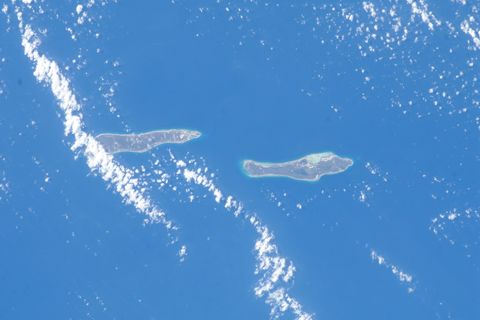
March 2013The Sister Islands from the International Space Station.
Astronaut photograph: NASA Johnson Space Center, Public domain, cropped
Why it's worth knowing
Booby Pond. On the south coast, near the western end, lies a seasonally flooded hypersaline lagoon of 43 hectares with a fringe of mangroves and dry forest, protected since 1993, a wetland of international importance under the Ramsar Convention since 1994, and managed by the National Trust for the Cayman Islands, which puts its resident colony at about 4,000 red-footed boobies, the only breeding site of the species in the Cayman Islands. BirdLife International counts up to 20,000 red-footed boobies there, possibly a third of the species’ whole Caribbean and Atlantic population, and up to 200 breeding pairs of magnificent frigatebirds, Wikipedia records. In 2025 a proposal to build a new airport beside the pond met local opposition; the government has since confirmed that the airfield will stay where it is, the Cayman Compass reported.

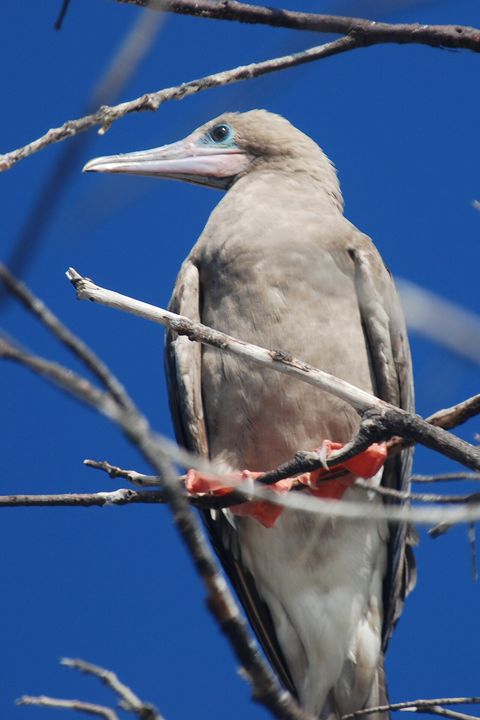
August 2007A red-footed booby perched in a snag on Little Cayman.
Photograph: The Lilac Breasted Roller, Red-footed Booby (Sula sula) 1166057565, CC BY 2.0
Bloody Bay Wall. Off the north coast, the reef runs out over a wall that, in National Geographic’s words, “plummets to more than a thousand feet”, an “undersea spacewalk”. It lies within Little Cayman’s marine protected areas, the territory’s Department of Environment records. In 1999 the photographer Jim Hellemn pieced together about 280 photographs of a stretch of the wall into one image, which National Geographic published in October 2001, and returned with scientists in 2010 to record how it had changed.
The field notes
Iguanas on the road
Little Cayman holds most of the remaining population of the Sister Islands rock iguana, Cyclura nubila caymanensis, a critically endangered subspecies found only here and on Cayman Brac, the National Trust records; habitat loss, road deaths, and feral cats and dogs have reduced it. Preston Bay beach is a protected nesting site for the iguanas and for sea turtles. Around Booby Pond live a critically endangered subspecies of dwarf boa and a critically endangered land snail found only on this island, by the government’s 2017 nomination of the reserve.
Reef science and lionfish
The Central Caribbean Marine Institute, founded in 1998, runs the Little Cayman Research Centre on the north coast, studying how coral reefs resist and recover. Since 2011 it has culled invasive lionfish with local dive operators and volunteers, and it reports fewer lionfish at the sites culled regularly, Wikipedia records. The island’s reefs were hit by coral bleaching in 2023; marine scientists reported promising early signs of recovery, the Cayman Compass reported.

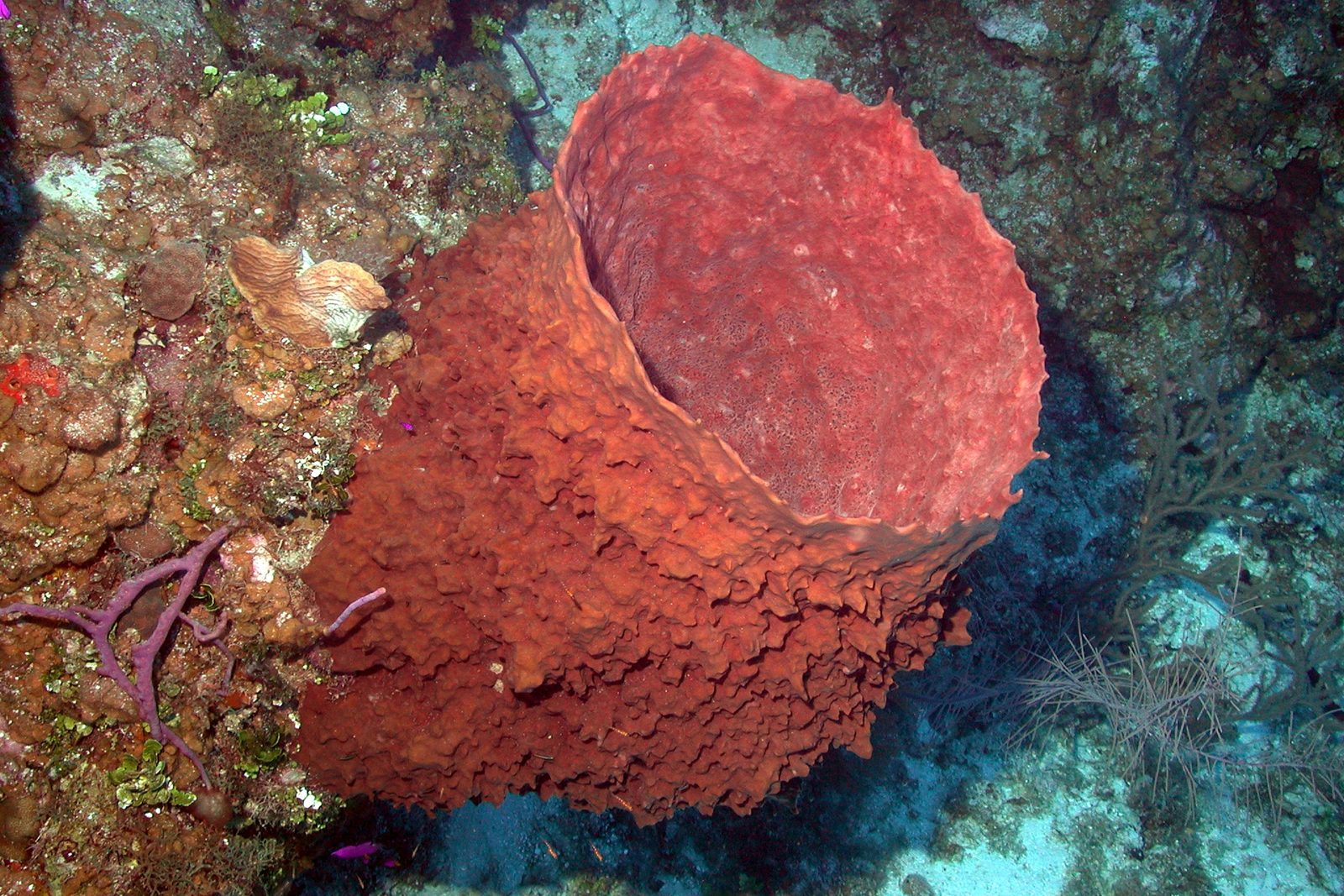
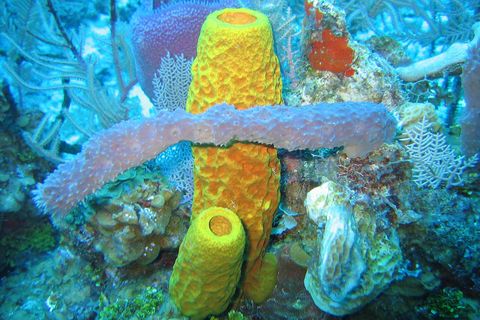
May 2007Tube, rope, vase and encrusting sponges at the lip of a reef wall in 60 feet of water, photographed by NOAA’s 2007 Twilight Zone expedition.
Photograph: NOAA, Twilight Zone Expedition 2007, Public domain (PD-USGov-NOAA), cropped
- Bring everything the stay will need. Errands are not what this island is for.
- Note down how far the wall goes down. Leave the remainder of the page blank; that is roughly right.
- Give the iguanas the whole road, and drive as if each bend had one on it.
- Greet everyone you pass. On an island this small, everyone is a neighbour.
- Watch the pond from its edge at dusk, when the nesting birds return over the mangroves.
A relic from Little Cayman

Relic, entry 224Depth: more than a thousand feetStatus: in marine protected areas
Bloody Bay Wall. The reef wall off Little Cayman’s north coast, where shallow coral gives way to a cliff that, in National Geographic’s words, plummets to more than a thousand feet; it lies within Little Cayman’s marine protected areas. It is seen from its rim by snorkellers and divers, with a licensed operator, and left untouched.
Tally, in the marginFor days I admired the reef top, its fans and fish and colours, and took it for the whole show. Then I swam out to where it ended, and found the reef had only been the doorstep.
Getting there
- 1
Small plane from Grand Cayman
By small plane from Grand Cayman.
- 2
Twin Otter to Edward Bodden Airfield
From Owen Roberts International Airport, the territory’s international gateway, Cayman Airways Express flies Twin Otter turboprops to Edward Bodden Airfield on Little Cayman, usually calling at Cayman Brac on the way; jets cannot use the short strip.
- 3
Flights, bed and dives booked ahead
The flights, a bed, and dives with a licensed operator.
- ✓
| J | F | M | A | M | J | J | A | S | O | N | D |
|---|---|---|---|---|---|---|---|---|---|---|---|
| January: best time | February: best time | March: best time | April: best time | May: best time | December: best time |
- December to May
When to go. December to May, outside the Atlantic hurricane season of June to November.
What to arrange ahead. The flights, a bed, and dives with a licensed operator. Bring what you need for the stay.
Safety and medical care. Little Cayman has no hospital: the Health Services Authority lists its hospitals as Faith Hospital on Cayman Brac and the Anthony S. Eden Hospital on Grand Cayman, and its Little Cayman Health Centre opens Monday to Friday from 8 a.m. to 2 p.m., with a doctor’s clinic on Wednesdays, and is closed at weekends and on public holidays except for emergencies. Serious cases go to Faith Hospital on Cayman Brac or to Grand Cayman, by boat, plane or the police helicopter, Cayman press reports record. The other hazards are the place’s own: sun, currents off Point of Sand, and storms in season.
For birders
- Designation
- Booby Pond and Rookery is Ramsar site no. 702, designated on 21 September 1994.Source: Ramsar Sites Information Service · read
- Birds to look for
- The National Trust for the Cayman Islands puts the reserve's resident colony at about 4,000 red-footed boobies and calls it the only breeding site of the species in the Cayman Islands; it also names a small, growing colony of magnificent frigatebirds.Source: National Trust for the Cayman Islands · read
- Birds to look for
- The Ramsar record describes a breeding colony of over 5,000 adult red-footed boobies at Booby Pond.Source: Ramsar Sites Information Service · read
- Best months
- Sep–Jun — The National Trust's management plan for the reserve, written for 2012 to 2015 and filed with its Ramsar record, says the red-footed booby's breeding season runs from September to June, with one egg laid.Source: National Trust for the Cayman Islands (Booby Pond Nature Reserve management plan 2012-2015) · read
- Where the source points
- The National Trust says the frigatebirds nest in trees along the pond's northern margin, and that the pond is a feeding area for herons, egrets, black-necked stilts and passing shorebirds.Source: National Trust for the Cayman Islands · read
- Visitor rule
- The National Trust says the reserve, including its privately owned southern margins, is protected under the Cayman Islands' Animals Law (2003 Revision), which prohibits disturbing any plant or animal life within its boundaries.Source: National Trust for the Cayman Islands · read
Bird calendar
Seasons as published by the park, refuge or specialist body named in each row, with the date we read it.
-
Red-footed boobies form a resident colony: all year.
Source: National Trust for the Cayman Islands · read
Mark this place
The passport stamp for this place.
Common questions
Where is Little Cayman?
Little Cayman is the smallest of the three Cayman Islands, a British Overseas Territory in the western Caribbean, about 5 miles west of Cayman Brac. It is about 10 miles long and a mile wide, and had 161 people at the 2021 census.
How do you get to Little Cayman?
By small plane: Cayman Airways Express flies Twin Otter turboprops from Owen Roberts International Airport on Grand Cayman to Little Cayman’s Edward Bodden Airfield, usually by way of Cayman Brac. Jets cannot land on the short strip.
Is there a hospital on Little Cayman?
No. The Cayman Islands’ Health Services Authority runs a health centre on Little Cayman, open Monday to Friday from 8 a.m. to 2 p.m. with a doctor’s clinic on Wednesdays and closed at weekends except for emergencies; its hospitals are Faith Hospital on Cayman Brac and the Anthony S. Eden Hospital on Grand Cayman, where serious cases go.
What is Booby Pond on Little Cayman?
Booby Pond Nature Reserve is a 43-hectare hypersaline lagoon with mangroves on Little Cayman’s south coast, a Ramsar wetland since 1994, run by the National Trust for the Cayman Islands. BirdLife International counts up to 20,000 red-footed boobies there.
What is Bloody Bay Wall?
Bloody Bay Wall is the reef wall off Little Cayman’s north coast that, in National Geographic’s words, plummets to more than a thousand feet. It lies within Little Cayman’s marine protected areas and is dived and snorkelled from its rim.
What is the Sister Islands rock iguana?
The Sister Islands rock iguana, Cyclura nubila caymanensis, is a critically endangered subspecies found only on Little Cayman and Cayman Brac, with most of its remaining population on Little Cayman. Preston Bay beach is a protected nesting site.
When is the best time to visit Little Cayman?
December to May, outside the Atlantic hurricane season of June to November.
How many people live on Little Cayman?
Little Cayman had 161 residents at the Cayman Islands’ 2021 census, by the territory’s statistics office. Its Booby Pond holds up to 20,000 red-footed boobies, BirdLife International estimates, so the birds outnumber the people many times over.
Photographs on this page
Tap a photograph to see it full size.
Photograph: NOAA, Twilight Zone Expedition 2007, Public domain (PD-USGov-NOAA), cropped
Astronaut photograph: NASA Johnson Space Center, Public domain, cropped
Photograph: NOAA, Twilight Zone Expedition 2007, Public domain (PD-USGov-NOAA), cropped
Photograph: The Lilac Breasted Roller, Red-footed Booby (Sula sula) 1166057565, CC BY 2.0




