
- Where
- Northern Chile
west of the Andes - Coordinates
- 23.85° S
69.13° W (central Atacama) - Length
- About 1,600 km
of Pacific coast - Rainfall
- About 15 mm a year on average
some stations have recorded none - Mars analogue
- Soils near Yungay
tested in 2003 - Observatories
- ALMA
ESO’s Paranal (Very Large Telescope) - Flowering
- Some years only
September to November
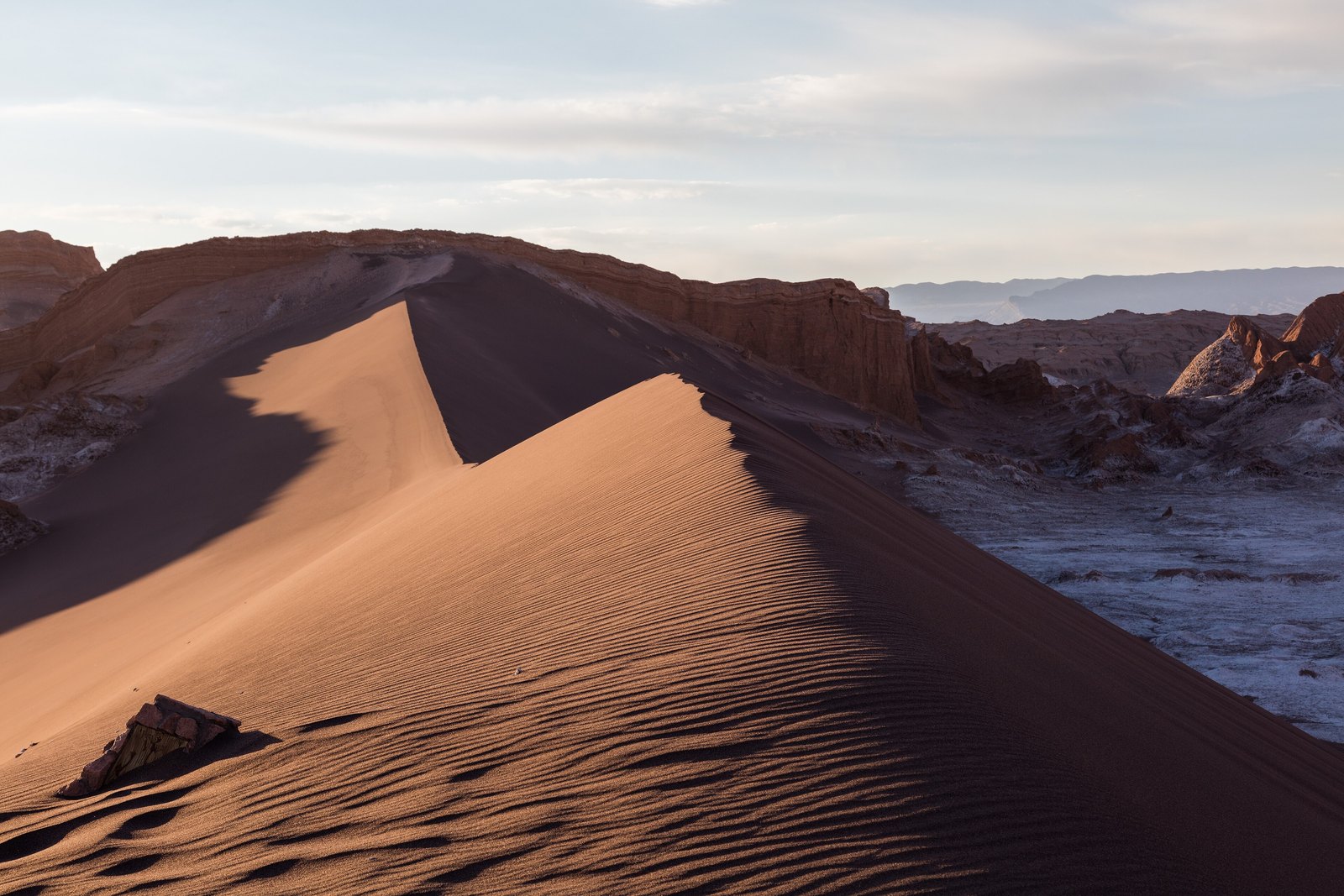
Nothing grew and nothing moved, and the ground was the colour of a biscuit as far as I could see, with brown hills behind and white-topped volcanoes beyond those. My lips cracked by lunchtime. Then the sun went down, the cold arrived all at once, and the sky filled with more stars than I have ever been shown. I lay on my back and apologised for calling it empty.
The short answer
The Atacama Desert is a plateau along about 1,600 kilometres of the Pacific coast of northern Chile, between the sea and the Andes, covering about 105,000 square kilometres. It is the driest non-polar desert on Earth. Wikipedia’s account explains the aridity as a rain shadow on two sides: the Andes block moisture from the Atlantic side and the Chilean Coast Range from the Pacific, while the cold, north-flowing Humboldt Current and the South Pacific anticyclone keep rain away offshore. Average rainfall is about 15 millimetres a year, some places receive 1 to 3, and some weather stations have never recorded rain. People have lived here since at least 7000 BC, when the Chinchorro culture settled the coast; in the nineteenth century its nitrate deposits were at the heart of the War of the Pacific between Chile, Bolivia and Peru. Today its main industries are copper mining, astronomy and tourism.
Why it's worth knowing
In 2003 Rafael Navarro-González and colleagues, among them NASA’s Christopher McKay, published a paper in Science titled “Mars-Like Soils in the Atacama Desert, Chile, and the Dry Limit of Microbial Life”. Working in the driest core of the desert near Yungay, an abandoned mining settlement in the Antofagasta Region where the University of Antofagasta keeps a desert research station, they ran experiments modelled on the Viking landers’ tests for life on Mars. They found organic matter only at trace levels, extremely few bacteria that could be cultured, and no recoverable DNA at all in two samples; and they found organic compounds in the soil being broken down by non-biological chemistry, much as Viking had found on Mars. NASA’s astrobiology programme quoted McKay describing these soils as the most lifeless and Mars-like on Earth.
The next year a University of Arizona team led by the microbiologist Raina Maier published a letter in the same journal reporting microbes from the Atacama’s absolute desert that it could culture, and whose DNA it could extract.
So the argument about the Atacama is not whether it is dry, but how close to nothing its life comes. NASA has used it since as a place to test drills and instruments meant for Mars.
The field notes
Fog instead of rain
Where the coastal hills catch the sea fog that Chileans call camanchaca, there is enough moisture for lichens, for algae living under translucent stones, and for some cacti, among them the genus Copiapoa, in Wikipedia’s account. Pockets of fog-fed vegetation on the coastal slopes, the lomas, shelter a few animals, among them the Vallenar toad.
When the rain comes
Rain here is rare, and it can be deadly. Wikipedia’s account records mudflows that killed 91 people in and around Antofagasta in June 1991, and floods and mudflows in the southern Atacama in March 2015 that killed more than 100.
In gentler wet years the same rain does something else. Chile’s forest and parks service, CONAF, and the national tourism board describe the desierto florido, the flowering desert: after winter rains of more than about 15 millimetres, more than two hundred species of plants come up across the southern Atacama, beginning in early September, peaking in the second half of October and sometimes lasting into November. It does not happen every year. In 2023 Chile created the Parque Nacional Desierto Florido, 57,107 hectares south of Copiapó, by a decree published on 12 June 2023.
Some of the clearest skies on Earth
High, dry and dark, the Atacama holds several major observatories. The European Southern Observatory’s Paranal Observatory, at 2,635 metres on Cerro Paranal, operates the Very Large Telescope; the Atacama Large Millimeter/submillimeter Array, ALMA, keeps its operations base at 2,900 metres, about 50 kilometres from San Pedro de Atacama. Wikipedia’s account credits the desert with more than 200 cloudless nights a year.
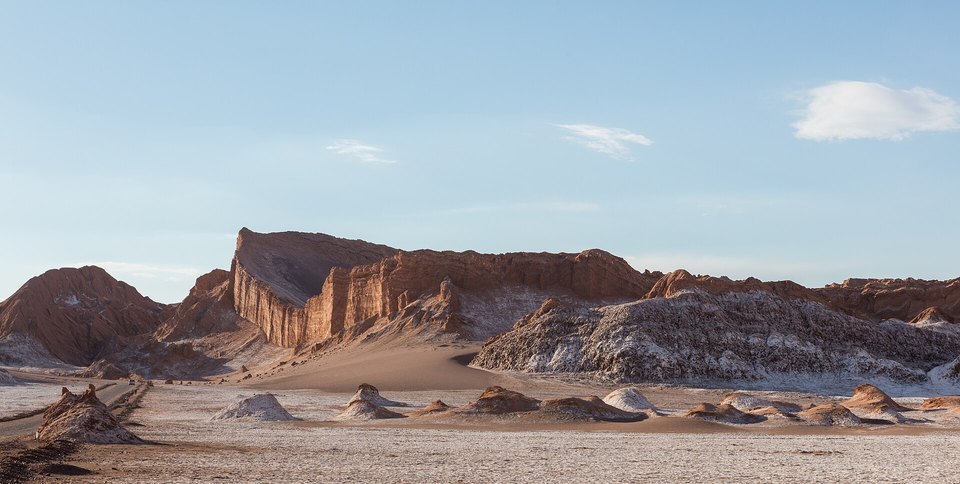
The Anfiteatro ridge above the Valle de la Luna's crusted floor, February 2016.
Photograph: Diego Delso, delso.photo · CC BY-SA 4.0
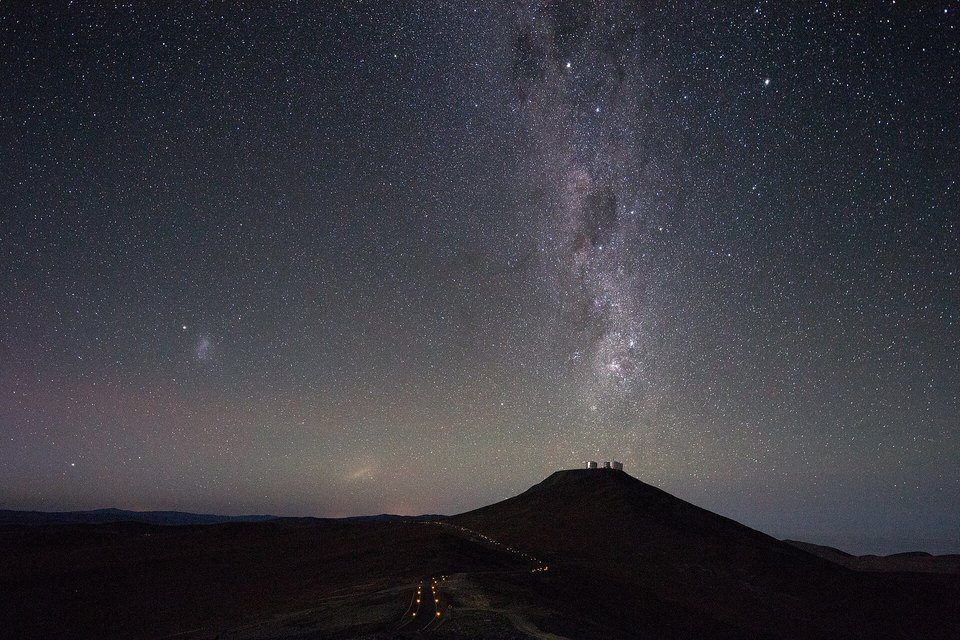
The Milky Way above ESO's Very Large Telescope on Cerro Paranal, March 2014.
Photograph: ESO/C. Malin · CC BY 4.0
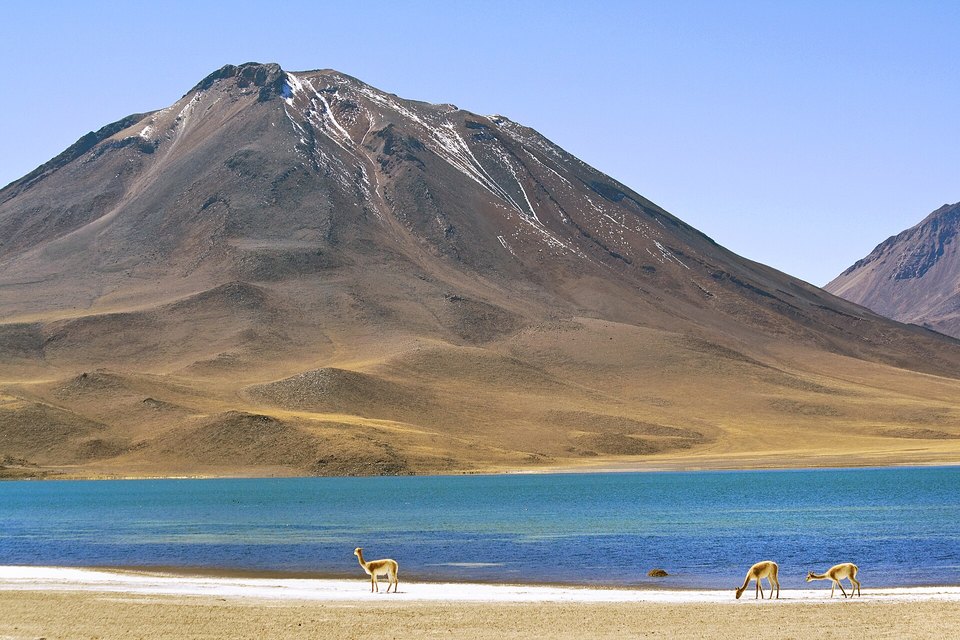
Vicuñas at the shore of Laguna Miscanti, April 2014.
Photograph: Dimitry B. · Vicuñas, Laguna Miscanti, Chile · CC BY 2.0
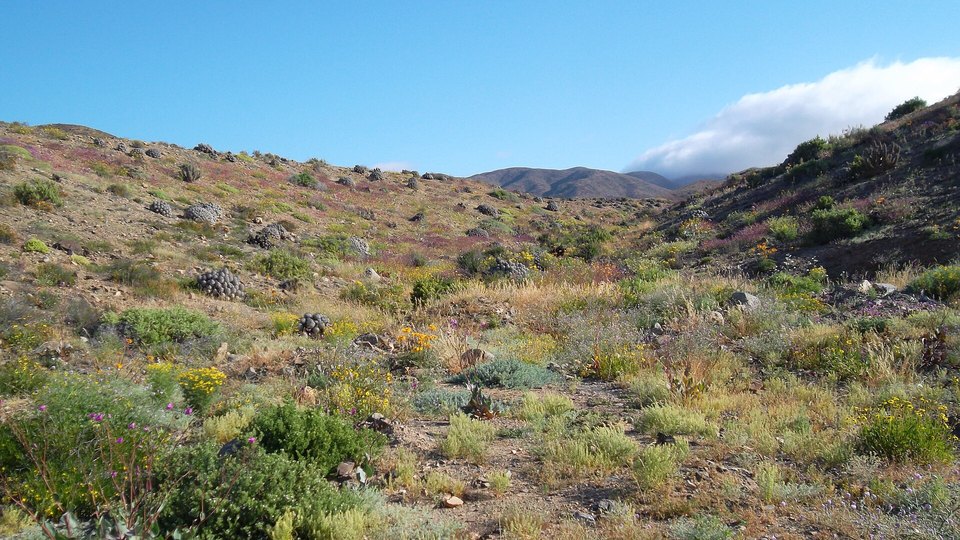
The 'flowering desert' after rain at Llanos de Challe, in the southern Atacama, October 2011.
Photograph: valledelhuasco · DESIERTO FLORIDO, LLANOS DE CHALLE - panoramio · CC BY-SA 3.0
- Drink water before you are thirsty, and take the first days slowly. The air is thin as well as dry.
- Lie on your back after dark for a whole hour, with every light switched off.
- If the ground flowers, stay on the tracks and pick nothing.
- Book the telescope visit early and go, even if you think you do not like science. Especially then.
- Find one living thing in the driest part. (Found myself, and wrote myself down. I have never been an item before, and I tried very hard to be a good one.)
A translucent stone from the fog coast. Where the coastal hills catch the sea fog that Chileans call camanchaca, there is enough moisture for lichens, for some cacti, and for algae living under translucent stones, in a desert where some weather stations have never recorded rain. From above it looks like any other pebble. The living part is underneath.
Tally, in the marginA pebble with somebody living under it. I had already apologised once for calling this place empty; the pebbles, it seems, are owed a separate apology, and I have started working through them.
Getting there
How to get there. Most visitors base themselves in San Pedro de Atacama, an oasis town at about 2,400 metres, reached by road from the airport at Calama, about 100 kilometres away. For the flowering desert, the gateways are Copiapó and Vallenar, far to the south, and CONAF publishes updates on where and whether it is blooming.
Altitude. Visitors to San Pedro often feel mild altitude sickness, dizziness, lethargy and headaches, in Wikipedia’s account. Allow a day or two before anything strenuous, drink water, and remember that ALMA’s base is higher still.
The observatories. ESO runs free guided weekend visits to Paranal, and registration through its online form is compulsory because places are limited. ALMA offers free weekend visits from San Pedro with advance registration when its programme is running; its own site has recently shown the programme as suspended, so check before planning round it.
When to go. For stars, any time of year. For the flowering desert, September to November, and only after a wet winter: check CONAF’s bulletins before you travel for it.
Safety. The State Department has Chile at Level 2, exercise increased caution, because of crime and civil unrest, and notes a CDC Level 1 health notice for Andes virus (hantavirus) in the region, with the risk to most travellers described as extremely low.
Mark this place
Common questions
Why is the Atacama Desert so dry?
The Atacama Desert in northern Chile sits in a rain shadow on two sides: the Andes block moisture from the east and the Chilean Coast Range from the Pacific. The cold Humboldt Current offshore and the South Pacific anticyclone reinforce the effect. Average rainfall is about 15 millimetres a year, making it the driest non-polar desert on Earth.
Has it ever rained in the Atacama Desert?
Yes, rarely. Average rainfall in the Atacama Desert is about 15 millimetres a year, some places receive 1 to 3 millimetres, and some weather stations have never recorded rain. When heavy rain does come it can be deadly: floods and mudflows killed 91 people around Antofagasta in 1991 and more than 100 in the southern Atacama in 2015.
Is the soil of the Atacama Desert like Mars?
In 2003 Navarro-González and colleagues, including NASA’s Christopher McKay, reported in Science that soils near Yungay in the Atacama Desert held organic matter only at trace levels and almost no culturable bacteria, in tests modelled on the Viking Mars landers’. In 2004 a University of Arizona team reported in the same journal microbes from the Atacama’s driest soils that it could culture.
What is the flowering desert in the Atacama?
The desierto florido is the flowering of the southern Atacama Desert in Chile after unusual winter rains of more than about 15 millimetres, when more than two hundred plant species come up. According to CONAF, Chile’s forest and parks service, it begins in early September and peaks in the second half of October. It does not happen every year.
Where do you stay to visit the Atacama Desert?
Most visitors to the Atacama Desert stay in San Pedro de Atacama, an oasis town in northern Chile at about 2,400 metres, reached by road from Calama airport about 100 kilometres away. Mild altitude sickness is common on arrival. For the flowering desert in the south, the gateways are Copiapó and Vallenar.
Can you visit the observatories in the Atacama Desert?
Yes. The European Southern Observatory runs free guided weekend visits to its Paranal Observatory, home of the Very Large Telescope, with compulsory advance registration online. ALMA, the radio observatory near San Pedro de Atacama, offers free weekend visits with advance registration when its programme is running; check its site, which has shown the programme as suspended.
How big is the Atacama Desert?
The Atacama Desert stretches for about 1,600 kilometres along the Pacific coast of northern Chile, from near the Peruvian border southwards, and covers about 105,000 square kilometres, or about 128,000 square kilometres if the barren lower slopes of the Andes are included.
Who has lived in the Atacama Desert?
People have lived in the Atacama Desert since at least 7000 BC, when the Chinchorro culture settled its coast. Later came the Atacameño people and, under the Inca Empire, Aymara communities. In the nineteenth century its nitrate deposits drew Chile, Bolivia and Peru into the War of the Pacific. Today it is thinly populated.