
- Where
- West of Sydney
New South Wales, Australia - Coordinates
- 33.7320° S
150.3120° E - Landform
- Sandstone plateau and gorges
up to about 1,300 m - Status
- Greater Blue Mountains Area
UNESCO World Heritage 2000 - Eucalypts
- 91 eucalypt taxa, per UNESCO
- Wollemi pine
- Found 1994
46 adults and 43 juveniles in the wild - Best visited
- Autumn for walking
any season for the lookouts
Took the train up out of the heat and got off into cold air that smelled of cough sweets. The edge of town stopped at an orange cliff, and below it grey-green treetops ran to the horizon under a haze so blue it looked painted on. White birds with yellow crests shouted about it. I stood at the rail and understood the name at once, which almost never happens.
The short answer
The Blue Mountains rise west of Sydney in New South Wales, and most of them lie within the Greater Blue Mountains Area, a World Heritage property of about 1.03 million hectares inscribed by UNESCO in 2000 and made up of seven national parks and the Jenolan Karst Conservation Reserve. UNESCO describes it as sandstone plateaux, escarpments and gorges dominated by temperate eucalypt forest. The towns strung along the ridge, Katoomba among them, are about two hours from Sydney by train. The World Heritage Area spans the Country of six Aboriginal peoples: the Darkinjung, Dharawal, Dharug, Gundungurra, Wiradjuri and Wonnarua.
Why it's worth knowing
The Blue Mountains are not mountains in the usual sense. They are a sandstone plateau, rising from less than 100 metres above sea level to about 1,300, that rivers have cut down into, leaving cliffs, escarpments and deep valleys. Stand at a lookout in Katoomba and the ground you are standing on is the old surface; the valley below is where it has been carved away.
The blue comes from the trees. The CSIRO, Australia’s national science agency, attributes the haze to isoprene given off by eucalypts: in the air it drives chemical reactions that form fine particles, and particles that size scatter blue light more than red or yellow. Wikipedia’s account of the World Heritage Area puts it slightly differently, as evaporated eucalyptus oil scattering the light; both explanations lead back to the forest.
And the World Heritage listing is for that forest. UNESCO inscribed the area for the evolution and diversity of the eucalypts in Australia’s long isolation after Gondwana: 91 eucalypt taxa grow within it. The Blue Mountains owe their trees twice: the name comes from the colour the trees give off, and the World Heritage listing is for the trees themselves.
In 1994 the plateau turned out to be keeping a different tree. David Noble, a National Parks and Wildlife Service officer exploring the canyons of Wollemi National Park, part of the World Heritage Area, came upon a stand of tall pines with fern-like leaves and lumpy bark that nobody could identify. According to the Botanic Gardens of Sydney, the Wollemi pine’s ancestors may have grown in the wet forests of eastern Australia from the Jurassic, about 200 million years ago, and on the fossil record scientists had thought the tree extinct for about two million years. The wild population is now 46 adult trees and 43 juveniles, in a single canyon whose location is kept secret.
The field notes
A secret, defended
Access to the wild grove is restricted to the few people managing, studying and monitoring it. The NSW National Parks and Wildlife Service says unauthorised visits risk trampling seedlings, damaging roots and bringing in weeds and pathogens such as Phytophthora cinnamomi, a root rot that has already been found in the wild population. The site was the first in New South Wales to be declared an Asset of Intergenerational Significance, which the Service describes as the strongest legal protection in the state’s national parks.
In the 2019–20 bushfires, fire reached Wollemi National Park. National Parks and Wildlife Service firefighters, working with the Rural Fire Service and air tankers, protected the grove, and the NSW Government reported the mission a success. Across the wider World Heritage Area the fires burned widely; preliminary reports cited by Wikipedia put the burned share at up to 80 per cent by January 2020.
Whose Country
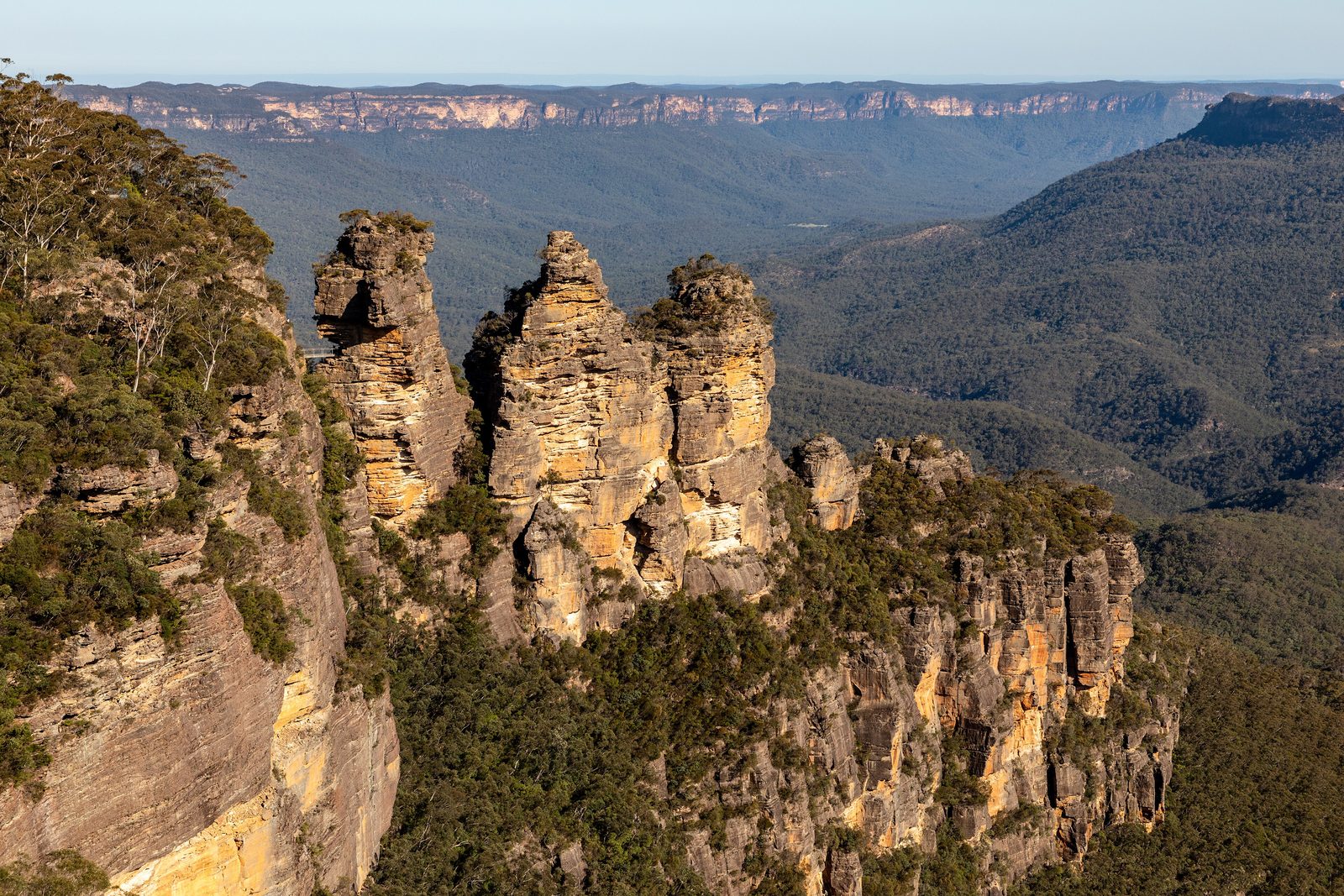
The NSW Government lists six Aboriginal peoples whose Country the World Heritage Area spans. The Three Sisters, the three sandstone pillars beside Echo Point in Katoomba, are a declared Aboriginal Place, and the National Parks and Wildlife Service names the Gundungurra and Darug peoples as its traditional custodians.
The Service records a Gundungurra creation story in which Gurangatch, a great eel-like being, was chased by Mirragan, a quoll, and their struggle gouged out the courses of the Wollondilly and Coxs rivers and the caves nearby. This entry leaves the stories of the Three Sisters to their custodians; guided walks with Aboriginal guides are the place to hear them.
Cut down, not pushed up
Wikipedia gives the Three Sisters as the product of erosion of Triassic sandstone, what the weather and the rivers have left of the cliff line. Basalt caps some of the higher ridges. The valleys below hold tall eucalypt forest and, in the most sheltered gorges, temperate rainforest.
The steepest way down at Katoomba is the Scenic Railway, an incline that began as part of the mining tramways built between 1878 and 1900 to bring coal and shale up the cliff; it now carries visitors instead.
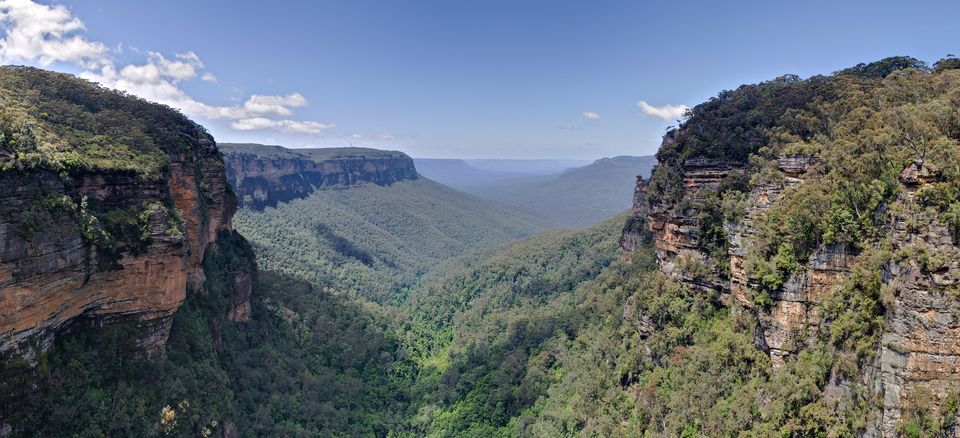
The Jamison Valley from a lookout, a stitched three-frame panorama, November 2008.
Photograph: David Iliff · Jamison Valley, Blue Mountains, Australia - Nov 2008 · CC BY-SA 3.0
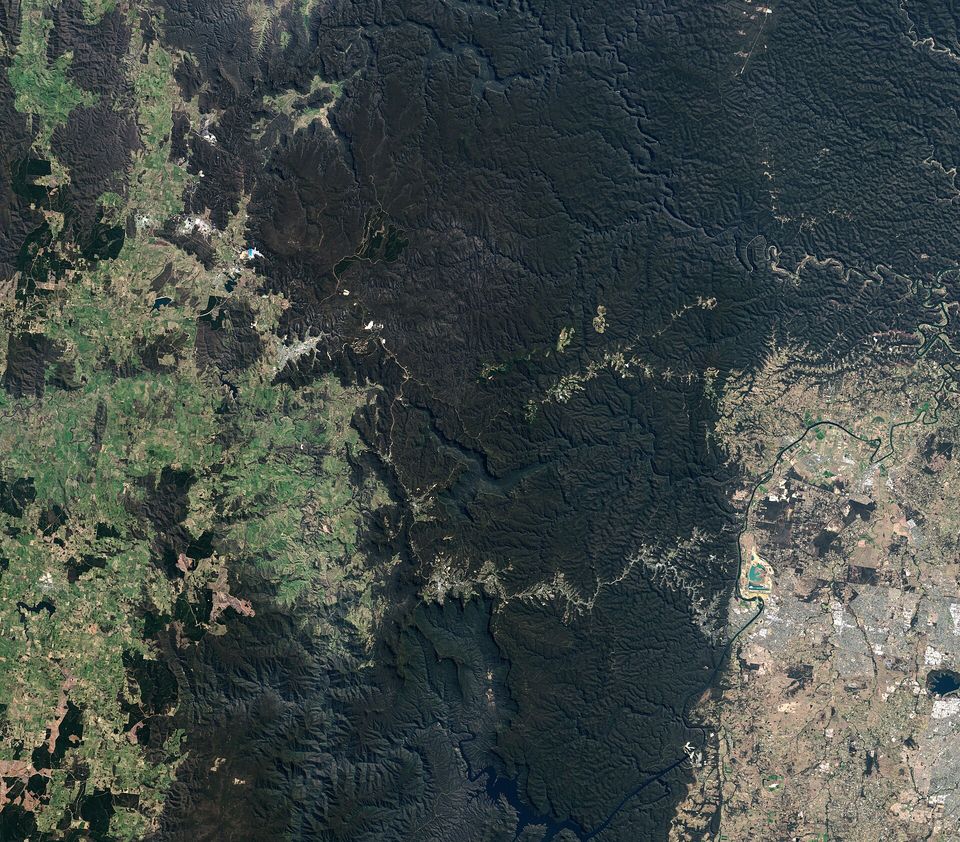
The dissected plateau from Landsat, 13 September 2000: dark eucalypt forest cut by gorges, with cleared land beyond its edges.
Satellite image: Jesse Allen and Robert Simmon, NASA Earth Observatory · Public domain
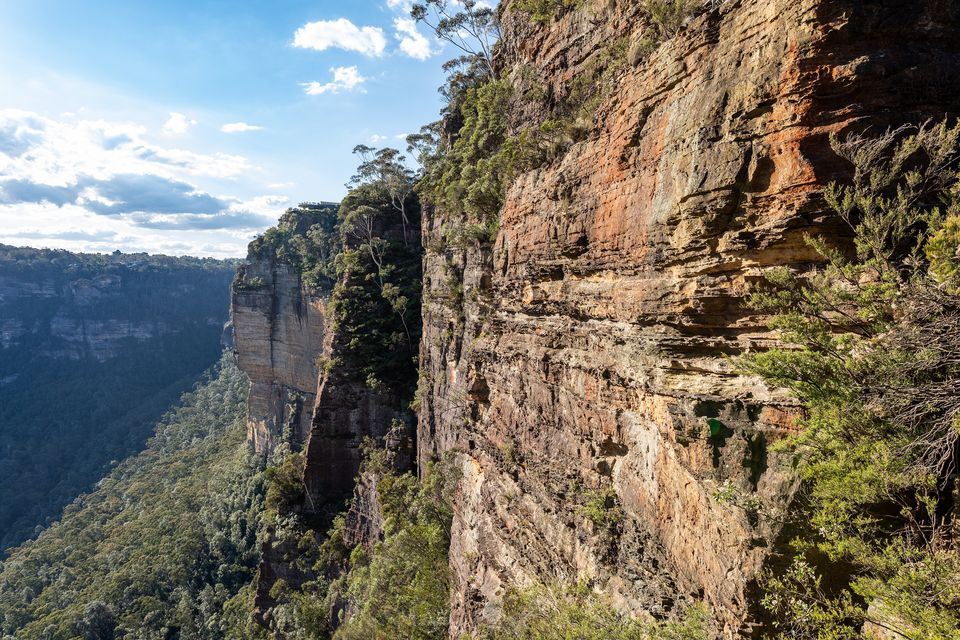
A sandstone cliff face in the Jamison Valley, October 2019.
Photograph: Dietmar Rabich / Wikimedia Commons · CC BY-SA 4.0
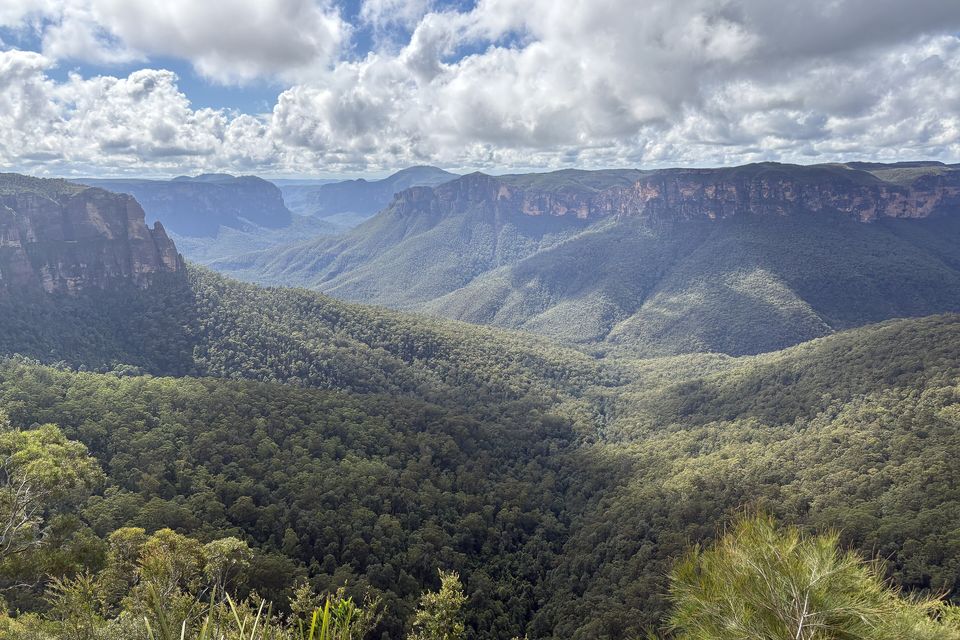
The Grose Valley from Govetts Leap lookout, Blackheath, March 2026.
Photograph: Dylanmayfuller · CC0 · cropped
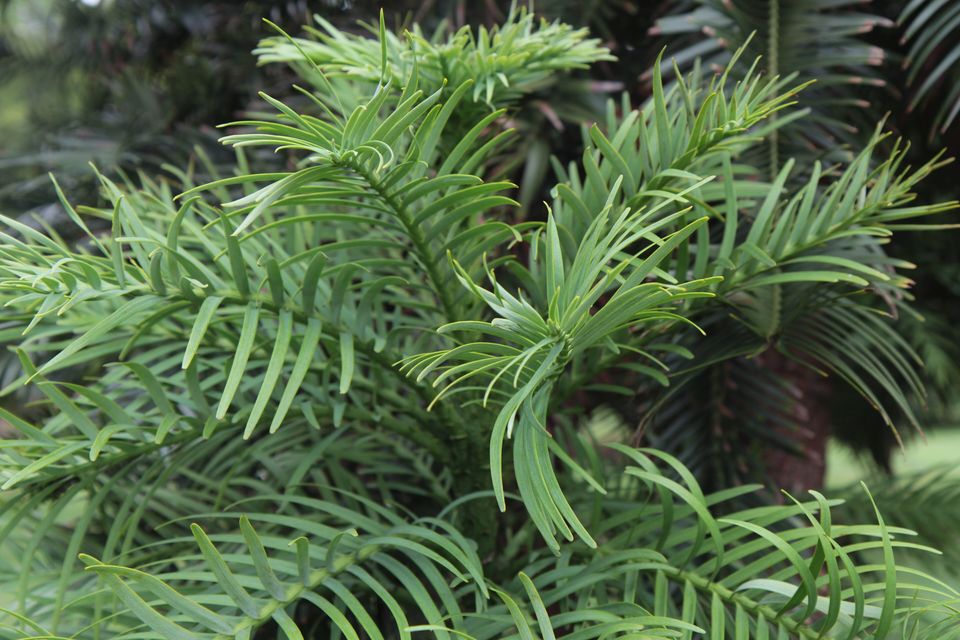
Foliage of a cultivated Wollemi pine at Kew Gardens, London, July 2016. The wild grove’s location is kept secret.
Photograph: Jonathanischoice · CC BY 4.0
- Get off the train, walk to the edge, and stand there longer than feels necessary.
- Go down into a valley at least once. The cliffs look different from underneath.
- At the three stone sisters, find out whose Country you are standing on, and leave their stories to the people they belong to.
- Visit the shy tree where it is allowed to be seen, and leave the wild ones to themselves.
- Walk every track on the map. (Map turned over. More tracks. Item moved to next visit, and the one after that.)
A Wollemi pine in a garden. The wild grove is closed to all but the handful of people who look after it, so the species was saved partly by being sent out: the Botanic Gardens of Sydney records that the first cultivated trees were auctioned at Sotheby’s in 2005 and reached nurseries in 2006, and a back-up collection grows at the Blue Mountains Botanic Garden at Mount Tomah. The tree you can stand beside, labelled, with a path to it, is the one that was sent into the open so that the others could stay hidden.
Tally, in the marginThe shyest tree in the world, living in the open with a label on it. I walked past it twice looking for something that seemed more ancient.
Getting there
How to get there. Trains run daily from Sydney Central to Katoomba, a trip of about two hours, and a local bus loops from the station past Echo Point to Scenic World. Driving, the Great Western Highway climbs the ridge through the towns. Echo Point lookout in Katoomba is the classic view of the Jamison Valley and the Three Sisters.
Walks. The Three Sisters walk starts at Echo Point. At Blackheath, further up the ridge, the Grand Canyon track descends deep into a canyon of the same name. Tracks into the valleys are steep, with many steps; carry water and allow for the climb back.
When to go. The National Parks and Wildlife Service calls the Katoomba area a year-round destination and recommends autumn for bushwalking and as the best and safest time for introductory canyoning and abseiling tours. In summer, check fire danger ratings and park alerts before walking.
To see a Wollemi pine. Not in the wild. A back-up collection grows at the Blue Mountains Botanic Garden at Mount Tomah, north of the main ridge, and the tree is planted in botanic gardens around the world.
Mark this place
Common questions
Why are the Blue Mountains blue?
Because of the eucalypts. The CSIRO, Australia’s national science agency, attributes the blue haze over the Blue Mountains in New South Wales to isoprene given off by eucalypt forest, which drives reactions in the air that form fine particles; particles that size scatter blue light more than other colours. Wikipedia’s account of the World Heritage Area describes the cause as evaporated eucalyptus oil.
Are the Blue Mountains mountains?
Not in the usual sense. UNESCO describes the Greater Blue Mountains Area in New South Wales as sandstone plateaux, escarpments and gorges. The plateau rises from under 100 metres to about 1,300 metres above sea level, and its cliffs and valleys were made by rivers cutting down into it rather than by rock being pushed up into peaks.
What is the Wollemi pine?
A tree discovered in 1994 by David Noble, a National Parks and Wildlife Service officer, in a canyon of Wollemi National Park in the Greater Blue Mountains Area of New South Wales. According to the Botanic Gardens of Sydney, its ancestors date back to the Jurassic, and on the fossil record scientists had thought it extinct for about two million years. The wild population is 46 adults and 43 juveniles.
Can you visit the Wollemi pines in the wild?
No. The location of the only wild population of the Wollemi pine, in the Greater Blue Mountains Area, is secret, and the NSW National Parks and Wildlife Service restricts access to essential staff because visitors could spread root rot and damage seedlings. Cultivated Wollemi pines can be seen at the Blue Mountains Botanic Garden at Mount Tomah and in botanic gardens elsewhere.
How did the Wollemi pines survive the 2019–20 bushfires?
They were defended. When the 2019–20 bushfires reached Wollemi National Park in the Blue Mountains, NSW National Parks and Wildlife Service firefighters, working with the Rural Fire Service and supported by air tankers, protected the secret grove of Wollemi pines, and the NSW Government reported the operation a success.
Why are the Blue Mountains a World Heritage Site?
UNESCO inscribed the Greater Blue Mountains Area in 2000 chiefly for its eucalypts: 91 eucalypt taxa grow in the area, which UNESCO says represents the evolution and diversification of the eucalypts in Australia’s isolation after Gondwana. It also protects relict species such as the Wollemi pine. The property covers about 1.03 million hectares in eight protected areas.
Whose Country are the Blue Mountains?
The Greater Blue Mountains World Heritage Area spans the Country of six Aboriginal peoples, according to the NSW Government: the Darkinjung, Dharawal, Dharug, Gundungurra, Wiradjuri and Wonnarua. The Three Sisters at Katoomba are a declared Aboriginal Place, whose traditional custodians the National Parks and Wildlife Service names as the Gundungurra and Darug peoples.
How do you get to the Blue Mountains from Sydney?
By train or car. Trains run daily from Sydney Central station to Katoomba in the Blue Mountains, a trip of about two hours, and a local bus loops from Katoomba station to Echo Point, the lookout for the Three Sisters. By car, the Great Western Highway climbs the ridge through the mountain towns.