
- Where
- Port Campbell National Park
Great Ocean Road, Victoria, Australia - Coordinates
- 38.6656° S
143.1042° E - The stacks
- Nine at the start of this century
seven now (Parks Victoria) - Rock
- Limestone 8.6–14 million years old
stacks shaped since the last ice age - Offshore
- Five drowned stacks, 50 m down
6 km out (found 2016) - Country
- Eastern Maar
native title recognised 2023 - Best visited
- Late afternoon to dusk
penguins come ashore after sunset
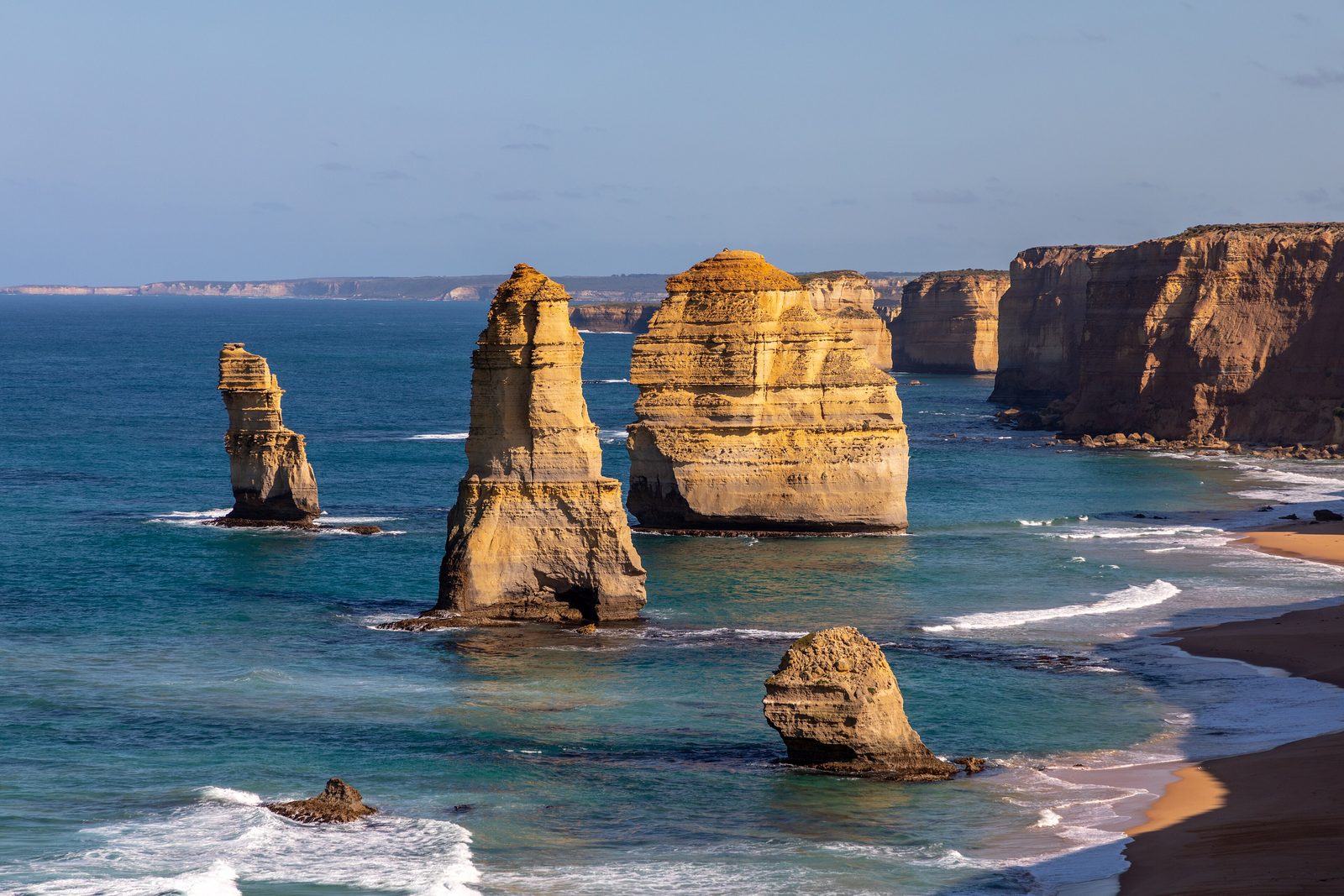
Wind straight off the bottom of the world, a clifftop of low heath, and below it a row of tall honey-coloured stone towers standing in a rough white sea. I counted them. Then I counted again and got a different number, and the man beside me got a third. At dusk small penguins came ashore on the beach below, very late for something, and nobody counted those.
The short answer
The Twelve Apostles are a group of limestone sea stacks standing off the cliffs of Port Campbell National Park, beside the Great Ocean Road in Victoria, south-eastern Australia. Parks Victoria says there were never twelve: there were nine at the beginning of this century, and it now counts seven. The ABC gives their height as up to 45 metres. The coast is the Country of the Eastern Maar people, whose native title over much of it the Federal Court recognised in 2023. The viewing platforms are a short walk from the visitor centre, and the stacks are best seen late in the day.
Why it's worth knowing
The name was a sales pitch from the start. The stacks were first known as the Pinnacles, and as the Sow and Piglets: the Sow was Muttonbird Island, at the mouth of Loch Ard Gorge, and the Piglets were the stacks along the coast. Parks Victoria says there were never twelve stacks here and that they were not always called the Apostles; Wikipedia records that the name was made official to attract more tourists, although there had only ever been nine.
They are younger than they look, too. In 2026 geologists at the University of Melbourne, publishing in the Australian Journal of Earth Sciences, used microscopic fossils to date the limestone to between 8.6 and 14 million years old. Tectonic movement lifted and tilted those layers out of the sea over millions of years, but the university says it was only in the last few thousand years, after the last ice age, that the waves exposed and shaped the pillars that stand there now.
And the sea has made Apostles before. In 2016 Rhiannon Bezore, a doctoral student, with David Kennedy of the University of Melbourne and Daniel Ierodiaconou of Deakin University, found five limestone stacks in sonar maps of the sea floor, 6 kilometres offshore and 50 metres under water. Bezore said they probably date back 60,000 years. They survived, the team argued in the Journal of Coastal Research, because the sea rose after the last ice age so quickly that it submerged them before waves could knock them down; the university described them as the first such stacks found preserved in the ocean. The only extra Apostles anyone has found are underwater, and they lasted by drowning.
The field notes
Counting
At 9.18 in the morning on 3 July 2005, one of the stacks collapsed into the sea; the ABC’s report that day said it left eight standing. Another stack fell in September 2009. The Great Ocean Road Coast and Parks Authority and Parks Victoria’s visitor pages now count both collapses among the Apostles, leaving seven, but at the time Parks Victoria told the ABC that the 2009 stack was the smallest of the Three Sisters, a separate group seen from the Razorback lookout near Loch Ard, and not an Apostle at all.
So the number depends on who is counting, which rocks they include, and in which year. Wikipedia adds that six of the seven can be seen from the most popular viewpoint.
A coast that keeps rearranging itself
The Authority describes limestone cliffs up to 60 metres high taking a prevailing south-westerly swell, with softer limestone wearing away into stacks, caves, arches, tunnels and blowholes. The usual sequence is cave, then arch, then stack, then rubble, and Wikipedia notes that today’s headlands are expected to become the next stacks.
It happens in public. On the evening of 15 January 1990 the landward span of London Bridge, a double natural arch near Port Campbell, west of the Apostles, fell into the sea and left two tourists stranded on the outer span; a police helicopter lifted them off, and no one was hurt.
The road, and whose Country
The Great Ocean Road runs 240 kilometres from Torquay to Allansford near Warrnambool. About 3,000 returned servicemen built it, mostly by hand, between 1919 and 1932, and it was dedicated to those killed in the First World War; it is on Australia’s National Heritage List, and Wikipedia calls it the largest war memorial in the world.
The coast it follows is Eastern Maar Country. On 28 March 2023, at a ceremonial sitting on a clifftop at Logan’s Beach in Warrnambool, the Federal Court recognised Eastern Maar native title over much of the Great Ocean Road coastline, including rights to access, use and protect the land under traditional law and custom, according to the Victorian Government’s First Peoples–State Relations office. Eastern Maar people had pursued the claim since 2012.
The fee
On 9 March 2026 the Victorian Government announced a fee for visitors to the new Twelve Apostles visitor centre, due to open at the end of 2026, with a booking system to manage numbers and guarantee parking at peak times. The ABC reported that the amount would be set after consultation with councils, operators and Traditional Owners, and that local residents and Eastern Maar people would not be charged. The government says the fee will help fund upgrades to tourist sites in the south-west.
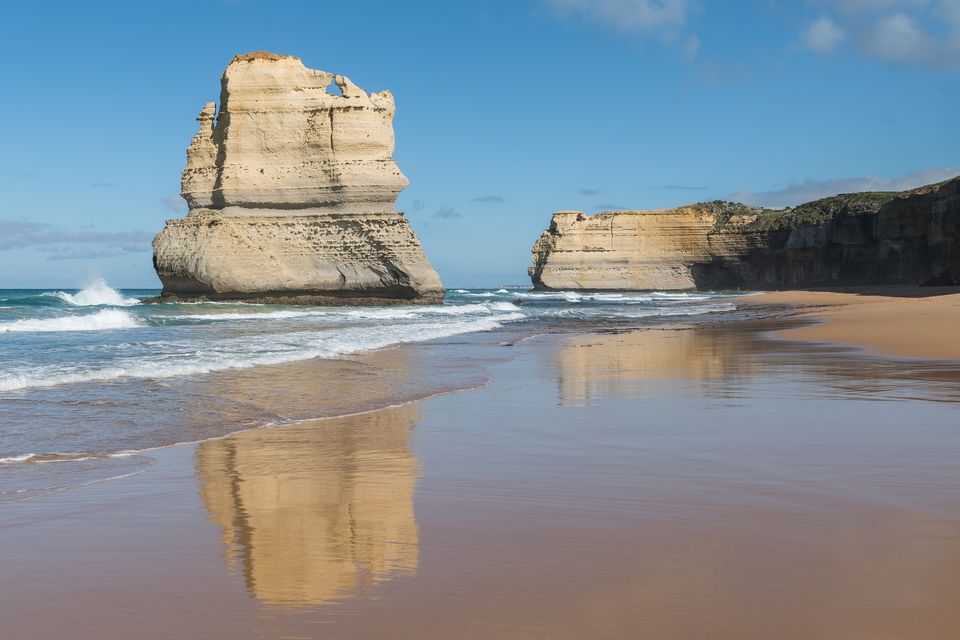
A limestone stack and its reflection at Gibson Beach, Port Campbell National Park, February 2023.
Photograph: DXR · CC BY-SA 4.0
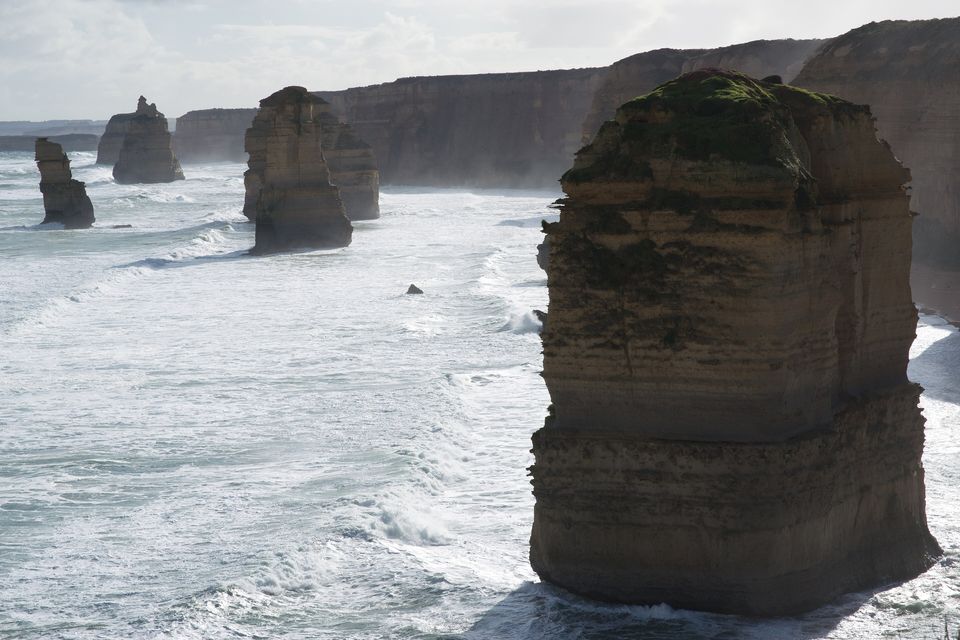
The layered limestone of one stack, with more stacks and the cliff line behind, July 2014.
Photograph: Jorge Láscar · The Twelve Apostles - Port Campbell National Park (19198552720) · CC BY 2.0
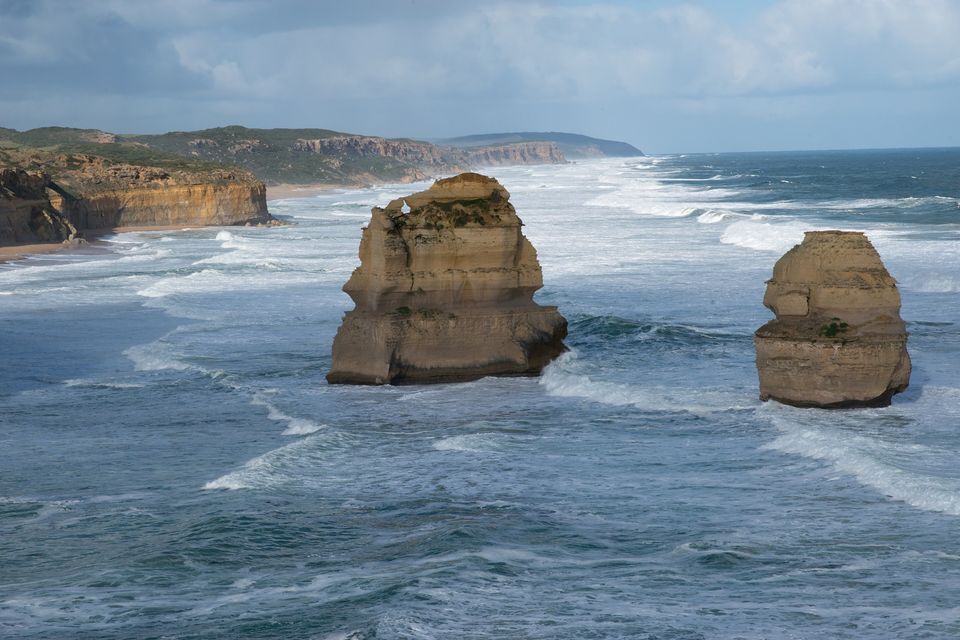
Two stacks in heavy surf, with the coast running away behind them, July 2014.
Photograph: Jorge Láscar · The Twelve Apostles (18767218483) · CC BY 2.0
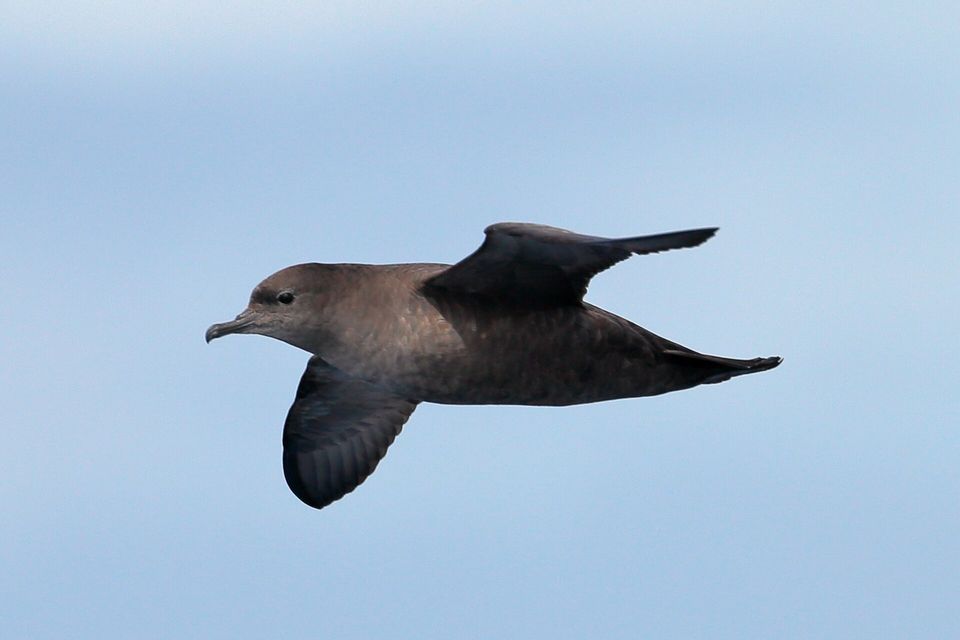
A short-tailed shearwater at sea off Port Fairy, further west along this coast, January 2016: the bird that flies in to the Sow at dusk.
Photograph: Ed Dunens · Short-tailed Shearwater (24236106362) · CC BY 2.0
- Come at the end of the day, stay past sunset, and bring something warm.
- Keep behind the fences. The edge is still being made.
- Find out whose Country this is before you reach the lookout, and say thank you when you get there.
- At dusk, look down instead of out. Something small is coming home.
- Count them. (Counted three times. Three answers. Item retained, with a note to count the penguins instead.)
The Sow. At the mouth of Loch Ard Gorge, a few minutes west of the Apostles, stands Muttonbird Island. Parks Victoria records that it was once called the Sow, when the stacks along the coast were her Piglets and nobody had thought of apostles. It has a bird’s name now. From October to April, short-tailed shearwaters that have flown a migration loop Parks Victoria puts at 30,000 kilometres, out to far-eastern Russia and Alaska and back, return to their burrows on it at dusk, in their thousands, to feed their chicks. The famous stacks get the photographs; the Sow gets the birds.
Tally, in the marginA rock that lost its name to a better story, and every evening its family comes home to it anyway. I was busy with the famous ones when they flew in over my head.
Getting there
How to get there. The Apostles are near the western end of the Great Ocean Road, which runs 240 kilometres from Torquay, south-west of Melbourne, to Allansford near Warrnambool. Driving the road with stops takes a long day; day tours run from Melbourne, and the inland highways make a quicker return. The viewing platforms are a short walk from the visitor centre.
The fee. A visitor fee and booking system are planned for the new visitor centre, due to open at the end of 2026. The amount had not been announced at the time of writing. Check the Great Ocean Road Coast and Parks Authority before you go.
When to go. Late afternoon into dusk, for the light on the stacks. Little penguins come ashore on the beach below after sunset, and Parks Victoria suggests looking down from the viewing platform to see them; binoculars help. From October to April, short-tailed shearwaters return to Muttonbird Island at Loch Ard Gorge at dusk.
On the cliffs. Keep to the paths and behind the fences. The cliffs are eroding and parts collapse without warning, so obey any closure.
Nearby. The Gibson Steps lead down to the beach just east of the Apostles. Loch Ard Gorge and London Bridge lie a few minutes west.
Mark this place
Common questions
How many of the Twelve Apostles are left?
Seven, by Parks Victoria’s count. Parks Victoria says there were nine limestone stacks at the Twelve Apostles, in Port Campbell National Park, Victoria, at the start of this century, and that collapses in 2005 and 2009 have left seven. In 2009, though, Parks Victoria told the ABC that the stack that fell that year was one of the nearby Three Sisters rather than an Apostle.
Why are they called the Twelve Apostles if there were never twelve?
Because the name was chosen for visitors. The stacks off Port Campbell were earlier known as the Pinnacles and as the Sow and Piglets, with Muttonbird Island as the Sow. Parks Victoria says there were never twelve; Wikipedia records that the name Twelve Apostles was made official to attract tourists, though there had only ever been nine.
What are the Drowned Apostles?
Five limestone sea stacks about 50 metres under water and 6 kilometres off the Great Ocean Road near the Twelve Apostles, found in sonar maps in 2016 by Rhiannon Bezore, David Kennedy of the University of Melbourne and Daniel Ierodiaconou of Deakin University. Bezore said they probably date back 60,000 years; they survived because the sea rose fast enough to submerge them before they eroded.
How old are the Twelve Apostles?
The rock is old and the stacks are young. In 2026 University of Melbourne geologists dated the limestone of the Twelve Apostles, using microscopic fossils, to between 8.6 and 14 million years old. The university says the pillars themselves were exposed and shaped by the sea only in the last few thousand years, after the last ice age.
When did one of the Twelve Apostles collapse?
At 9.18 in the morning on 3 July 2005, according to the Great Ocean Road Coast and Parks Authority, a stack of the Twelve Apostles in Port Campbell National Park collapsed into the sea; the ABC reported that day that eight were left standing. Another stack fell in 2009, which Parks Victoria now counts among the Apostles.
Do you have to pay to see the Twelve Apostles?
A fee is planned. On 9 March 2026 the Victorian Government announced a fee and booking system for the new Twelve Apostles visitor centre, due to open at the end of 2026, with the amount to be set after consultation. The ABC reported that local residents and Eastern Maar people would be exempt. Check the Great Ocean Road Coast and Parks Authority before travelling.
Who are the Traditional Owners of the Twelve Apostles coast?
The Eastern Maar people. On 28 March 2023 the Federal Court of Australia, sitting at Logan’s Beach in Warrnambool, recognised Eastern Maar native title over much of the Great Ocean Road coastline, according to the Victorian Government, including rights to access, use and protect the land under traditional law and custom. Wikipedia states that the area includes the Twelve Apostles.
Can you see penguins at the Twelve Apostles?
Yes, at dusk, from above. Little penguins come ashore after sunset on the beach below the Twelve Apostles, and Parks Victoria suggests looking down from the viewing platform to see them. They are small and the light is low, so binoculars help.