
- Where
- Magelang Regency, Central Java,
about 40 km north-west of Yogyakarta - Coordinates
- 7.6079° S
110.2038° E - Built
- 8th–9th centuries AD
- Form
- Six square platforms and three round,
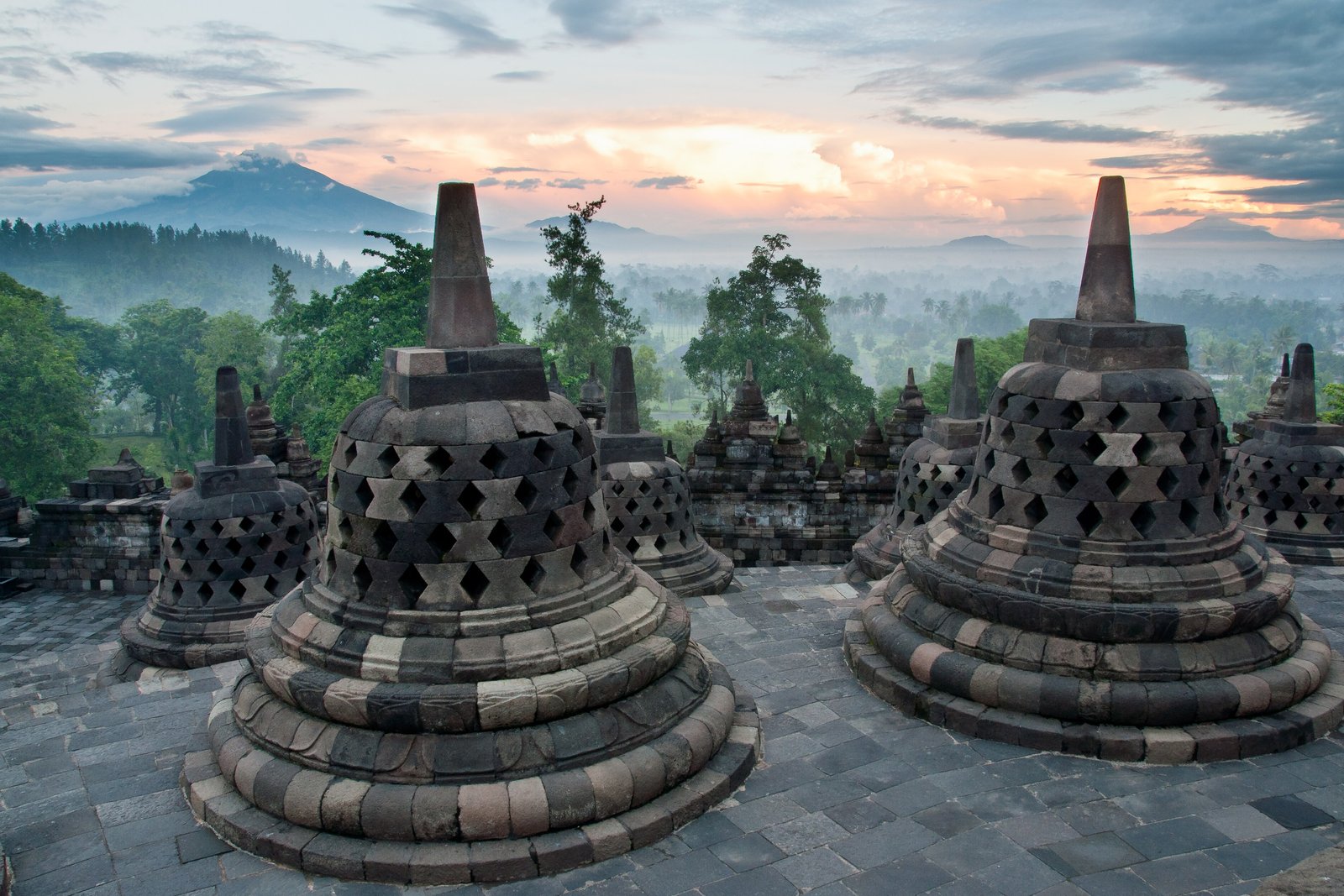
72 latticed stupas round a central one - The hidden foot
- 160 panels, found 1885,
photographed 1890–91, covered again - Status
- UNESCO World Heritage, 1991,
with Mendut and Pawon - Climbing
- Separate ticket; guided,
by quota, in upanat sandals
Came up out of the palms and the mist in the dark, and climbed a hill of grey carved stone, round and round, past walls of stories I could not read. At the top, stone bells with little windows, and inside each one somebody sitting very still. Volcanoes all round. A call to prayer drifted up from a village below. I sat down too, as still as I could manage.
The short answer
Borobudur is a Mahayana Buddhist monument on a hill in the Kedu Plain of Central Java, Indonesia, about 40 kilometres north-west of Yogyakarta, between the twin volcanoes Sindoro–Sumbing and Merbabu–Merapi. UNESCO dates it to the 8th and 9th centuries; Wikipedia’s account ties its building to the Sailendra dynasty. It is built as nine stacked platforms, six square and three circular, under a central stupa, and Wikipedia counts 2,672 relief panels and originally 504 statues of the Buddha, 72 of them seated inside perforated stupas on the circular terraces. UNESCO inscribed it in 1991 together with two smaller temples, Mendut and Pawon, which stand to the east on a straight line with it. It is still a place of worship: at Vesak, in May or June, Indonesian Buddhists walk in procession from Mendut by way of Pawon to Borobudur.
Why it's worth knowing
The monument was built to be walked. Pilgrims enter from the east and circle it clockwise, climbing gallery by gallery; Wikipedia’s account traces about 3 kilometres of narrative reliefs, in eleven series, along the way. The first series ought to come first. It is not there to see.
It is underneath. In 1885 the Dutch engineer Jan Willem IJzerman, chairman of the Archaeological Society in Yogyakarta, found that the monument’s base enclosed a hidden foot. Behind the outer stonework were carved panels illustrating the Karmawibhangga, a text on the law of karma: cause and effect. Borobudur’s own conservation office, the Balai Konservasi Borobudur, records that there are 160 of them, that the photographer Kassian Cephas photographed them all in 1890 and 1891, and that the foot was then closed again. Today only the south-east corner is uncovered.
The first chapter of Indonesia’s most visited monument is known to nearly everyone who comes here through one photographer’s plates. His prints are displayed in the Karmawibhangga Museum, a few hundred metres north of the temple.
Why the foot was covered is not settled. Some of the hidden panels are unfinished, and a few carry short inscriptions that appear to be instructions for the carvers. Wikipedia sets out two kinds of explanation: a practical one, that the builders feared the structure would slide outwards and added a wider base to hold it, and various religious or symbolic ones.
The field notes
What the hidden panels show
The 160 panels do not tell one continuous story. In Wikipedia’s description each is a complete illustration of cause and effect: gossip and murder with their punishments, charity and pilgrimage with their rewards, the pains of hell and the pleasures of heaven. The conservation office notes that the carvers also portrayed many sides of everyday life in Java in their own time, which makes the buried reliefs a picture of ninth-century Javanese life as well as a sermon.
The photographer
Kassian Cephas, who made the 1890–91 photographs, is described by the Borobudur conservation office as a bumiputera, a native Javanese photographer, and credited with documenting Borobudur, Mendut and Pawon. The covering stones were taken down so that the whole series could be photographed, and then put back. His photographs are how the full series is known.
A million stones, numbered
Borobudur lay under volcanic ash and jungle for centuries; when and why it was abandoned is not known. Wikipedia’s history has Stamford Raffles, who governed Java for Britain from 1811 to 1816, told in 1814 of a great monument in the jungle near the village of Bumisegoro. He sent the engineer Hermann Cornelius, whose 200 men took two months to clear it; Raffles never went himself. Restorations followed, the largest between 1975 and 1982, when the Indonesian government and UNESCO dismantled more than a million stones, catalogued and cleaned them, and set them back with new drainage built into the structure.
Hands that point the way
The Buddhas are not all alike. Wikipedia’s account notes that the statues in the niches of the square terraces make different hand gestures, mudras, according to the direction they face, while those in the latticed stupas at the top all make the same one. More than 300 of the original 504 statues are damaged, most of them headless, and 43 are missing; many of the heads went to museums abroad, and Germany returned its collection in 2014.
Ash and stairs
The monument stands about 28 kilometres from the crater of Merapi. Ash from its eruption of November 2010 settled up to 2.5 centimetres deep on the statues and clogged the drains, and by Wikipedia’s account more than 55,000 blocks were taken apart to clear them. Visitors wear it down too: the stone stairs had grown so thin that the two main stairways were covered with wooden treads from 2014, and everyone who climbs now wears upanat, special sandals issued by the site’s operator.
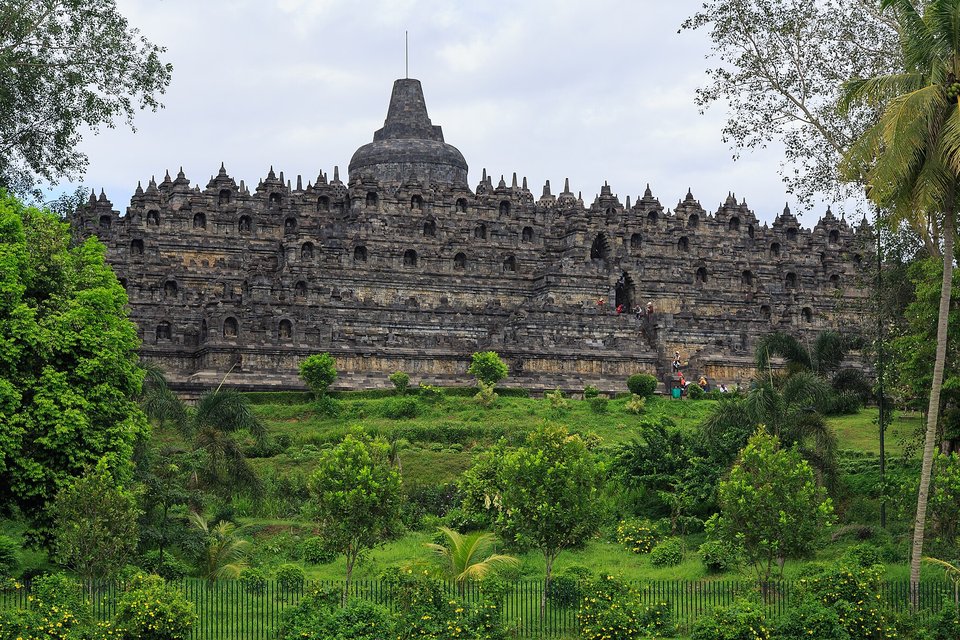
The whole monument seen across the park, February 2015.
Photograph: CEphoto, Uwe Aranas · Borobudur-Temple-Park View of the temple-01 · CC BY-SA 3.0 · cropped
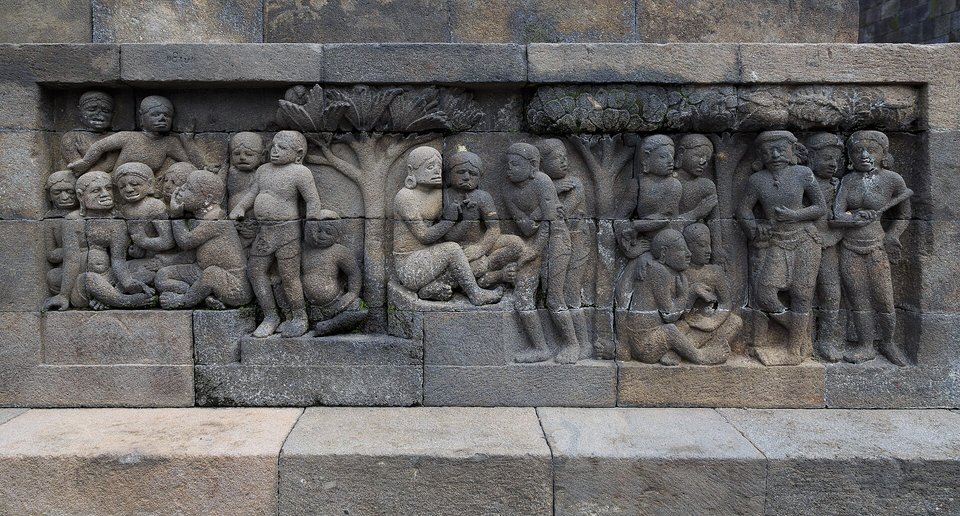
One of the carved narrative relief panels, February 2015.
Photograph: CEphoto, Uwe Aranas · Borobudur-Temple-Park Indonesia Reliefs-of-Borobudur-01 · CC BY-SA 3.0
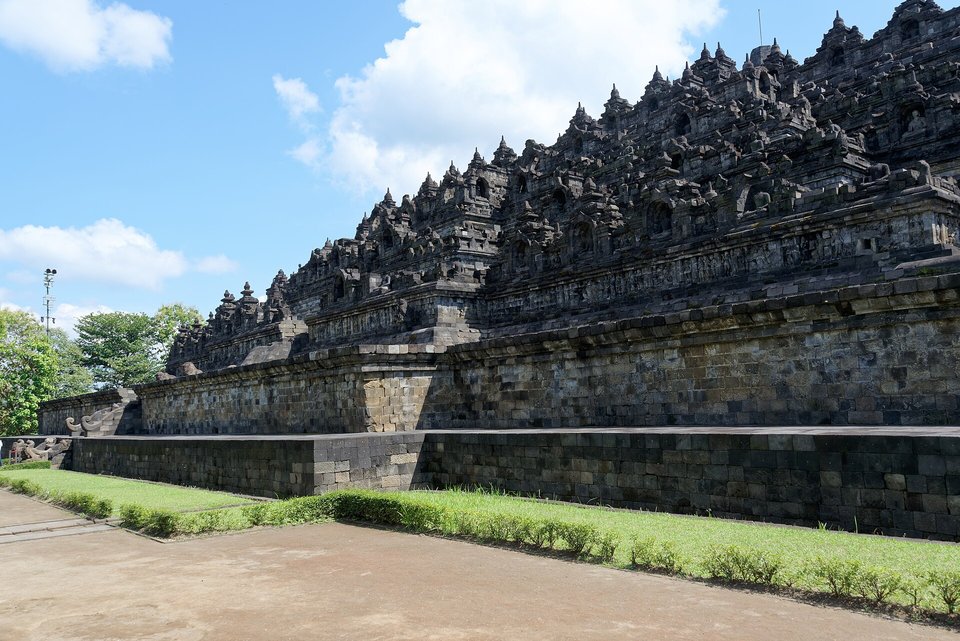
The stepped terraces rising from the base, seen from ground level, August 2022.
Photograph: Jakub Hałun · CC BY-SA 4.0
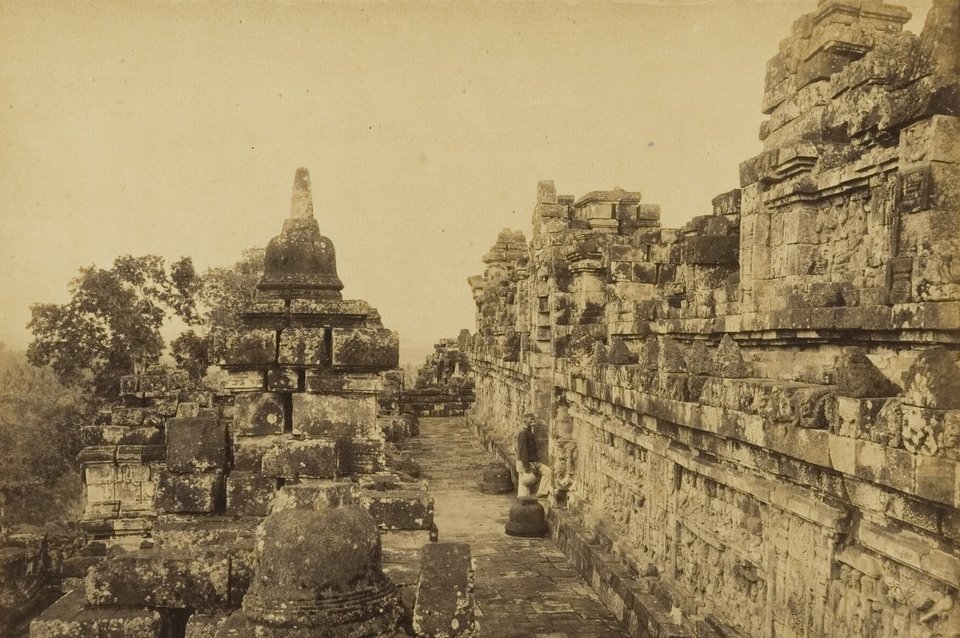
A gallery of the monument before its restoration, with the photographer Kassian Céphas beside the wall, 1889 to 1890 (historic photograph).
Photograph: Kassian Céphas (KITLV) · Public domain · cropped
- Walk round it clockwise, the way the pilgrims do, and fall in behind anyone who has come to pray.
- Put on the soft sandals they give you without argument. The stone has been walked on enough.
- Find the corner where the buried carvings show, and read one panel properly, from the deed to what came of it.
- Look at the hands of the seated figures on each side, and notice that they are not all doing the same thing.
- Walk every gallery on every terrace before adding anything to the list. (Walked them all. The list now reads, in full, ‘again’.)
A carved panel of the hidden foot. One of the 160 Karmawibhangga reliefs round Borobudur’s original base, each a small scene of what people do, and what comes of it. At the south-east corner a stretch of the later base has been left off, and some of the panels can be seen where they were carved; the rest of the first chapter is still behind the stone. At that corner visitors can read it; everywhere else round the monument, they are standing on it.
Tally, in the marginA deed and what came of it, carved in stone and then covered up. Deed: walked right round the bottom admiring the carvings. What came of it: learned at the corner which chapter I had been standing on.
Getting there
How to get there. Most visitors come by road from Yogyakarta, about 40 kilometres to the south-east, which has an international airport. The monument stands in a park run by the state tourism group InJourney through PT Taman Wisata Candi, which sells tickets through its official site; the same site sells tickets for Prambanan.
Two kinds of ticket. The operator sells a courtyard ticket for the grounds round the monument and a separate ticket to climb it. Climbers go up in guided groups at set times, within a daily quota, and must wear the upanat sandals issued with the ticket, which are theirs to keep. Since July 2025 the climb has run every day of the week. The quota was set at 1,200 people a day in 2022, and the operator says it is trialling changes, so book ahead. Small sunrise and sunset sessions, each limited to about 100 people a day, are sold separately.
Vesak. Indonesia’s Buddhists hold their Vesak (Waisak) ceremonies here at the full moon of May or June, with a procession from Mendut by way of Pawon. It is a religious festival first: check the operator’s notices for closures and restrictions on the day, and keep a respectful distance from the ceremonies.
Safety. The United States has Indonesia at Level 2, exercise increased caution, because of natural disasters, unrest and terrorism, and names places of worship among possible targets; its Level 4 areas, Central Papua and Highland Papua, are at the far eastern end of the country. Volcanic ash has closed the monument before. The advisory points travellers to Indonesia’s geological agency for current volcano alerts.
Mark this place
Common questions
What is Borobudur?
Borobudur is a Mahayana Buddhist monument of the 8th and 9th centuries in Magelang Regency, Central Java, Indonesia, built as nine stacked platforms, six square and three circular, under a central stupa. Wikipedia counts 2,672 relief panels and originally 504 statues of the Buddha. UNESCO inscribed it in 1991 together with the nearby temples of Mendut and Pawon.
What is the hidden foot of Borobudur?
The hidden foot is Borobudur’s original base, enclosed by a later band of stonework. Behind it are 160 relief panels illustrating the Karmawibhangga, the law of cause and effect. The Dutch engineer J. W. IJzerman found it in 1885, and the Borobudur conservation office records that Kassian Cephas photographed the panels in 1890–91 before they were covered again.
Can you see the hidden reliefs at Borobudur?
Only in part. At Borobudur in Central Java the later base covers the 160 Karmawibhangga panels except at the south-east corner, where a section is left open. The complete set is known from Kassian Cephas’s photographs of 1890–91, which are displayed in the Karmawibhangga Museum a few hundred metres north of the temple.
Why was the base of Borobudur covered?
The reason the carved foot of Borobudur was encased is not settled. One explanation, set out in Wikipedia’s account, is structural: the builders may have feared the monument would slide outwards, and added a wider base to hold it. Scholars have also proposed religious or symbolic reasons. Some of the hidden panels were left unfinished.
Can you climb Borobudur?
Yes, with a separate climbing ticket. Borobudur’s operator, InJourney’s PT Taman Wisata Candi, runs guided climbs in timed groups under a daily quota, set at 1,200 in 2022, and every climber must wear upanat, sandals that protect the stone. Since July 2025 the climb has been offered every day. A courtyard ticket covers the grounds but not the monument.
Is Borobudur still a place of worship?
Yes. Borobudur in Central Java is used for Buddhist worship and pilgrimage, and each year at the full moon of May or June Indonesian Buddhists celebrate Vesak there, walking in procession from Mendut temple by way of Pawon to Borobudur. Pilgrims circle the monument clockwise as they climb through its galleries.
Who rediscovered Borobudur?
In 1814 Stamford Raffles, then governing Java for Britain, was told of a large monument in the jungle near the village of Bumisegoro, and sent the engineer Hermann Cornelius, whose men cleared it over two months. Wikipedia’s history notes that Raffles never visited the site himself, and that the monument had never been entirely forgotten by the people who lived around it.
How far is Borobudur from Yogyakarta?
Borobudur is about 40 kilometres north-west of the city of Yogyakarta, in Magelang Regency, Central Java, Indonesia. Most visitors make the trip by road from Yogyakarta, which has an international airport. Tickets for the grounds and for the guided climb are sold by the site’s operator, PT Taman Wisata Candi, part of the state tourism group InJourney.