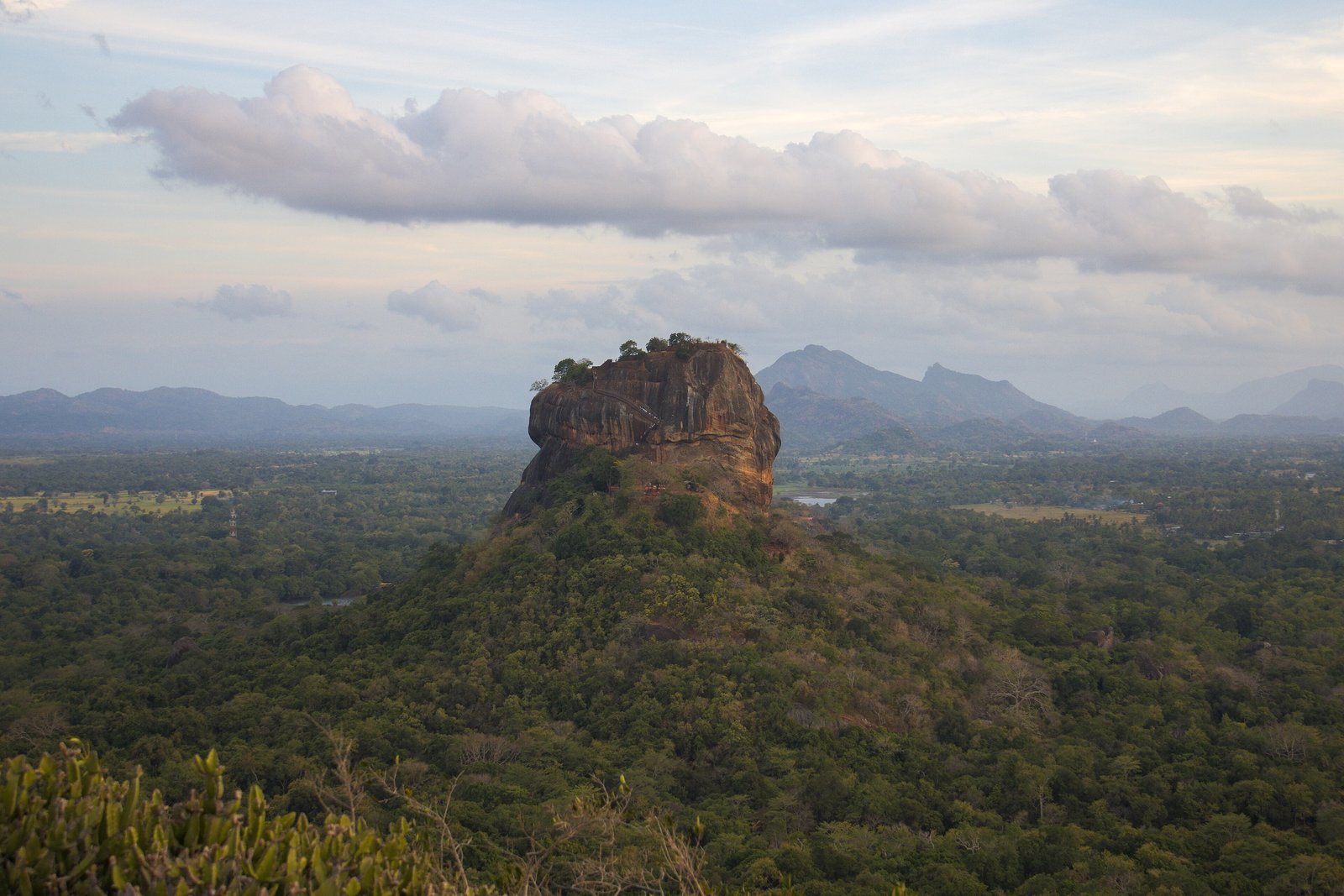

- Where
- Matale District, Central Province,
Sri Lanka, near Dambulla - Coordinates
- 7.9569° N
80.7597° E - The rock
- Granite, about 180 m high
- Capital of
- King Kassapa I,
477–495 - The Mirror Wall
- Verses of the 8th–10th centuries;
685 read by Paranavitana - Status
- UNESCO World Heritage, 1982
- Tickets
- Central Cultural Fund; foreign
visitors’ prices set in US dollars
Came through water gardens and brick ruins towards one enormous rock standing alone in green jungle, climbed between a pair of giant paws and up stairs clinging to the cliff. Painted women in a hollow of the rock, smiling at nobody. A long pale wall covered in tiny old scratched writing. At the top, wind, and the whole green country below. I wrote nothing on anything, and felt proud.
The short answer
Sigiriya is an archaeological site in Matale District, in the Central Province of Sri Lanka, near the town of Dambulla. UNESCO describes it as the ruins of the capital built by King Kassapa I, who reigned from 477 to 495, on the steep slopes and summit of a granite peak about 180 metres high. The way up passed through a gigantic lion of brick and plaster; the head has gone, but the paws remain. Around the base lie gardens, moats and walls, and on the rock face, about 100 metres up, are fifth-century paintings of women. After Kassapa’s death the site became a Buddhist monastery, which Wikipedia’s account says lasted until the 13th or 14th century. UNESCO inscribed it in 1982.
The Sri Lankan chronicle, the Cūḷavaṃsa, says that Kassapa seized the throne from his father, King Dhatusena, and had him killed, and UNESCO’s description calls Kassapa parricidal. Wikipedia sets out other versions, in which his father began the work, or the rock was a Buddhist site with no military purpose.
Why it's worth knowing
The paintings made Sigiriya famous. The people who came to look at them made it talk.
Along the path below the paintings runs the Mirror Wall, a brick wall faced with plaster that, in Wikipedia’s description, was once polished enough to reflect whoever walked beside it. Visitors wrote on it. Most of the surviving verses date from the 9th and 10th centuries, some from the 8th, and they were left by people of every sort; Wikipedia lists poets, provincial governors and housewives among them. Most are addressed to the painted women.
The archaeologist Senarat Paranavitana read 685 of them and published them in the 1950s, in two volumes, as Sigiri Graffiti, subtitled as Sinhalese verses of the eighth, ninth and tenth centuries. The Sunday Times of Sri Lanka reported in 2010 that the epigraphist Benille Priyanka had deciphered about 820 more. Writing on the wall is now banned, to protect what is already there.
Not every visitor was charmed in the same way. One woman, in the translation Wikipedia quotes, complained that a “deer-eyed maiden of the mountain side arouses anger in my mind”. And a man who signs himself Budal recorded that he had come to see Sigiri and that, since everyone else had written poems, he did not. Translations of his lines differ in detail; they agree on the point. More than a thousand years ago, Sigiriya already had a visitor who refused to write in the visitors’ book, and wrote in it to say so.
The field notes
The lion
The name comes from the gateway. According to the Cūḷavaṃsa, as Wikipedia summarises it, Kassapa built a gateway in the form of an enormous lion on a small plateau about halfway up the rock, and the site’s older name, Sinhagiri, the Lion Rock, comes from it. UNESCO describes galleries and staircases emerging from the mouth of a gigantic lion built of bricks and plaster. The head has collapsed. The paws still flank the stairs.
The painted women
UNESCO places the surviving paintings in a recess on the western face of the rock, about 100 metres above the ground, and notes that they are exposed to gradual decay. Wikipedia quotes the writer John Still, in 1907, calling the whole face of the hill “a gigantic picture gallery”, perhaps the largest picture in the world; most of it has been lost. Who the women are is still argued: royal women, in one reading, women taking part in religious observances in another. On 14 October 1967 paint was thrown over them, and the restoration took until April 1968.
Gardens that still work
Below the rock, the water gardens are laid out symmetrically on an east–west axis and linked by underground conduits to the moat and the great artificial lake to the south. Wikipedia’s account describes fountains made of circular limestone plates that still work, especially in the rainy season, and calls Sigiriya’s gardens among the oldest landscaped gardens in the world.
A novelist’s rock
Arthur C. Clarke based Yakkagala, the rock fortress of his novel The Fountains of Paradise, on Sigiriya, and wrote, in the words Wikipedia quotes, that its reality was “so astonishing that I have had no need to change it in any way”.
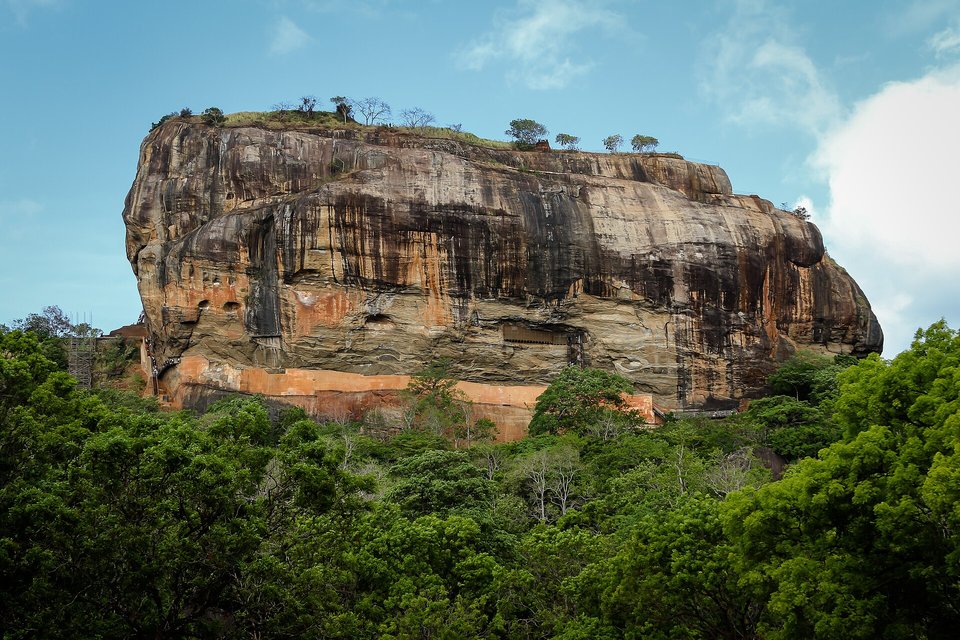
The rock's sheer, streaked face, July 2016.
Photograph: V. Epiney · Sigirîya Lion Rock (36231936082) · CC BY-SA 2.0
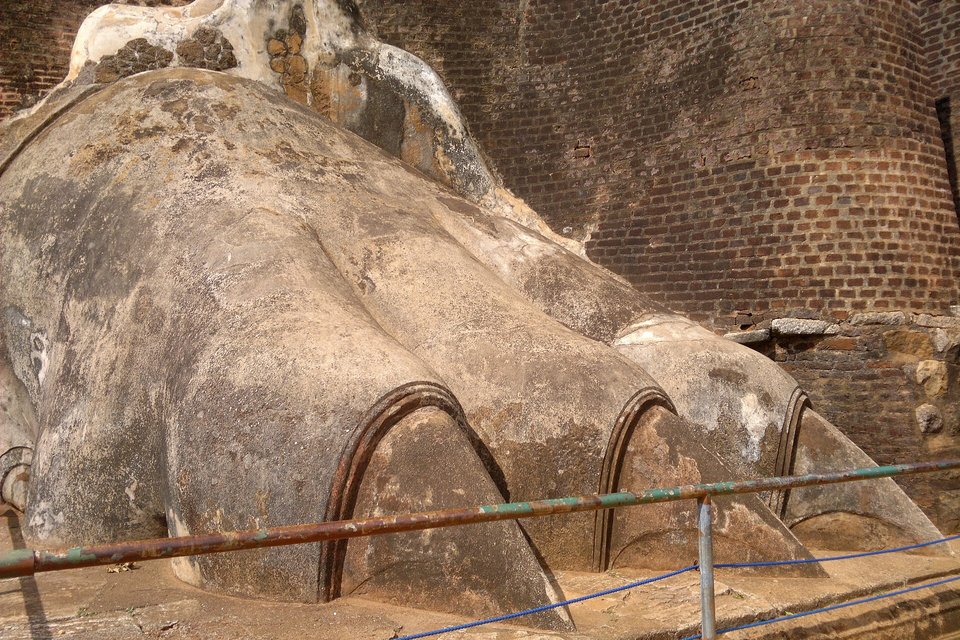
The carved lion's paws at the start of the final climb, August 2011.
Photograph: Venkasub · Lions Paw, Sigirya · CC BY-SA 3.0 · cropped
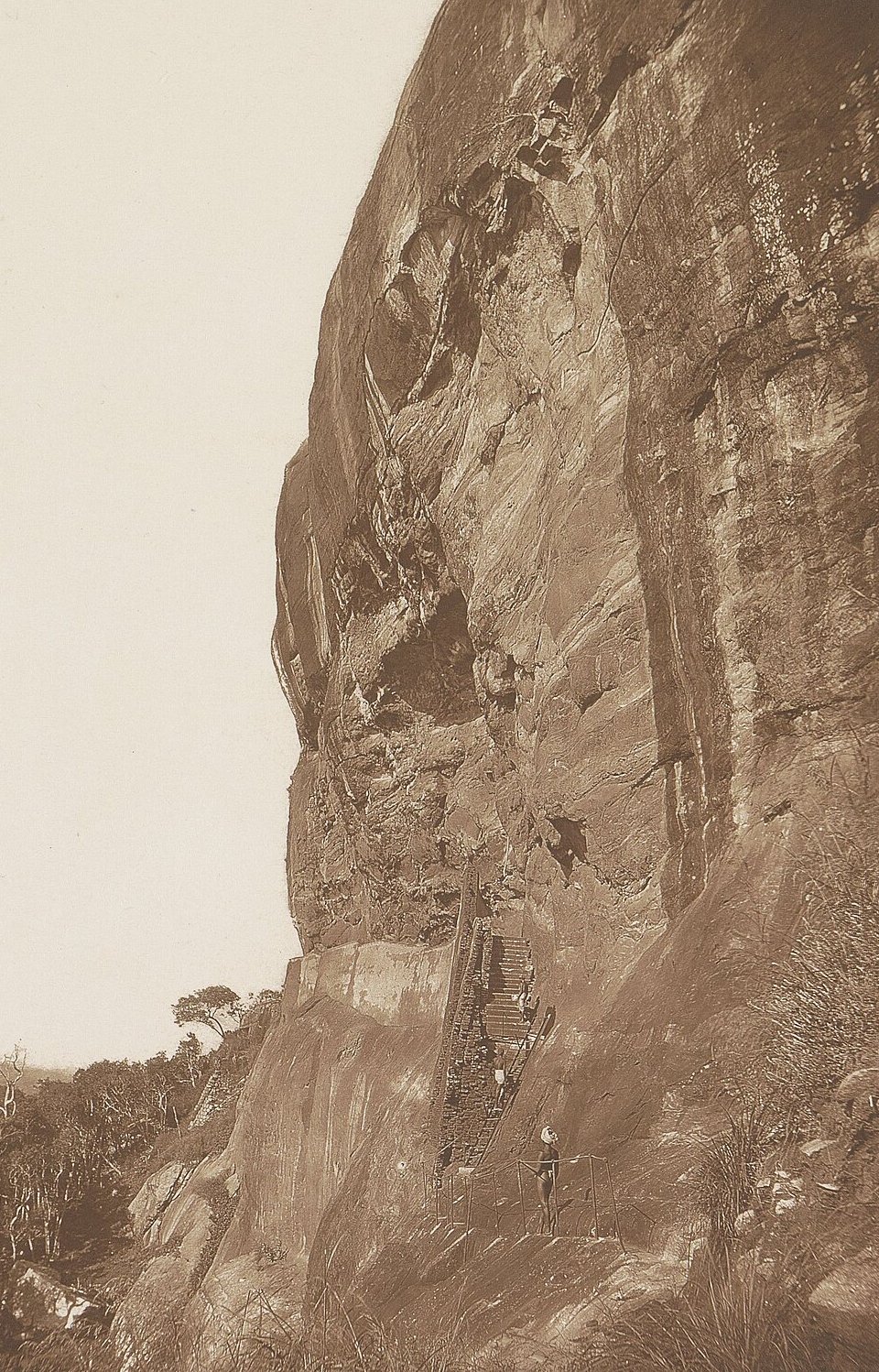
The rock face and the stair to the old gallery, photographed by Henry William Cave, printed 1896 (historic photograph).
Photograph: Henry William Cave (Rijksmuseum) · CC0 · cropped
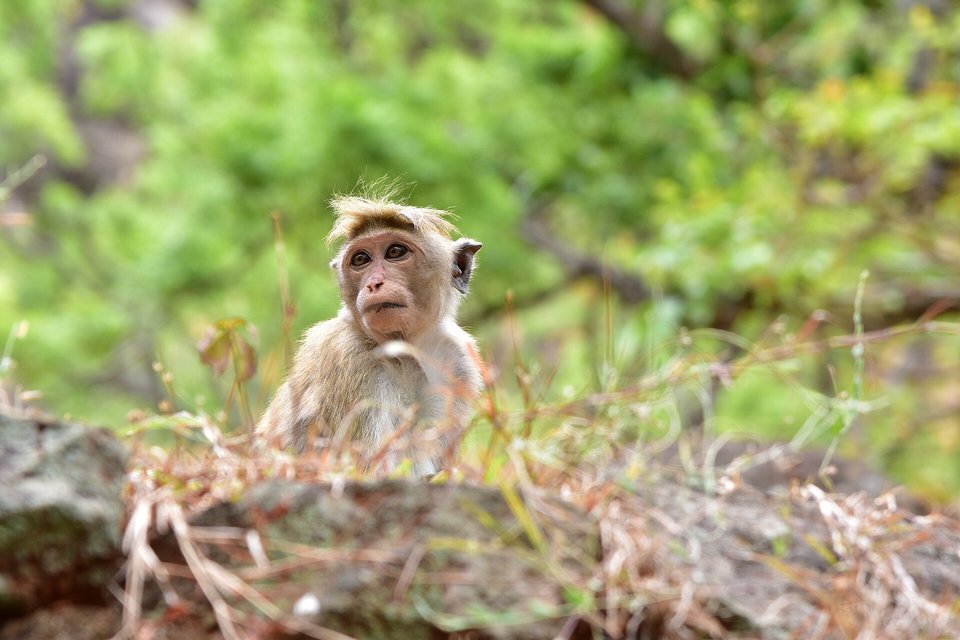
A toque macaque at Sigiriya, August 2018.
Photograph: Ruzi SunJ · CC BY-SA 4.0
- Start up at opening time, before the heat and the crowds decide the day for you.
- Stop between the paws and look up at where the rest of the lion was.
- Read the old wall slowly, and add nothing to it. It is not yours, and it has enough.
- Walk back through the water gardens and see whether a fountain is working.
- Climb the other rock next door at first light, to look back at this one. (Did. From up there I could see the whole of yesterday’s list, and several things it had missed.)
Budal’s verse on the Mirror Wall. Among the hundreds of lines that visitors scratched into the wall’s plaster between the 8th and 10th centuries is a short one signed by a man called Budal. He records that he came to see Sigiri and that, since everyone else had written poems, he did not. The verses around it praise, pine and complain. His declines, on the wall, in writing.
Tally, in the marginA whole wall of people writing poems, and the one I shall remember is the man who declined. I have put this in my notebook instead of on anything older, which I think he would allow.
Getting there
How to get there. Sigiriya is in the interior of Sri Lanka, near Dambulla. Visitors arrive by road, from Colombo, where the international airport is, or from Kandy, and stay in Sigiriya village or around Dambulla. Pidurangala, a second rock about a kilometre to the north, looks back at it.
Tickets. Entry is run by the Central Cultural Fund, which sells tickets at the site and online. Its prices for foreign visitors are set in US dollars and paid in rupees; citizens of SAARC countries pay half. Ticket counters at its heritage sites open from 7 a.m. to 5 p.m. daily. Professional filming and drones need the Fund’s written approval in advance.
The climb. The way to the summit is a long climb by stairs and walkways on the rock, past the paintings and the Mirror Wall to the lion’s paws and the palace ruins on top. Start at opening time, before the heat and the queues build, and follow the guards’ instructions at the paintings.
Safety. The United States has Sri Lanka at Level 2, exercise increased caution, because of unrest, terrorism and landmines; the landmine risk is in the north and east, highest in the northern districts of the Northern Province. Sigiriya is in the Central Province, away from those areas. The advisory names tourist locations among possible terrorist targets.
Mark this place
Common questions
What is Sigiriya?
Sigiriya is an archaeological site in Matale District, Central Province, Sri Lanka: the ruins of the capital built by King Kassapa I, who reigned from 477 to 495, on and around a granite rock about 180 metres high. It has a lion gateway, fifth-century wall paintings, the verse-covered Mirror Wall and water gardens. UNESCO inscribed it in 1982.
Who built Sigiriya?
According to the Sri Lankan chronicle the Cūḷavaṃsa and to UNESCO, King Kassapa I built his capital on and around the rock of Sigiriya during his reign from 477 to 495, after seizing the throne from his father, King Dhatusena. After his death the site became a Buddhist monastery. Wikipedia records other versions, in which Dhatusena began the work.
What is the Mirror Wall at Sigiriya?
The Mirror Wall at Sigiriya, in Sri Lanka, is a brick wall faced with plaster that runs beside the path below the rock’s paintings; Wikipedia describes it as once polished enough to reflect a person walking beside it. Visitors of the 8th to 10th centuries scratched verses into it, most of them addressed to the painted women. Writing on it is now banned.
How many poems are on the Sigiriya Mirror Wall?
More than 1,500. The archaeologist Senarat Paranavitana deciphered 685 verses from the Mirror Wall at Sigiriya, Sri Lanka, and published them in the 1950s as Sigiri Graffiti; the Sunday Times of Sri Lanka reported in 2010 that the epigraphist Benille Priyanka had deciphered about 820 more. Wikipedia gives the total as more than 1,500.
Why is Sigiriya called Lion Rock?
Sigiriya, in Sri Lanka, takes its older name, Sinhagiri or Lion Rock, from a gateway in the form of an enormous lion that King Kassapa I built halfway up the rock, according to the Cūḷavaṃsa. UNESCO describes staircases emerging from the mouth of a gigantic lion of brick and plaster. The head has collapsed; the paws remain.
Can you still see the Sigiriya frescoes?
Yes. The surviving paintings of women at Sigiriya, Sri Lanka, are in a recess on the western face of the rock, about 100 metres above the ground, reached by the stairway to the summit. UNESCO notes that they are slowly deteriorating, and most of the painted gallery once described by the writer John Still has been lost.
How do you buy tickets for Sigiriya?
Tickets for Sigiriya in Sri Lanka are sold by the Central Cultural Fund at the site and through its online booking service. Prices for foreign visitors are set in US dollars and paid in rupees, and citizens of SAARC countries pay half. The Fund’s ticket counters open from 7 a.m. to 5 p.m. daily.
Is Sigiriya safe to visit?
The United States has Sri Lanka at Level 2, exercise increased caution, because of unrest, terrorism and landmines, with the landmine risk in the north and east of the island. Sigiriya is in the Central Province, near Dambulla, away from those areas; the advisory names tourist locations among possible terrorist targets.