
- Where
- Near Selçuk, İzmir Province,
western Türkiye - Coordinates
- 37.9395° N
27.3417° E - River
- Kaystros (Küçük Menderes),
which silted its harbours - Refounded
- About 300 BC by Lysimachus,
on a new site - Library of Celsus
- Begun in the 110s AD;
façade re-erected 1970–1978 - Status
- UNESCO World Heritage, 2015
- Best visited
- Spring and autumn;
early in the day
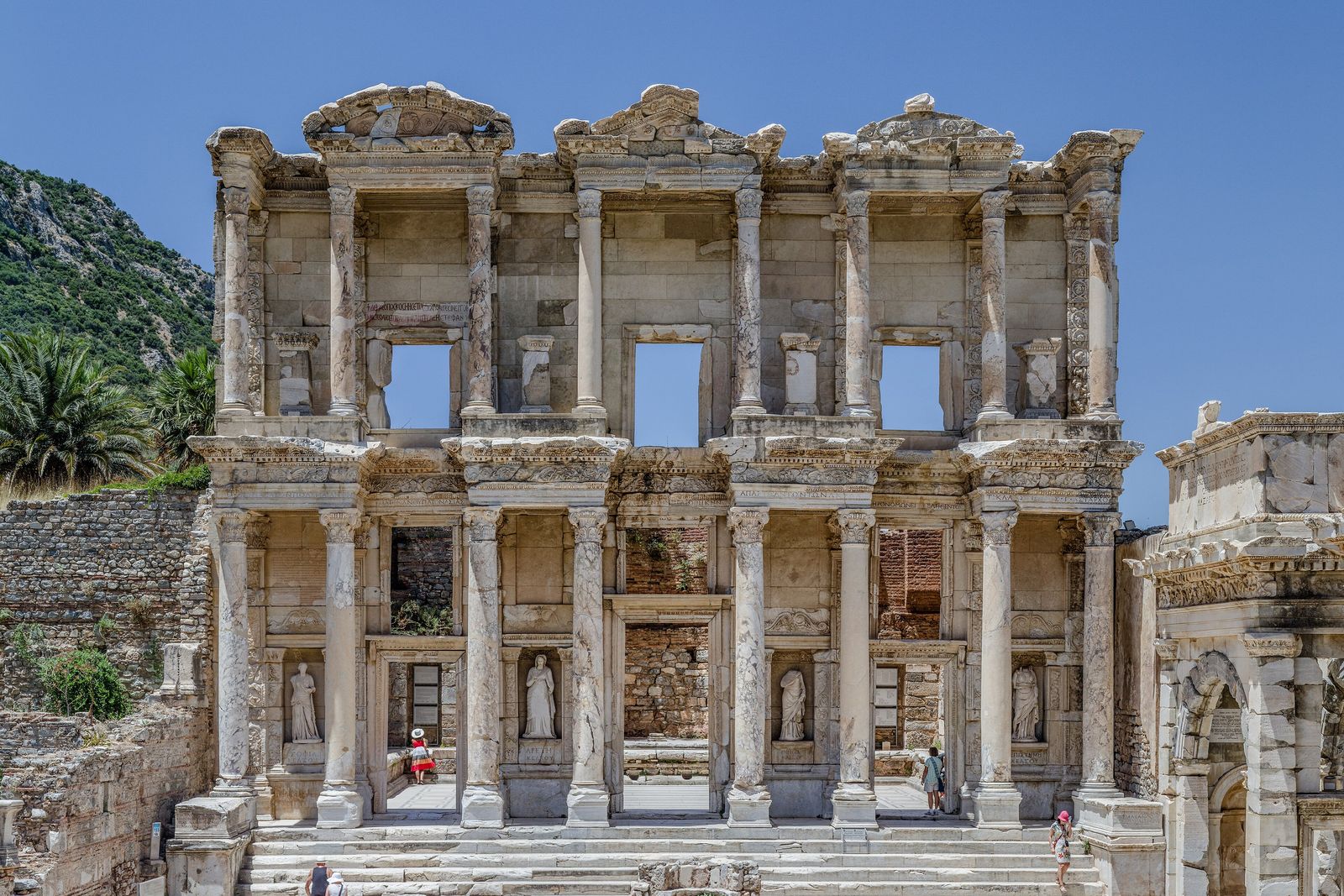
The call to prayer followed me out of the town, and then it was a marble street polished slippery by feet, broken columns, pines, the heat already up. At the bottom stood a tall carved front with nothing behind it. Another street ran on towards the sea, and the sea was not there. Just reeds, and a heron, and me, all waiting for water.
The short answer
Ephesus is the site of an ancient Greek and Roman city on the Aegean side of Anatolia, near the town of Selçuk and about 70 kilometres south of İzmir. It was famous for the Temple of Artemis, one of the Seven Wonders of the ancient world, and under Rome it was a leading city of the province of Asia. Around 300 BC Lysimachus, one of Alexander’s successors, moved its people from the old settlement round the temple to a new site about two kilometres away, the city whose ruins most visitors walk through. Its best-known buildings are the Library of Celsus and the Great Theatre, which Wikipedia gives an estimated 25,000 seats and Türkiye’s official tourism site 30,000. Austrian archaeologists have excavated there since 1895. By the fifteenth century the city had been abandoned, and in 2015 UNESCO inscribed it as a World Heritage Site.
Why it's worth knowing
Ephesus is usually visited as a set of monuments. It is better read as a port that lost an argument with a river.
UNESCO’s description of the site calls it an outstanding harbour city, with a sea channel and harbour basin on the Kaystros in the Roman period, and says its earlier and later harbours record a changing river landscape from Classical Greek to medieval times. It describes Ephesus as a series of Hellenistic and Roman settlements founded on new sites, following the coastline as it retreated westward. The river carried soil down from its valley and dropped it in the bay, and the land grew out towards the sea.
The people of the valley helped. Friederike Stock and colleagues, drilling cores in the plain, reported that sediment built up fast from the eighth century BC and especially from Hellenistic times, when the delta advanced about 1.5 kilometres, most probably because of human impact: they name deforestation, ploughing and grazing, especially by goats, as the main causes of erosion upstream. A 2015 study by Hugo Delile and colleagues dated the layers in the Roman harbour for the first time, and suggested that its final isolation may have been triggered when the river shifted its course.
The same silt reached the goddess. By Wikipedia’s account of the archaeologist Anton Bammer’s work, the ground at the Temple of Artemis rose about two metres between the eighth and sixth centuries BC and 2.4 metres more by the fourth, and the temple was rebuilt on the same spot each time. Wikipedia says the harbour is now about five kilometres inland, and that the marshes left behind brought malaria to the city in its last centuries.
The field notes
A street to the water
From the Great Theatre a broad marble street runs west, towards where the Roman harbour was. It is called the Arkadiane, after the emperor Arcadius, who restored it at the end of the fourth century AD and, by Wikipedia’s account, raised its level. It was lined with colonnades and linked the city to its ships. The harbour at its end is now a silted basin, and the Austrian Archaeological Institute notes that the harbour and its channel shifted over time as the river silted them up.
A library that is also a tomb
The Library of Celsus was commissioned in the 110s AD by Tiberius Julius Aquila Polemaeanus as a monument to his father, Tiberius Julius Celsus Polemaeanus, a consul and former proconsul of Asia, and finished after Aquila’s own death, under Hadrian. Celsus was buried beneath it, in a marble sarcophagus in a crypt under the apse, which Wikipedia notes was an unusual honour inside a city. Wikipedia’s account says it is believed to have held about 12,000 scrolls.
Fire destroyed the interior in AD 262 and an earthquake brought down the façade in the tenth or eleventh century. The two-storey façade that visitors see was re-erected between 1970 and 1978 from the fallen pieces, with copies where parts were missing; the Austrian Archaeological Institute calls the work a milestone in its history at Ephesus, and Wikipedia names the German archaeologist Volker Michael Strocka as its leader. The statues of the four virtues in its niches are not the originals.
One column for a Wonder
The Temple of Artemis was rebuilt several times. A version begun around 550 BC with money from Croesus of Lydia burned in 356 BC, an act of arson popularly pinned on a man named Herostratus, though Wikipedia records that modern scholars have questioned his part. The larger temple that replaced it was one of the Seven Wonders on Antipater of Sidon’s list, and was destroyed in AD 262.
John Turtle Wood found the site in 1869 for the British Museum after six years of searching, and sculpted fragments went to London. Today, just outside Selçuk, the temple is marked by a single column assembled from pieces found on the site.
Pilgrims then and now
The New Testament’s Acts of the Apostles sets a riot against Paul in the city’s theatre. Near Selçuk, the Basilica of St John was built in the sixth century under the emperor Justinian, and the House of the Virgin Mary, about seven kilometres from the town, is a place of Christian pilgrimage; both are places where people come to pray.
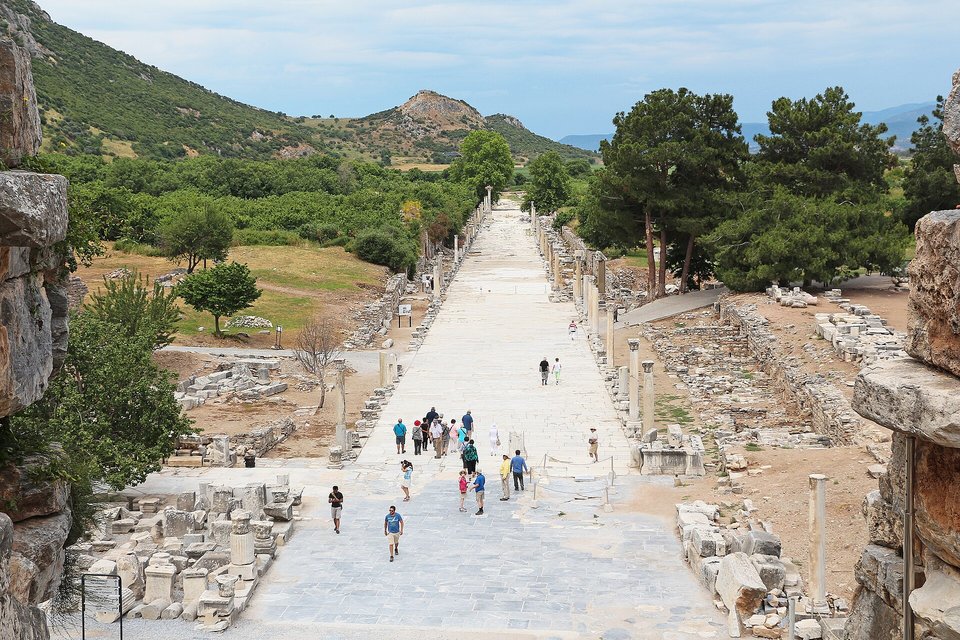
The Arkadiane seen from the Great Theatre, running west across the plain where the Roman harbour was, June 2014.
Photograph: Bernard Gagnon · Ephesus - Arcadiane Street 01 · CC BY-SA 3.0
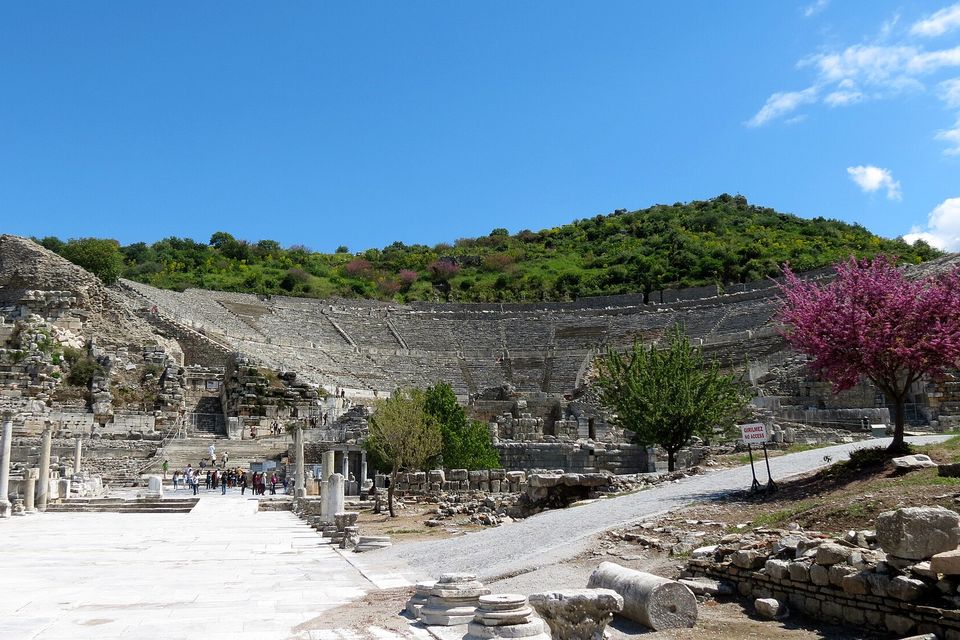
The Great Theatre on its hillside, a tree in flower beside the path, April 2014.
Photograph: Erik Cleves Kristensen · Theater of Ephesus (13976302123) · CC BY 2.0 · cropped
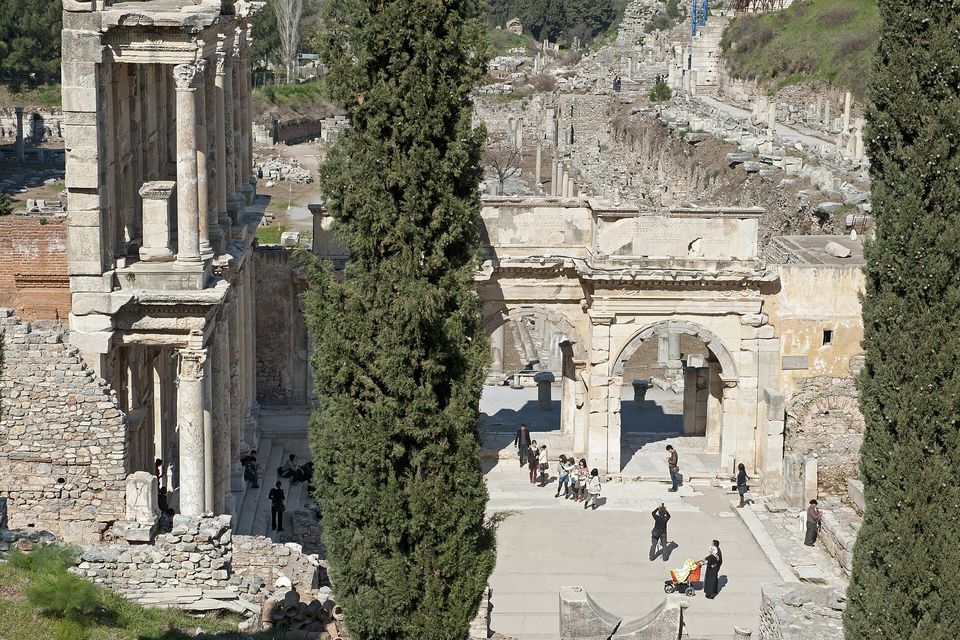
The Library of Celsus seen from the hillside above, March 2011.
Photograph: Dick Osseman · CC BY-SA 4.0
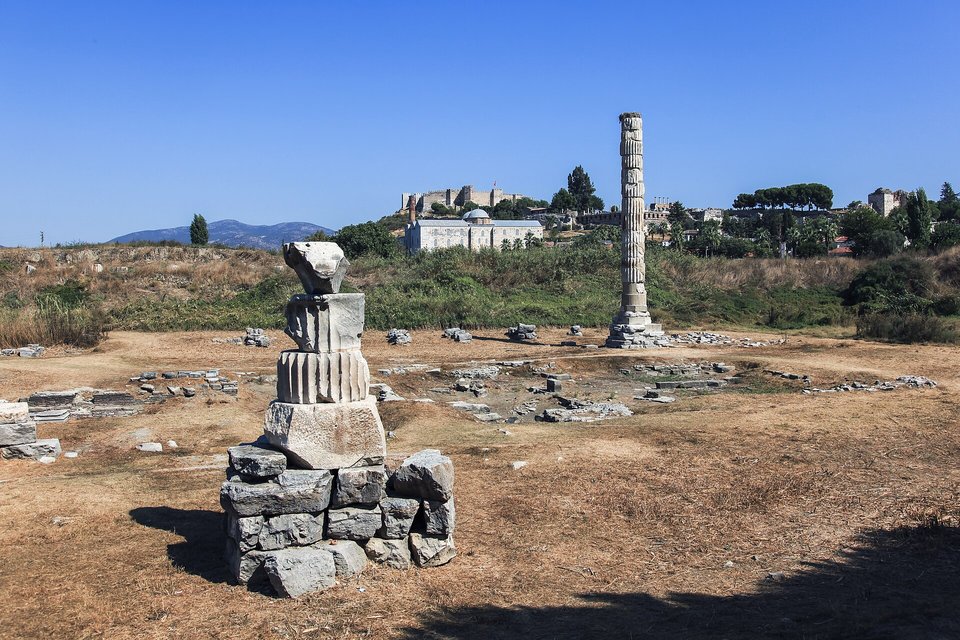
The single column that marks the Temple of Artemis outside Selçuk, with the İsa Bey Mosque and Ayasuluk castle behind, October 2011.
Photograph: Roy Egloff · CC BY-SA 4.0
- Start at the top gate early and walk downhill, with the heat behind you rather than in front.
- Sit high in the theatre for a while and look along the street to where the harbour was.
- Go and stand by the single column at the edge of town, and imagine the rest of it. Take your time; there is a lot of rest.
- At the house on the hill and the old basilica, dress for church and let the people praying pray.
- Find the sea. (It had moved on long before I arrived. The item has been moved down the page after it.)
The Arkadiane, the harbour street. A broad marble street running west from the Great Theatre of Ephesus towards the Roman harbour, lined with colonnades and named after the emperor Arcadius, who restored it at the end of the fourth century AD. It was built to carry people between the city and its ships. The river silted the harbour up, and the street now runs out towards a basin with no water in it.
Tally, in the marginA marble street laid out for the ships and still waiting for them. The reeds at the end are the harbour, which makes the heron and me the last two passengers.
Getting there
How to get there. Ephesus lies just outside Selçuk, about 70 kilometres south of İzmir, whose airport is the nearest large one.
Tickets and gates. The site has two entrances with ticket offices, a lower and an upper. The Ministry of Culture and Tourism’s museum site lists summer hours, from April to October, of 08:00 to 19:00 at the lower office and 08:00 to 18:00 at the upper, and evening openings on some days in season; the ticket also covers the Ephesus Experience Museum. Check the ministry’s site for the current hours and price.
When to go. Spring and autumn are the comfortable seasons. In summer, start as early as the gates allow.
Safety. The United States has Türkiye at Level 2, exercise increased caution, because of terrorism, armed conflict and arbitrary detentions. Its Level 4 warning applies only within 10 kilometres of the borders with Syria and Iraq, some 800 kilometres from Ephesus. The advisory warns that criticising the government, including on social media, can lead to arrest, and asks visitors to be cautious at tourist sites and places of worship.
Mark this place
Common questions
Why is Ephesus no longer by the sea?
Ephesus lost its sea to silt. The Kaystros river, today’s Küçük Menderes, filled the bay with sediment and pushed the coast west, and UNESCO describes Ephesus as a series of settlements founded on new sites to follow the retreating shore. Friederike Stock and colleagues report that the delta advanced about 1.5 kilometres in Hellenistic times, most probably through deforestation, ploughing and grazing.
How far is Ephesus from the sea today?
Wikipedia gives the Roman harbour of Ephesus as about five kilometres inland today, and the ancient city as 3 to 4 kilometres from the present coast. In Roman times Ephesus had a harbour basin and a sea channel on the Kaystros river; the river’s silt later cut the harbour off, and the basin is now silted land west of the Great Theatre.
What is the Library of Celsus?
The Library of Celsus at Ephesus was built in the early second century AD by Tiberius Julius Aquila Polemaeanus in memory of his father, Celsus, a former proconsul of Asia, who is buried in a crypt beneath it. Fire gutted it in AD 262 and an earthquake later toppled its façade, which archaeologists re-erected from the fallen pieces between 1970 and 1978.
What is left of the Temple of Artemis at Ephesus?
Very little. The Temple of Artemis at Ephesus, one of the Seven Wonders of the ancient world, was destroyed in AD 262. John Turtle Wood found its site in 1869 for the British Museum, which holds sculpted fragments. The site, just outside Selçuk in Türkiye, is marked today by a single column assembled from pieces found there.
Who moved Ephesus to its present site?
Lysimachus, one of the successors of Alexander the Great, moved the people of Ephesus around 300 BC from the old settlement near the Temple of Artemis to a new site about two kilometres away, the city whose ruins stand today. For a time he renamed it Arsinoea after his wife, Arsinoe II. The move was one of several that followed the changing coastline.
How big is the theatre at Ephesus?
The Great Theatre of Ephesus is estimated to have seated about 25,000 people, according to Wikipedia; Türkiye’s official tourism site gives 30,000 and calls it the country’s largest ancient theatre. From it the Arkadiane, a colonnaded marble street restored by the emperor Arcadius around AD 400, runs west towards the silted Roman harbour.
When did Ephesus become a UNESCO World Heritage Site?
UNESCO inscribed Ephesus as a World Heritage Site in 2015. Its description stresses the harbour city’s changing relationship with the Kaystros river, from Classical Greek to medieval times, and takes in the site of the Temple of Artemis, the Roman city with the Library of Celsus and the Great Theatre, and the House of the Virgin Mary.
Is it safe to visit Ephesus?
The United States has Türkiye at Level 2, exercise increased caution, because of terrorism, armed conflict and arbitrary detentions, in an advisory updated on 9 June 2026. Its Level 4 area is only the strip within 10 kilometres of the Syrian and Iraqi borders, about 800 kilometres from Ephesus. It warns that criticising the government, including online, can lead to arrest.