
- Where
- Dodecanese, eastern Aegean,
Greece - Coordinates
- 37.3090° N
26.5470° E - Size
- 34 km²;
population 3,283 (2021) - Monastery
- Founded 1088 by Christodoulos,
by grant of Alexios I - Tradition
- Where John received
the Revelation - Status
- UNESCO World Heritage, 1999
- Getting there
- By sea only;
no airport on the island
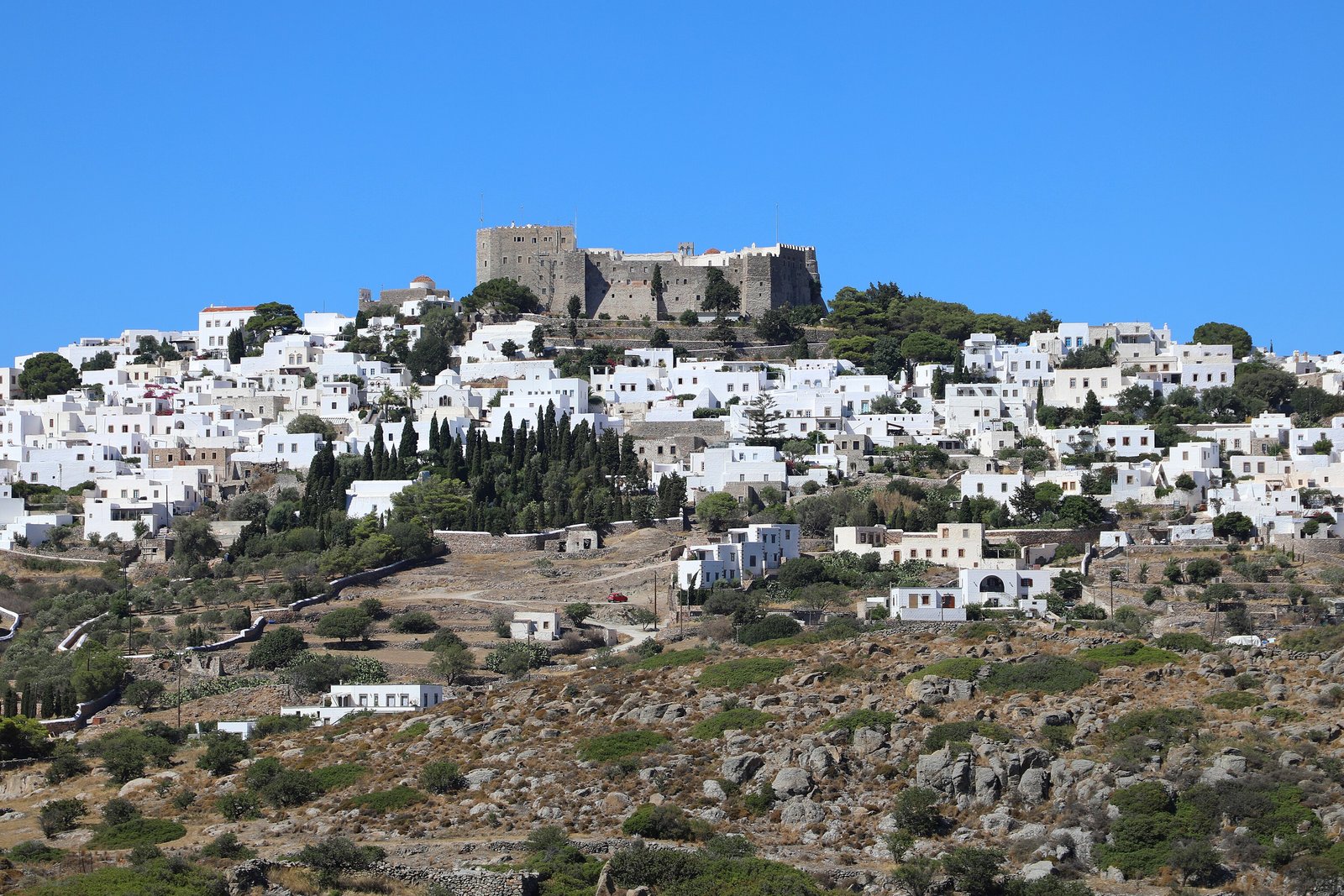
The ferry came in at dusk, and above the little harbour a white town was poured over a hill, with a grey fortress sitting on the very top. Walked up in the cool of the morning between dry stone walls and bare slopes, bells somewhere above me. Inside the gate a monk in black nodded to me, and I nodded back as though we did this every morning.
The short answer
Patmos is one of the northernmost islands of the Dodecanese, in the eastern Aegean, 34 square kilometres in area with 3,283 people at the 2021 census. Its port is Skala, and its capital, Chora, stands on the hill above, around the Monastery of Saint John the Theologian. The monastery was founded in 1088 by the monk Christodoulos under a grant from the Byzantine emperor Alexios I Komnenos. The island’s fame comes from the Book of Revelation, whose author names himself John and writes that he “was in the isle that is called Patmos” (Revelation 1:9); early Christian tradition identified him with the apostle John. UNESCO inscribed Chora, the monastery and the Cave of the Apocalypse in 1999, and calls Chora one of the best-preserved and oldest of the Aegean choras. The island was Italian from 1912 and joined Greece, with the rest of the Dodecanese, in 1948.
Why it's worth knowing
It is not often that a whole island is signed over to one man, and fewer still to a monk. Christodoulos had lived as a monk in the Holy Land, on Mount Latros and on Kos before he and his companions chose Patmos. Wikipedia’s account says they wanted it for its isolation, which came partly from a harbour unsuitable for regular shipping, and for its tradition as the place where Revelation was written. At his request, in April 1088, the emperor Alexios I Komnenos authorised the monastery and gave him authority over the island, by an imperial deed with a golden seal, a chrysobull, as Greece’s national tourism site calls it. UNESCO places the grant within Alexios’s policy of settling the islands and creating a base in the Aegean.
Christodoulos built for defence. The monastery was fortified from the start against pirates and Seljuk raids, and it still looks like what it was built to be: a polygonal castle with towers and battlements on a hilltop. Wikipedia’s account says most of it was finished within three years. Its builder did not stay to enjoy it: quarrels among the monks and Turkish raids drove him from the island, and he died on Euboea on 16 March 1093.
The town followed the walls. Wikipedia’s account of the monastery says that, unusually, it took the surrounding community into its life from its foundation, and that Chora was built around its fortifications. The island’s people came in waves after that: refugees from Constantinople after 1453, and from Crete after the fall of Candia in 1669.
The field notes
A castle for a monastery
The oldest parts of the monastery are the katholikon, the main church, and the refectory, both from the eleventh century; a two-storey arcade on the south side was rebuilt in dressed stone in 1698. Christodoulos wrote the community’s rule, the Hypotyposis, in May 1091. Wikipedia gives about 40 monks living there in 2012, and it remains a working Greek Orthodox monastery and a place of pilgrimage.
Leaves of a purple book
The monastery’s library holds at least 330 manuscripts, 267 of them on parchment, including 82 manuscripts of the New Testament, by Wikipedia’s count. Among them are 33 leaves of the Codex Petropolitanus Purpureus, a sixth-century book of the Gospels written in silver ink on parchment dyed purple, with gold for sacred names. The rest of the surviving book is scattered: 182 leaves in St Petersburg, and others in the Vatican Library, which has six, in London, Vienna, New York, Athens, Thessaloniki and a private collection in Italy. Greece’s national tourism site says the monastery’s museum and sacristy keep Byzantine manuscripts, rare printed books, icons and sacred relics; which pieces are on display at a given time is for the monastery to say.
The cave
About halfway up the road from Skala to Chora is the Cave of the Apocalypse, the grotto where Christian tradition places John’s visions. It is a Greek Orthodox church. UNESCO’s description says the island is reputed to be where Saint John the Theologian wrote both his Gospel and the Apocalypse around AD 95; the book itself names its author only as John, and which John he was is a matter of tradition.
A privileged island
Under Ottoman rule the monastery kept trading privileges, recorded in Ottoman documents held in its library. Venice held the island during the Cretan War, from 1659 to 1669, and Russia during the Orlov revolt, from 1770 to 1774. Italy took the Dodecanese in 1912 and held Patmos until 1943, when Germany took it over; after the Germans left in 1945 the island governed itself until it joined Greece in 1948.
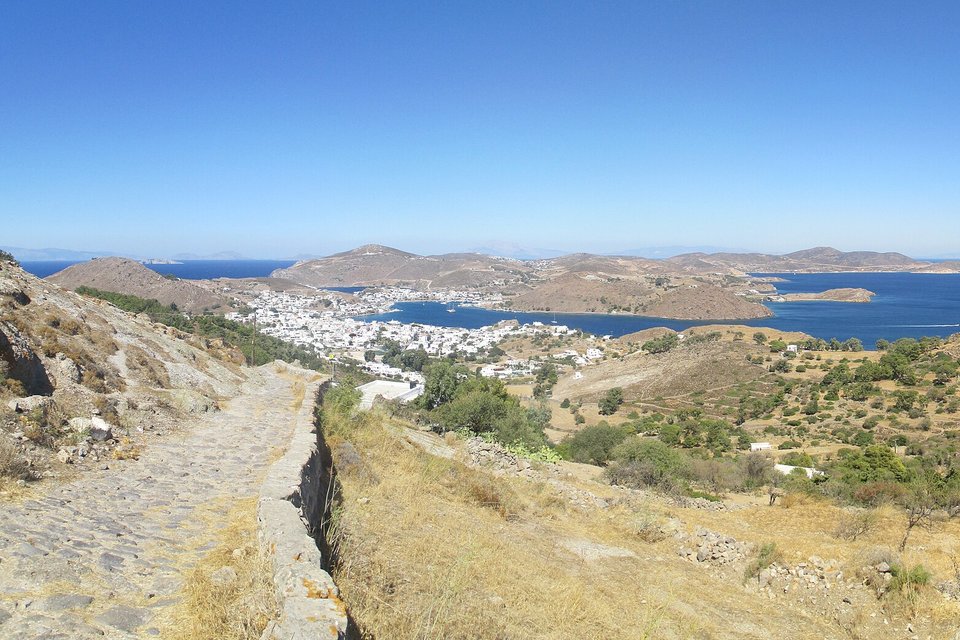
A stone-paved path between dry-stone walls above Skala and its bay, 2013.
Photograph: Tomisti · Patmos panorama 1 · CC BY-SA 3.0 · cropped
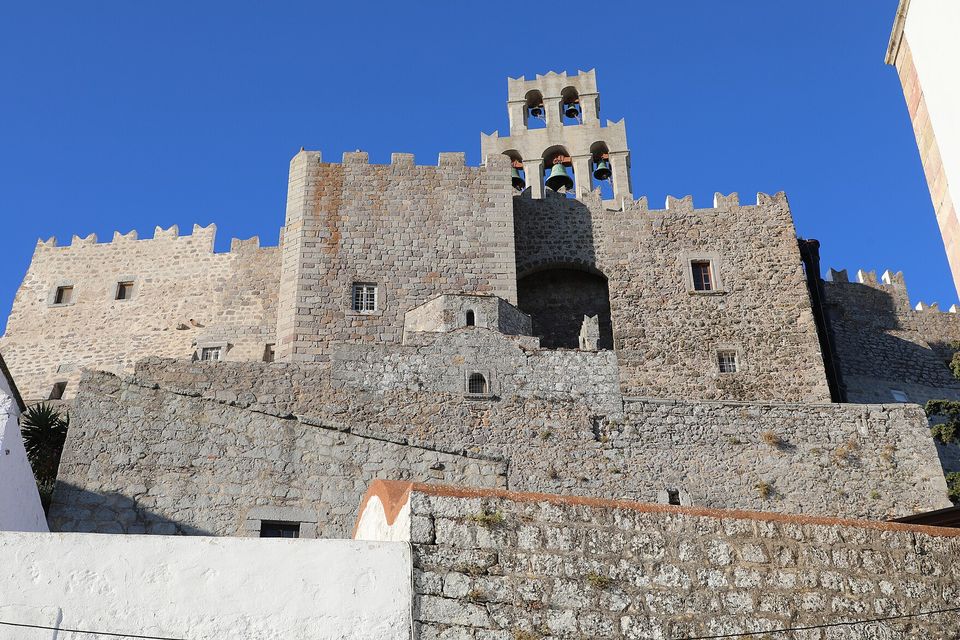
The fortified walls and bell-gable of the Monastery of Saint John from the outside.
Photograph: Francesco Bini · CC BY-SA 4.0 · cropped
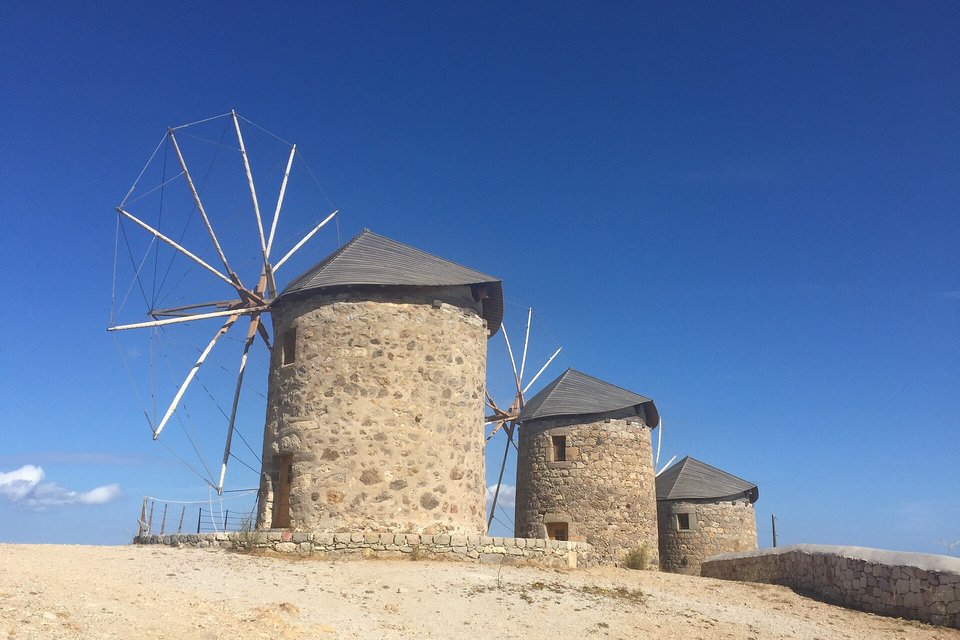
Stone windmills on Patmos, October 2021.
Photograph: PLBechly · CC BY-SA 4.0 · cropped
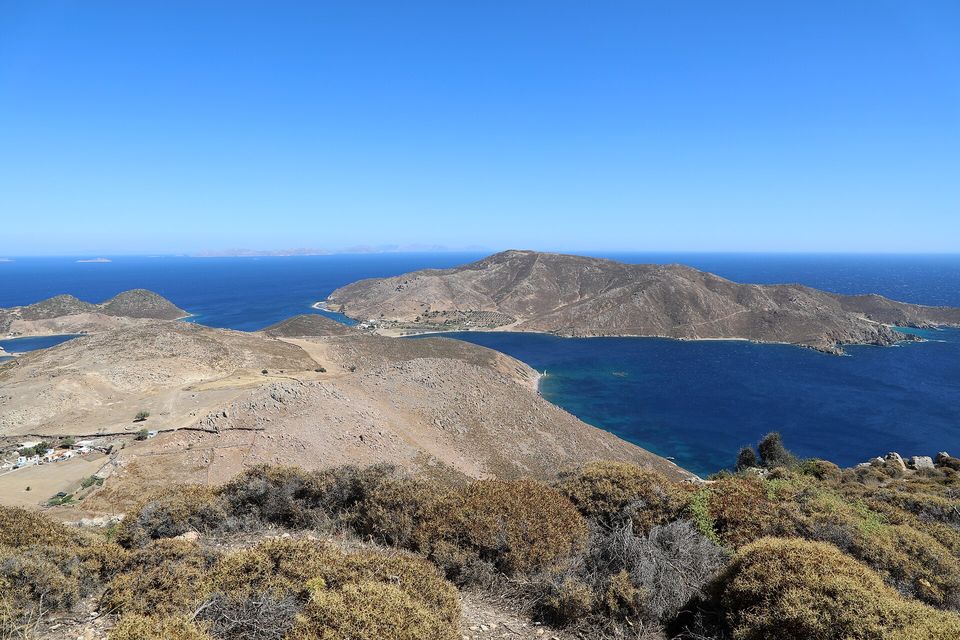
The south coast towards Psili Ammos from Hagios Ilias.
Photograph: Francesco Bini · CC BY-SA 4.0
- Dress for church before you climb: the monastery and the cave are both, and people are praying in them.
- Go up in the morning, while the path is cool and the doors are open.
- Look back down at the harbour from the walls, then put the camera away for a while.
- Take the slow ferry at least once, and stay on deck for the arrival.
- Keep the list closed inside the monastery. (Kept it closed. Remembered four things on the steps outside and wrote them all down in a great hurry.)
The battlements of the Monastery of Saint John. On the hill above Skala, the monastery that Christodoulos founded in 1088 was fortified from the start, with towers and crenellations, against pirates and Seljuk raids. It has been a working Orthodox monastery ever since, and the white houses of Chora are packed around the foot of its walls. From the harbour it reads as a castle; it is a monastery that had to be one.
Tally, in the marginA monastery with battlements. My notes from the harbour say castle, underlined twice, and I have left them as they are, since the builders plainly meant me to write exactly that.
Getting there
How to get there. Patmos has no airport; everything arrives by sea. Ferries run from Piraeus, the port of Athens, and link Patmos with neighbouring islands including Leros, Lipsi, Samos and Rhodes. Travellers who fly land on a neighbouring island with an airport, such as Leros or Samos, each about an hour’s flight from Athens, and take a ferry on. Check the season’s timetables: services are fewer outside summer.
The monastery. The monastery stands about 3.5 kilometres from the port at Skala. The Ministry of Culture’s listing for its Treasury gives winter hours, from early November to March, of 08:00 to 13:00 daily, and summer hours of 08:00 to 13:30 daily with extra afternoon openings, 16:00 to 18:00, on Tuesdays, Thursdays and Saturdays; it is closed to visitors on the first three days of Lent. Plan the visit for the morning.
How to be there. The monastery and the Cave of the Apocalypse are places of worship. Dress as for church, keep your voice down, and ask before taking any photograph.
Safety. The United States has Greece at Level 1, exercise normal precautions. The advisory mentions petty crime in popular tourist places and demonstrations that can disrupt transport.
Mark this place
Common questions
Who gave Patmos to the monk Christodoulos?
The Byzantine emperor Alexios I Komnenos. In April 1088, at the request of the monk Christodoulos, he authorised a monastery on Patmos and gave Christodoulos authority over the island, by an imperial chrysobull. UNESCO places the grant within Alexios’s policy of settling the Aegean islands. Christodoulos founded the Monastery of Saint John the Theologian and died on Euboea in 1093.
Why does the monastery on Patmos look like a castle?
Because it was built as a fortress. The monk Christodoulos, who founded the Monastery of Saint John the Theologian on Patmos in 1088, fortified it heavily against pirates and Seljuk raids, as a polygonal castle with towers and battlements. The island’s capital, Chora, grew up around its walls, and the monastery is still a working Greek Orthodox community.
Was the Book of Revelation written on Patmos?
The Book of Revelation says so: its author, who names himself John, writes that he “was in the isle that is called Patmos” (Revelation 1:9). Christian tradition places his visions in the Cave of the Apocalypse on the hillside between Skala and Chora, and identifies him with the apostle John; the book itself names him only as John.
Is Patmos a UNESCO World Heritage Site?
Yes. In 1999 UNESCO inscribed the Historic Centre (Chorá) with the Monastery of Saint-John the Theologian and the Cave of the Apocalypse on the Island of Pátmos. UNESCO describes Chora as one of the best-preserved and oldest settlements of its kind in the Aegean, and the monastery as a place of pilgrimage and Greek Orthodox learning since 1088.
What is in the monastery library on Patmos?
The library of the Monastery of Saint John the Theologian on Patmos holds at least 330 manuscripts, 267 on parchment, including 82 New Testament manuscripts. Among them are 33 leaves of the sixth-century Codex Petropolitanus Purpureus, a Gospel book in silver ink on purple parchment whose other surviving leaves are mostly in St Petersburg, with six in the Vatican Library.
How do you get to Patmos?
Only by sea: Patmos, in Greece’s Dodecanese islands, has no airport. Ferries run from Piraeus, the port of Athens, and from neighbouring islands including Leros, Lipsi, Samos and Rhodes. Travellers who fly land on a neighbouring island with an airport, such as Leros or Samos, and take a ferry on to Skala, the island’s port.
When is the monastery on Patmos open?
The Greek Ministry of Culture’s listing for the Treasury of the Monastery of Saint John the Theologian on Patmos gives winter hours of 08:00 to 13:00 daily, and summer hours of 08:00 to 13:30 daily with extra openings from 16:00 to 18:00 on Tuesdays, Thursdays and Saturdays. It closes to visitors on the first three days of Lent.
How big is Patmos?
Patmos, in the Dodecanese in Greece, covers 34.05 square kilometres and had 3,283 inhabitants at the 2021 census. Its highest point, Profitis Ilias, is 269 metres above sea level. The main settlements are Chora, around the monastery, and Skala, the island’s only commercial port, about four kilometres apart.