
- Where
- South Pacific
French overseas collectivity - Islands
- 118, across 5 archipelagos
- Gateway
- Papeete, Tahiti (PPT)
- Getting around
- Air Tahiti; cargo ships
- Language
- French, Tahitian, Marquesan
- Best visited
- May–October (drier)
Five archipelagos, not one
French Polynesia spreads 118 islands across an area of ocean comparable in size to Europe, in five distinct groups. The Society Islands — Tahiti, Moorea, Bora Bora — are what the postcards show and where most visitors stay. The Tuamotus are coral atolls: rings of reef around lagoons, low, remote, and extraordinary underwater. The Marquesas are steep young volcanoes with almost no protecting reef. The Australs and the Gambiers are further still and barely visited.
The distances are the thing people underestimate. The Marquesas are 1,200 kilometres from Tahiti — roughly London to Rome — and everything routes through Papeete.
Atoll or high island?
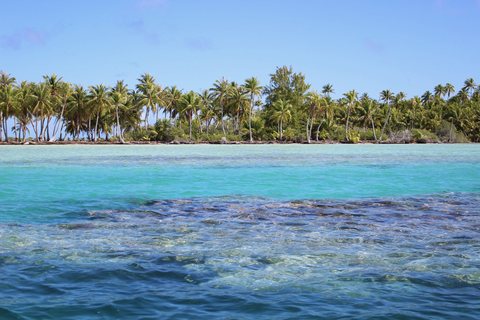
The distinction shapes everything about a visit, and it is a matter of age. A Pacific volcano rises, builds a fringing reef, then slowly subsides. The reef keeps growing upward. Over millions of years the island sinks away and the reef remains as a ring around open water — an atoll.
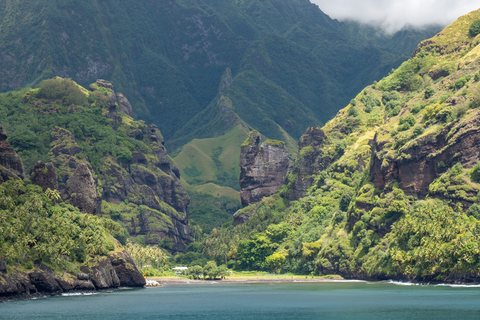
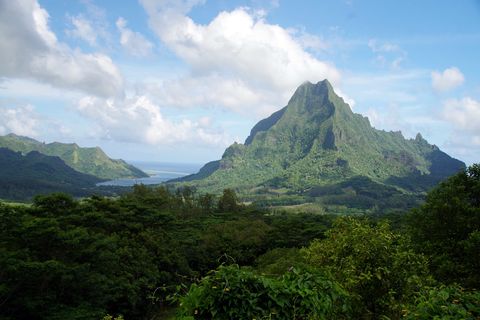
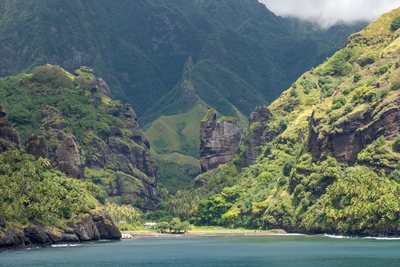
So the Tuamotus are old: flat, sandy, with vast lagoons and deep passes where marine life concentrates. The Marquesas are young: no reef has had time to form, the Pacific hits the cliff directly, the water is dark and the beaches often black. Bora Bora sits between the two, mid-transformation.
Inside the postcard
Even the Society Islands hold more than the lagoon. Bora Bora’s airport is not on the island: it is on Motu Mute, a flat reef islet across the lagoon, where United States forces built the airstrip in 1943 for a Second World War fuelling base codenamed Bobcat that saw no fighting. Visitors still land there and take the boat across, and on the ridge above Faanui two of the American coastal guns still point out to sea.
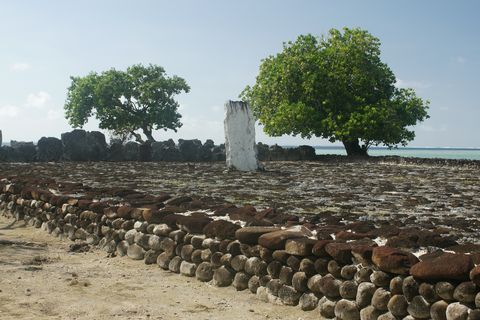
On Raiatea, the second-largest of the Society Islands, Taputapuātea is a complex of marae, open-air ceremonial places of paved stone, on a point facing a sacred pass in the reef. UNESCO describes it as a political, ceremonial and funerary centre from which stones were carried to other islands to found marae of the same name, and inscribed it as a World Heritage Site in 2017. Air Tahiti flies to both islands from Papeete; at the marae, visitors are asked not to climb on the stones.
Getting around
Air Tahiti runs the inter-island network from Papeete and sells multi-island passes, which are usually cheaper than separate tickets and constrain the routing. Flights to the outer archipelagos are less frequent and worth booking early.
The alternative, and for the Marquesas the better one, is the Aranui — a working cargo-and-passenger ship that supplies the islands and takes travellers along on its rounds, calling at places with no airstrip. It is slower, more interesting, and books out well ahead.
Places in this collection
-
 Entry № 009
Fakarava
A UNESCO Biosphere Reserve atoll whose southern pass holds hundreds of grey reef sharks stacked in the current — visible even to snorkellers.
-
 Entry № 010
The Marquesas
Vertical volcanic islands with no reef to soften the Pacific, monumental stone tiki, and two famous graves above Atuona.
-
 Entry № 109
Bora Bora
Visitors still land on an airstrip US forces built on a reef islet in 1943 for a wartime fuel base, then cross the lagoon by boat. For years it was French Polynesia's only international airport.
-
 Entry № 122
Taputapuātea
On Raiatea, a marae at the centre of an old alliance of islands. UNESCO records that stones were carried from it to found marae of the same name elsewhere.
-
 Entry № 130
Moorea
The jagged island facing Tahiti, whose native tree snails were lost in the wild, bred in zoos and carried home, each with a dot of paint. The ones found without a dot were born there.
Common questions
How many islands are in French Polynesia?
French Polynesia comprises 118 islands spread across five archipelagos — the Society Islands, the Tuamotus, the Marquesas, the Australs and the Gambiers — across an area of ocean comparable in size to Europe. Papeete on Tahiti is the gateway for essentially all arrivals.
What is the difference between an atoll and a high island?
A high island is a volcano still standing above the sea, often with a fringing or barrier reef. An atoll is what remains after the volcano subsides over millions of years while its reef keeps growing upward — a ring of coral around a lagoon with no central peak. The Tuamotus are atolls; the Marquesas are young high islands with almost no reef.
How do you travel between islands in French Polynesia?
Air Tahiti operates the inter-island flight network from Papeete and sells multi-island passes that are generally cheaper than separate tickets. For the Marquesas, the cargo-and-passenger ship Aranui is an alternative that calls at islands without airstrips.
When is the best time to visit French Polynesia?
May to October is the drier, cooler season across French Polynesia and the most reliable window for travel. Specific events have their own timing: the marbled grouper spawning at Fakarava happens around the June or July full moon, and the Marquesas Arts Festival is held every four years.
Is French Polynesia only about lagoons and overwater bungalows?
No. That image comes from the Society Islands, one of five archipelagos. The Tuamotu atolls are known for diving in tidal passes with exceptional marine life, and the Marquesas have almost no reef, a distinct language and culture, and archaeological sites inscribed by UNESCO in 2024.
Know somewhere that belongs here?
The Field Guide grows by recommendation. If there is a place you love — somewhere strange, overlooked, or simply worth the trip — tell us about it and why it matters. Good suggestions get researched, written up, and credited to the person who sent them in.
Suggest a place →