
Part of French Polynesia
- Where
- Society Islands,
French Polynesia - Coordinates
- 17.5380° S
149.8300° W - From Tahiti
- About 17 km north-west,
across a channel - Population
- 17,718 (2017 census)
- The snails
- Partula tree snails,
zoo-bred and returned - Darwin
- Saw it from Tahiti in 1835:
“a framed engraving” - Getting there
- Ferry or short flight
from Tahiti
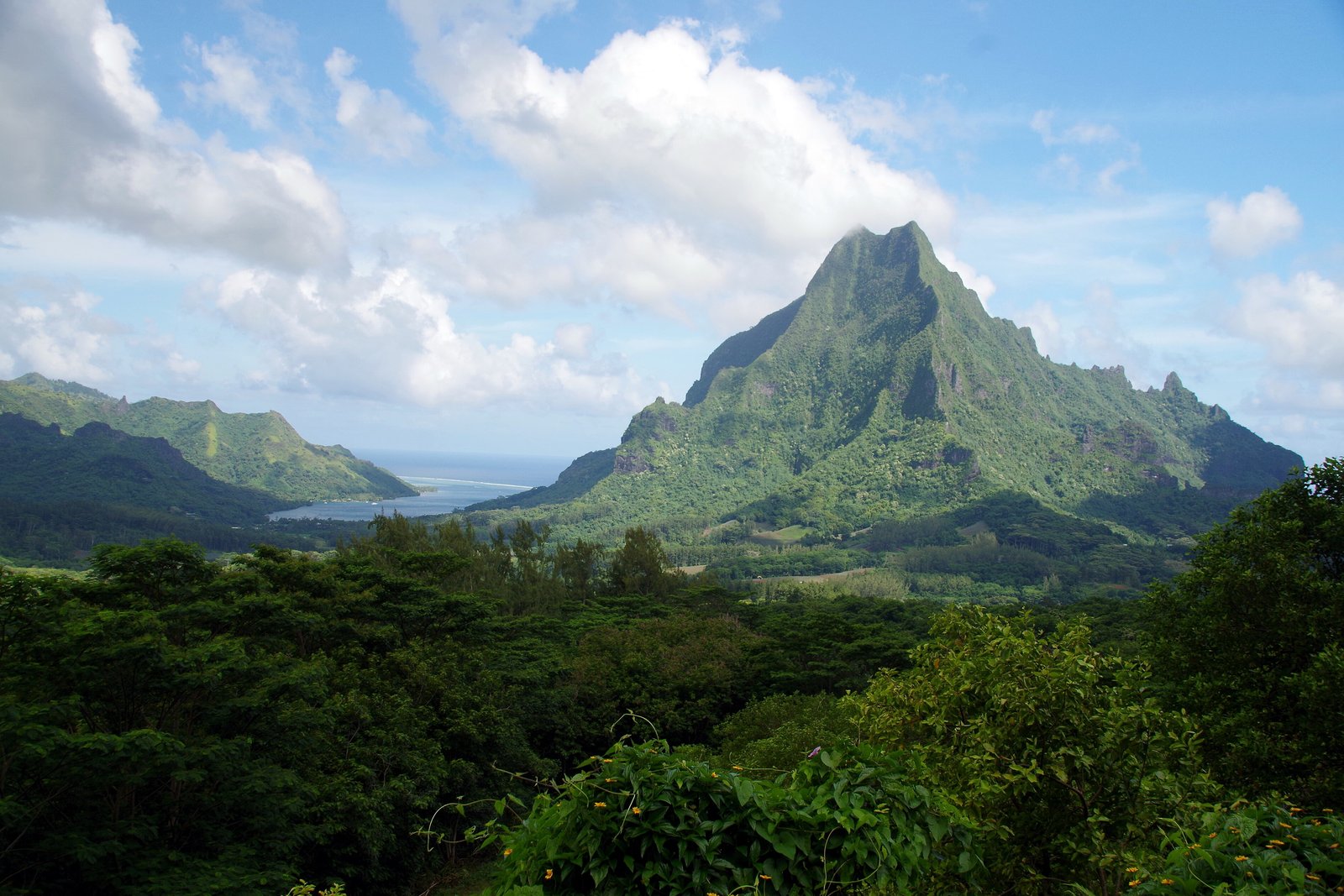
Crossed from the bigger island on a morning boat, and the whole thing rose up ahead: green spires like broken teeth, a pale lagoon, a line of white where the sea hit the reef. Walked up a valley past old stone platforms under huge rooty trees, then sat at the top with a blue bay on either side. Somebody was singing in a church below. I stayed until they stopped.
The short answer
Moorea (Mo’orea) is a volcanic island in the Windward group of the Society Islands, in French Polynesia, about 17 kilometres north-west of Tahiti. Wikipedia describes it as a shield volcano formed 1.5 to 2.5 million years ago and now ringed by a coral reef and a narrow lagoon; it is about 16 kilometres across, its highest point is Mount Tohivea, and two deep bays, Ōpūnohu Bay and Cook’s Bay, cut into its north shore side by side. It had 17,718 inhabitants at the 2017 census. Wikipedia translates the name as ‘yellow lizard’; an older name was Aimeho, written by early visitors as Eimeo.
Why it's worth knowing
Moorea’s forests were home to several species of Partula, tree snails one or two centimetres long found on these islands and nowhere else. They were lost in the wild to a snail brought in to deal with another snail. The Zoological Society of London’s account says wild Partula populations were devastated in the 1980s and early 1990s by the rosy wolf snail, Euglandina rosea, a carnivore introduced to control the giant African land snail, which had itself been introduced; the last surviving individuals of 15 Partula species and subspecies were collected by conservationists in the early 1990s and bred in zoos. A 2019 genomic study by Amanda Haponski, Taehwan Lee and Diarmaid Ó Foighil, in Evolutionary Applications, counts eleven of the eighteen Partula species of Moorea and Tahiti as wiped out by what it calls an ill-advised biological control programme, and finds that every one of the five species groups still has members alive in captivity or in remnant wild populations.
Then the zoos started sending them back. Every year, zoo-bred snails make a two-day journey to Tahiti, Moorea and Huahine and are released into the forest, each marked with a dot of UV-reflective paint so that the team can find it at night, when the snails are active. ZSL has reported more than 7,000 snails released in a single year, and the first wild-born adult Partula tohiveana found on Moorea in about 40 years, some of them outside the original release area. The IUCN’s Mollusc Specialist Group reports that Partula tohiveana has been moved on the IUCN Red List from Extinct in the Wild to Critically Endangered.
The field notes
A picture in a frame
In November 1835, from the mountains of Tahiti, Charles Darwin looked across the channel at Moorea, then called Eimeo, and wrote in his Beagle diary that the view might be compared to “a framed engraving, where the frame represents the breakers, the marginal paper the lagoon”. He saw “a narrow but well defined line of brilliant white where the waves first encountered the wall of coral”, and inside it “the smooth glassy water of the lagoon, out of which the mountains rose abruptly.” Wikipedia connects the view with his theory of how reefs and atolls form, which he published in 1842.
Cook’s Bay, and the bay next door
Cook’s Bay, also called Paopao Bay after the island’s largest village at its head, is named after James Cook, who anchored not there but in Ōpūnohu Bay, the next bay west, on the other side of Mount Rotui. Wikipedia’s articles date his landing to 30 September 1777 and to October 1777. During that visit one of Cook’s goats was stolen, and when negotiations failed to recover it, Wikipedia records, armed parties from his ships burned houses and canoes on the island. Many exterior scenes of the 1984 film The Bounty were shot at Ōpūnohu Bay.
The valley of marae
Inland from Ōpūnohu Bay, the once densely populated Ōpūnohu valley holds the remains of many marae, the stone platforms of Polynesian worship. Archaeologists have worked there since Kenneth Emory in the 1920s and Roger Green in the 1960s, and Wikipedia’s account traces the valley’s society from early farming to the large stepped marae of its last chiefs. Marae Titiroa, among banyan trees, was restored in the late 1960s, and the multi-level Marae Ahu-o-Mahine stands nearby. The road continues to the Belvédère lookout over Mount Rotui and both bays.
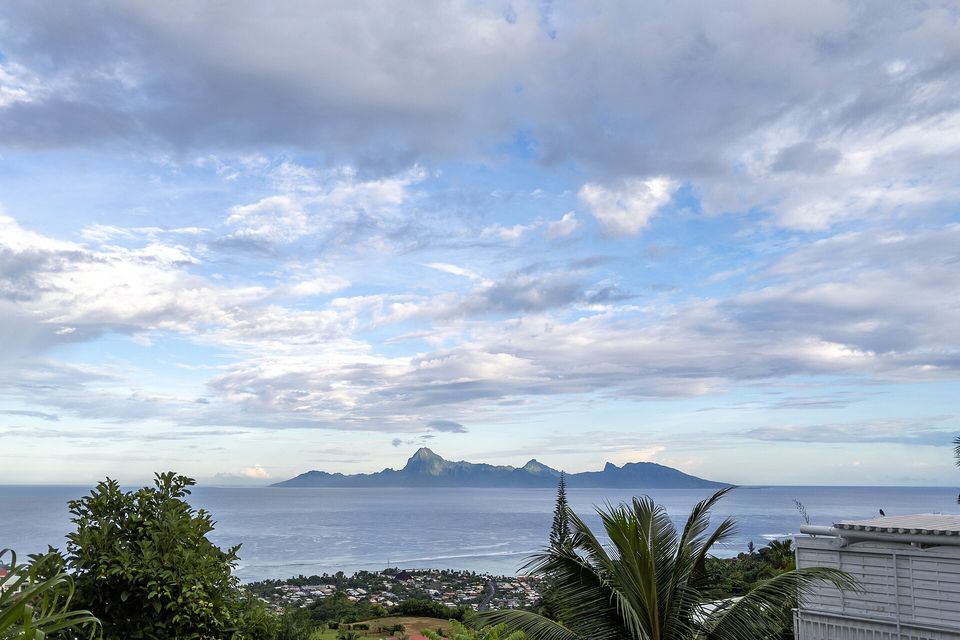
Moorea on the horizon across the channel from the heights of Tahiti, April 2019.
Photograph: Matthew Dillon · Tahiti, French Polynesia - View of Moorea from "home" (48027307981) · CC BY 2.0 · cropped
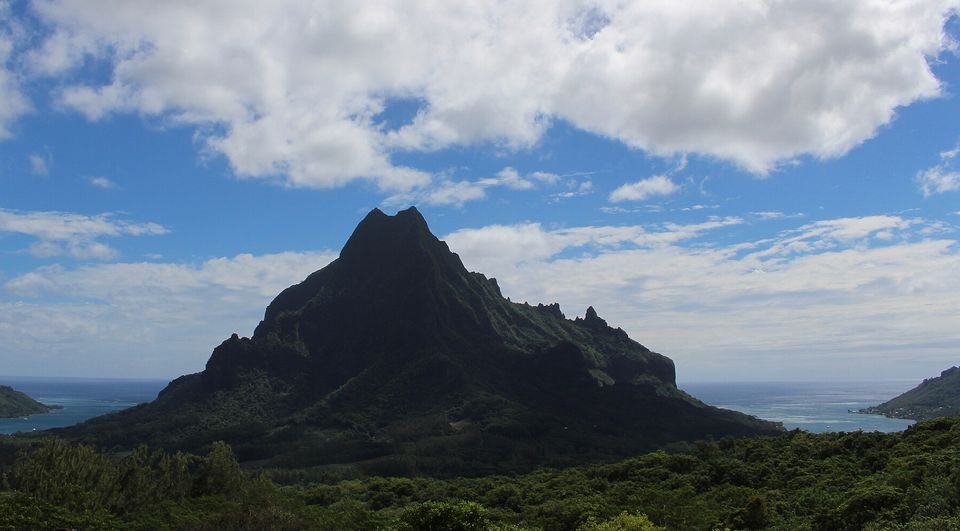
Mount Rotui between Cook's Bay and Ōpūnohu Bay, August 2017.
Photograph: Fanny98716 · CC BY-SA 4.0 · cropped
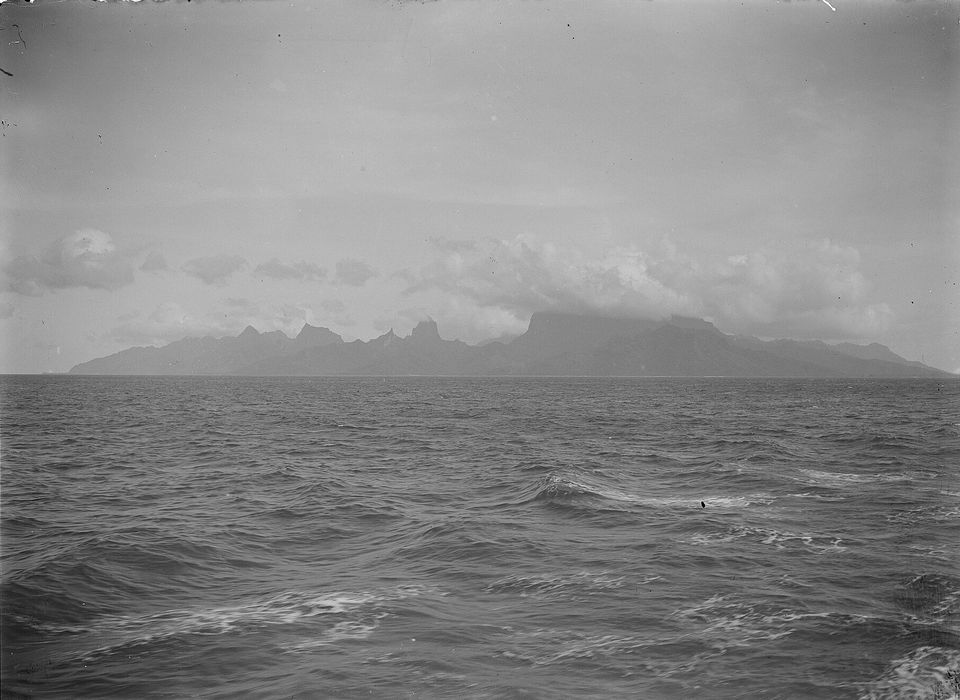
Moorea's jagged skyline from the sea, 1908 (historic glass-plate photograph).
Photograph: Henry Winkelmann (Auckland War Memorial Museum) · Public domain · cropped
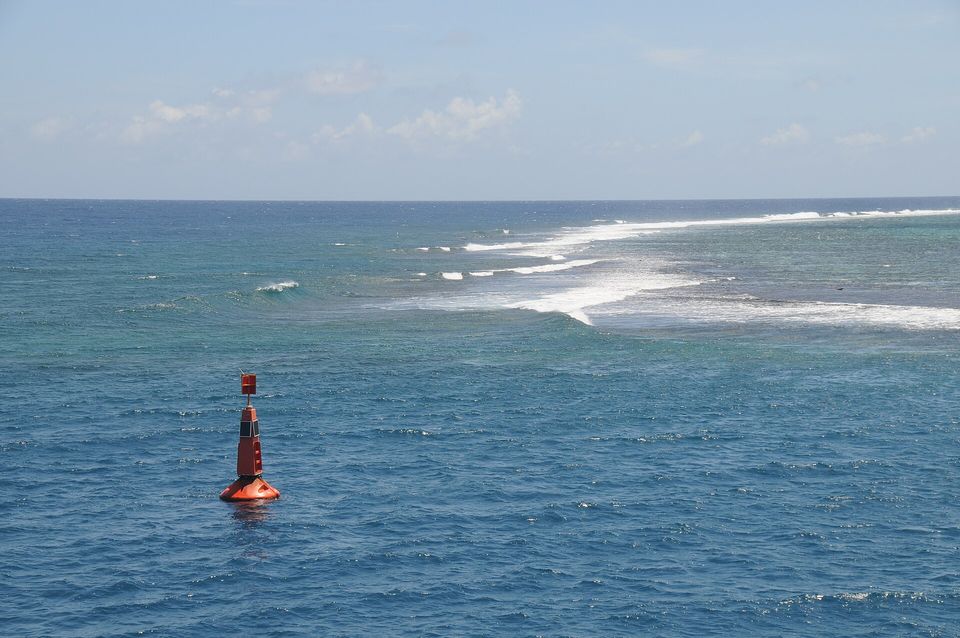
A channel marker at the reef pass into Cook's Bay, with surf breaking on the barrier reef, January 2009.
Photograph: David Broad · Moorea, entrance to Cook's Bay - panoramio · CC BY 3.0
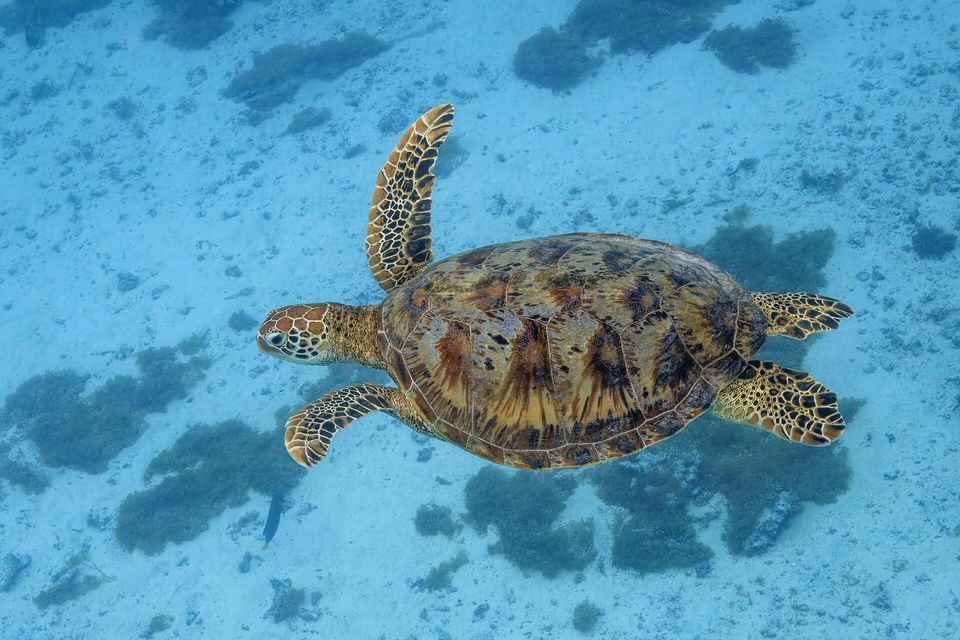
A green sea turtle over the sand of Moorea's lagoon, October 2024.
Photograph: Charles J. Sharp · CC BY-SA 4.0
- At the stone platforms in the valley, look and do not climb. They are still somebody's.
- Take the early boat across and stand at the rail for the arrival.
- Walk up to the lookout between the bays, and then stop talking for a while.
- Snorkel the lagoon slowly and keep your hands to yourself. The reef is busy.
- Leave the island with nothing added to the list. (Left with the list longer than the queue for the boat. Item handed to the snails, who will get round to it.)
A snail with a painted dot. A Partula tree snail, one or two centimetres long, with a small dot of UV-reflective paint on its shell. Before each year’s release on Moorea, conservationists from the zoos that bred them mark every snail, so that it can be found at night with a UV torch, when the snails are active. A snail found in the forest without a dot was born there, and in recent years the team has reported finding wild-born adult Partula tohiveana on Moorea for the first time in about 40 years.
Tally, in the marginA snail wearing a dot of paint so that someone can find it again in the dark. I went out with a torch looking for dots, and it was the thought of the plain ones, the ones nobody had painted, that made me sit down on a root.
Getting there
How to get there. International flights land at Faa’a International Airport on Tahiti. From Papeete, ferries cross to Moorea’s terminal at Vai’are Bay on the east coast, and there are short flights to Moorea Airport, in Wikipedia’s account. Check the operators’ own timetables.
When to go. Wikipedia describes the climate as warm and humid all year, with the heaviest rain from December to February and the drier months from July to September.
The snails. The snails are tiny, critically endangered, active at night and monitored by conservation teams. This entry does not suggest looking for them on your own; the forest they live in is theirs.
How to be there. The marae of the Ōpūnohu valley are sacred sites. Look from the paths, do not climb on the stones, and leave nothing and take nothing.
Safety. The United States has French Polynesia at Level 1, exercise normal precautions, in an advisory reissued on 2 December 2024. Its advisory for France, at Level 2, is a separate item.
Mark this place
Common questions
What happened to the Partula snails on Moorea?
Moorea’s native Partula tree snails, in French Polynesia, were devastated in the wild in the 1980s and early 1990s by the rosy wolf snail, a predator introduced to control the introduced giant African land snail, according to the Zoological Society of London. Survivors were collected in the early 1990s and bred in zoos, which now return zoo-bred snails to the island every year.
Why are the Partula snails on Moorea marked with paint?
Before release in French Polynesia, each zoo-bred Partula snail is marked with a small dot of UV-reflective paint, so that conservationists can find it at night with a UV torch, when the snails are active, the Zoological Society of London explains. An unmarked snail found on Moorea was born in the wild, which is how breeding by released snails has been confirmed.
Are Partula snails still extinct in the wild?
Not all of them. The IUCN’s Mollusc Specialist Group reports that Partula tohiveana, a tree snail of Moorea in French Polynesia, has been moved on the IUCN Red List from Extinct in the Wild to Critically Endangered, after zoo-bred snails released on Moorea survived and their offspring reached adulthood. ZSL reported the first wild-born adults in about 40 years.
Why is it called Cook’s Bay?
Cook’s Bay on Moorea, French Polynesia, is named after the British navigator James Cook, although Cook anchored in Ōpūnohu Bay, the next bay to the west, during his third voyage in 1777. Wikipedia dates his landing to 30 September 1777 in one article and to October 1777 in another. Cook’s Bay is also called Paopao Bay.
What did Charles Darwin say about Moorea?
In November 1835, looking at Moorea, then called Eimeo, from the mountains of Tahiti, Charles Darwin wrote in his Beagle diary that the view might be compared to “a framed engraving, where the frame represents the breakers, the marginal paper the lagoon”. Wikipedia links the view to his theory of how coral reefs and atolls form.
How do you get to Moorea from Tahiti?
Ferries cross from Papeete on Tahiti to Moorea’s ferry terminal at Vai’are Bay, on the island’s east coast, and there are short flights to Moorea Airport, which opened in 1967. International flights to French Polynesia land at Faa’a International Airport on Tahiti. Moorea lies about 17 kilometres north-west of Tahiti.
What are the marae in the Ōpūnohu valley?
The marae of the Ōpūnohu valley on Moorea, French Polynesia, are the stone platforms of Polynesian worship built by the valley’s former inhabitants. Archaeologists have studied them since Kenneth Emory in the 1920s and Roger Green in the 1960s. Marae Titiroa was restored in the late 1960s; Marae Ahu-o-Mahine, nearby, has several levels.
How big is Moorea?
Moorea, in the Society Islands of French Polynesia, is about 16 kilometres across, with Mount Tohivea as its highest point, and had 17,718 inhabitants at the 2017 census. It is a shield volcano formed 1.5 to 2.5 million years ago, ringed by a coral reef and a narrow lagoon, and lies about 17 kilometres north-west of Tahiti.