
Part of French Polynesia
- Where
- Ōpoā, south-east Raiatea
Society Islands, French Polynesia - Coordinates
- 16.8361° S
151.3592° W - What it is
- A complex of marae
paved courts, platforms, standing stones - Faces
- Te Ava Mo’a
a sacred pass in the reef - Age
- Possibly from about AD 1000
rebuilt at least twice - Status
- UNESCO World Heritage, 2017
with valleys, lagoon and ocean - Entry
- Open access
do not climb on the stones
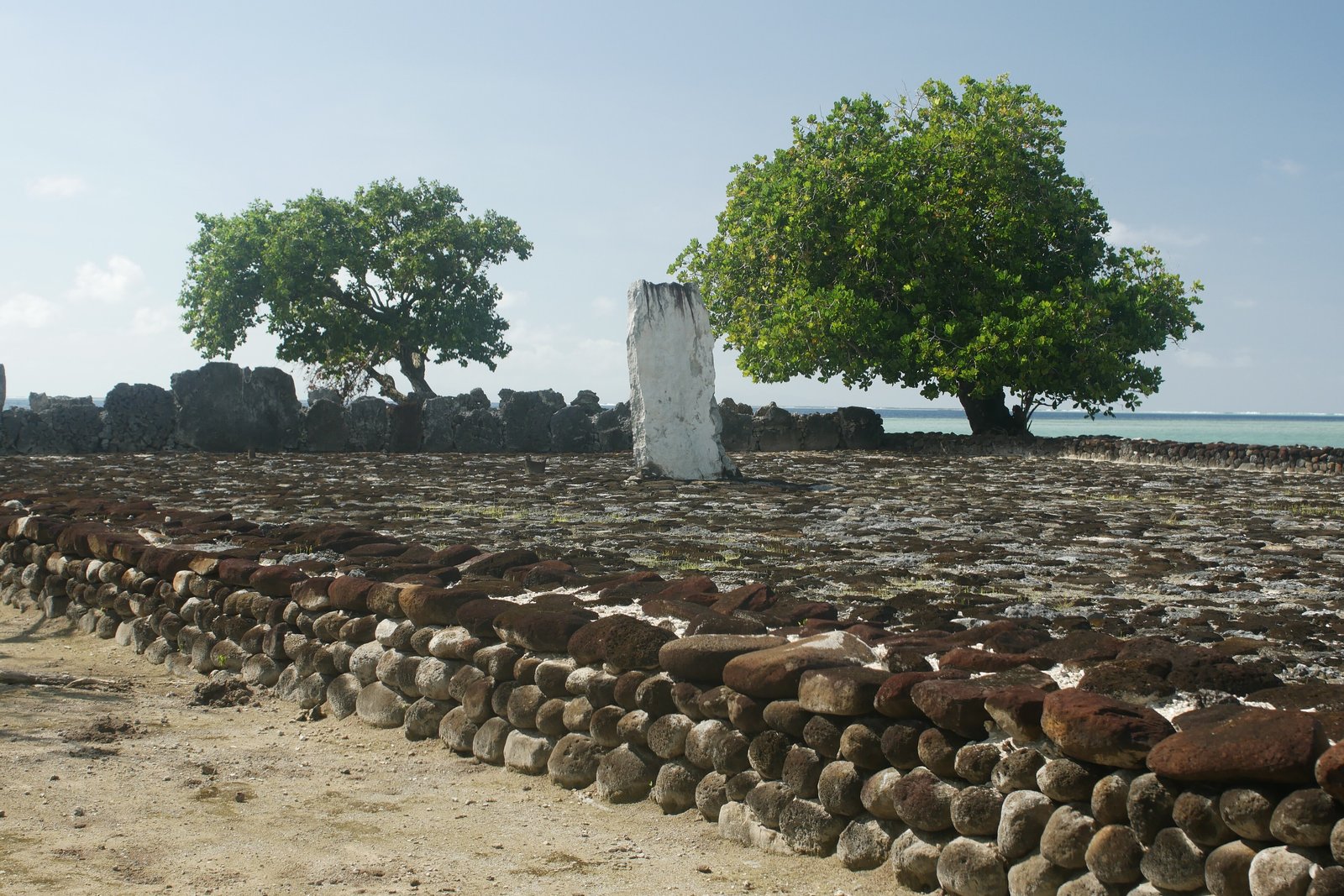
Warm rain, then sun, and a long point of land running out into a green lagoon. Low walls and paved courts of dark stone and pale coral, a few slabs standing upright among them. Out at the reef the surf broke white everywhere except in a gap straight in front of the stones. I kept my voice down without being asked. So did everyone else.
The short answer
Taputapuātea is a marae complex at Ōpoā, on the south-east coast of Raiatea, the second-largest of the Society Islands in French Polynesia. A marae is an open-air ceremonial place of paved stone, and this is several of them together on a low point of land running out into the lagoon. UNESCO describes it as a political, ceremonial and funerary centre, where the world of the living met the world of the ancestors and the gods, and as testimony to a thousand years of mā’ohi civilisation. It stands, in UNESCO’s phrase, at the centre of the “Polynesian Triangle”, the last part of the globe to be settled by humans. It was inscribed on the World Heritage List in 2017, together with two forested valleys, a portion of the lagoon and reef, and a strip of open ocean beyond.
Why it's worth knowing
Most temples stay where they are built. Taputapuātea travelled. UNESCO’s description of the site says that the marae was a concrete expression of a paramount alliance formed by its line of chiefs and its cult, and that stones were transported from it to other islands to found other marae with the same name. The alliance was held together by regular gatherings, at Taputapuātea, of chiefs, warriors and priests from the other islands.
Wikipedia’s account, drawing on the voyaging historian Ben Finney among others, names the reach of that alliance: the Cook Islands, the Austral Islands, a marae in Hawaiʻi and Māori in New Zealand, each of which set up new marae with a rock taken from Raiatea as a spiritual link. The same account records that the alliance broke when fighting broke out at a gathering and two leading high priests were killed, and that the departing voyagers left through an ordinary pass in the reef rather than the sacred one, which was taken as a bad omen.
The stones are still there, and so, in places, are their descendants. Tahiti Tourisme’s page on the Protestant church at Papetoai, on Moorea, says that an upright stone in front of it comes from the marae of Taputapuātea, and that this is why the old marae on that site has the status of a national marae.
The field notes
The courtyard and the pass
The complex sits at the end of a peninsula that Wikipedia names as Cape Matahira-i-te-ra’i, whose sacred area is called Te Pō. Its centre is the marae itself, a rectangular courtyard which Wikipedia gives as about 44 by 60 metres, paved with stone; UNESCO describes a paved courtyard with a large standing stone at its centre. At its east end is the ahu, a raised platform used for ceremonies. Other marae stand beside it, among them Hauviri, which Wikipedia says was used for investing chiefs.
The complex looks out, UNESCO notes, to Te Ava Mo’a, a sacred pass in the reef that encloses the lagoon. Raiatea’s Wikipedia article records that James Cook, arriving from Tahiti in the Endeavour on 20 July 1769, sailed in through that pass, anchored off Ōpoā and landed near the marae to take possession of the island for Britain.
Gods, and what was offered to them
By Wikipedia’s account the first marae here was dedicated to Ta’aroa, the creator, and later to ’Oro, whom Wikipedia’s articles describe as a god of war and of life and death; the marae became the centre of a voyaging network as his cult spread. The marae may have been founded as early as about AD 1000 and was rebuilt at least twice between the fourteenth and eighteenth centuries. Priests and navigators gathered here, the same account says, to share knowledge of genealogy and of deep-ocean navigation. The offerings made to ’Oro included human sacrifices, which Wikipedia records plainly, and UNESCO counts the complex as a funerary centre as well as a ceremonial one. It is a sacred and funerary place, and visitors are asked to treat it as one.
Abandoned, and taken back
Warriors from a neighbouring island ransacked the marae around 1763, by Wikipedia’s account, and after missionaries arrived in the early nineteenth century it was abandoned; Raiatea’s article records it as destroyed in 1828. When the Māori scholar Te Rangi Hīroa (Sir Peter Buck) visited in 1929 he found it overgrown, and wrote: “The bleak wind of oblivion had swept over Opoa.”
The marae was restored in 1994. In 1995, Wikipedia records, a great gathering was held there in an attempt to heal the old breach. The people of Ōpoā formed an association, Na Papa E Va’u Raiatea, to care for the site, and Wikipedia credits its work with the UNESCO inscription of 9 July 2017.
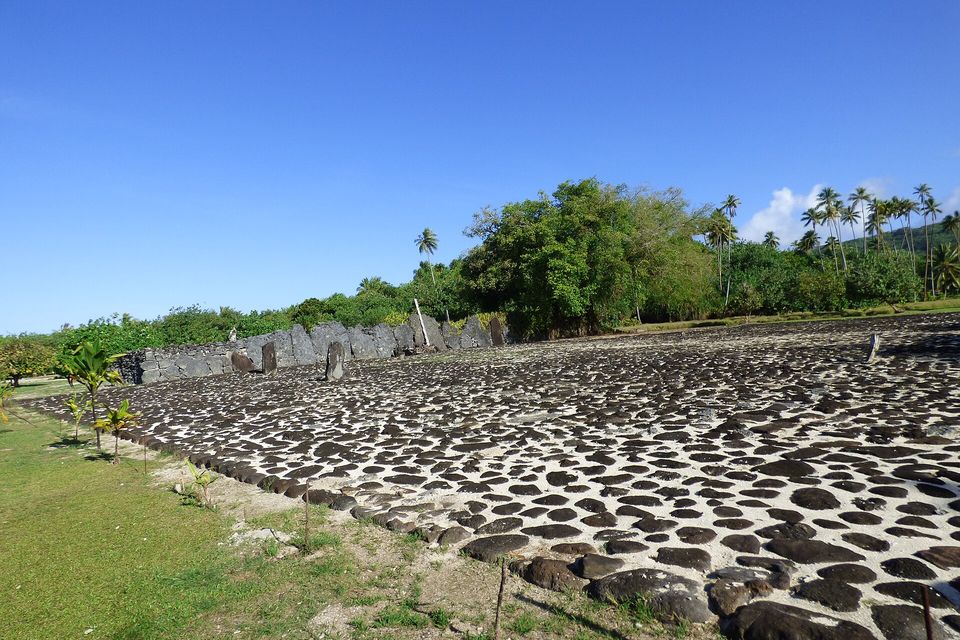
The paved court of the marae, September 2017.
Photograph: Kounilig · CC BY-SA 4.0 · cropped
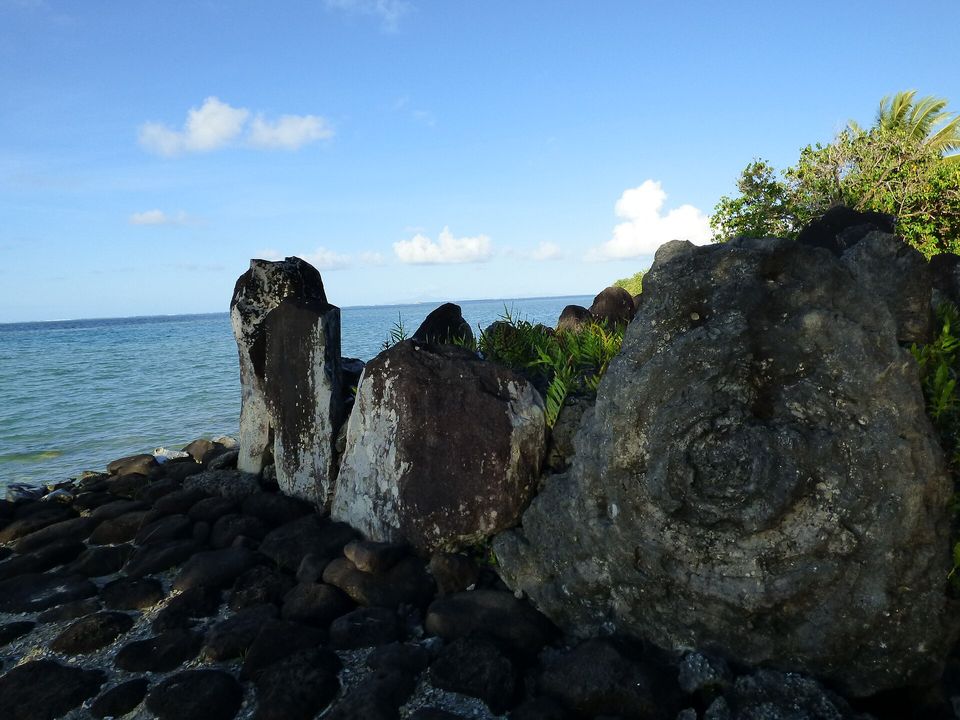
Upright stones at the lagoon edge of the marae, September 2017.
Photograph: Kounilig · CC BY-SA 4.0
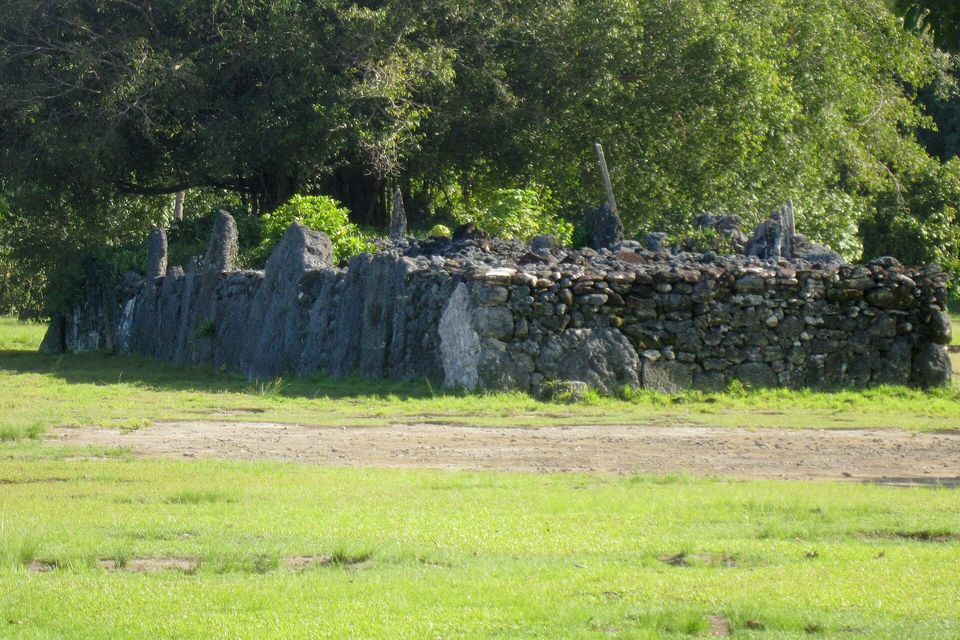
A wall of upright slabs at a marae in the Te Pō complex at Ōpōā, Raiatea, March 2013.
Photograph: PA · Marae, Raiatea · CC BY-SA 3.0 · cropped
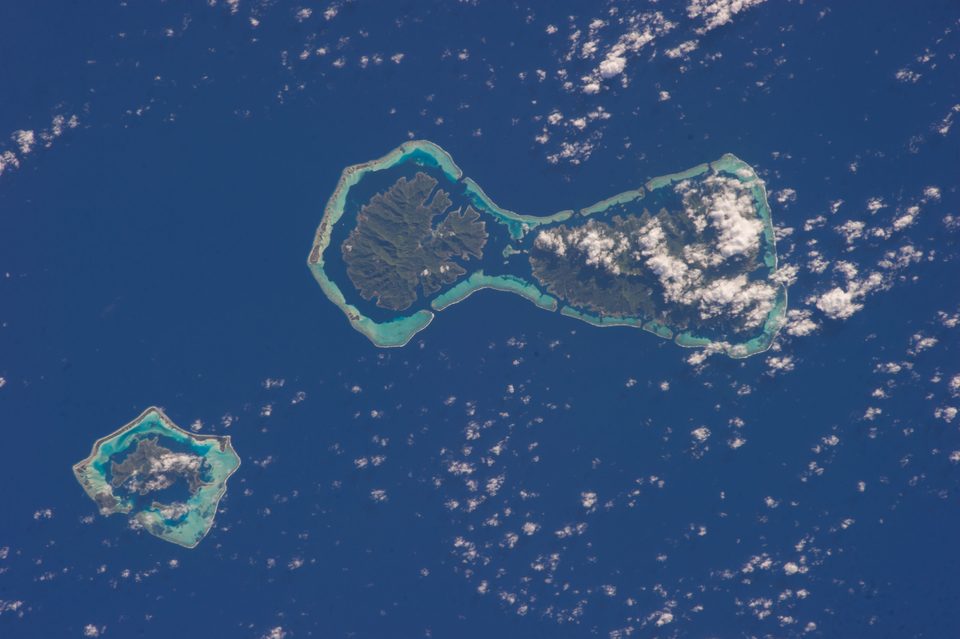
Raiatea (right, partly under cloud) and Taha'a inside their shared reef, with Bora Bora at lower left, from the International Space Station, October 2013 (astronaut photograph).
Astronaut photograph: NASA (ISS crew photograph ISS037-E-022125) · Public domain
- Do not climb on the stones or step onto the paved courts. Walk round them on the path, slowly.
- Come early, before anyone else, and let the place be quiet first.
- Take the path up the hill opposite and look back at the whole point, then out to the gap in the reef.
- If someone from the village is there to talk about it, listen more than you ask.
- Write this place into the list in your best handwriting. (Did. It is still the neatest thing on the list by a long way, which says something about the rest of it.)
The standing stone in the courtyard. At the heart of Taputapuātea is a paved courtyard with a large standing stone at its centre, and it is one of the stones that stayed. Others were carried from this marae to other islands to found new marae with the same name, so that a piece of this place stands in temples across the ocean. The stones here are fragile and sacred, and are not to be climbed or touched; they are looked at from the path.
Tally, in the marginSomebody told me, quietly, that other islands keep a stone from this place in their own temples. I had been walking round these stones as if they were the whole of it. They are more like the first page.
Getting there
How to get there. Fly to Tahiti, then on to Raiatea: Tahiti Tourisme gives the Air Tahiti flight as about 45 minutes, into the airport at Uturoa in the north of the island, where taxis and hire cars wait. Boats from Papeete take 5 to 8 hours depending on the company. The marae is on the south-east coast at Ōpoā, about 17 km from the airport in a straight line (this entry’s measurement) and further by the coast road.
At the site. Tahiti Tourisme describes free access, with information panels, and guided visits available; a footpath climbs the hill opposite to a viewpoint over the lagoon and the ocean towards Huahine. Its guidance for the site is plain: do not climb on the stones, respect the silence, take your waste away, and bring no fires, alcohol, picnics or pets. The paved courts and platforms are sacred and funerary; stay on the paths.
When to go. Wikipedia’s climate figures for Ōpoā show a warm, wet year, averaging about 26.6°C, with December the wettest month.
What to book ahead. The inter-island flight and a car or a guide. Nothing at the marae itself needs a ticket.
Safety. The United States has French Polynesia at Level 1, exercise normal precautions, in an advisory reissued on 2 December 2024 without changes. (France itself is at Level 2 because of terrorism and civil unrest; that advisory’s text concerns metropolitan France.)
Mark this place
Common questions
What is Taputapuātea?
Taputapuātea is a complex of marae, open-air ceremonial places of paved stone, at Ōpoā on the south-east coast of Raiatea in French Polynesia. UNESCO describes it as a political, ceremonial and funerary centre and as testimony to a thousand years of mā’ohi civilisation, and inscribed it on the World Heritage List in 2017.
Why were stones taken from Taputapuātea?
Stones were taken from Taputapuātea on Raiatea to found new marae on other islands. UNESCO says they were transported to found other marae with the same name, as an expression of the alliance centred on the marae. Wikipedia’s account lists the Cook Islands, the Austral Islands, Hawaiʻi and Māori New Zealand among the places where marae were founded with a rock from Raiatea.
Where is Taputapuātea?
Taputapuātea is at Ōpoā, on a point of land on the south-east coast of Raiatea, one of the Leeward Islands of the Society Islands in French Polynesia. It faces Te Ava Mo’a, a sacred pass in the reef. Raiatea’s airport, at Uturoa in the north, is about 45 minutes’ flight from Tahiti.
When was Taputapuātea made a World Heritage Site?
UNESCO inscribed Taputapuātea on the World Heritage List in 2017, on 9 July by Wikipedia’s date. The property includes the marae complex, two forested valleys, a portion of the lagoon and coral reef, and a strip of open ocean, recognising the site and its setting together.
Can you visit Taputapuātea?
Yes. Tahiti Tourisme describes the marae of Taputapuātea on Raiatea as freely accessible, with information panels and guided visits. It asks visitors not to climb on the stones, to respect the silence, to take their waste away and to bring no fires, alcohol, picnics or pets, because it is a sacred site.
How old is Taputapuātea?
UNESCO calls Taputapuātea on Raiatea testimony to a thousand years of mā’ohi civilisation. Wikipedia’s account says the marae may have been founded as early as about AD 1000 and was expanded and rebuilt at least twice between the fourteenth and eighteenth centuries, before being abandoned in the nineteenth and restored in 1994.
What does the name Taputapuātea mean?
Wikipedia’s article on the marae gives the name Taputapuātea as meaning “sacrifices from afar”, and says that, according to legend, it was given by Hiro, a descendant of the god ’Oro, who built the marae. No primary source for the translation was reached for this entry.
Did James Cook visit Taputapuātea?
Yes. Wikipedia’s article on Raiatea records that James Cook, arriving from Tahiti in the Endeavour on 20 July 1769, sailed through the sacred reef pass Te Ava Mo’a, anchored off Ōpoā and landed near the marae of Taputapuātea, where he took possession of the island for Britain in a brief ceremony.