
- Where
- The medina of Marrakesh
Morocco - Coordinates
- 31.6258° N
7.9894° W - What it is
- The medina’s main square and marketplace
- Protected
- Since 1922
as part of Morocco’s artistic heritage (UNESCO) - UNESCO
- Masterpiece of oral heritage, 2001
Representative List, 2008 - The medina
- UNESCO World Heritage, 1985
- Entry
- Free
open day and night
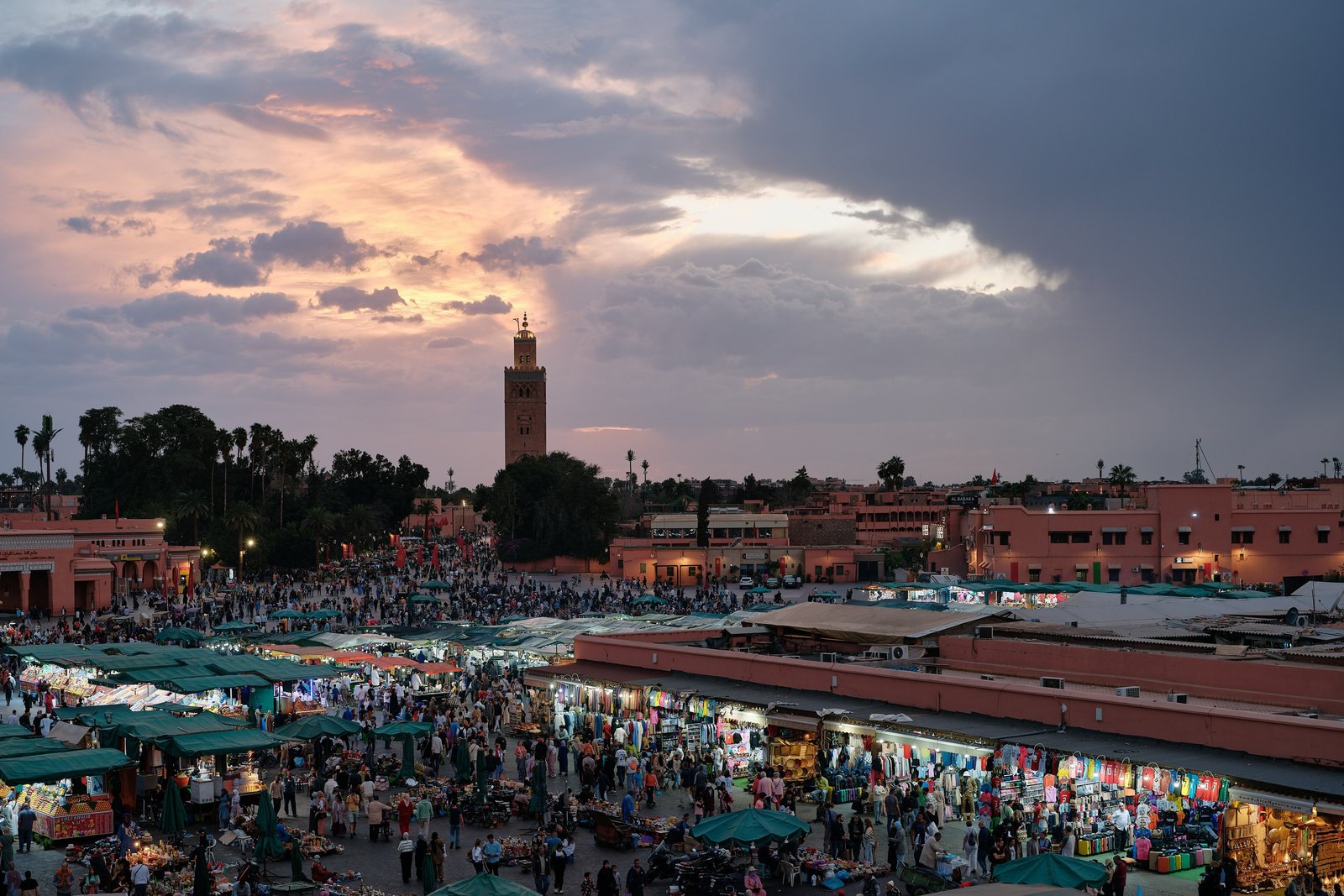
By dusk the open ground had filled with smoke from more grills than I could count, and every few steps a ring of people stood round somebody telling a story. A man in red, hung with brass cups, sold water from a leather bag, and a tall square tower above the rooftops turned pink. I understood none of the words and stayed in one ring for most of an hour.
The short answer
Jemaa el-Fnaa is a square and marketplace in the medina, the old walled city, of Marrakesh in Morocco, and it remains, in Wikipedia’s words, the city’s main square, used by locals and visitors alike. The Koutoubia Mosque, whose 77-metre minaret UNESCO calls the symbol of the city, stands close by, and the souks open off one side of the square. UNESCO proclaimed the “cultural space of Jemaa el-Fna Square” a Masterpiece of the Oral and Intangible Heritage of Humanity in 2001, and inscribed it on the Representative List of the Intangible Cultural Heritage of Humanity in 2008. The medina around it has been a World Heritage Site since 1985.
Why it's worth knowing
Nearly every UNESCO listing protects a thing: a building, a landscape, a reef. Jemaa el-Fnaa is protected for what people do on it. And it is one of the places that made that kind of protection possible.
According to The UNESCO Courier of December 2000, the Spanish writer Juan Goytisolo, who spent part of every year in Marrakesh, stood at the source of the idea. He had written against a plan to build a fifteen-storey glass tower on the square, arguing that any change to its layout would endanger what happened on it every day, and the project was abandoned. In June 1997 UNESCO and the Moroccan National Commission for UNESCO held an international consultation in Marrakesh on preserving popular cultural spaces, and later that year UNESCO’s General Conference, at its 29th session, created the Proclamation of Masterpieces of the Oral and Intangible Heritage of Humanity. Wikipedia’s account of the programme says plainly that the idea came from the campaign to preserve this square.
The square was in the first group proclaimed, in 2001. In 2008, by Wikipedia’s account, the 90 proclaimed Masterpieces, the square among them, were incorporated into UNESCO’s new Representative List of the Intangible Cultural Heritage of Humanity.
The field notes
What exactly is protected
UNESCO’s own description lists what happens on the square through the day and far into the night: dental care, traditional medicine, fortune-telling, preaching and henna tattooing; water-carrying, fruit and traditional food; and performances by storytellers, poets, snake-charmers, Berber musicians, Gnaoua dancers and players of the senthir. Its storytellers, UNESCO says, improvise on the outline of old texts, adapting them for a wider audience. The Courier called them halaiquis, and reported Goytisolo’s view that the loss of a single one mattered more to humanity than the deaths of two hundred best-selling authors.
UNESCO names the threats as urbanisation, and in particular property speculation and road building. What it lists as heritage cannot be fenced or restored; it lasts only as long as people keep coming to perform it and to listen.
A square without walls
The square has no formal architectural edge, as Wikipedia’s history of it notes; it began, under the Almoravid dynasty that founded Marrakesh around 1070, as an open space beside a fortress and later a palace gate, used for markets, parades and public executions. It has survived because it kept being used. UNESCO gives the medina’s founding as 1070–72.
The name is disputed. Wikipedia sets out several readings, and reports that historians favour one: that it recalls a great mosque the Saadian sultan Ahmad al-Mansur began in the square in the late sixteenth century and abandoned, so that jamaa al-fna’ came to mean something like “the ruined mosque”.
Hard days
On 28 April 2011 a bomb in a café on the square killed 17 people. After the earthquake of 8 September 2023, which brought down the minaret of the Kharbouch Mosque overlooking the square, residents slept out in the open square for fear of aftershocks. Wikipedia also records a renovation of the square begun in May 2025 and scheduled to finish by the end of that year; check what is open when you go.
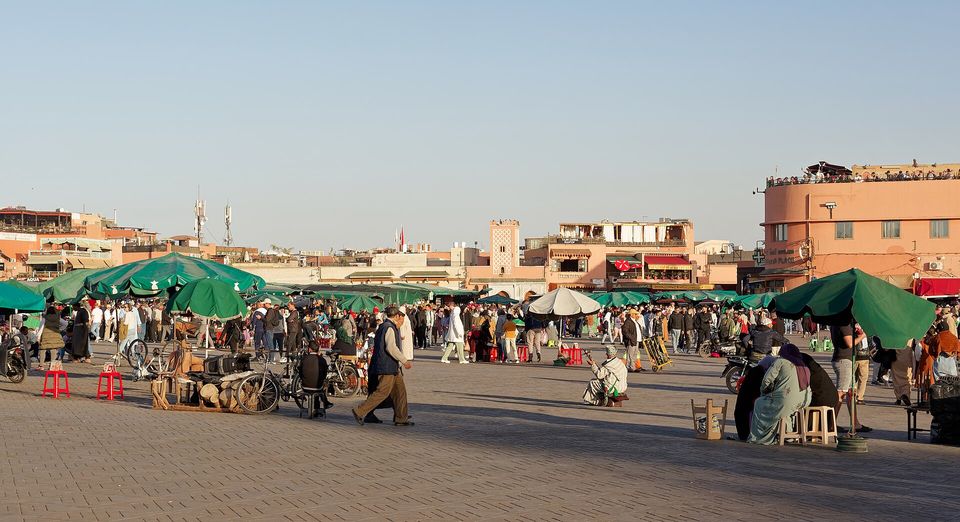
The square in late-afternoon light with the stall umbrellas out, January 2025.
Photograph: Jakub Hałun · CC BY 4.0
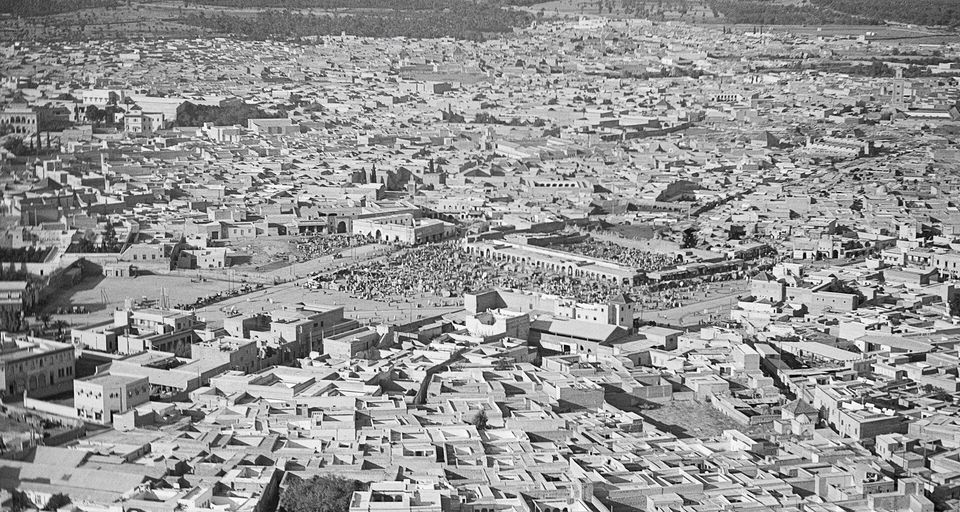
The square crowded with people, seen from 400 m during Walter Mittelholzer's flight to Lake Chad, 1930 to 1931 (historic aerial photograph).
Photograph: Walter Mittelholzer (ETH-Bibliothek Zürich) · CC BY-SA 4.0 · cropped
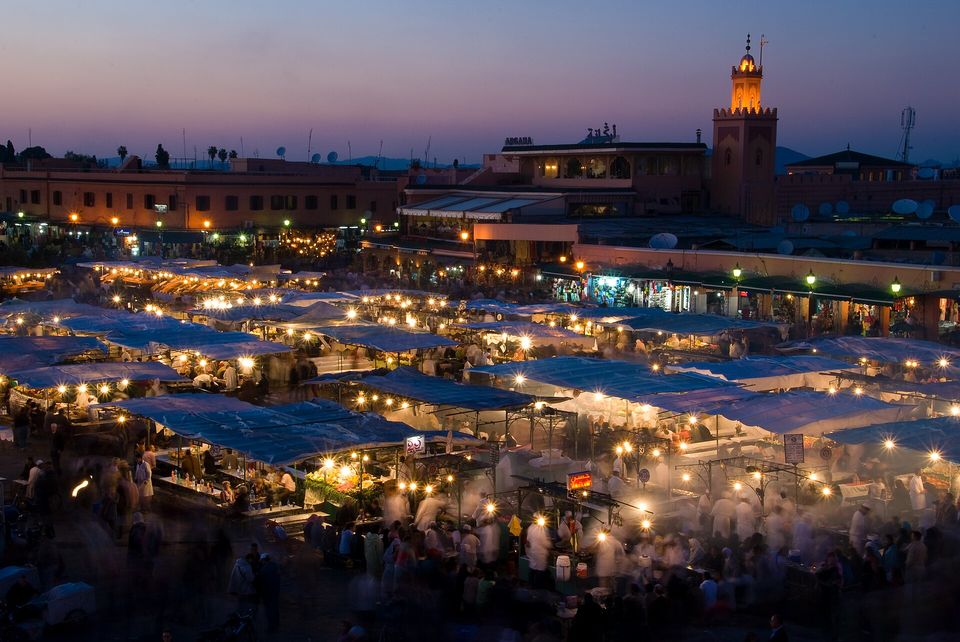
Food stalls lit at blue hour, March 2008.
Photograph: Michal Osmenda · Djemaa El Fna at sunset (2362267954) · CC BY-SA 2.0
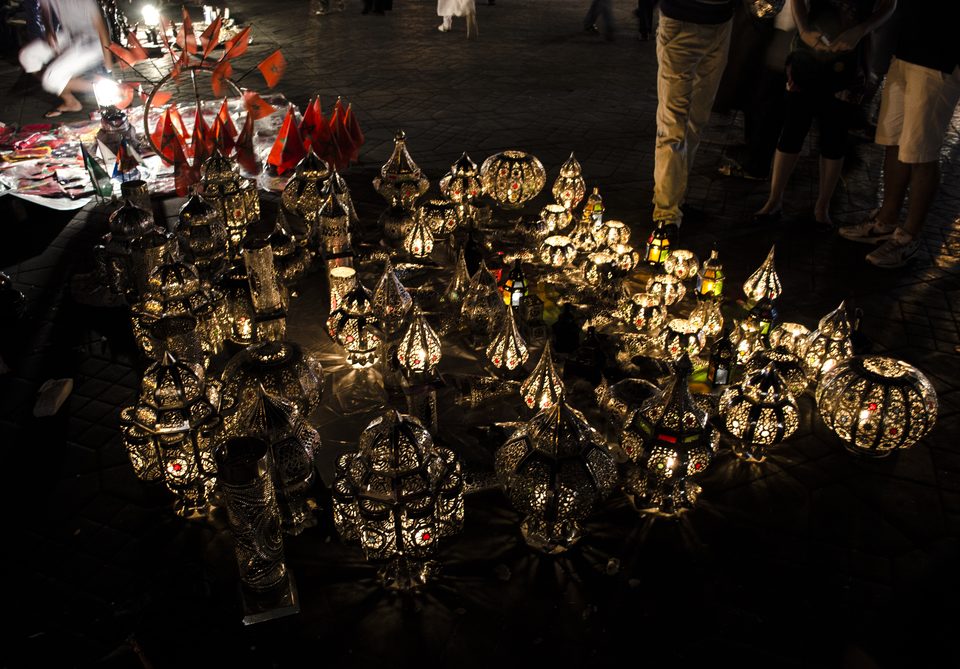
Lanterns for sale laid out on the square at night, June 2013.
Photograph: Carlitos0802 · Lámparas en Plaza de Yamaa el Fna · CC BY-SA 3.0
- If you stop in a ring to listen, pay when they ask, as you would anyone whose evening you had borrowed.
- Ask before you photograph anybody, and accept the answer, whichever it is.
- Eat at a stall where local families are eating, and sit where you are told.
- Climb to a terrace at sunset and watch the ground fill up from above before you go down into it.
- Hear one story all the way to the end. (Understood none of it, stayed till the end, and was told it continues tomorrow. Item carried forward, like the story.)
A water seller’s brass cup. By day, before the storytellers and the food stalls, the square belongs to juice stalls and to water sellers, who work it with traditional leather water-bags and brass cups. Water-carrying is on UNESCO’s list of what goes on in the square, beside the storytellers, poets and musicians, and it is part of the cultural space UNESCO proclaimed here in 2001.
Tally, in the marginA brass cup, handed over full and taken back empty in about the time it takes to say thank you. I drank without looking at it, and saw how brightly it had been polished only when it was the next man’s turn.
Getting there
How to get there. Marrakesh Menara Airport, which Wikipedia describes as receiving flights from Europe, Casablanca, the Arab world and, since 2024, North America, is about 5 km from the square in a straight line (this entry’s measurement). The square is the hub of the medina: most routes through the old city lead to it, and the Koutoubia minaret is the landmark to walk towards.
When to go. Any day, and more than once in a day: Wikipedia describes the square changing from juice stalls and water sellers by day, to storytellers, musicians and entertainers late in the afternoon, to food stalls after dark, when the crowd is at its peak. There is no ticket and no closing time.
On the square. The performers and stallholders are working. Ask before you photograph anyone, and expect that some will ask to be paid and some will say no. Wikipedia notes that chained macaques and snake charmers also work the square, despite the protected status of those species under Moroccan law; this entry leaves the choice to you.
What to book ahead. A place to stay in or near the medina, and nothing else; the square needs no booking.
Safety. The United States has Morocco at Level 2, exercise increased caution, because of terrorism, in an advisory reissued on 21 April 2025 with no area-specific warnings. It names tourist locations, transport hubs and markets among likely targets, and advises staying alert in tourist spots and avoiding demonstrations.
Mark this place
Common questions
What is Jemaa el-Fnaa?
Jemaa el-Fnaa is the main square and marketplace of the medina of Marrakesh, Morocco, beside the Koutoubia Mosque. By day it holds juice stalls, water sellers and healers; in the evening storytellers and musicians; after dark, food stalls. UNESCO recognises the activity on it, its “cultural space”, as intangible cultural heritage of humanity.
Why is Jemaa el-Fnaa protected by UNESCO?
UNESCO protects Jemaa el-Fnaa in Marrakesh for its living traditions, not its buildings: its storytellers, poets, musicians, dancers, healers and stallholders. It proclaimed the square’s cultural space a Masterpiece of the Oral and Intangible Heritage of Humanity in 2001 and inscribed it on the Representative List of the Intangible Cultural Heritage of Humanity in 2008.
What did Juan Goytisolo do for Jemaa el-Fnaa?
The Spanish writer Juan Goytisolo, who spent part of each year in Marrakesh, campaigned against a plan to build a fifteen-storey glass tower on Jemaa el-Fnaa, and the project was abandoned. The UNESCO Courier of December 2000 credits his commitment and the square as the source of UNESCO’s programme of Masterpieces of the Oral and Intangible Heritage of Humanity.
What does Jemaa el-Fnaa mean?
The meaning of Jemaa el-Fnaa is disputed. Wikipedia sets out several readings, including “the gathering place”, and reports that historians favour an explanation from the ruined mosque that the Saadian sultan Ahmad al-Mansur began in the square in the late sixteenth century and abandoned, so that the name came to mean something like “the mosque of ruin”.
When is the best time to visit Jemaa el-Fnaa?
Jemaa el-Fnaa in Marrakesh changes through the day, so the best plan is to visit more than once: in the day for the juice stalls and water sellers, in the late afternoon for storytellers and musicians, and after dark for the food stalls, when Wikipedia says the crowd is at its peak. Entry is free and there is no closing time.
How far is Jemaa el-Fnaa from Marrakesh airport?
Jemaa el-Fnaa is about 5 km in a straight line from Marrakesh Menara Airport, which serves flights from Europe, Casablanca, the Arab world and, since 2024, North America. The square is at the centre of the medina of Marrakesh, near the Koutoubia Mosque, whose minaret is the usual landmark for finding it.
Is the medina of Marrakesh a World Heritage Site?
Yes. The Medina of Marrakesh was inscribed on UNESCO’s World Heritage List in 1985. UNESCO dates the city’s founding by the Almoravids to 1070–72 and calls the Koutoubia Mosque’s 77-metre minaret the symbol of the city. Jemaa el-Fnaa, inside the medina, is listed separately as intangible heritage.
Is Jemaa el-Fnaa safe to visit?
The United States has Morocco at Level 2, exercise increased caution, because of terrorism, in an advisory reissued on 21 April 2025 with no area-specific warnings; it names tourist locations and markets among possible targets. A bomb in a café on Jemaa el-Fnaa killed 17 people on 28 April 2011.