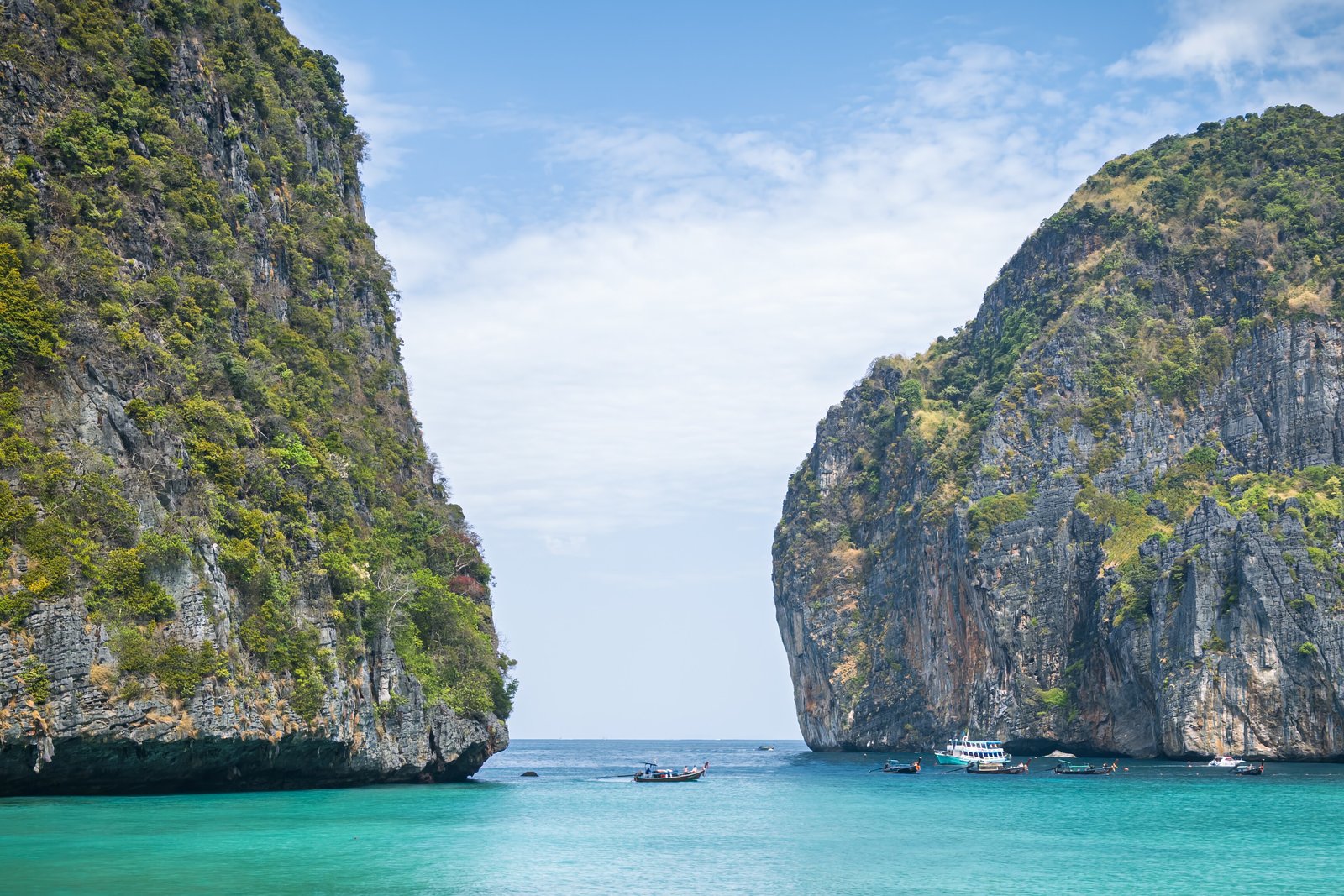

- Where
- Ko Phi Phi Le, Krabi province,
Thailand (Andaman Sea) - Coordinates
- 7.6775° N
98.7656° E - Park
- Hat Noppharat Thara–
Mu Ko Phi Phi National Park - Closed
- From 1 June 2018;
reopened January 2022 - Swimming
- Not allowed
in the bay - Sharks
- Up to 118 at once
(park survey, 2026) - Annual closure
- 1 August to 30 September
(check the park)
A long wooden boat with coloured cloth at its bow took me behind an island of sheer grey cliffs hung with green, to a jetty and a boardwalk through the trees. Then a white beach in a ring of stone. A ranger with a whistle kept us at the water’s edge. Small dark fins went to and fro in the shallows, and I found I was on the ranger’s side.
The short answer
Maya Bay (Ao Maya) is a cove on Ko Phi Phi Le, the smaller of the two main Phi Phi islands in the Andaman Sea, in Krabi province, Thailand. Wikipedia describes the island, about 2 square kilometres, as a ring of steep limestone hills around two shallow bays, Maya Bay and Loh Samah. It is part of Hat Noppharat Thara–Mu Ko Phi Phi National Park. The bay became world-famous as the setting of the film The Beach, shot there in 1999 and released in 2000, and the crowds followed. The park closed it in 2018. Since it reopened in 2022, visitors land at a pier on the far side of the island, walk to the beach on a boardwalk and are not allowed to swim.
Why it's worth knowing
Maya Bay is a beach that was loved nearly to death, closed, and given back to its wildlife. Wikipedia’s account gives an estimated 5,000 visitors a day on the beach and 200 boats a day anchoring in the bay before 2018, and surveys by marine biologists found that 80 per cent of the surrounding coral had been destroyed by boat traffic and pollution. Thailand’s Department of National Parks announced a four-month closure from 1 June 2018, then, on 1 October 2018, closed the beach indefinitely, its director, Songtam Suksawang, saying that it had been completely destroyed along with the plants that covered it. It stayed shut for three and a half years; the Tourism Authority of Thailand reported the reopening planned for 1 January 2022.
What came back were the sharks. Blacktip reef sharks were reported close to the beach by December 2018, and Wikipedia records that they began breeding there again. In July 2025 the national park service’s marine research centre at Trang counted a record 158 in the bay, and its survey from 31 January to 6 February 2026, using drones over 17 flights, recorded up to 118 at one time and an average of 69 in the mornings, when activity peaked; the Bangkok Post, reporting both, quotes the researchers confirming the bay as a key breeding habitat. Swimming in the bay is prohibited.
The field notes
What the film changed
For The Beach, Wikipedia’s account says, 20th Century Fox bulldozed and landscaped the beach and altered its sand dunes to widen it and make it look more like the paradise of the story. Wikipedia’s two articles disagree on whether coconut palms were planted or cleared. Environmental groups sued. In 2006 Thailand’s Supreme Court upheld an appeals-court ruling that the filming had harmed the environment and ordered damage assessments; the defendants included 20th Century Fox and some Thai officials.
Rebuilding a reef
Coral restoration began in June 2018, run by the park service’s marine operation centre at Trang. Wikipedia reports that by February 2019 more than 15,000 corals of several local species had been propagated in the bay. The reopening rebuilt the approach: a new jetty at Loh Samah, on the opposite side of the island, and, the Bangkok Post reported, a five-minute walk on a wooden trail to the beach, so that boats no longer anchor over the bay’s reef.
The rules have kept changing. The Bangkok Post and the Nation have reported hourly caps of 300, 375 and 380 visitors, in different years. Since the reopening, the park has also closed the bay each year from 1 August to 30 September, which the Nation reported was to let the reefs recover and to keep visitors safe from the rough monsoon sea.
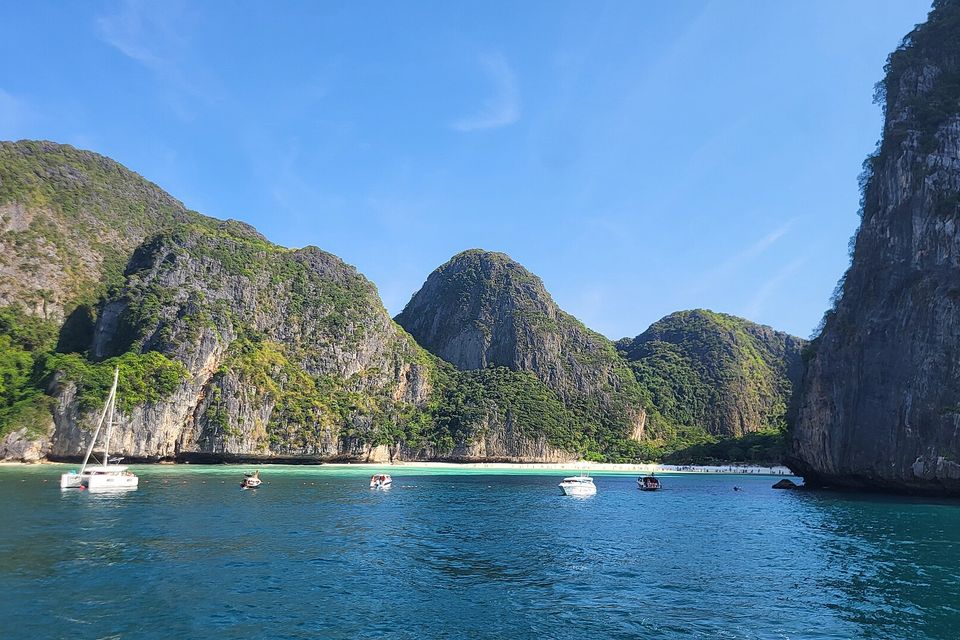
Maya Bay from the water, January 2025.
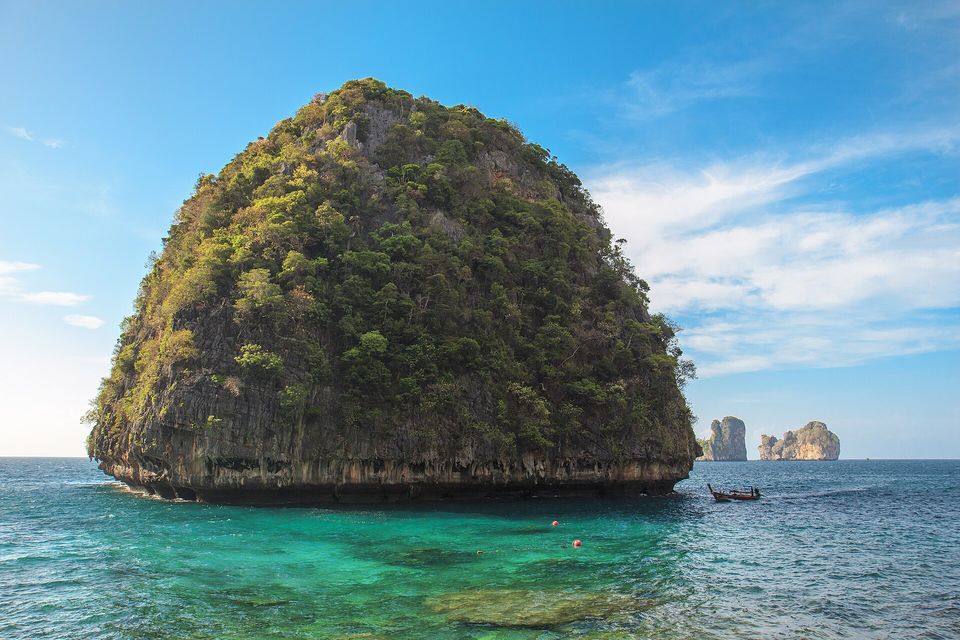
The rounded rock off Loh Samah Bay, on the far side of Ko Phi Phi Le, April 2018.
Photograph: Алексей Коптелов (Aleksey Koptelov) · CC BY-SA 4.0
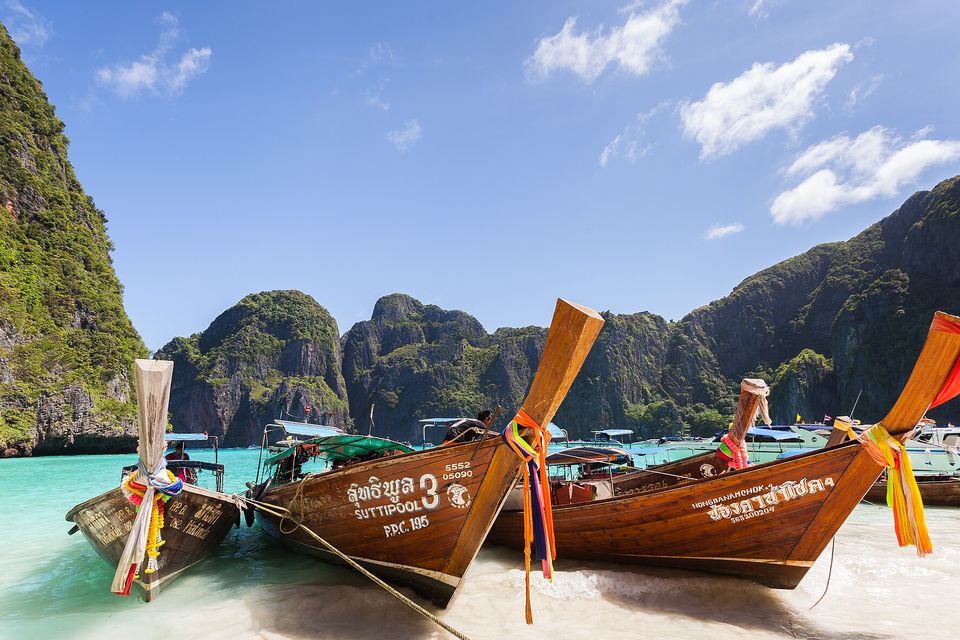
Longtail boats on Maya Beach in August 2013, five years before the bay was closed to visitors (historic view).
Photograph: Diego Delso · Playa Maya, Ko Phi Phi, Tailandia, 2013-08-19, DD 13 · CC BY-SA 3.0 · cropped
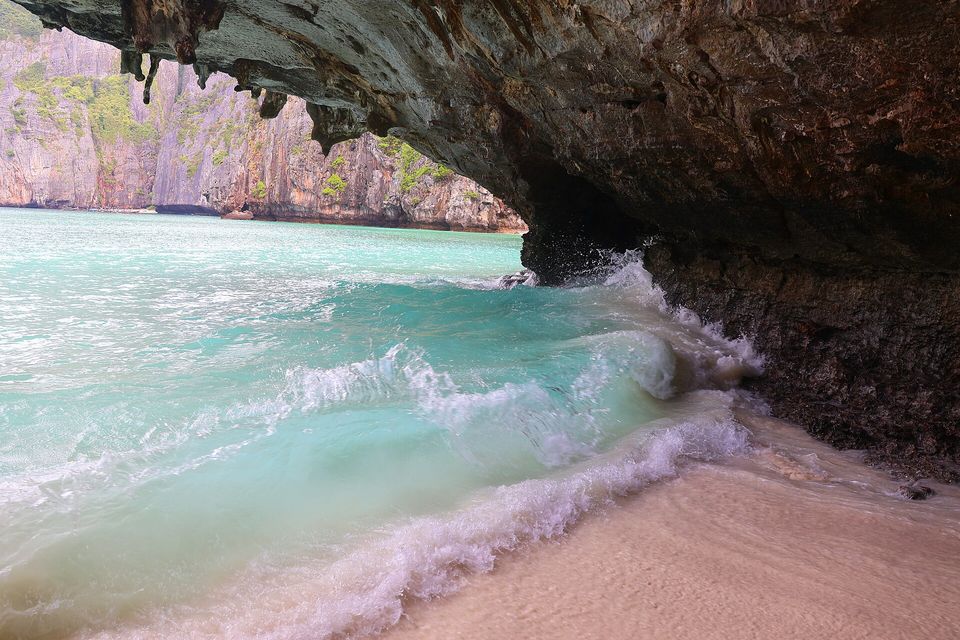
A wave breaking under a limestone overhang at the edge of Maya Beach, November 2024.
Photograph: AramilFeraxa · CC BY-SA 4.0
- Stay where the ranger says. The shallows belong to someone smaller.
- Take the earliest boat you can, and let the others be second.
- Brush the sand off your feet before the boardwalk. It lives here.
- Look at the bay for the whole of the time you are given, and photograph only some of it.
- See the bay and leave the list on the boat. (Left it on the boat. The boat added two items on the way back.)
A young blacktip reef shark in the shallows. Since the closure of 2018, blacktip reef sharks have returned to breed in Maya Bay. A national-park survey in February 2026 counted up to 118 at once, with activity peaking in the mornings. You will not be allowed to swim with them. From the edge of the water, on a calm morning, you have a good chance of seeing fins moving in the shallows, but no one can promise it on a given day.
Tally, in the marginA shark small enough to turn round in a puddle, going about its business in water I was not allowed to put a toe in. I had come all this way for a beach, and it took me until lunch to see that I had been shown round a nursery.
Getting there
How to get there. Maya Bay is reached only by boat, on day trips from the mainland and from Ko Phi Phi Don, the larger island nearby. Boats land at the Loh Samah pier on the back of Ko Phi Phi Le, and a boardwalk leads through to the beach. Visits are time-limited, Wikipedia says to no more than an hour, and numbers are capped per hour. The national park charges an entrance fee; confirm whether your tour includes it.
When to go. The bay closes every year from 1 August to 30 September during the south-west monsoon. At the time of writing, the park had announced the 2026 closure from 1 August and reopening on 1 October 2026. Wikipedia gives the park’s seasons as a rainy season from May to December and a hot, drier season from January to April.
How to be there. No swimming, whatever the heat. Stay at the water’s edge, take nothing from the beach, and do not chase or feed the sharks. The rules exist for them.
Safety. The United States has Thailand at Level 1, exercise normal precautions. Its increased-caution areas are near the Cambodian border and in the southern provinces of Yala, Pattani and Narathiwat, about 290 kilometres from Maya Bay at the nearest, by our measurement. Burma, at Level 4, is about 250 kilometres to the north at the nearest point of its border.
Mark this place
Common questions
Can you swim at Maya Bay?
No. Since Maya Bay on Ko Phi Phi Le, Thailand, reopened in 2022, swimming in the bay has been banned. Visitors walk in from the Loh Samah pier on a wooden trail, and the bay, where blacktip reef sharks breed, stays closed to swimmers.
Why was Maya Bay closed?
Thailand’s Department of National Parks closed Maya Bay, on Ko Phi Phi Le, from 1 June 2018 because of damage from mass tourism: an estimated 5,000 visitors and 200 boats a day, and 80 per cent of the surrounding coral destroyed. The closure was made indefinite on 1 October 2018, and the bay reopened in January 2022 after three and a half years.
Is Maya Bay closed every year?
Yes. Maya Bay in Thailand’s Hat Noppharat Thara–Mu Ko Phi Phi National Park closes each year from 1 August to 30 September, during the monsoon, to let the reefs recover and to keep visitors safe from rough seas. For 2026, trade reports of the park’s notice gave the reopening as 1 October.
Are there sharks at Maya Bay?
Yes, blacktip reef sharks. After Maya Bay, in Thailand, closed in 2018 they returned and began breeding there again. The Bangkok Post reported a record 158 counted in July 2025, and a February 2026 national-park drone survey recording up to 118 at one time.
What film was shot at Maya Bay?
The Beach, starring Leonardo DiCaprio, was filmed at Maya Bay on Ko Phi Phi Le, Thailand, in 1999 and released in 2000. The production bulldozed and landscaped the beach and altered its dunes; in 2006 Thailand’s Supreme Court upheld a ruling that the filming had harmed the environment.
How do you get to Maya Bay?
By boat only, on day trips from the Thai mainland or from Ko Phi Phi Don. Boats no longer enter Maya Bay itself; they land at a pier at Loh Samah on the other side of Ko Phi Phi Le, and a boardwalk leads to the beach. Visits are time-limited and there is a national-park entrance fee.
How many people can visit Maya Bay?
Maya Bay, in Thailand’s Phi Phi islands, has had an hourly cap on visitors since it reopened in 2022. The Bangkok Post and the Nation have reported different limits in different years, from 300 to 380 visitors an hour; check the park’s current rule. Before the 2018 closure, an estimated 5,000 people a day crowded onto the beach.
Has the coral recovered at Maya Bay?
Recovery is under way. Coral rehabilitation at Maya Bay, on Ko Phi Phi Le, began in June 2018, and Wikipedia reports that more than 15,000 corals of local species had been propagated by February 2019. Boats now land at Loh Samah instead of anchoring in the bay, which removed the main source of damage.