The short answer
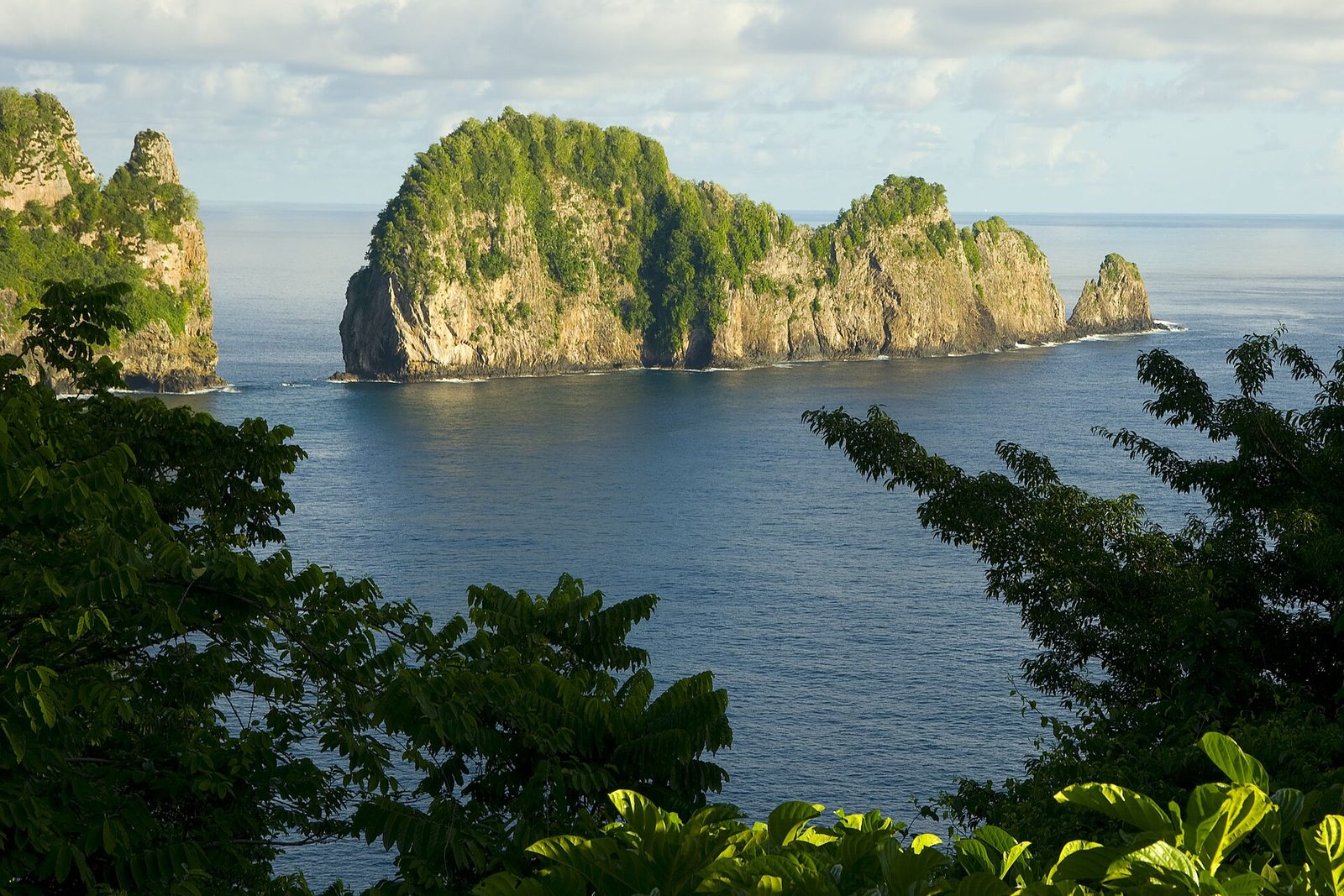
The National Park of American Samoa covers parts of three volcanic islands in the US territory of American Samoa: Tutuila, the main island, and Taʻū and Ofu in the Manuʻa group to the east. It protects tropical rainforest that runs from the mountaintops to the shore, rugged coast and about 4,000 acres of ocean with coral reefs. It lies about 2,600 miles south-west of Hawaiʻi, far out in the South Pacific. Congress created it in 1988, and nearly all of its land is leased from village councils rather than owned. There is no entrance fee.
From Tally’s diary
Rain came across the green mountain in a grey curtain, stopped as suddenly as it started, and the whole forest steamed and began to sing. Something large and dark flapped slowly over the treetops in broad daylight, as if it had somewhere important to be. Down in the village somebody waved me into the shade. I sat on the floor, legs tucked, and was given something wonderful to eat.
Inside the park
- Ofu
The park’s smallest piece: a long white beach and a shallow reef on Ofu, in the Manu’a Islands, reached by a small plane.
Photograph: National Park Service, Public domain (PD-USGov, US National Park Service), cropped

Why it's worth knowing
A forest from somewhere else. The park holds the only paleotropical rainforest in the US national park system: a forest whose plants trace their origins to the ancient forests of South-east Asia, not the Americas. More than 475 kinds of plant grow in it, with towering banyans and ferns, and the only native land mammals are three kinds of bat. Two of them are big fruit bats, the Samoan fruit bat and the white-naped fruit bat; the third, the small sheath-tailed bat, eats insects. Anyone used to squirrels and deer in a national park will find the treetops here busy with something quite different.
Reefs that hold their own. Coral reefs fringe all three islands, with more than 230 kinds of coral and more than 900 kinds of fish, the greatest marine variety of any US national park. It is the only US national park with an Indo-Pacific coral reef. Green and hawksbill turtles swim there, and humpback whales pass by in the southern winter. Some of the corals, in places such as the lagoon at Ofu, have shown an unusual resistance to warming water, which makes them a place scientists watch closely for what happens to reefs as the ocean warms.
Islands from a hot spot. The Samoan islands are a chain of volcanoes made as the Pacific Plate moves over a stationary hot spot, where molten rock pierces the plate and builds volcanoes, some tall enough to rise above the sea. Rain falls hard on them: 125 inches a year in the drier places and up to 300 inches in the highest mountains. On Taʻū, Lata Mountain is the highest point in American Samoa; on Tutuila, the Mount ʻAlava trail climbs steep ridges with the help of ladders.
The field notes
Faʻasamoa, the Samoan way
The people of American Samoa trace their Polynesian ancestry back more than 3,000 years, and nearly everyone is Samoan. Life follows the faʻasamoa: the extended family, the ʻaiga, comes first; respect, faʻaaloalo, is owed to elders, to custom and to the land; and each family is led by its matai, a chief chosen to serve. Visitors ask permission before taking photographs or using a beach. Inside a fale, a traditional house, they sit on the floor before speaking, eating or drinking, with legs crossed or covered by a mat. At dusk a village pauses for evening prayers, sā, and anyone passing through waits quietly.
The umu
Samoan cooking is at its best from the umu, an earth oven. Rocks are heated in a pit, and taro, breadfruit, fish, pork and chicken, wrapped in banana or breadfruit leaves, are laid on top and covered with more leaves to steam and bake slowly. Coconut goes into almost everything: palusami is young taro leaves cooked in coconut cream, and faʻalifu is taro or breadfruit in coconut cream. Taro has been a staple in Samoa for thousands of years.
Fine mats
Some of the most treasured objects in Samoan life are fine mats, woven for the great occasions: weddings, funerals and the bestowing of chiefly titles. They are part of how families mark the most important moments of their lives together.

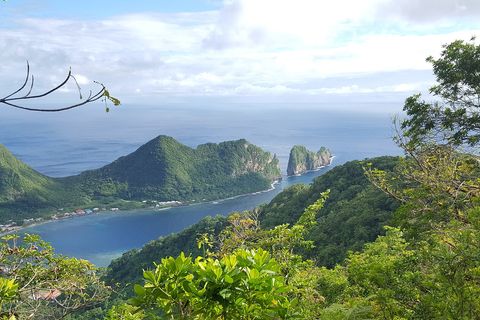
June 2018Looking down from the Mount ʻAlava trail.
Photograph: Eddy23, CC BY-SA 4.0, cropped

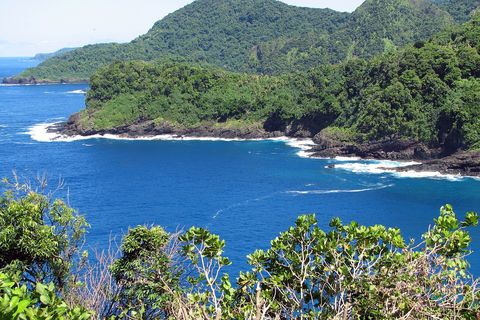
December 2005Amalu Bay, Tutuila.
Photograph: NPS / Tavita Togia, Public domain, cropped
- Wait out the rain under a big leaf. (Waited. It stopped. It started again. The leaf and I became quite close.)
- Watch a flying fox cross the valley. (Watched three. Each one made it look easy, which it is, for a bat.)
- Learn to say hello properly. (Learned it. Said it to everyone. Got hello back every time.)
- I walked through the village slowly at dusk and stopped where everyone else stopped, very still, while the evening prayers went by.
- Find the highest point of the mountain trail. (Found the ladders first. The highest point was further up than the ladders, which seemed unfair.)
A relic from National Park of American Samoa
Relic, entry 356Wings up to three feet acrossOut by day as well as by night
A Samoan fruit bat, the peʻa vao, hanging from a branch in broad daylight. It is a big bat, with wings that can reach three feet from tip to tip, and unlike most bats it is out by day as well as by night, soaring on the warm air over the ridges with slow, easy wing beats. Up close it often wears a pale triangular patch from its forehead to the back of its head, above russet-brown shoulders. It roosts alone or in pairs, the males out on bare branches along the ridge tops, and it lives nowhere in the world but the Samoan islands and Fiji.
Tally, in the marginAn umbrella with a face, I thought, hanging from a branch with its eyes shut, until it opened its wings and set off to plant some more of the forest. I have never before felt quite so grateful to someone for being asleep upside down.
Getting there
- 1
By air
Flights land at Pago Pago International Airport on Tutuila.
- 2
To the Manuʻa islands
Smaller planes fly on to Taʻū and Ofu.
- 3
Visitor centre
Pago Pago, open weekdays from 8 a.m. to 3 p.m.
- ✓
| J | F | M | A | M | J | J | A | S | O | N | D |
|---|---|---|---|---|---|---|---|---|---|---|---|
| June: best time | July: best time | August: best time | September: best time |
- The cooler, drier season, June to September
How to get there. Flights arrive at Pago Pago International Airport on Tutuila, and smaller flights go on from there to Taʻū and Ofu. The National Park of American Samoa Visitor Center is in Pago Pago, opposite the Pago Way Service Station, open on weekdays from 8 a.m. to 3 p.m. and closed at weekends and on federal holidays. Some trails cross private land and need a family’s permission, sometimes with a small fee. There is no entrance fee for the park.
When to go. It is warm and humid all year. The long wet season, from October to May, brings frequent showers and the chance of tropical storms; the cooler, drier season, June to September, is the best time to be outdoors.
Safety. American Samoa is a US territory, so no State Department advisory applies. The park warns of strong tidal outflows, slippery coral rubble and falling coconuts, and of storms in the wet season.
Mark this place
The passport stamp for this place.
Common questions
How far away is the National Park of American Samoa?
About 2,600 miles south-west of Hawaiʻi. The National Park of American Samoa is on three islands far out in the South Pacific, in the US territory of American Samoa.
How do you get to the National Park of American Samoa?
By air to Pago Pago. Flights land at Pago Pago International Airport on Tutuila, where the park’s visitor centre is; smaller planes continue to the islands of Taʻū and Ofu.
Which islands are in the National Park of American Samoa?
Three: Tutuila, Taʻū and Ofu. The National Park of American Samoa covers parts of each, with rainforest on land and about 4,000 acres of ocean and coral reef.
What is special about the rainforest in American Samoa?
It is the only paleotropical rainforest in the US national park system. The National Park of American Samoa’s forest comes from South-east Asian origins and is pollinated largely by fruit bats.
Does the National Park of American Samoa charge an entrance fee?
No. There is no fee and no entrance pass is needed for the National Park of American Samoa; some trails on family land may ask a small fee.
When is the best time to visit American Samoa?
The drier season, June to September. In the National Park of American Samoa the wet season runs from October to May, with frequent rain and the chance of tropical storms.
What is fa'asamoa?
The Samoan way of life. In American Samoa, home of the National Park of American Samoa, the faʻasamoa puts the extended family first, honours elders and is led by chiefs called matai.
Photographs on this page
Tap a photograph to see it full size.
Photograph: NPS, Public domain, cropped
Photograph: Eddy23, CC BY-SA 4.0, cropped
Photograph: NPS / Tavita Togia, Public domain, cropped




