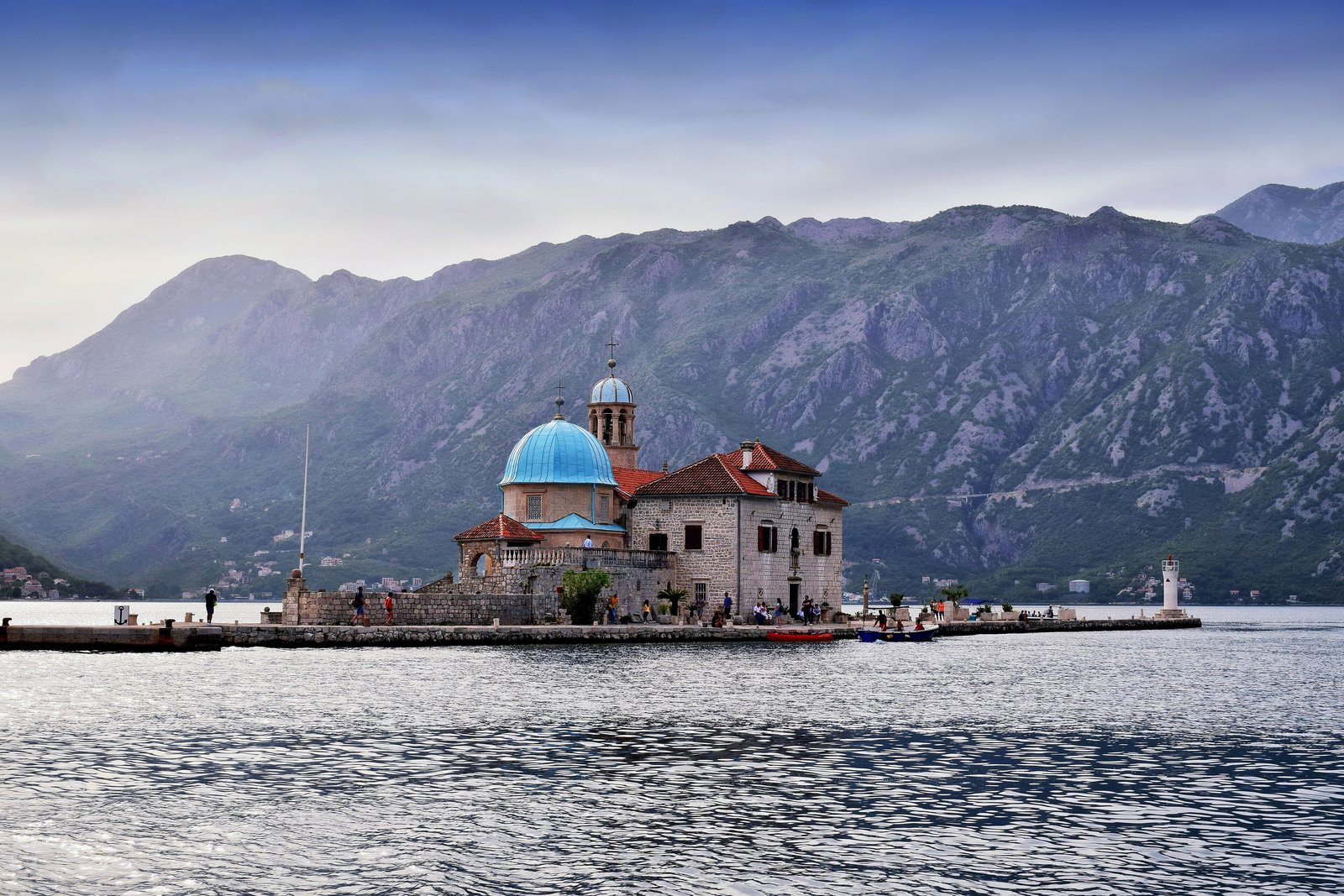

- Where
- Bay of Kotor, off Perast
Montenegro - Coordinates
- 42.4864° N
18.6894° E - Made of
- Stones and sunken ships
on a reef called Škrpjel - Area
- 3,030 m²
(Wikipedia) - Tradition
- Icon found on 22 July 1452
(Diocese of Kotor) - Fašinada
- Every 22 July, at sunset
- Advisory
- Montenegro Level 1
Still water between steep grey mountains, salty though it looked like a lake. A boatman took me out from a little stone town to an island that was almost entirely church, next door to one that was almost entirely cypress trees. Inside, the walls were crowded with small painted ships in storms, and every one of them looked relieved. I sat at the back and had nothing to add.
The short answer
Our Lady of the Rocks, in Montenegrin Gospa od Škrpjela, is a small artificial island in the Bay of Kotor, off the old seafaring town of Perast. It was raised on a bare reef, called Škrpjel, by dropping stones and, by Wikipedia’s account, by sinking old and captured ships loaded with rock around it. Most of it is taken up by the Catholic church of Our Lady of the Rocks, which belongs to the Diocese of Kotor and has a museum attached; there is also a small shop and a navigation light. Its neighbour, the islet of Sveti Đorđe (St George), is natural and holds a Benedictine monastery. The bay, which Wikipedia describes as a ria, a drowned river valley, rather than the fjord it resembles, is part of the Natural and Culturo-Historical Region of Kotor, a UNESCO World Heritage Site since 1979.
Why it's worth knowing
Most islands are found. This one was delivered, a boatload at a time, and the deliveries have not stopped.
The Diocese of Kotor gives the tradition that is kept in Perast: 22 July 1452 is counted as the island’s birthday, the day seamen found the icon of Our Lady on the reef. By the legend Wikipedia relays, sailors returning from a successful voyage laid a stone on the reef, and over the centuries the island rose out of the sea. By the diocese’s account, the church’s presbytery was built from 1720 to 1725 to designs by a local builder, Ilija Katičić.
The building goes on every summer. On the evening of 22 July, Montenegro’s national tourism organisation says, the boats of Perast set off at sunset, loaded with stones and tied together in a convoy, sail out to the island and throw the stones into the sea around it. The procession is called the fašinada, a name the tourism organisation traces to the Italian fascia, a ribbon or bandage, for the boats bound together. Wikipedia’s article on Perast calls the islet the only artificially built island in the Adriatic and gives its area as 3,030 square metres; this entry has not found a survey that confirms the first claim.
The field notes
A church full of ships
The sanctuary keeps a large collection of votive paintings of ships, the Diocese of Kotor says, with the most valuable hung in the central hall, along with pieces of wrecks and other objects brought by people who had come through disasters at sea, kept as thanks for their rescue. Wikipedia counts 68 paintings by Tripo Kokolja, a seventeenth-century Baroque painter from Perast, among them a ten-metre Death of the Virgin, and names the icon on the altar as the work of Lovro Dobričević of Kotor, of about 1452. The museum also holds fragments of Greek and Roman amphorae raised from the sea near the islet.
An embroidery with hair in it
The most famous object in the museum is a small embroidery of the altar and its icon by Jacinta Kunić of Perast, stitched in silk and in gold and silver thread, with human hair used for the figures’ hair. The accounts of it differ in the details. The Diocese of Kotor says that by tradition she worked on it for 20 years and finished it in 1828. Montenegro’s tourism organisation gives the years as 1803 to 1828 and says she was waiting for her sailor husband to come home. Wikipedia gives 25 years, says she went blind, and says the hair was her own.
The narrow water
Perast stands on a cape above the Verige Strait, the narrowest part of the Bay of Kotor, which Wikipedia gives as 340 metres wide at its tightest. The town grew rich under Venice, when, by Wikipedia’s account, it built its Baroque palaces and churches and kept a noted school for seamen; its population at the 2023 census was 237.
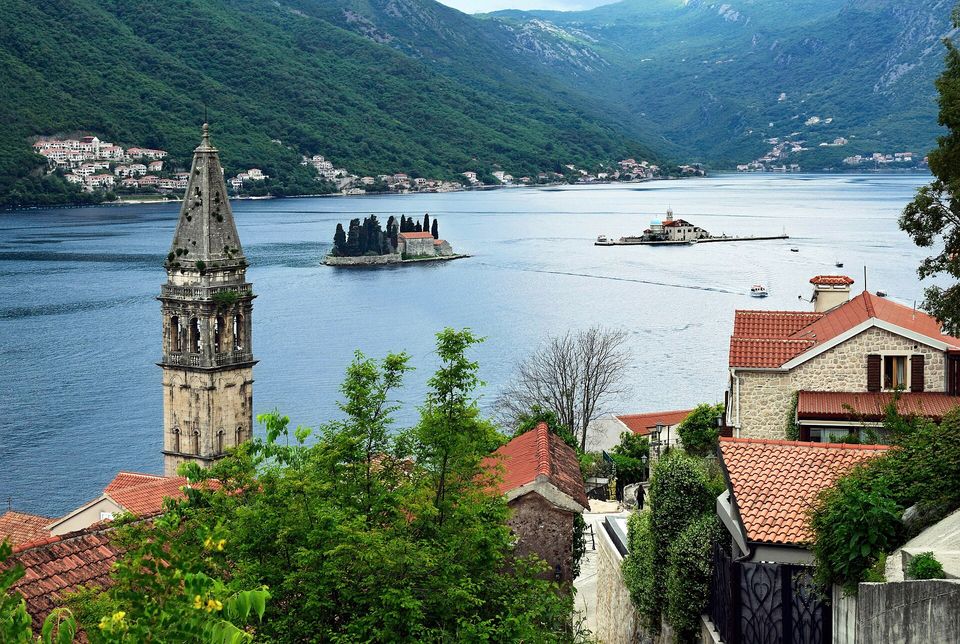
The two islets off Perast: St George's, natural and dark with cypresses, and Our Lady of the Rocks, made by hand. May 2025.
Photograph: Jocelyn Erskine-Kellie · Perast, View of the Islands · CC BY-SA 2.0
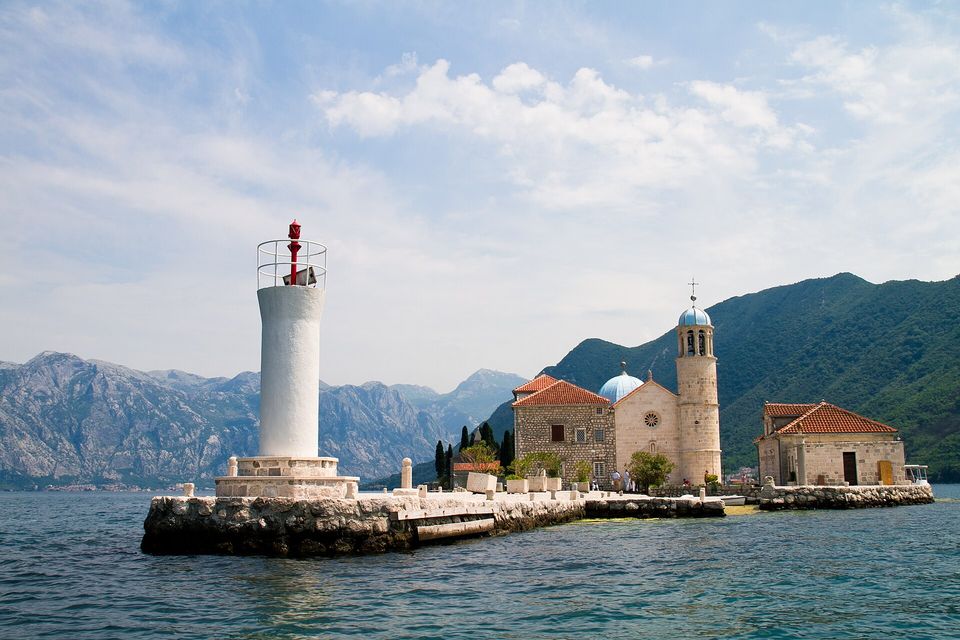
The islet's stone quay, small navigation light and church, May 2012: an island raised on a reef by dropping stones.
Photograph: Tuomas Luukkonen / HL MediaDesign Oy · CC0
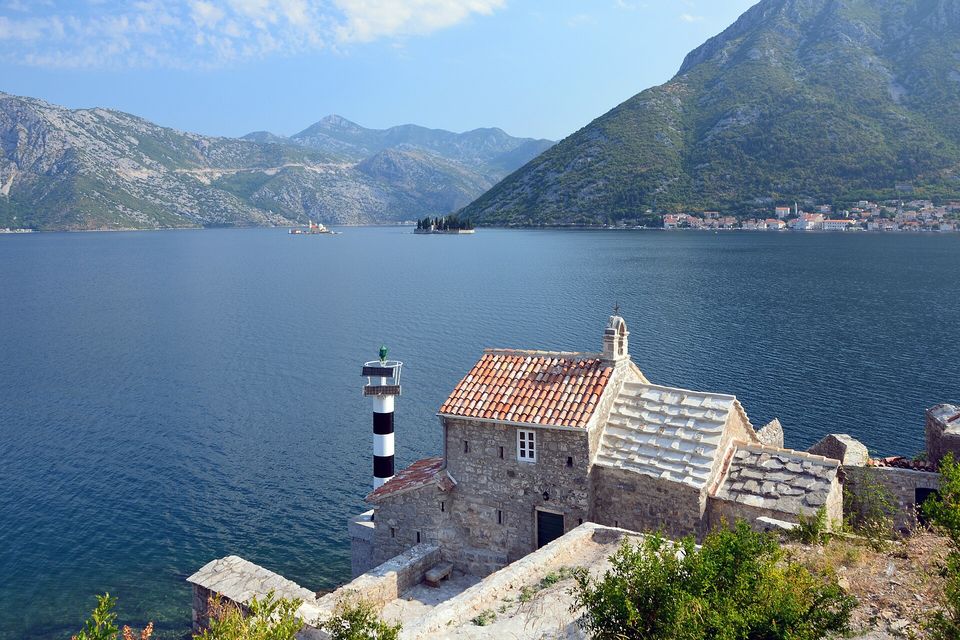
The Bay of Kotor from the road above Lepetane: the chapel of Our Lady of Angels in the foreground, the two islets far off and Perast at the right, July 2015.
Photograph: Gzzz · CC BY-SA 4.0 · cropped
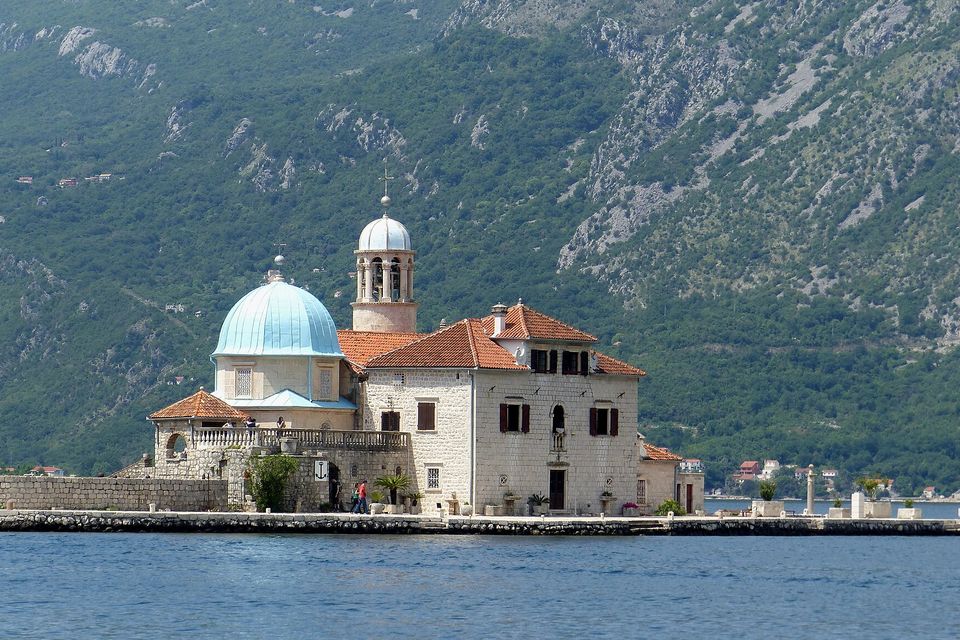
Gospa od Škrpjela: the domed church and its bell tower on the islet, May 2018.
Photograph: Wolfgang Sauber · CC BY-SA 4.0 · cropped
- Take the short boat straight across from the town, not the long one round the bay, so there is time to sit.
- Inside, lower your voice to the size of the room, which is small.
- Find the old embroidery in the museum and look very closely at the hair.
- Bring a stone for the island and an item for the list. Only one of them will stay where you put it.
- Come back for the summer evening when the whole town goes out in boats, and watch from the shore.
A stone for the island. Everything above the waterline here began as something carried out by boat: stones laid on a bare reef, old and captured ships loaded with rock and sunk around it, and then more stones, every year, on the evening of 22 July. Perast’s tradition says the first were laid by seamen coming home safe from a voyage. A stone thrown at the fašinada does not come back; it goes to the bottom with all the others, and the island is the pile.
Tally, in the marginI had never thought of a stone as a thank-you before. The beach on the way back has become very slow going.
Getting there
How to get there. Tivat Airport is 8 km from Kotor, by Airports of Montenegro’s figure, and Perast is 12 km beyond Kotor along the bay, about a fifteen-minute drive, according to Montenegro’s national tourism organisation. Podgorica’s airport is farther inland.
Out to the island. Boats leave from the docks below the bell tower in Perast, the tourism organisation says, and most of them are there to carry passengers to Our Lady of the Rocks. Many boat tours round the bay also stop there. The church is a working Catholic sanctuary: dress for a church, keep your voice down, and let anyone praying finish first.
When to go. The bay is at its busiest in summer. The fašinada takes place every 22 July at sunset and is best watched from the shore at Perast.
Safety. The State Department has Montenegro at Level 1, exercise normal precautions (27 August 2026), and calls it generally a safe destination, with no area-specific warnings. Bosnia and Herzegovina, whose border is about 15 km away, is at Level 2 for crime, landmines and terrorism, and Croatia at Level 1.
Mark this place
Common questions
Is Our Lady of the Rocks a man-made island?
Yes. Our Lady of the Rocks (Gospa od Škrpjela), off Perast in Montenegro’s Bay of Kotor, was built up on a bare reef by dropping stones and, by Wikipedia’s account, by sinking old and captured ships loaded with rock around it. Local people still add stones every 22 July, in a procession called the fašinada.
What is the fašinada?
The fašinada is a procession held every 22 July at sunset in Perast, Montenegro, when local boats loaded with stones and tied together in a convoy sail out to the islet of Our Lady of the Rocks and drop the stones into the sea around it. Montenegro’s national tourism organisation traces the name to the Italian fascia, a ribbon or bandage.
How did Our Lady of the Rocks begin?
By the tradition kept in Perast and given by the Diocese of Kotor, seamen found an icon of the Virgin and Child on a reef in the Bay of Kotor on 22 July 1452, which is counted as the island’s birthday. By the legend, sailors returning safely from voyages laid stones on the reef until an island rose.
How do you get to Our Lady of the Rocks?
Boats to Our Lady of the Rocks leave from the docks below the bell tower in Perast, Montenegro, and many boat tours of the Bay of Kotor also stop there. Perast is 12 km from Kotor, and Tivat Airport is 8 km from Kotor, according to Montenegro’s tourism organisation and airports authority.
What is inside the church of Our Lady of the Rocks?
The church of Our Lady of the Rocks, off Perast in Montenegro, holds a collection of votive paintings of ships given in thanks for rescues at sea, according to the Diocese of Kotor, 68 paintings by the Baroque painter Tripo Kokolja by Wikipedia’s count, an icon of about 1452 attributed to Lovro Dobričević, and a museum with Roman and Greek amphora fragments and a famous embroidery.
What is special about the embroidery at Our Lady of the Rocks?
The embroidery by Jacinta Kunić of Perast, in the museum of Our Lady of the Rocks, uses human hair for the hair of its figures, alongside silk and gold and silver thread. The Diocese of Kotor says that by tradition she worked on it for 20 years, finishing in 1828; Wikipedia gives 25 years and says the hair was her own.
Is Our Lady of the Rocks the only artificial island in the Adriatic?
Wikipedia’s article on Perast describes Our Lady of the Rocks as the only artificially built island in the Adriatic Sea, with an area of 3,030 square metres. SockMonkey has not found an independent survey of the Adriatic’s islands that confirms the claim, so it is given here as Wikipedia’s.
Is Montenegro safe to visit?
The U.S. State Department has Montenegro at Level 1, exercise normal precautions, its lowest level, and describes it as generally a safe destination, with no area-specific warnings (advisory of 27 August 2026). Neighbouring Bosnia and Herzegovina is at Level 2, and Croatia at Level 1.