The short answer
Wright Brothers National Memorial is in the town of Kill Devil Hills, on North Carolina’s Outer Banks. It protects the ground where Wilbur and Orville Wright made the first successful powered, controlled airplane flights, on December 17, 1903. The brothers, bicycle makers from Dayton, Ohio, tested gliders here from 1900. A granite boulder marks where the 1903 Flyer left the ground, and markers show where each of that day’s four flights landed. A 60-foot monument stands on top of Big Kill Devil Hill, the dune they glided from. The brothers called the place Kitty Hawk, after the nearest town of the time.
From Tally’s diary
The wind came steadily off the sea and leaned on me all morning, and the sand underfoot kept trying to go somewhere else. On top of a grassy hill a tall pale shaft stood with wings carved into its sides. Below, a row of small stones ran out across the flat ground, each one further than the last. I walked to every one, and felt I had been somewhere.
Why it's worth knowing
Wind, sand and solitude. The brothers wrote to the Weather Bureau in Washington for a list of windy places. They chose Kitty Hawk, the sixth windiest, for its steady wind, soft sand for landing, high dunes and isolation. Their first glider, in 1900, gave less lift than they expected, so they flew it mostly as a kite, loaded with sand bags and chains. A local man, Tom Tate, got some thrilling rides on it. In 1901 the gliders spun into the sand so often that Wilbur told Orville, “Not within a thousand years would man ever fly.” They went home, built a wind tunnel and worked out their own figures for wings. By 1903 they had made more than a thousand glides from Big Kill Devil Hill, which made them the first real pilots before they ever had an engine.
Twelve seconds. On December 14, 1903, Wilbur won a coin toss to fly first, climbed too steeply and dived into the sand. Three days later it was Orville’s turn. The brothers, in coats and ties, waved a bed sheet to call volunteers from the nearby lifesaving station, then shook hands, since nobody could be heard over the engine. At 10:35 Orville released the wire and the Flyer ran down its wooden rail. One of the volunteers, John Daniels, squeezed the shutter of a camera set up in advance, and took one of the most famous photographs ever made. Into that wind the Flyer’s speed over the ground was under seven miles an hour. Each flight that day went further than the one before, until a gust caught the machine on the ground and rolled it over. The brothers sent a short, matter-of-fact telegram home to their father.
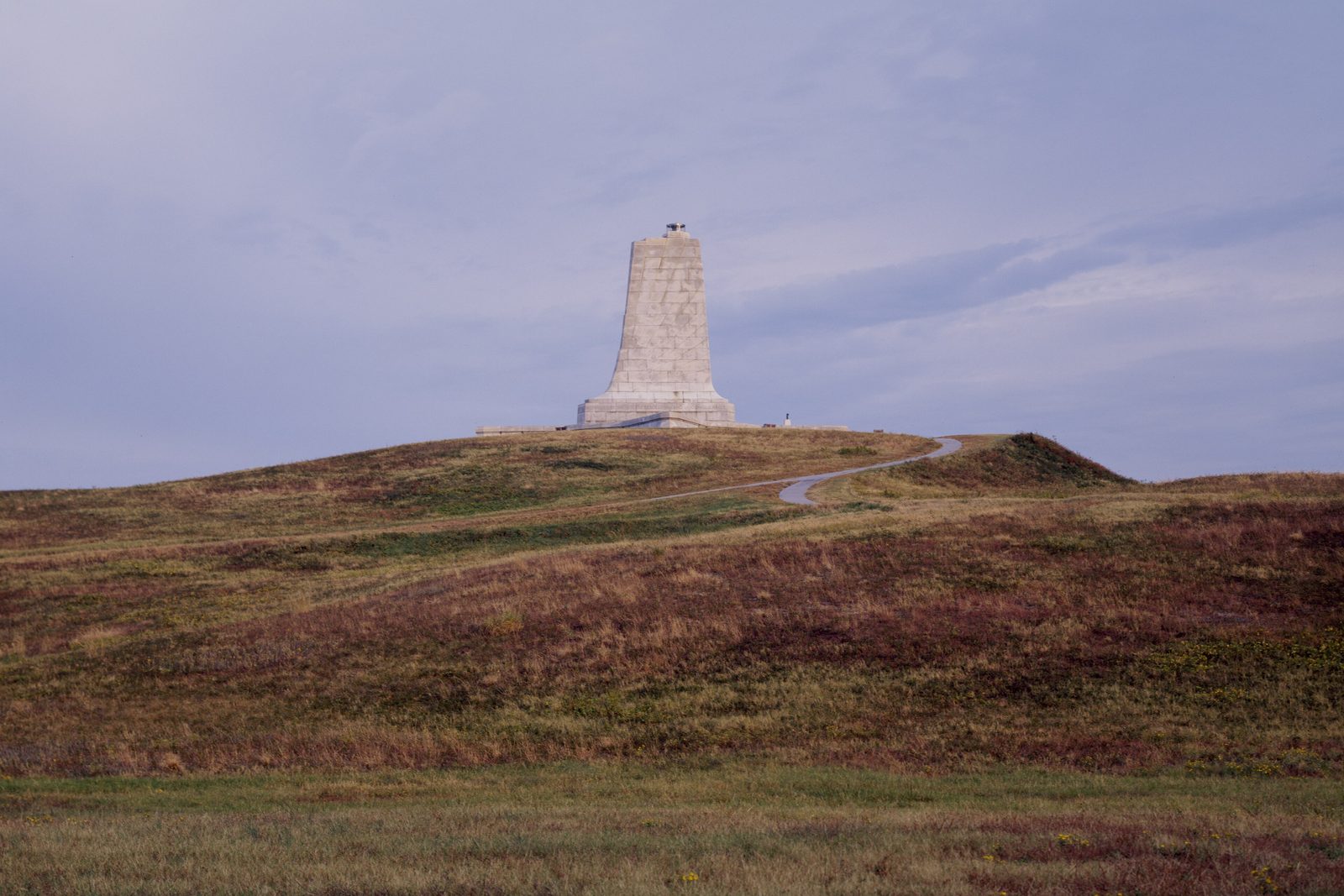
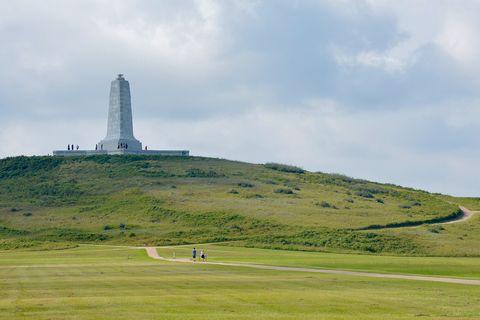
The hill that had to be tied down. Big Kill Devil Hill is a 90-foot dune, and dunes walk. By 1928 it had drifted about 450 feet to the south-west since the brothers glided from it. That year the Coast Guard and local people began planting shrubs and sand grass to hold it still, a job finished in 1931. A wire fence went round its base to keep off tourists, souvenir hunters and wild hogs. Then the monument went up on top, built between December 1931 and November 1932: an Art Deco shaft with stylized wings carved down two sides.
The field notes
The memorial that built the road
The brothers chose the Outer Banks because almost nobody went there. In 1903 the islands had only a few hundred residents, sand-cart paths and no bridge, and could be reached only by boat. In the 1920s a newspaper editor from Elizabeth City, W. O. Saunders, led a campaign for a memorial, partly to bring roads and visitors. Congress created Kill Devil Hill National Memorial on March 2, 1927. The campaigners then used it to argue for a bridge to the islands, finished in 1930, and a new road from Kitty Hawk to Nags Head. The monument the brothers earned is the thing that ended the isolation they came for.
A boulder and a crowd
On December 17, 1928, the 25th anniversary of the flights, more than 3,000 people gathered on the sand with 200 delegates to an international aviation conference. They dedicated a granite marker at the approximate spot of the take-off and laid the cornerstone of the monument on the hill. Orville Wright was there, and so was Amelia Earhart. Wilbur had died of typhoid fever in 1912. For the centennial, on December 17, 2003, more than 30,000 people came.
A rail, two propellers and 605 pounds
The 1903 Flyer had a wingspan of 40 feet 4 inches and weighed 605 pounds on its own, nearly five times as much as the brothers’ 1902 glider. Wheels would have sunk in the sand, so it took off from a 60-foot wooden rail on a little trolley running on bicycle hubs. Unable to buy a light enough engine, the brothers designed their own, and Charles Taylor, a machinist from their bicycle shop, built it. They designed their own propellers too, from their wind-tunnel figures, and made the first efficient airplane propellers. Chains drove the pair, one chain crossed so the two turned in opposite directions. Their camp buildings, a hangar and living quarters, have been reconstructed where they stood.

December 1903The first flight, December 17, 1903.
Photograph: John T. Daniels, 1903, Public domain, cropped

June 2014The First Flight boulder and its bronze tablet.
Photograph: Ken Lund, First Flight Marker, Wright Brothers National Memorial, Kill Devil Hills, North Carolina, CC BY-SA 2.0, cropped

September 2017Big Kill Devil Hill and its path under a gray sky.
Photograph: Yuming Huang, CC BY-SA 4.0, cropped
- Stand on top of the hill in the wind with my arms out, and see what happens. (Nothing happened. I am told this is how it starts.)
- Walk out to the farthest stone and look back at the first. (It is not far at all. That was the part that took my breath away.)
- Shake hands with somebody before anything important. (Shook hands with a ranger before lunch. Lunch went extremely well.)
- Run alongside something that is trying to fly. (Ran alongside a gull. It was not impressed, and landed first.)
- Look inside the plain wooden sheds and admire how little anybody needed, by the look of it. (I have taken more than that on a picnic.)
A relic from the Wright Brothers National Memorial

Relic, entry 361Height: about 60 feetGranite from Mount Airy
A granite monument with wings. A tall three-sided shaft, about 60 feet of it, with wings carved down two of its sides and a beacon at the top that shines like a lighthouse’s. It is Art Deco-inspired, with a nod to ancient Egypt, and it stands on a star-shaped base on top of the big dune where the Wright brothers learned to glide. Its granite came from Mount Airy, North Carolina.
Tally, in the marginI stood at the foot of the hill for some time, waiting for it to take off, it looked so ready. It never did. In the end I went up to it instead, which I gather is how most of us manage, and the wind did what it could to help.
Getting there
- 1
From the north
From Norfolk, Virginia, Route 168 becomes US 158 in North Carolina.
- 2
From the west
US 64 runs east to Nags Head, then US 158 runs north.
- 3
Kill Devil Hills
The memorial stands at mile post 7.5 on US Highway 158.
- ✓
How to get there. The memorial is at mile post 7.5 on US Highway 158 in Kill Devil Hills, at 1000 North Croatan Highway. From the north, the route from Norfolk, Virginia, follows Route 168, the Chesapeake Expressway (a toll road), which becomes US 158 in North Carolina. From the west, US 64 runs east to Nags Head, then US 158 north. The nearest big airports are Norfolk International, about 100 miles north, and Raleigh-Durham, about 200 miles west; the park’s own First Flight Airstrip, 3,000 feet long, takes small private planes in daylight. There is no public bus. The park is self-pay and cashless, with fee machines in the main parking lot.
When to go. The memorial is open every day of the year except December 25, and marks each December 17 with an anniversary event.
Safety. Coastal storms sometimes close the Outer Banks parks at short notice; the park’s news page carries closures and reopenings.
Mark this place
The passport stamp for this place.
Common questions
Where did the Wright brothers make the first flight?
At Kill Devil Hills, on North Carolina’s Outer Banks. The Wright brothers took off from flat ground below Big Kill Devil Hill on December 17, 1903. They called the place Kitty Hawk, after the nearest town, because Kill Devil Hills did not become a town until about 50 years later.
How long was the first flight?
Twelve seconds. Orville Wright’s first flight at Kill Devil Hills on December 17, 1903, covered about 120 feet, less than the length of a modern airliner, into a 27-mile-an-hour headwind.
How many flights did the Wright brothers make on December 17, 1903?
Four. Orville and Wilbur Wright took turns, and each flight at Kill Devil Hills went further; Wilbur’s fourth, the last of the day, covered 852 feet in 59 seconds before a gust rolled the Flyer over on the ground.
Why did the Wright brothers choose Kitty Hawk?
For wind, sand and solitude. After asking the Weather Bureau for a list of windy places, the Wright brothers picked Kitty Hawk, on North Carolina’s Outer Banks, for its steady wind, soft sand, high dunes and isolation.
Who flew first, Orville or Wilbur?
Orville, though Wilbur won the coin toss. Wilbur Wright’s first attempt at Kill Devil Hills, on December 14, 1903, ended in the sand, so when the Flyer was repaired three days later it was Orville’s turn.
How tall is Big Kill Devil Hill?
Ninety feet. Big Kill Devil Hill, where the Wright brothers practiced gliding from 1900 to 1902, is a sand dune that was planted with grasses from 1928 to stop it drifting, and the Wright Brothers Monument stands on top.
Are the Wright brothers buried at the memorial?
No. There are no graves at Wright Brothers National Memorial; Wilbur and Orville Wright are buried with their family at Woodland Cemetery in their hometown of Dayton, Ohio.
Photographs on this page
Tap a photograph to see it full size.
Photograph: Carol M. Highsmith, Public domain, cropped
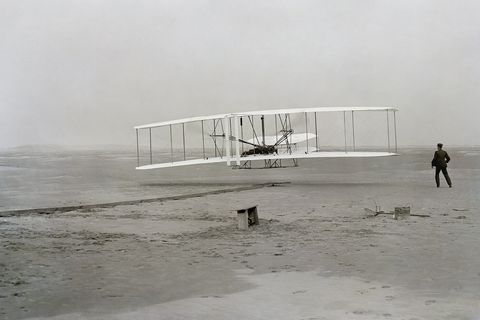
Photograph: John T. Daniels, 1903, Public domain, cropped
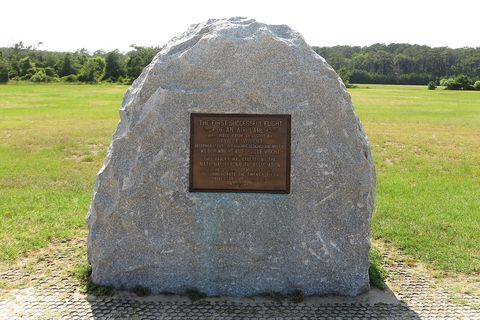
Photograph: Ken Lund, First Flight Marker, Wright Brothers National Memorial, Kill Devil Hills, North Carolina, CC BY-SA 2.0, cropped
Photograph: Yuming Huang, CC BY-SA 4.0, cropped




