
- Where
- RN8 north of Morondava,
Menabe region, western Madagascar - Coordinates
- 20.2508° S
44.4186° E - The trees
- Grandidier’s baobab,
Adansonia grandidieri, about 30 m tall - How many
- 20–25 along 260 m of road;
about 25 more in the fields - Species status
- IUCN Endangered;
wild only in Madagascar - Protection
- Temporary 2007; natural monument,
Decree No. 2015-760 - Best visited
- Late afternoon to sunset,
in the dry months
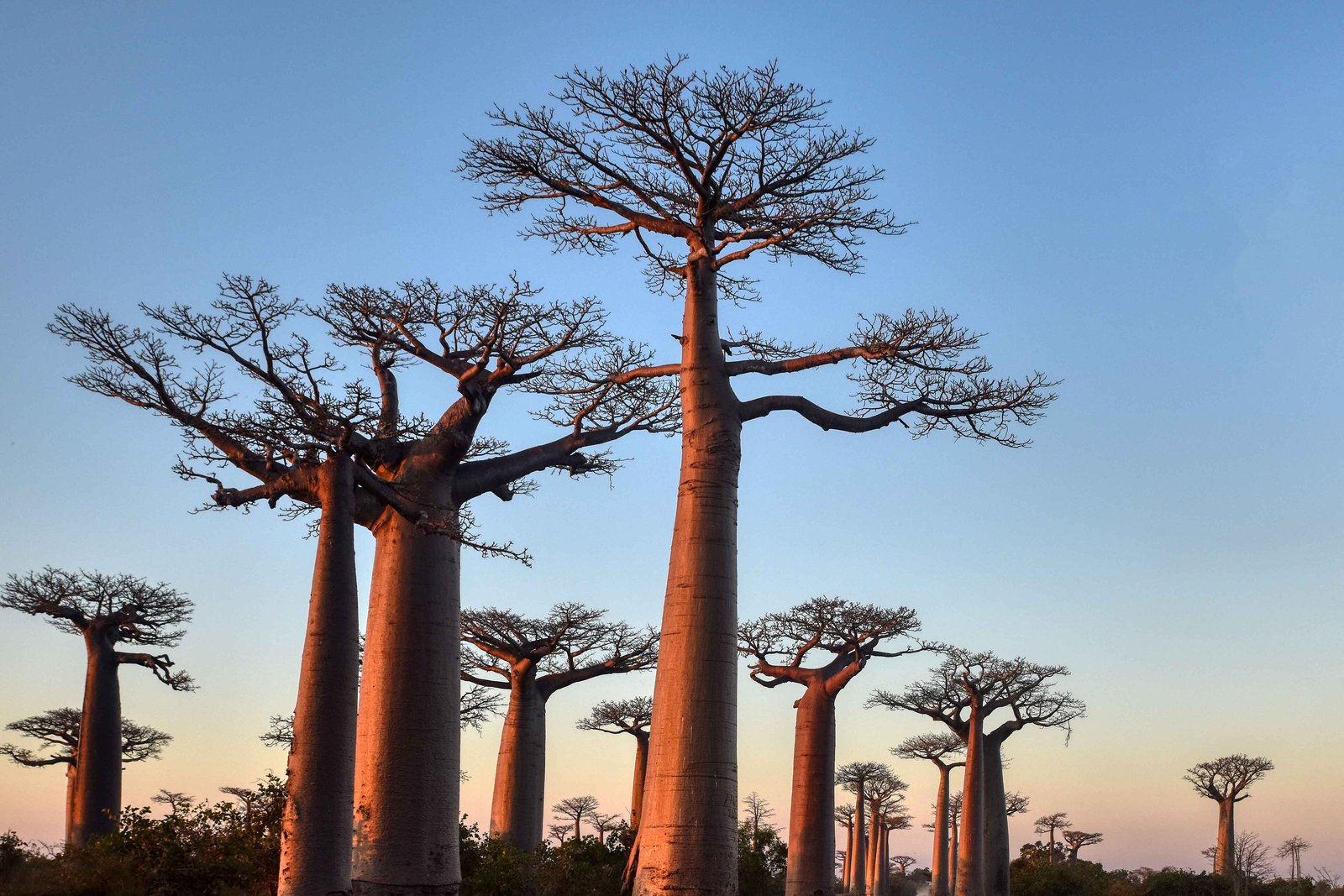
A red dirt road, flat fields of rice shining with water, and along it a row of enormous grey trees with no branches until the very top, like columns holding up a ceiling somebody took away. A cart pulled by humped cattle came through at sunset, the driver waving, and the trunks turned pink and then went out, one after another. Nobody spoke much. It seemed the right thing.
The short answer
The Avenue of the Baobabs is a group of Grandidier’s baobabs, Adansonia grandidieri, lining the unpaved RN8 between Morondava and Belon’i Tsiribihina in the Menabe region of western Madagascar. Wikipedia counts 20 to 25 of them along a 260-metre stretch of the road, and about 25 more in the rice paddies and meadows nearby, each about 30 metres tall. The species grows wild only in Madagascar and is listed as Endangered on the IUCN Red List. The site was given temporary protected status in July 2007 and became a protected area, in the category of natural monument, under Decree No. 2015-760 of 28 April 2015. A Malagasy NGO, Fanamby, has run a conservation and ecotourism project there since 2014.
Why it's worth knowing
The postcard shows an avenue. It is a remnant.
The baobabs, known locally as renala or reniala, which Wikipedia glosses as “mother of the forest”, did not grow in a line along a road or stand alone above open ground. They grew in dense forest. As the forest was cleared for agriculture, Wikipedia’s account says, the baobabs were left standing, kept by the local people as much for their own sake as for their value as food and building material. The road runs through what was left.
The species’ problem is that the land around it no longer lets it replace itself. The assessments of Adansonia grandidieri made for the IUCN and for the 2016 CITES meeting describe much of its habitat as cleared and unsuitable for seeds to germinate, a very low rate of natural regeneration, and seedlings killed by fire because they lack the thick bark of older trees; slash-and-burn farming, logging, charcoal production and mining are named among the threats. Wikipedia adds effluent from encroaching paddy fields to the list for the avenue itself. The trees in the photograph are old survivors standing in fields where young ones struggle, which makes the famous view a conservation problem as well as a landscape.
How old the avenue’s trees are has not been measured directly, so far as this entry could find. Elsewhere, Adrian Patrut’s team has radiocarbon-dated the two largest known Grandidier’s baobabs, near Andombiro in the south-west, at between 1,300 and 1,500 years.
The field notes
The tree
Grandidier’s baobab has a smooth, near-cylindrical trunk and a flat crown of branches only at the very top. It is one of several baobab species found only in Madagascar, and one of three there listed as threatened, with Adansonia suarezensis (Endangered) and Adansonia perrieri (Critically Endangered), according to Mongabay’s summary of the Red List. The two largest known individuals, Tsitakakoike and the Pregnant baobab, are hollow, multi-stemmed trees in the Andombiry forest, and Patrut’s team concluded that Grandidier’s baobab is the third baobab species shown to have individuals living more than a thousand years.
The lovers down the road
About seven kilometres to the north-west stand the Baobab Amoureux, two trees of another endemic species, Adansonia za, that have grown twisted around each other. Wikipedia records the local legend: a young man and a young woman from nearby villages, each promised to someone else, asked their god to let them be together, and the two trees are the answer they were given.
Keeping it
The 2007 temporary protection was, in Wikipedia’s words, a step towards making the avenue Madagascar’s first natural monument; the 2015 decree created the protected area “Allee des Baobabs” in the district of Morondava. Fanamby’s project, begun in 2014, aims at conservation and income for the local community, and it opened visitor facilities in 2018. Protection gives the trees on the road a legal standing; it does not by itself change what happens in the fields around them.
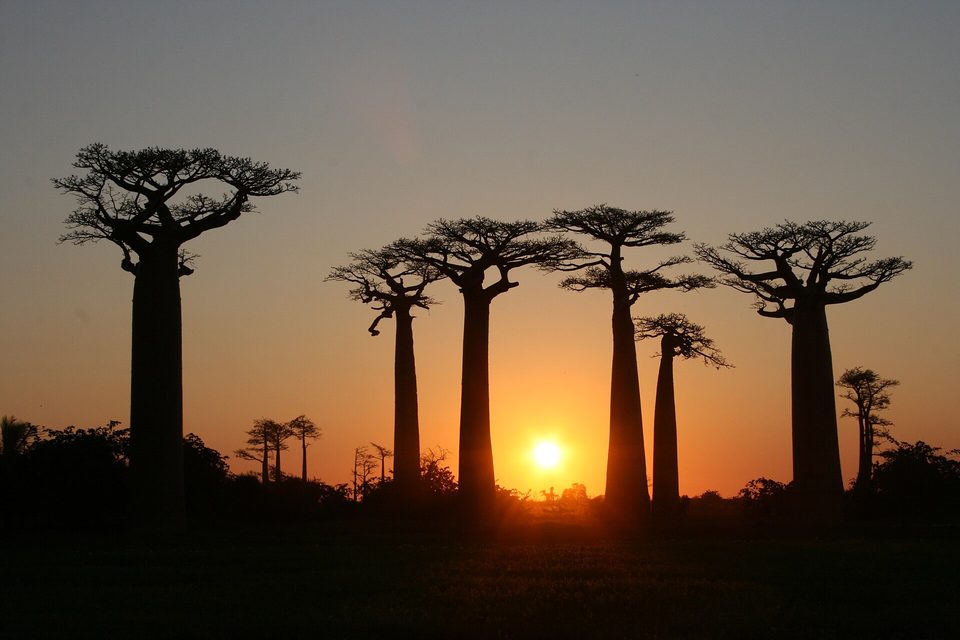
Baobabs in silhouette against the setting sun, May 2011.
Photograph: Gavinevans · Avenue of the Baobabs at Sunset · CC BY-SA 3.0 · cropped
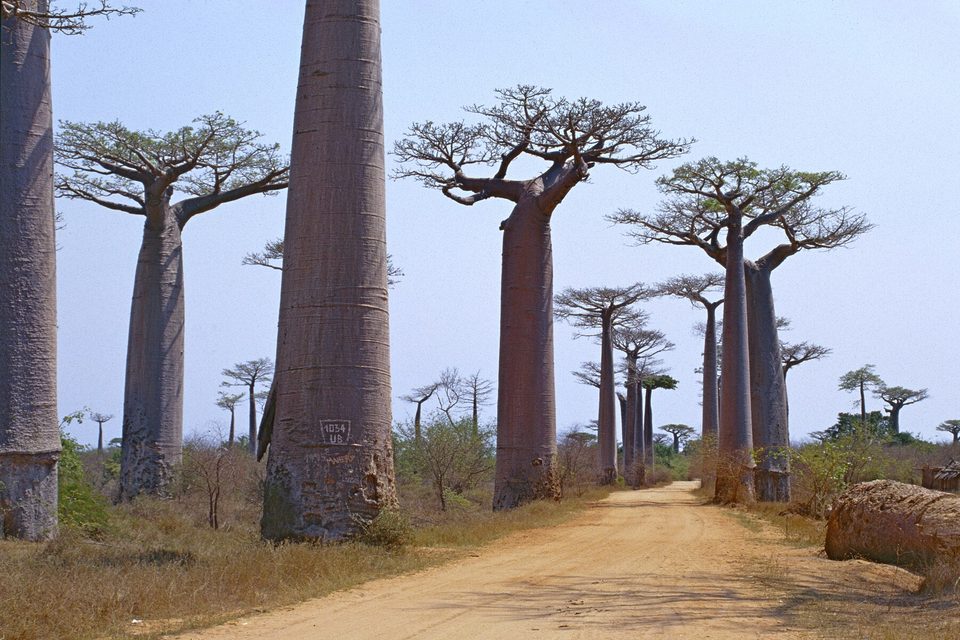
Grandidier's baobabs (Adansonia grandidieri) along the avenue in daylight, November 1998.
Photograph: Bernard DUPONT · " Avenue of the Baobabs " (Adansonia grandidieri) (9576865450) · CC BY-SA 2.0 · cropped
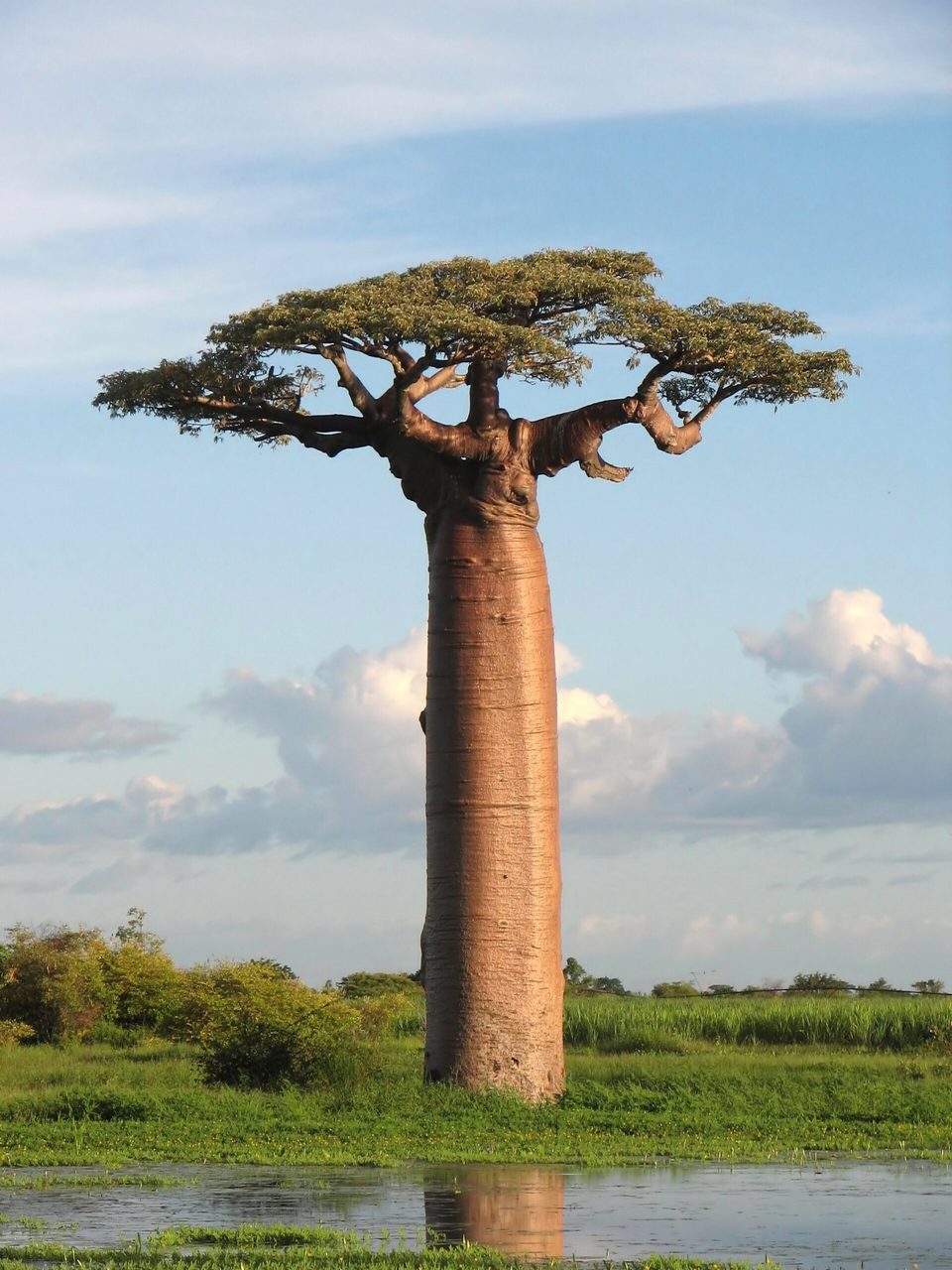
A single Grandidier's baobab (Adansonia grandidieri) standing in wet ground in the wet season, March 2007, Morondava area.
Photograph: Bernard Gagnon · Adansonia grandidieri04 · CC BY-SA 3.0
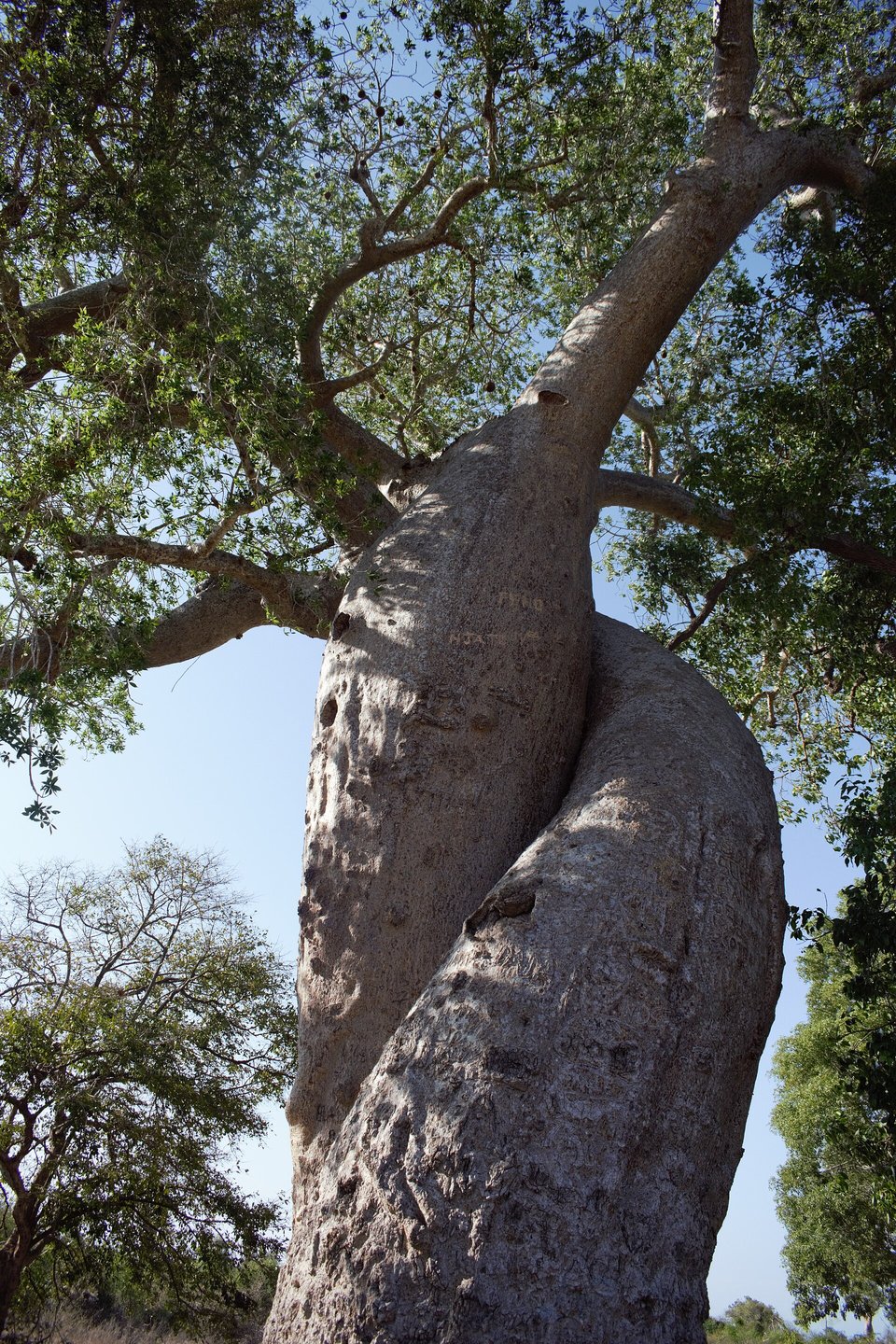
The Baobab Amoureux, two trees twisted around each other near Morondava, November 2020.
Photograph: Cactus0625 · CC BY-SA 4.0
- Come for the end of the day and stay until the trunks go dark.
- Ask before you photograph the people and their carts. They are going home, not posing.
- Look past the famous row to the trees standing alone in the fields, and give them a moment too.
- Ask about the road before you take it, and take the plane if they tell you to.
- Count the trees. (Counted the road. Then the fields. Then started on the ones that might have been trees in the dusk. Item abandoned in favour of dinner.)
The Baobab Amoureux. About seven kilometres north-west of the avenue, two baobabs of a different species, Adansonia za, have grown wrapped around each other so closely that the trunks twist together. The local story is of two young people promised to others who asked to be together and were given this. Everybody photographs the straight trees on the avenue at sunset; these two are the ones that did something unexpected.
Tally, in the marginA pair of trees wrapped round each other so tightly nobody can say where either stops. I spent the whole evening on the straight ones and nearly missed the pair that had gone crooked on purpose.
Getting there
How to get there. Morondava, on the west coast, is the gateway; the avenue is on the RN8 a short drive north of the town, and most visitors come out by car or taxi from Morondava for the afternoon. Morondava has a domestic airport with scheduled flights from Antananarivo, which Tsaradia lists. The overland road from Antananarivo runs by way of Antsirabe and the RN34 through Miandrivazo and Malaimbandy, and the RN34 between Miandrivazo and Malaimbandy is one of the areas where the U.S. State Department says to reconsider travel because of crime. Flying avoids it.
Safety. The State Department has Madagascar at Level 2 and lists the Menabe Region south of Morondava among its Level 3 areas. The avenue lies north of the town, outside the named areas. The advisory says violent crime is most likely after dark, in remote areas and on major roads in the south and west: travel with a local driver, come and go in daylight, and check the advisory before you set out.
When to go. In the dry months, when the unpaved RN8 is easiest; the rains can make it hard going. The light is best from late afternoon to sunset, which is when most people come. There is a small parking fee.
Being a guest. People live and farm along the road. Ask before photographing anyone, and if you want a picture of the stalls, buy something first.
Mark this place
Common questions
Why are the baobabs on the Avenue of the Baobabs in a row?
They were not planted as an avenue. The Grandidier’s baobabs along the RN8 north of Morondava in Madagascar once stood in dense forest; when the forest was cleared for farming, local people kept the baobabs, and the road runs through what remained, according to Wikipedia. The row is a remnant of that forest.
What kind of trees are on the Avenue of the Baobabs?
Grandidier’s baobabs, Adansonia grandidieri, about 30 metres tall with smooth cylindrical trunks and branches only at the top. The species grows wild only in Madagascar and is listed as Endangered on the IUCN Red List. The Avenue of the Baobabs has 20 to 25 of them along a 260-metre stretch of the RN8, according to Wikipedia.
Is the Avenue of the Baobabs protected?
Yes. The Avenue of the Baobabs near Morondava was given temporary protected status by Madagascar’s environment ministry in July 2007 and became a protected area, in the category of natural monument, under Decree No. 2015-760 of 28 April 2015. The Malagasy NGO Fanamby has run a conservation and ecotourism project there since 2014.
How old are the trees on the Avenue of the Baobabs?
No radiocarbon dating of the trees on the Avenue of the Baobabs was found for this entry, so their age is not known from direct measurement. Adrian Patrut’s team has radiocarbon-dated the two largest known Grandidier’s baobabs, near Andombiro in south-western Madagascar, at between 1,300 and 1,500 years.
Is it safe to visit the Avenue of the Baobabs?
The U.S. State Department has Madagascar at Level 2 (advisory of 4 December 2025) and lists the Menabe Region south of Morondava, and the RN34 between Miandrivazo and Malaimbandy, among its Level 3 reconsider-travel areas. The Avenue of the Baobabs lies on the RN8 north of Morondava, outside those areas; flying to Morondava avoids the RN34.
How do you get to the Avenue of the Baobabs?
Fly or drive to Morondava on Madagascar’s west coast, then take the RN8 north for a short drive to the Avenue of the Baobabs. Morondava’s domestic airport has scheduled flights from Antananarivo. The overland route from the capital uses the RN34, part of which the U.S. State Department lists as a Level 3 area because of crime.
What are the Baobab Amoureux?
The Baobab Amoureux are two baobabs of the endemic species Adansonia za that have grown twisted around each other, about seven kilometres north-west of the Avenue of the Baobabs near Morondava, Madagascar. A local legend, recorded by Wikipedia, tells of two young people promised to others whose wish to be together was granted in the form of the two trees.
Why is Grandidier's baobab endangered?
Much of the forest where Grandidier’s baobab grows in western Madagascar has been cleared, leaving ground poor for germination, and seedlings are killed by fire because they lack the thick bark of older trees. Assessments made for the IUCN and CITES name slash-and-burn farming, logging, charcoal production and mining; the IUCN lists the species as Endangered.