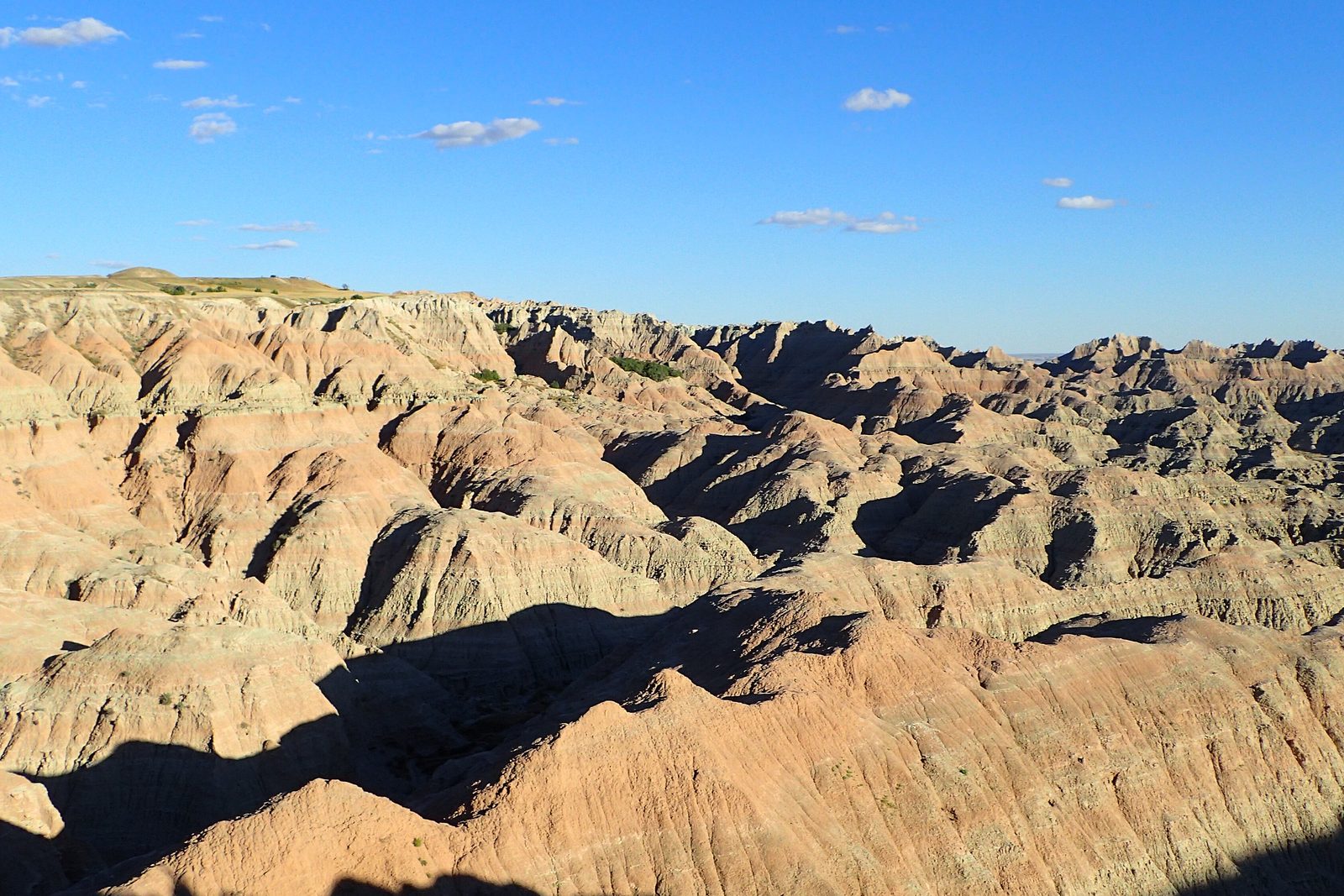
The short answer
Badlands National Park covers 244,000 acres of south-west South Dakota: sharply eroded buttes, pinnacles and spires standing in a mixed-grass prairie, 75 miles east of Rapid City. Its rocks were laid down over tens of millions of years by a shallow sea, then by rivers and wind, and they are full of fossils of ancient mammals. The park has two parts. The North Unit is crossed by the paved Badlands Loop Road. The South Unit, the Stronghold District, lies on the Pine Ridge Reservation and is managed by the National Park Service together with the Oglala Lakota Tribe. Bison, pronghorn, bighorn sheep and the endangered black-footed ferret all live on the prairie.
From Tally’s diary
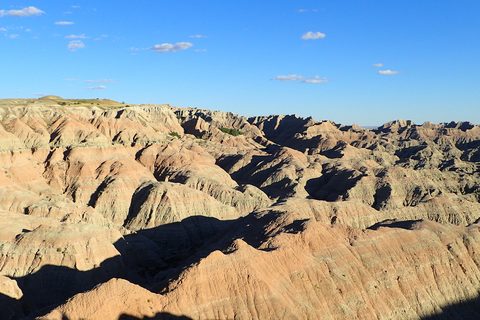
The ground was striped like a cake somebody had left out in the rain, pink and cream and a pale mustard yellow, and it crumbled when I looked at it too hard. Out on the grass beyond, a great shaggy shape stood facing the wind as if it had an appointment with it. I faced the wind too. I lasted about a minute.
Why it's worth knowing
A layer cake, sliced open. The bottom layer, the Pierre Shale, settled on the floor of the Western Interior Seaway, a warm, shallow sea that once stretched from the Gulf of Mexico to the Arctic Ocean. It held ammonites and mosasaurs, marine reptiles that could measure over 50 feet long, but no dinosaurs: dinosaurs could not swim, so none have turned up in the Badlands at all. Above the shale come the mustard-coloured Yellow Mounds, an ancient soil. Then come grey claystones from a hot, wet floodplain rather like the Everglades, the layers of a cooler, drier savannah and, on top, 30 to 28 million years old, the Sharps Formation. Each band is a different world.
A graveyard of thunder beasts. The area now in the park is considered the birthplace of vertebrate paleontology in the American West. By the mid-1800s, 77 of the 84 species of ancient animal known from North America’s fossil record had been found in the White River Badlands. The biggest are the brontotheres, about 8 feet tall and 16 feet long, with paired horns more than 3 feet long sticking out from their noses. Their scientific name means “thunder beast”, and it was inspired by Lakota oral histories of giant beings bound up with violent thunderstorms. Red Cloud, the Lakota leader, later visited the paleontologist who coined it, Othniel Charles Marsh, at Yale.
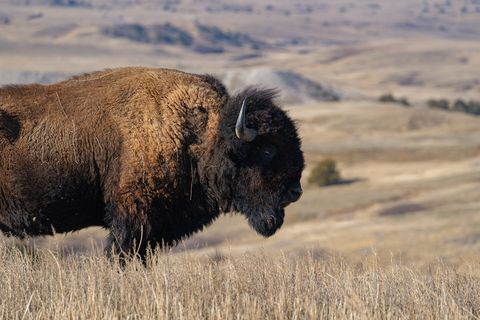
Back from the brink. At least 30 million bison once roamed the country; by 1884 an estimated 325 wild ones were left. Bison came back to the Badlands in 1963, from Theodore Roosevelt National Park, and the herd now numbers around 1,200. The black-footed ferret had a closer call still. It was declared extinct in 1980, until a ranch dog called Shep brought one home in Meeteetse, Wyoming, in 1981. The 18 survivors of that colony, captured in 1987, became the founders of later reintroductions, and ferrets now live in the park’s prairie dog towns.
The field notes
The Big Pig Dig
About 34 million years ago, in a drought, animals crowded around one shrinking watering hole, and some waded in too far and never came out. Scavengers came for the bodies and trampled the bones deeper into the mud. In 1997 two visitors, Steve Gasman and Jim Carney, spotted backbones and limb bones just outside the Conata Picnic Area and reported them instead of taking them. Park staff set out to rescue the bones from theft and erosion and did not finish for 15 field seasons. The site is named for Archaeotherium, the “big pig”, a scavenger with huge jaws that looks like a giant pig but is closer kin to the hippo.
A bombing range on the reservation
In the Second World War the US Air Force took 341,726 acres of the Pine Ridge Reservation, home of the Oglala Lakota, for a gunnery range, including 337 acres of what was then Badlands National Monument. The land was called useless and empty; it was not, and 125 families were moved from their farms and ranches. Pilots practised on old cars and on bullseyes 250 feet across ploughed into the ground, and the big fossil bones of titanotheres, gleaming white from the air, made popular targets. Spent shell casings still turn up across the South Unit, which is now managed together with the tribe.
Islands of an older prairie
All over the park, flat-topped slabs of grass and soil sit on top of the eroded rock. These sod tables are the last traces of the prairies that covered much more of the Badlands at the end of the last ice age, when the climate was cooler and wetter. Their roots soak up storm rain and protect the rock beneath, so they wear away more slowly than the bare slopes around them. Most of the park’s archaeological sites have been found on them, some up to 12,000 years old. From the Pinnacles overlook, the canyons and sod tables to the south show what the unbroken prairie to the north will one day become.
Why “bad”?
For hundreds of years the Lakota have called this country mako sica, which translates literally as “bad lands”. French fur trappers who spent time with the Lakota passed the name on as “bad lands to travel across”. They had a point. Rain turns the clay slick and sticky, the canyons and buttes make it hard to find a way through, the few water sources are muddy, winters are cold and windy and summers hot and dry. People came to hunt in season, as far back as 12,000 years ago, but archaeologists have found no sign that anyone ever settled here for good.

March 2024A bison on the prairie.
Photograph: USDA Forest Service, Public domain

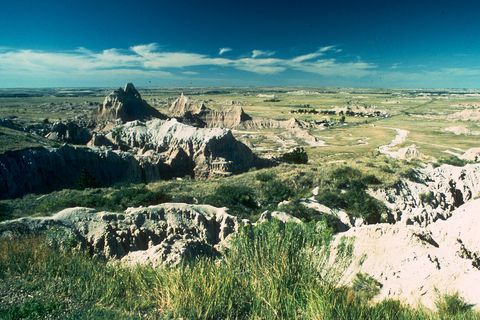
Eroded buttes and spires above green prairie in summer.
Photograph: NPS, Public domain, cropped
- Find the oldest-looking stripe on the hill. (Found one. Found an older one underneath it. They go down a very long way.)
- I spotted a bone poking out of a slope, wished it good afternoon, and went to tell a ranger rather than my pocket.
- Count the little dogs popping out of the ground. (Each one popped up, shouted, and vanished before I could write it down. The total is somewhere between some and a great many.)
- Out on the southern tables I walked quietly, hat in hand. It is somebody’s home, and I was a guest.
- Stay until the stripes turn pink at sunset. (Stayed. They went pink, then purple, then gone. I was the last thing standing, apart from the hills.)
A relic from Badlands National Park
Relic, entry 332Among the most common Badlands fossilsNamed for its mountain-shaped teeth
An oreodont skull, weathering out of the rock. Oreodonts are among the most common fossils in the Badlands, plant-eaters that looked like a mix of camel, sheep and pig and lived in herds, very likely for safety. The name has nothing to do with biscuits: it means “mountain tooth”, because their molars look like miniature mountain ranges. On the open, grassy plains of 34 to 30 million years ago they were about as plentiful as zebras are on the Serengeti now.
Tally, in the marginA skull with a grin full of tiny mountain ranges, which I took for some fierce sort of creature until it turned out to have spent its whole life chewing leaves. I have stopped judging anybody by their teeth.
Getting there
- 1
From the east
Exit 131 at Interior leads about three miles south to the Northeast Entrance.
- 2
From the west
Exit 110 at Wall leads about seven miles south to the Pinnacles Entrance.
- 3
Through the North Unit
The Badlands Loop Road is a two-lane paved road through the North Unit.
- ✓
How to get there. Badlands National Park is 75 miles east of Rapid City, South Dakota, and Interstate 90 runs right along its northern edge. From the east, exit 131 (Interior) leads about three miles south to the Northeast Entrance; from the west, exit 110 at Wall leads about seven miles south to the Pinnacles Entrance. State Highway 44 is a quieter, scenic way in, meeting Highway 377 in the town of Interior, two miles south of the Interior Entrance. The Badlands Loop Road (Highway 240) is a two-lane paved road through the North Unit; Sage Creek Rim Road is gravel and can close for a while after heavy rain or snow. No road crosses the South Unit, though Sheep Mountain Table Road climbs into it four miles south of Scenic. Cell service is patchy and GPS directions are not always reliable, so the park’s own maps and directions are the surest guide.
When to go. The weather swings between extremes of 116°F and −40°F. Summers are hot and dry, with occasional violent thunderstorms and hail; June is the wettest month, and winters bring 12 to 24 inches of snow in all.
Safety. The State Department’s travel advisories cover other countries, so none applies here. Unexploded shells from the old gunnery range still surface in the South Unit; finds are reported to the White River Visitor Center, and the park’s alerts carry current closures.
Mark this place
The passport stamp for this place.
Common questions
Why is it called the Badlands?
Because the Lakota called it that first. For hundreds of years the Lakota have called this part of South Dakota mako sica, literally “bad lands”, for its sticky clay, maze of canyons and scarce water; French trappers passed the name on as “bad lands to travel across”.
How fast are the Badlands eroding?
Remarkably fast for rock: about an inch a year. The buttes of Badlands National Park began eroding about 500,000 years ago, and scientists estimate they will have worn away completely in another 500,000.
Were there dinosaurs in the Badlands?
No, and for a good reason. The oldest rocks in Badlands National Park formed on the floor of a shallow sea, and dinosaurs could not swim; the sea held ammonites and mosasaurs instead, and the younger layers hold ancient mammals.
What fossils are found in Badlands National Park?
Ancient mammals, above all. Badlands National Park is known for oreodonts, among its most common fossils, for the horned brontotheres, the big scavenging “pig” Archaeotherium and a saber-toothed, cat-like hunter called the nimravid.
Are there bison in Badlands National Park?
Yes, around 1,200 of them. Bison were returned to Badlands National Park in 1963 from Theodore Roosevelt National Park, and they stay all winter, facing into the storms in coats so thick that snow sits on top without touching the skin.
What was the Big Pig Dig?
A fossil dig that started with two sharp-eyed visitors. In 1997 they reported bones beside the Conata Picnic Area in Badlands National Park; the excavation lasted 15 field seasons and recovered more than 19,000 fossils from a 34-million-year-old watering hole.
Where is Badlands National Park?
In south-west South Dakota, 75 miles east of Rapid City. Badlands National Park lies just south of Interstate 90, with entrances off exits 110 at Wall and 131 at Interior.
Photographs on this page
Tap a photograph to see it full size.
Photograph: Krzysztof Ziarnek, Kenraiz, CC BY-SA 4.0, cropped
Photograph: USDA Forest Service, Public domain
Photograph: NPS, Public domain, cropped




