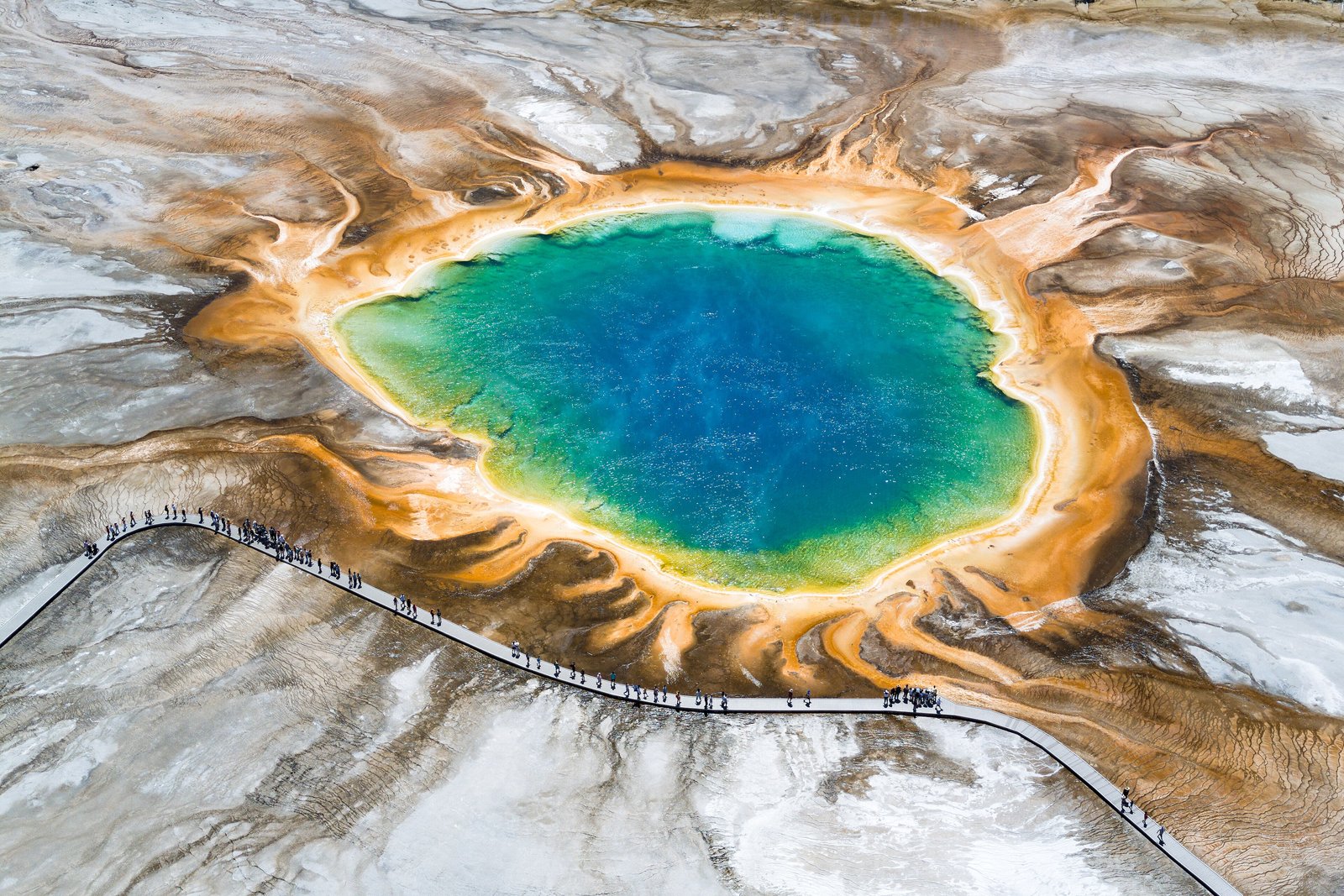

Part of The US National Parks
- Where
- Mostly northwestern Wyoming,
with parts in Montana and Idaho - Coordinates
- 44.4280° N
110.5885° W - Area
- 3,468 sq mi
(8,983 km²) - Hot ground
- More than 10,000 hydrothermal features;
about half the world’s active geysers - The microbe
- Thermus aquaticus, from Mushroom Pool,
Lower Geyser Basin, 1966 - Status
- National park, 1 March 1872;
UNESCO World Heritage, 1978 - Best visited
- Late spring to early autumn,
when the park roads are open
Steam coming out of the ground on a frosty morning, and a smell of boiled eggs. I walked the planks over pools of a blue I have no word for, with orange and green slime running out of them in bands, while a shaggy bison strolled through the steam. Something in the ground went off like a kettle and everyone cheered. I cheered too, then went back to the slime.
The short answer
Yellowstone National Park covers 3,468 square miles, mostly in the northwestern corner of Wyoming, with smaller parts in Montana and Idaho. President Ulysses S. Grant signed the act creating it on 1 March 1872, and the National Park Service describes it as the beginning of a worldwide national park movement. It sits on a volcanic plateau, and the U.S. Geological Survey counts more than 10,000 hydrothermal features in it: hot springs, geysers, steam vents and mud pots, including about half of the world’s active geysers. The Park Service lists 27 tribes with historic and modern connections to the land. Most roads are open to cars from late spring to early autumn; the road across the north of the park stays open all year.
Why it's worth knowing
The colours around Yellowstone’s hot springs, the orange, yellow, brown and green that band outward from the blue centres, are not minerals. They are mats of microbes, each band a community suited to a different temperature as the water cools on its way out of the spring. The hottest centres are too hot for anything that photosynthesises. Before the 1960s, biologists did not expect much to live in water that hot at all.
Thomas Brock, a microbiologist at Indiana University, first noticed the life in the springs on a visit in 1964. In August 1966 he came back with colleagues and students, among them Hudson Freeze, then an undergraduate. The U.S. Geological Survey’s Yellowstone Volcano Observatory records that Freeze isolated a new bacterium from a sample taken at Mushroom Pool, a small hot spring in the Great Fountain Group of the Lower Geyser Basin. Brock and Freeze described it in the Journal of Bacteriology in 1969 as Thermus aquaticus, strain YT-1, and deposited it in the American Type Culture Collection.
Two decades later, the biochemist Kary Mullis needed an enzyme that could copy DNA at the high temperatures his new method used. The Park Service’s account is that Mullis found Brock’s Mushroom Pool culture in the American Type Culture Collection, a colleague bought some, and the heat-proof DNA polymerase grown from it, Taq, made the polymerase chain reaction fast and cheap. The DNA testing now used in medical diagnosis and criminal investigation runs, in large part, on an enzyme from a hot spring most Yellowstone visitors never see.
The park had no share in what followed. Wikipedia records that Hoffmann-La Roche bought the PCR and Taq patents from Cetus, Mullis’s employer, for $330 million, and that the Park Service came to call the episode “the Great Taq Rip-off”. In the late 1990s Yellowstone signed a research agreement with a biotechnology company, Diversa, and after an environmental impact statement that Yellowstone led, the Park Service issued a Record of Decision in March 2010 to apply benefits-sharing across the national parks: research on a park’s organisms can now carry an agreement to send a share of later earnings back to the park.
The field notes
Mushroom Pool
Mushroom Pool is small and plain by Yellowstone’s standards. The Yellowstone Volcano Observatory notes that its name may date from the 1890s, given either for its shape or for the algae and bacteria in it, and that it was off the beaten path and not a visitor destination, though close enough to a road for researchers to reach. Sources name it both Mushroom Pool and Mushroom Spring; the Park Service and the Geological Survey use Mushroom Pool.
Thermal features in Yellowstone are protected, and visitors must keep to boardwalks and marked trails in thermal areas. The crust around a spring can be thin, and the water beneath it is near boiling. Mushroom Pool is not on a boardwalk; the mats that made it famous can be seen instead in the runoff channels of springs that are.
From a culture collection to a laboratory staple
The polymerase chain reaction copies a chosen stretch of DNA over and over by heating and cooling a mixture, and each heating step destroyed the ordinary enzymes then available, which had to be added again. An enzyme from a bacterium that lives in near-boiling water survives the heating. Wikipedia’s account, citing the original papers, dates the first isolation of Taq polymerase to 1976 and says Thermus aquaticus grows best at 65 to 70 °C.
Mullis shared the 1993 Nobel Prize in Chemistry for the invention of PCR. The University of Wisconsin–Madison, where Brock later worked, has held the discovery up as a paragon of basic science.
The rest of the hot ground
The Geological Survey counts more than 10,000 hydrothermal features, clustered into about 120 thermal areas, and at least 500 geysers that erupt. The Lower Geyser Basin, where Mushroom Pool lies, is the largest thermal area in the park. Old Faithful is in the Upper Geyser Basin, and Grand Prismatic Spring, ringed with the same kinds of microbial mat, is in the Midway Geyser Basin between the two.
The heat comes from the volcanic system beneath the plateau. It is the reason the springs exist and the reason the park is watched continuously by the Yellowstone Volcano Observatory.
Whose park
The Park Service lists 27 tribes with historic and modern connections to the lands now inside Yellowstone. Its own history says that for tribes such as the Blackfeet, Crow, Kiowa, Nez Perce, Cheyenne and Shoshone-Bannock, the closing off of the park meant the loss of hunting grounds, living space and lands of great spiritual significance. Wikipedia records that in 1864 a group of Piegan Blackfeet guided a Jesuit, Xavier Kuppens, to the geysers they already knew.
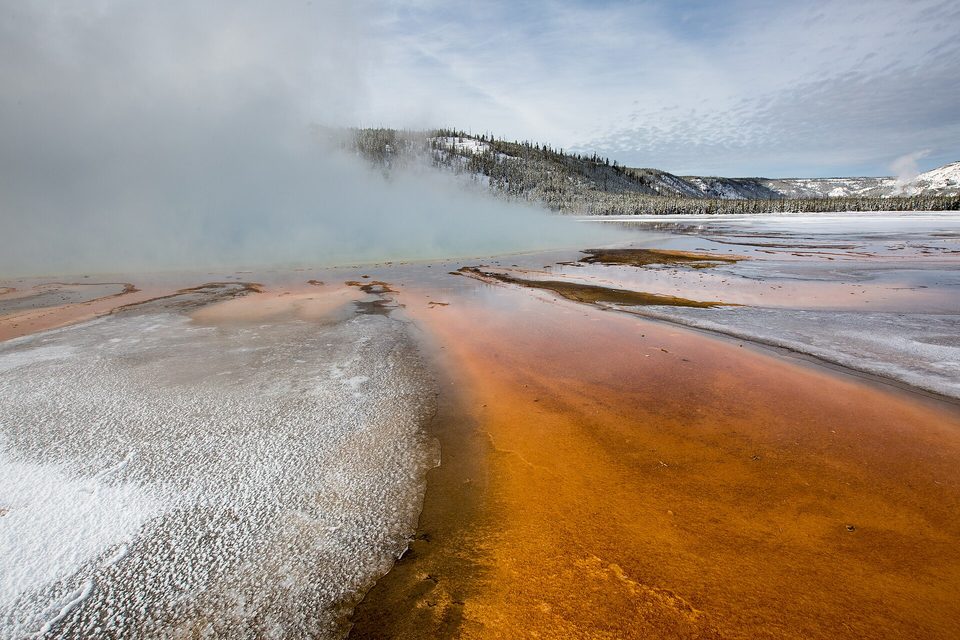
Orange and yellow thermophile mats where hot spring water runs out across the ground, November 2016.
Photograph: NPS / Neal Herbert · Public domain · cropped
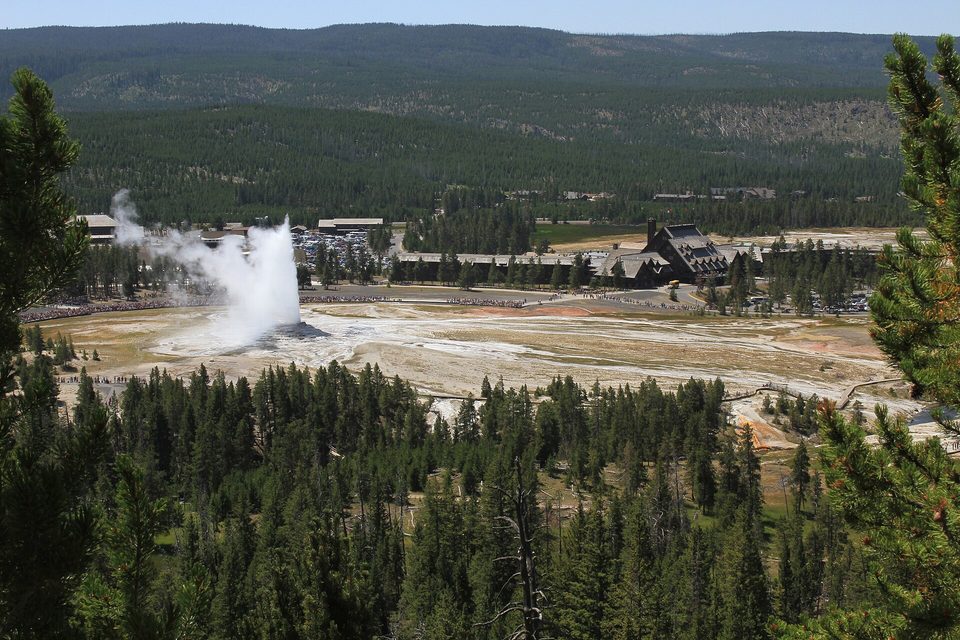
Old Faithful erupting above the Upper Geyser Basin, with the Old Faithful Inn beyond, August 2013.
Photograph: NPS / Jim Peaco · Public domain · cropped
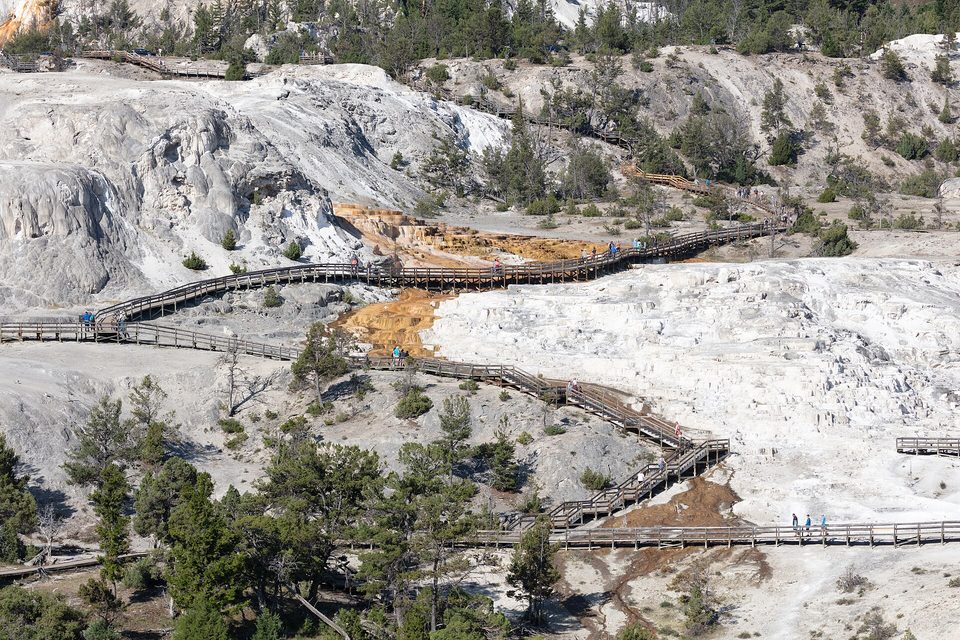
The white travertine terraces of Mammoth Hot Springs with the boardwalk crossing them.
Photograph: NPS / Jacob W. Frank · Public domain · cropped
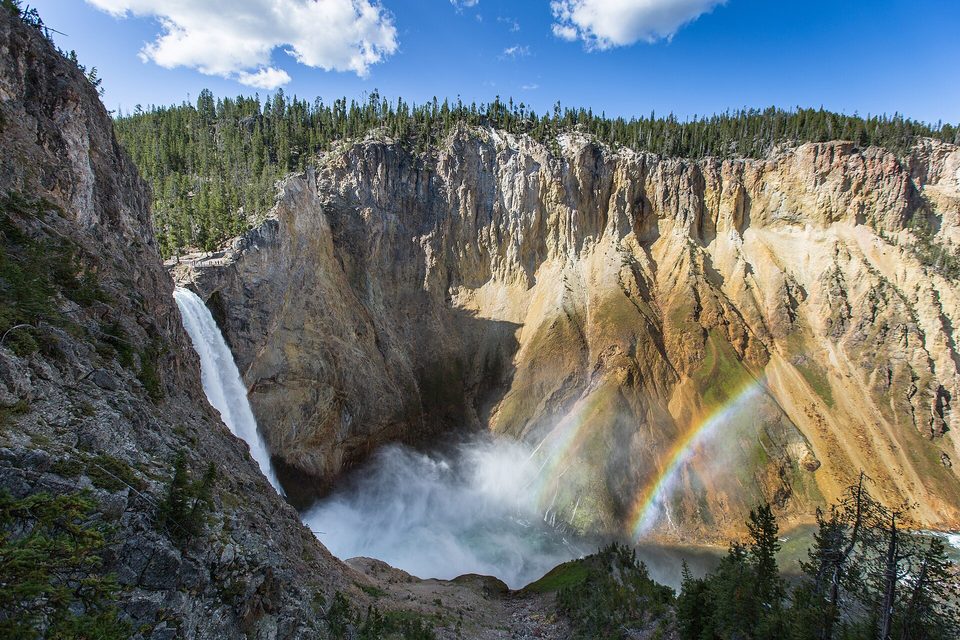
A double rainbow in the mist at the Lower Falls of the Yellowstone River, seen from Uncle Tom's Trail, September 2014.
Photograph: NPS / Neal Herbert · Public domain · cropped
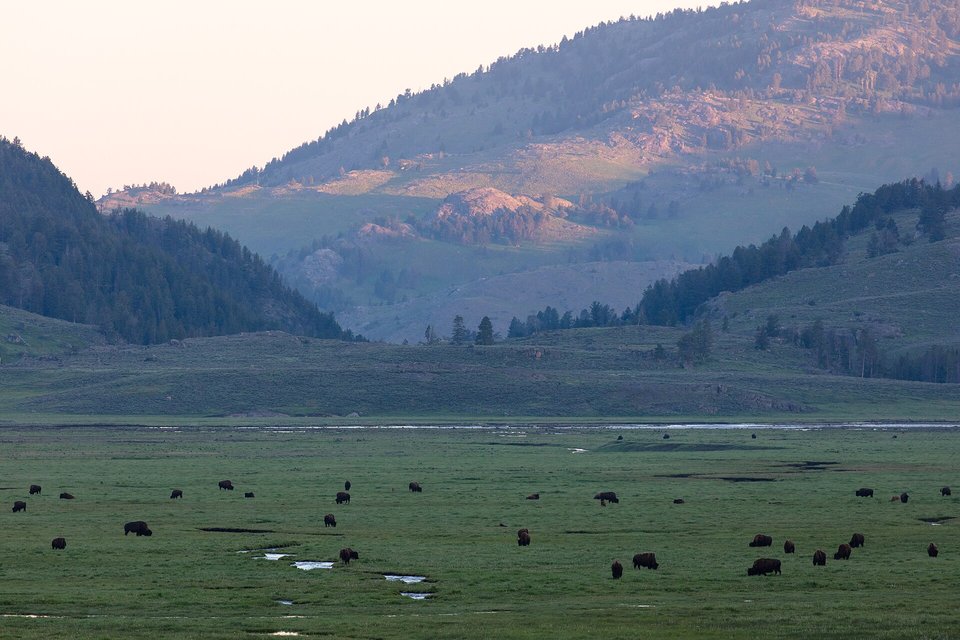
Bison grazing in the Lamar Valley at sunrise, June 2018.
Photograph: NPS / Jacob W. Frank · Public domain
- Stay on the boardwalk, every step. The crust is thin and the water would cook you.
- Look at the edges of the pools, not only the middles, where the colours run out in bands. Then find out what they are.
- Give the bison the whole road. They will take it anyway.
- Remember that this was somebody’s hunting ground and holy ground before it was anybody’s park.
- Wait for the famous spout. (Waited. Added several other spouts while waiting. The list is now mostly spouts.)
Mushroom Pool. A small hot spring in the Great Fountain Group of the Lower Geyser Basin, named, perhaps in the 1890s, for its shape or for what grew in it. It has no boardwalk and no crowd, and the rules that protect Yellowstone’s thermal ground keep visitors away from it. In August 1966 a sample from it yielded Thermus aquaticus, strain YT-1, and from that strain came the enzyme behind the modern DNA test. Almost nobody who visits Yellowstone sees it, and almost everybody who has had a PCR test owes it something.
Tally, in the marginA plain little pool off the path that nobody photographs, and it turned out to be the important one. I had spent the whole afternoon applauding the ones that shout.
Getting there
How to get there. Yellowstone has five entrances. Airports serving the park include Bozeman in Montana and Cody and Jackson in Wyoming, and gateway towns such as Gardiner, West Yellowstone and Cody sit at the entrances. Distances inside the park are long and speed limits are low, so allow more time than the map suggests.
When to go. Most park roads close to cars from early November, reopen in stages from mid-April and are fully open by late spring, weather permitting; in 2026 the first spring opening was delayed by a storm. The road from the North Entrance through Mammoth Hot Springs to the Northeast Entrance is open all year. In winter, from mid-December, the interior is reached by snowcoach and guided snowmobile only.
What it costs. The park charges an entrance fee. Since 1 January 2026, non-U.S. residents aged 16 and over also pay a $100 per-person nonresident fee at Yellowstone unless they hold the $250 nonresident annual pass. Lodging inside the park is limited and books early; the gateway towns have more.
In the thermal areas. Stay on boardwalks and marked trails, keep children and pets close, and never touch the water. Give bison, elk and bears the distances the park posts; they are wild and fast.
Mark this place
Common questions
What is Thermus aquaticus and where was it found in Yellowstone?
Thermus aquaticus is a bacterium that thrives in near-boiling water. Hudson Freeze, an undergraduate working with the microbiologist Thomas Brock of Indiana University, isolated it from a sample taken in August 1966 at Mushroom Pool, a small hot spring in the Great Fountain Group of Yellowstone’s Lower Geyser Basin. Brock and Freeze named it in the Journal of Bacteriology in 1969.
How did Yellowstone contribute to PCR?
The polymerase chain reaction needs an enzyme that survives repeated heating. Kary Mullis, according to the National Park Service, found Thomas Brock’s Yellowstone culture of Thermus aquaticus in the American Type Culture Collection; the heat-proof enzyme grown from it, Taq polymerase, made PCR fast and cheap. Mullis shared the 1993 Nobel Prize in Chemistry for the method.
Can you visit Mushroom Pool in Yellowstone?
Not up close. Mushroom Pool, where Thermus aquaticus was found in 1966, is a small hot spring in Yellowstone’s Lower Geyser Basin that the U.S. Geological Survey describes as off the beaten path and not a visitor destination. Yellowstone’s rules keep visitors on boardwalks and marked trails in thermal areas, and the same kinds of microbial mats can be seen from the boardwalks elsewhere.
Why are Yellowstone's hot springs so colourful?
The orange, yellow, brown and green bands around Yellowstone’s hot springs are mats of heat-loving microbes, according to the National Park Service and the U.S. Geological Survey. Each band holds a community suited to a particular temperature as the water cools away from the centre. The hottest centres are too hot for photosynthesising microbes, which is why they stay clear and blue.
Did Yellowstone earn money from Taq polymerase?
No. Hoffmann-La Roche bought the PCR and Taq patents from Cetus for $330 million, according to Wikipedia, and Yellowstone had no agreement entitling it to a share. The park later signed a research agreement with the biotechnology company Diversa, and in March 2010 the National Park Service issued a Record of Decision, prepared with Yellowstone in the lead, to apply benefits-sharing across the national parks for discoveries made through park research permits.
When did Yellowstone become a national park?
President Ulysses S. Grant signed the act establishing Yellowstone National Park on 1 March 1872. The National Park Service describes Yellowstone’s founding as the start of a worldwide national park movement. The park covers 3,468 square miles, mostly in Wyoming, with parts in Montana and Idaho.
How many geysers and hot springs are in Yellowstone?
The U.S. Geological Survey counts more than 10,000 hydrothermal features in Yellowstone National Park, including hot springs, geysers, steam vents and mud pots, clustered into about 120 thermal areas. At least 500 of Yellowstone’s geysers erupt, about half of the active geysers on Earth. The Lower Geyser Basin is the park’s largest thermal area.
When are Yellowstone's roads open?
Most of Yellowstone’s roads close to cars in early November and reopen in stages from mid-April into late spring, weather permitting. The road between the North Entrance, Mammoth Hot Springs and the Northeast Entrance is open all year. From mid-December the interior is reached only by snowcoach or guided snowmobile, according to the National Park Service.