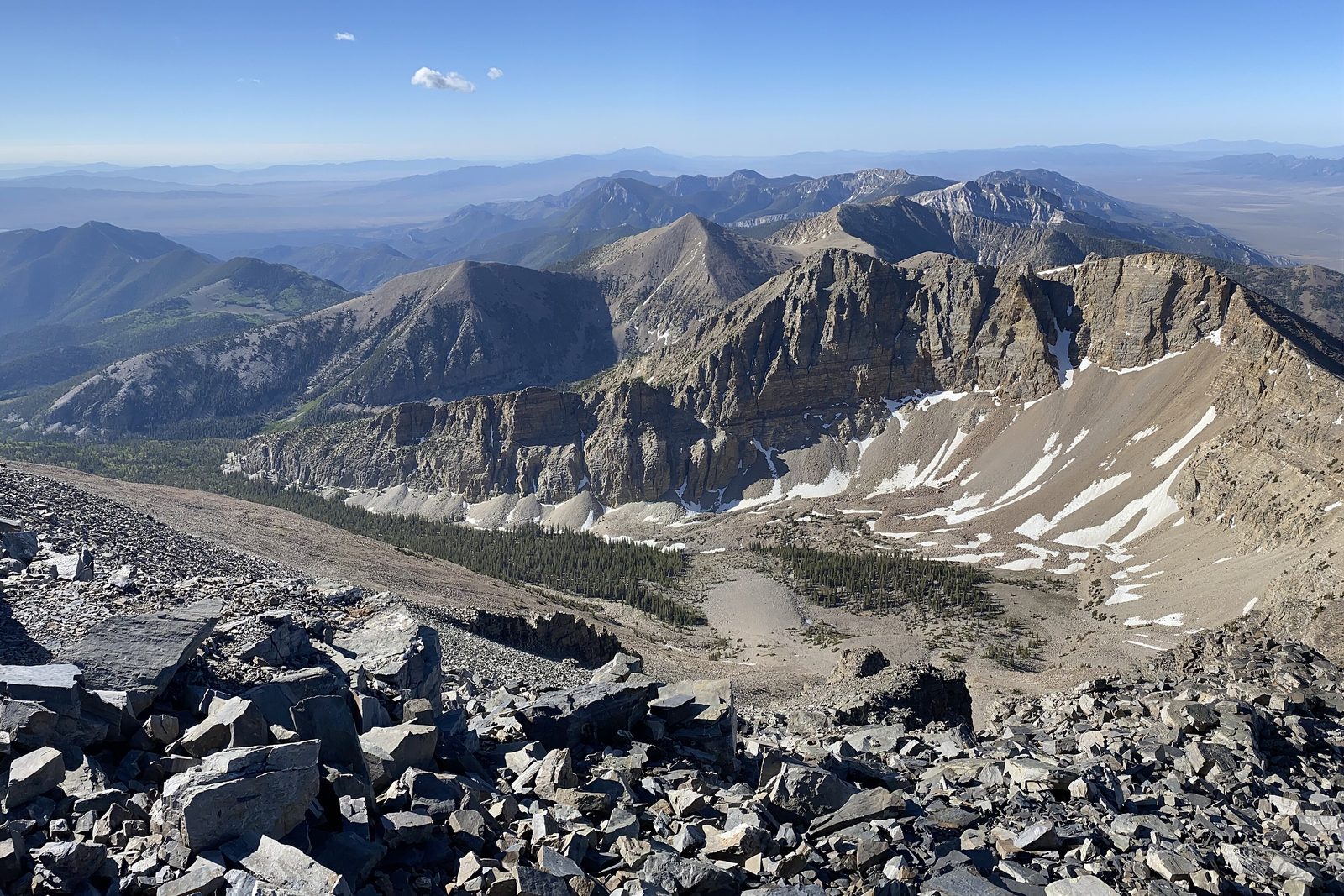
The short answer
Great Basin National Park protects a slice of the South Snake Range in remote east-central Nevada, five miles west of the small town of Baker, near the Utah line. It rises from sagebrush desert, where even the lowest ground is above 5,000 feet, to the peaks around Wheeler Peak. Up there are alpine lakes and groves of Great Basin bristlecone pine, among the oldest living trees on Earth. At its foot is Lehman Caves, the longest cave system in Nevada, made a national monument in 1922; the national park around it followed on October 27, 1986. The night sky is so dark that the park is a Gold Tier International Dark Sky Park.
From Tally’s diary
The wind up near the snow had twisted the old trees into shapes like wrung-out washing, silver and bare, with here and there one green arm still going. I stood among them feeling young, which does not happen often. Then I took my hat off. It seemed the least I could do, in company that old.
Why it's worth knowing
The basin that keeps its water. The Great Basin is a region of about 200,000 square miles where no river reaches the sea. Rain and snowmelt evaporate, sink into the ground or run into lakes, most of them salty. It is not one bowl but hundreds of small ones, separated by north-south mountain ranges, so many that Nevada is the most mountainous state in the country. Each range is an island of forest and alpine meadow standing in a sea of sagebrush. On the hottest July days the town of Baker can pass 100°F while walkers by the alpine lakes above are in the 70s.
Trees that skip a year. Great Basin bristlecone pines grow only in California, Nevada and Utah, and the oldest of them live for thousands of years. They manage it by growing slowly in the harshest places, on rocky ridges where little else will grow and fires have little to burn. Their wood becomes so dense that insects, fungi and rot can barely touch it, and wind and snow twist them into strange, beautiful shapes. Because they keep a record of good years and bad in their rings, they are vaults of thousands of years of weather. The park has three main groves, below Wheeler Peak, on Mount Washington and around Eagle Peak. The Wheeler Peak grove, the easiest to reach, is unusual in growing on a glacial moraine of quartzite boulders.
A cave of wondrous beauty. Lehman Caves formed in limestone laid down in a warm, shallow sea near the equator about 550 million years ago, later squeezed into marble. Warm, acidic water rising from below dissolved its rooms, and then dripping water filled them with formations. Among the stalactites, draperies and soda straws are more than 300 cave shields, pairs of flat calcite plates separated by a thin crack, a formation found in very few caves anywhere. The local newspaper announced the find in April 1885, describing “a cave of wondrous beauty” with stalactites so close together that the explorers planned to come back with sledgehammers.
The field notes
The tree that was cut down
Donald Currey had the Forest Service’s permission to take core samples from the bristlecones below Wheeler Peak in the summer of 1964, and permission, too, to cut the big one down. Why he did is still argued: some say his coring tool broke off in the trunk, some that it was too short for such a big tree, others that he wanted a whole slice to study. Counting the rings showed Prometheus to be the oldest tree then known. An older bristlecone, 5,065 years old, was not found until 2012, and there may be older ones still, undated.
Forty ways to find a cave
More than 40 different accounts of the discovery of Lehman Caves have turned up, and nobody knows which is true. The most likely date is 1885, and the man most likely responsible was Absalom Lehman, a rancher who had mined for gold in California and Australia before settling in Snake Valley. One story says his horse broke through the crust over the entrance; another credits his brother Ben, who felt a strong wind blowing out of a hole behind some bushes. People knew of the entrance long before, perhaps as early as 1000 AD: Indian bones were found beneath it, almost certainly placed there with care.
Weddings under the stalactites
In the 1920s the cave’s official custodians were Clarence and Beatrice Rhodes, a former restaurant owner and his wife, who kept the tour fees as their pay. It was a dollar a person, children under twelve free, for tours that often lasted three hours or more. They swapped the rope ladders for stairs, dug out floors for headroom and fitted out one room for gatherings. Couples were married in the cave, and musicians played tunes on the stalactites and stalagmites. One of the cabins the Rhodes built in 1928 still stands near the visitor centre.
The darkest kind of night
The park became a Gold Tier International Dark Sky Park in 2016, with some of the clearest, least polluted night skies in the contiguous United States. From nearly anywhere in it, thousands of stars, the bright planets, star clusters, meteors, the Andromeda Galaxy and the whole arc of the Milky Way can be seen without a telescope. Underground, the darkness belongs to the cave’s own animals, among them the Great Basin pseudoscorpion, a false scorpion first found in Lehman Caves and the park’s biggest invertebrate predator.

September 2014A bristlecone pine on the Bristlecone Trail.
Photograph: Famartin, CC BY-SA 4.0, cropped

July 2024A mountain lake below pale cliffs.
Photograph: Roller Coaster Philosophy, Great Basin National Park - 53837531366, CC BY 2.0, cropped

January 2015Formations in Lehman Caves.
Photograph: Famartin, CC BY-SA 4.0, cropped
- Count the rings of an old tree. (Started on a fallen branch. Gave up at the first knot. The tree did not mind. It has plenty.)
- Go underground and keep my elbows to myself. (Kept them in. The cave kept dripping. We got on very well.)
- Lie on my back after dark and find one star nobody else is looking at. (Found too many. Picked one at random and kept it.)
- I stopped beside a crack in the rock where cold air came breathing out, and said good afternoon to whoever was down there.
- Walk up to where the snow lives in summer. (Walked. It was there. I was out of breath and it was not.)
A relic from Great Basin National Park
Relic, entry 345Each root feeds only its own sectionSome trees live on a stripe at a time
A single strip of living bark on an ancient bristlecone. Many of the oldest trees in the high groves are mostly bare, silvery wood, twisted by the wind, with just one ribbon of bark spiralling up the trunk to a few green branches. That ribbon is the whole tree still alive. A bristlecone’s roots each feed only the part of the tree directly above them, so when a root dies, only its own section dies, and the rest carries on. Some trees live on for centuries this way, a stripe at a time.
Tally, in the marginI thought the tree had died long ago and was only being polite about it, until I saw the one stripe of bark winding up it to a handful of green. It had simply decided to carry on with less. I took that very much to heart.
Getting there
- 1
From US 6 and 50
Nevada Highway 487 runs five miles south to Baker.
- 2
Into the park
Highway 488 runs five miles west from Baker.
- 3
From Utah
Highway 21 through Milford becomes Nevada 487 at the state line.
- ✓
| J | F | M | A | M | J | J | A | S | O | N | D |
|---|---|---|---|---|---|---|---|---|---|---|---|
| June: best time | July: best time | August: best time | September: best time |
- Summer brings the best trail conditions and access
How to get there. Great Basin National Park is in remote east-central Nevada, five miles west of Baker. From US Highway 6 and 50, Nevada Highway 487 runs five miles south to Baker, and Highway 488 runs five miles west into the park. From the south in Utah, Highway 21 through Milford and Garrison becomes Nevada 487 at the state line; crossing it moves the clock into Pacific Time. The nearest commercial airports are Cedar City (142 miles) and St. George (207 miles), both in Utah, with limited flights and no rental cars; Salt Lake City is 234 miles away and Las Vegas 286. Phone navigation apps can send drivers to the wrong, remote corners of the park; the Park Service suggests routing to the Lehman Caves Visitor Center or to Baker. Services are few and far apart.
When to go. Summer brings the best trail conditions and access, and the busiest season runs from Memorial Day to Labor Day. The Wheeler Peak Scenic Drive is usually open between Memorial Day and early November, depending on snow. Lehman Caves is entered only on ranger-guided tours, limited to 20 people, which run all year except Thanksgiving, Christmas Day and New Year’s Day and often sell out.
Safety. The State Department’s travel advisories cover other countries, so none applies here. Cell coverage is little or none; the park’s conditions page lists what is open and closed.
Mark this place
The passport stamp for this place.
Common questions
How old are the bristlecone pines in Great Basin National Park?
Thousands of years old. A bristlecone called Prometheus, cut down below Wheeler Peak in Great Basin National Park in 1964, had 4,862 rings and was about 4,900 years old, the oldest tree then known.
What was Prometheus?
A bristlecone pine that was cut down. Prometheus grew in the Wheeler Peak grove in what is now Great Basin National Park until 1964, when a geographer had it felled; its rings showed it to be about 4,900 years old.
Can you visit Lehman Caves without a guide?
No. Lehman Caves, in Great Basin National Park, can only be entered on a ranger-guided tour of up to 20 people, and the tours are regularly sold out.
What are cave shields?
Rare cave formations: two flat plates of calcite with a thin crack between them. Lehman Caves in Great Basin National Park has more than 300, a formation seen in very few caves on Earth.
Is Great Basin National Park good for stargazing?
Among the best in the country. Great Basin National Park in Nevada became a Gold Tier International Dark Sky Park in 2016, and the Milky Way can be seen with the naked eye from nearly anywhere in it.
What is the Great Basin?
A region of about 200,000 square miles where no river reaches the sea. It covers most of Nevada and half of Utah, and Great Basin National Park protects one small, representative piece of it.
Where is Great Basin National Park?
In east-central Nevada, five miles west of the town of Baker, near the Utah border. The nearest commercial airport is Cedar City, Utah, 142 miles away.
Photographs on this page
Tap a photograph to see it full size.
Photograph: Ken Lund, Wheeler Peak, Great Basin National Park, Nevada132, CC BY-SA 2.0, cropped
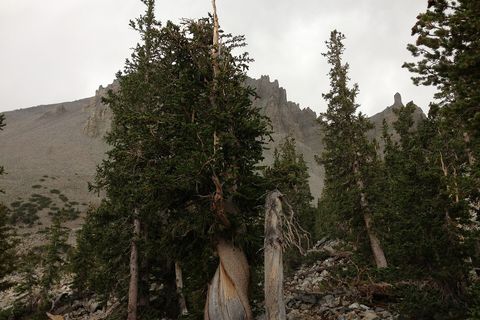
Photograph: Famartin, CC BY-SA 4.0, cropped
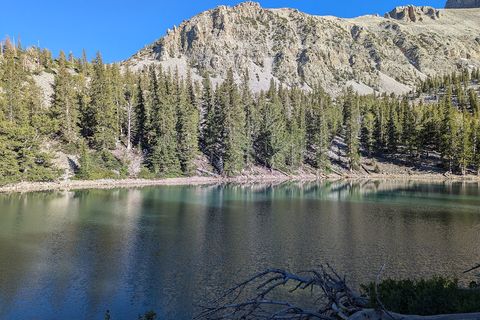
Photograph: Roller Coaster Philosophy, Great Basin National Park - 53837531366, CC BY 2.0, cropped
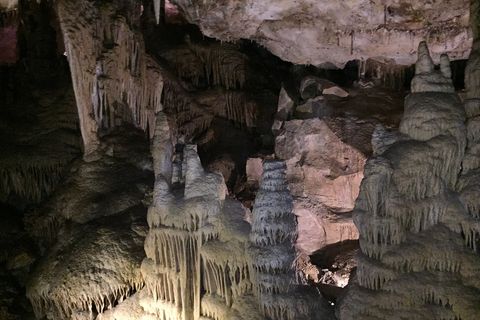
Photograph: Famartin, CC BY-SA 4.0, cropped




