The short answer
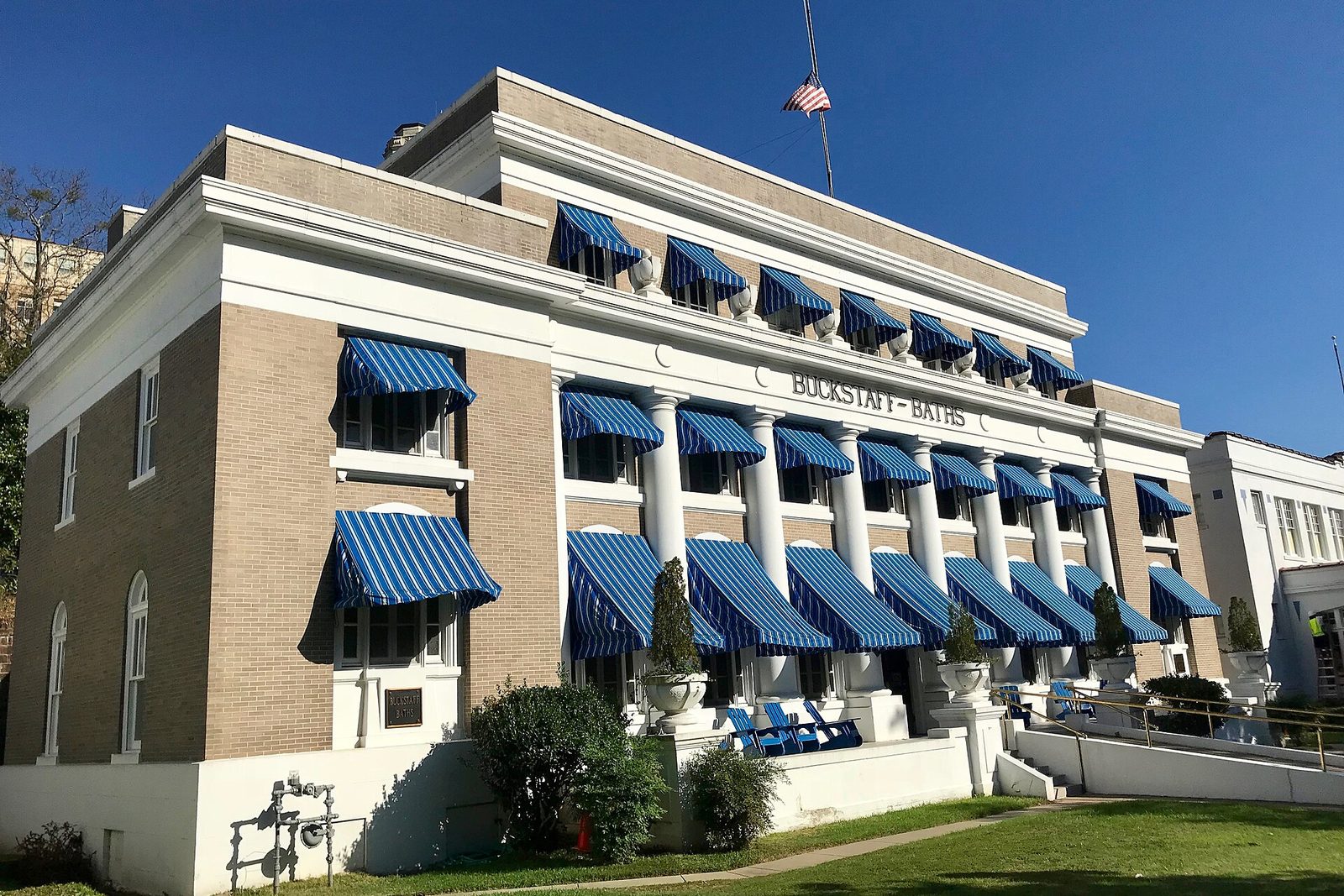
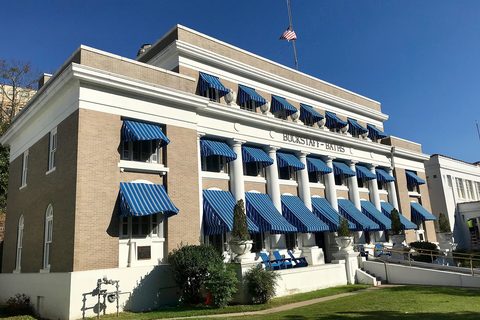
Hot Springs National Park is a national park in the middle of a small city, Hot Springs, Arkansas, about an hour south-west of Little Rock. It protects the thermal springs that rise on the western slope of Hot Springs Mountain, the forested ridges around them, and Bathhouse Row, the town’s street of grand old spas. An act of Congress signed by President Andrew Jackson on April 20, 1832, reserved the springs. There is no entrance fee, no outdoor soaking, and two of the bathhouses, the Buckstaff and the Quapaw, still run baths with water piped straight from the springs.
From Tally’s diary
Warm steam came drifting out of the hillside beside the pavement, and a little stream of water ran past my feet hot enough to make me take them away again. Behind me stood a row of grand old buildings, each with a fancier front door than the last. I chose the one with the most tiles and went in, feeling extremely important.
Why it's worth knowing
Not a volcano in sight. Most hot springs are warmed by volcanoes. These are not. About 300 million years ago two of the earth’s plates collided and folded the rock of the Ouachita Mountains into long, zigzag ridges, cracking it as they bent. Rain and snow seep down those cracks into the earth, where the deeper they go the hotter the rock becomes. After thousands of years the water meets a fault that brings it back up quickly. Novaculite, a dense, hard rock of tiny quartz crystals better known as an Arkansas whetstone, helps steer it down. The result is the only non-volcanic hot springs of their quality in the United States: hot, clear and odourless.
The Great American Spa. The first bathhouses were tents and lumber shacks perched over individual springs, and the wooden ones that followed kept burning, rotting or falling down. In the early 1880s the government roofed over Hot Springs Creek in an underground arch, landscaped the ground above and cleared the way for the Row. Doctors prescribed courses of baths, and from 1896 the Victorian bathhouses were replaced by the masonry and steel palaces that stand now. The Fordyce, opened in 1915 and the largest, cost over $212,000 to build and fit out; it now holds the visitor centre and its rooms of old equipment. The Buckstaff, opened in 1912, has never fully closed since its first bath.
Free water for everybody. The government has long owned the water and sold it to the bathhouses. From 1878 it also built free bathhouses for poor people over a popular spring known as the “mud hole”, and kept them running until 1956. At first anyone could use them, black or white, man or woman, and the queues could last two or three hours. Visitors can still see the water rising in display springs and pouring down the Hot Water Cascade on Arlington Lawn, where it leaves behind a grey, spongy rock called tufa.
The field notes
A shotgun over a spring
In 1884 the Army was building a hospital in Hot Springs and diverting spring water for the work. The reservation’s superintendent, Samuel Hamblen, needed every drop for the bathhouses, so he sent men to cut the hospital off. The Army’s Captain Jacobs asked him to stop, was ignored, sent his clerk for a double-barrelled shotgun, removed the superintendent from the spring “in a most effectual manner” and stood guard over it. Hamblen and his men retreated, both sides appealed to Washington, and Washington told the Army to buy city water instead. The Army-Navy hospital was finished in 1887. No superintendents were harmed.
Separate baths
After Reconstruction ended, African Americans could work in the bathhouses but could not bathe freely in them. In the 1880s black patrons could buy tickets at a few houses on the Row, but not for the morning hours the doctors thought best. The Crystal Bathhouse on Malvern Avenue was the first built for African Americans alone; it burned in the great fire of 1913, which destroyed 50 city blocks. Its successor on the same site, the Pythian, was designed by W. T. Bailey, head of architecture at the Tuskegee Institute. Until the Civil Rights Act of 1964, black visitors bathed mainly at bathhouses run by black owners. Much of the work on the Row itself, as bath attendants, massage therapists and porters, was done by African Americans, and the park is now recording their stories.
Gym machines from Sweden
Inside the Fordyce stand the strange, handsome contraptions of Dr. Gustav Zander, a Swedish physician born in Stockholm in 1835, who worked out in the 1850s that machines could do the job of a gymnastics assistant better than any person. Each model worked one set of muscles, or imitated one kind of massage, with weights, levers and pulleys that could be set for the user. The designs look remarkably like the machines in a modern gym.
A tower above the town
A lookout has stood on top of Hot Springs Mountain for more than a century. A steel tower with a lift opened there in 1906; the present one, 216 feet tall, opened in June 1983. Its open-air upper deck stands 1,256 feet above sea level and looks out over 140 square miles of countryside, the whole park and part of the Ouachita Mountains. Trails wind through the woods below it, a world away from the street.

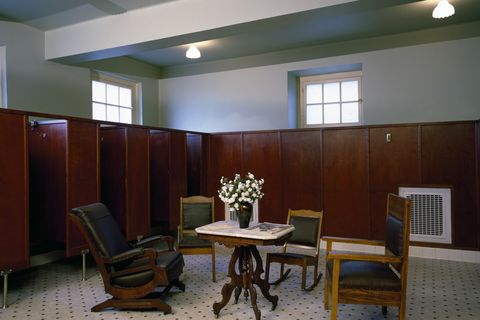
A lounge inside the Fordyce Bathhouse.
Photograph: Carol M. Highsmith, Public domain, cropped
- Watch the steam rise off the hillside on a cool morning. (Watched. It rose. I fogged up my spectacles trying to see where it went.)
- Find the oldest-looking front door on the street. (Found eight. Each one was older-looking than the one before.)
- I tried one of the old exercise machines with great dignity, and it tried me back, with rather more.
- Climb up to the tower and look for the edge of the hills. (The hills went on past the edge of looking.)
- Write a postcard about the water to somebody who will not believe it. (Wrote three. Still on the list: one somebody who will.)
A relic from Hot Springs National Park
Relic, entry 346Built for strengthening the armsSteady resistance, set by weights
A Zander machine in the Fordyce Bathhouse. This one was built for strengthening the arms and enlarging the chest, with upright bars, weights and pulleys. Once an attendant had set the weights, the machine did the rest, giving steady resistance that a human assistant, tiring or distracted, never could, which was exactly Dr. Zander’s point. Several dozen models each worked their own set of muscles, and the idea behind them, weights moved by levers, is the one behind the machines in fitness clubs now.
Tally, in the marginA contraption of bars and weights and pulleys, I thought, for going nowhere very slowly, and then I learned it was built to make people stronger. I sat on it for a while, out of respect.
Getting there
- 1
From Little Rock
Interstate 30 west and US Highway 70 lead into town, about an hour.
- 2
From Texarkana
Interstate 30 and Arkansas Highway 7 cover the 112 miles.
- 3
On foot
Bathhouse Row lines Central Avenue in the middle of town.
- ✓
How to get there. Hot Springs is 54 miles from Little Rock, about an hour’s drive by Interstate 30 west and US Highway 70 into town, then Central Avenue to the Fordyce Bathhouse Visitor Center at 369 Central Avenue. From Texarkana it is 112 miles by Interstate 30 and Arkansas Highway 7, which becomes Central Avenue; from Fort Smith, 129 miles by US 71 and US 270. Parking is on metered streets and in the Exchange Street garage. The visitor centre is open every day from 9 to 5 except Thanksgiving, Christmas Day and New Year’s Day.
When to go. The park is open all year, and summers are hot and humid.
Safety. The State Department’s travel advisories cover other countries, so none applies here. The thermal water comes out of the ground very hot; the park’s alerts page carries current closures.
Mark this place
The passport stamp for this place.
Common questions
Where does the water at Hot Springs come from?
From rain that fell thousands of years ago. At Hot Springs National Park in Arkansas, rain sinks along cracks in the Ouachita Mountains to as much as 7,500 feet underground, heats up, and re-emerges about 4,400 years later.
How hot are the springs in Hot Springs National Park?
About 143°F on average. The springs of Hot Springs National Park come out of Hot Springs Mountain at around 143°F (62°C), and the water has cooled enough to touch by the time it reaches the display pools.
Can you bathe in the hot springs?
Yes, indoors. At Hot Springs National Park the thermal water is piped into two bathhouses on Bathhouse Row, the Buckstaff and the Quapaw, which offer baths; there is no soaking outdoors.
Are the hot springs volcanic?
No. The springs of Hot Springs National Park are heated by the natural warmth deep underground, not by a volcano, and they are the only non-volcanic geothermal springs of such quality in the United States.
When were the hot springs protected?
In 1832. An act of Congress signed on April 20, 1832, reserved the springs that are now Hot Springs National Park in Arkansas.
What is Bathhouse Row?
A street of historic spas. Bathhouse Row in Hot Springs National Park is a line of eight bathhouses built between 1892 and 1923; the Fordyce is the visitor centre, and the Buckstaff and Quapaw still offer baths.
Does Hot Springs National Park charge an entrance fee?
No. Hot Springs National Park is an urban park in downtown Hot Springs, Arkansas, with no entrance fee; the bathhouses charge for their own baths.
Photographs on this page
Tap a photograph to see it full size.
Photograph: daveynin, Buckstaff Bathhouse, CC BY 2.0, cropped
Photograph: Carol M. Highsmith, Public domain, cropped




