The short answer
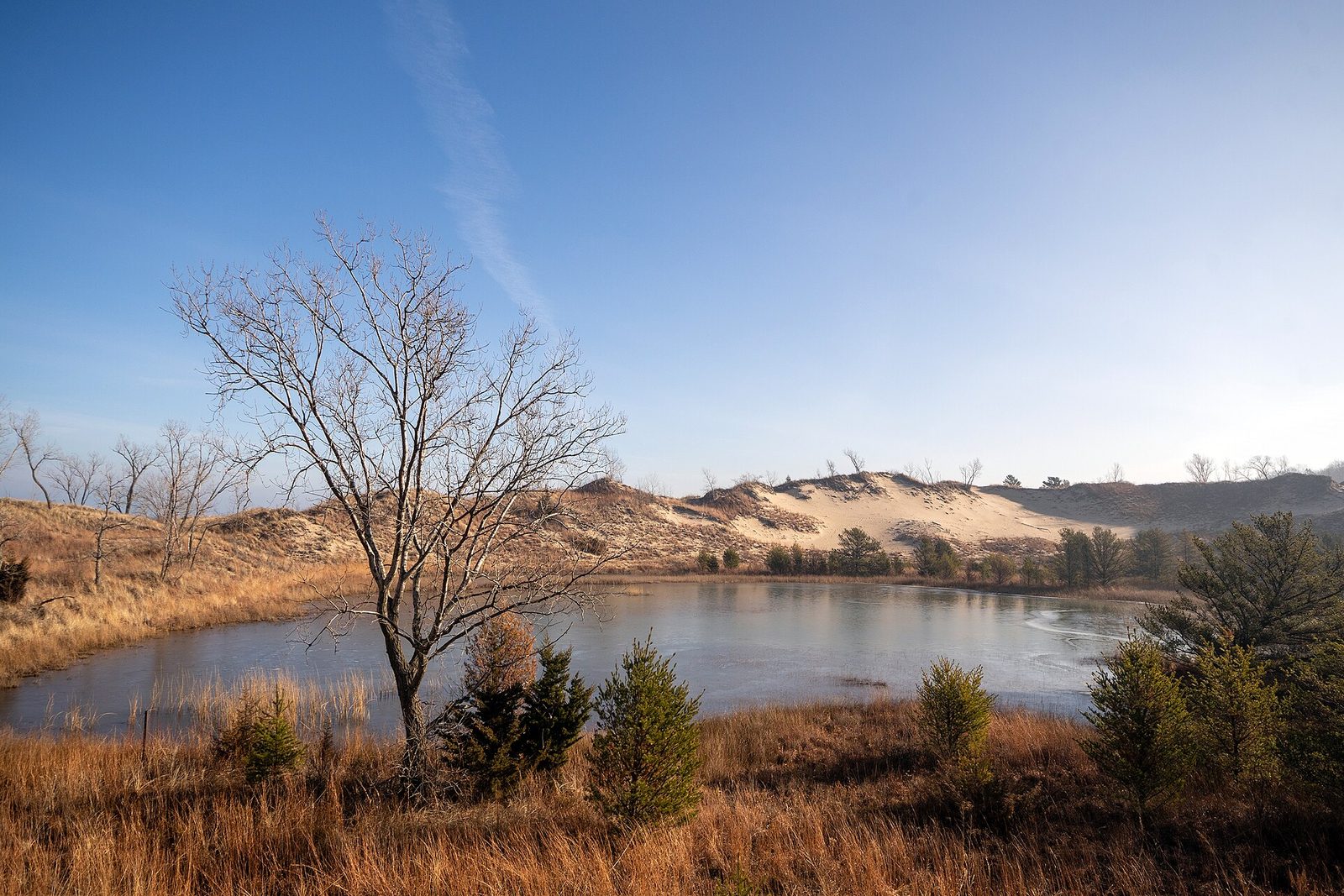
Indiana Dunes National Park runs along 15 miles of Lake Michigan’s southern shore in north-west Indiana, and it is the closest national park to Chicago. Behind the beaches and dunes lie fens, bogs, marshes, prairies, black oak savannas and woods. Trains on the South Shore commuter line stop inside the park, and it has been a national park since 2019, after more than fifty years as a national lakeshore.
From Tally’s diary
The sand squeaked under my feet all the way up, and at the top the wind off the water nearly sat me down again. Behind me the grass gave way to little pines and the pines to proper woods, as if the hill had been arranged in a line by somebody very tidy. Far along the shore, chimneys smoked. I looked at both for a long time.
Why it's worth knowing
Where ecology took root. In the 1890s a University of Chicago botanist, Henry Chandler Cowles, brought his students to these dunes and showed them that the plants change in a predictable order inland from the water, from marram grass on the bare beach sand to shrubs and pines and at last an oak wood. That process, plant succession, is the reason lawns need mowing. His 1899 study of the dune vegetation made him known as the “father of plant ecology” in North America and made the dunes famous among scientists around the world. The whole story can still be walked. Marram grass thrives on being buried by blowing sand, and the roots of a single plant may spread 20 feet in every direction, holding the foredune together. Behind it, sheltered from the wind, new plant communities take hold, until the bare sand becomes an oak-covered dune. Only a few thousand years ago the shoreline was a mile inland, south of what is now Route 12.
More orchids than Hawaii. The park holds more than 1,400 kinds of ferns and flowering plants, among them 28 kinds of native orchid, more than the whole state of Hawaii, and more than 350 kinds of birds have been seen within it. Its black oak savannas, sparse woods of fire-resistant oaks over prairie flowers, are among the last and best in the world: oak savannas once covered about fifty million acres from Michigan to Nebraska and now cover about 30,000. Fire, set on purpose, keeps them open for the wild lupine, the only food of the young Karner blue butterfly.
Saved by a schoolteacher. Lovers of the dunes, the landscape architect Jens Jensen among them, formed the Prairie Club of Chicago in 1908, and in October 1916, weeks after the National Park Service was created, its first director held hearings in Chicago on a “Sand Dunes National Park”. Four hundred people came, 42 spoke in favour, and nobody spoke against. Then the First World War intervened, and the slogan “Save the Dunes!” became “First Save the Country, Then Save the Dunes!”. In 1952 Dorothy Buell, an English teacher from Ogden Dunes, helped found the Save the Dunes Council, which bought land and lobbied for it alongside Senator Paul Douglas until Congress finally authorized the lakeshore in 1966. The visitor center is named for her.
The field notes
The last of the Central Dunes
The Central Dunes were the place the Save the Dunes campaigners most wanted to protect, and they were lost: the land was cleared for the Port of Indiana and a steel works. In the winter of 1962, as the bulldozers went in, Dorothy Buell remembered Senator Douglas standing beside her with tears running down his cheeks. John Hawkinson, an artist and Boy Scout leader who wrote and illustrated children’s nature books with his wife, was the last to sell his land there. By holding on until the end, he helped persuade the steel company not to oppose the national lakeshore.
Saturday afternoon walks
In 1910 the Chicago writer Lois Willoughby described a “Saturday Afternoon Walk” through Miller Woods, one of the outings of a walking club whose members included the landscape architect Jens Jensen. Those walks grew into the Prairie Club and the first efforts to protect the dunes. The Paul H. Douglas Trail through Miller Woods now follows the same haunts, through some of the finest black oak savanna that remains.
Ice on the shore
In a hard winter, breaking waves and spray freeze along the beach into mounds and ledges of shelf ice that can look like solid ground running out into the lake. It is anything but: shelf ice builds outward from the beach without freezing to the lake bottom, and it is full of hidden cracks and holes that can give way like a trapdoor. The Park Service warns never to step onto it.
Ten thousand years of footprints
More than 225 archaeological sites in the park record 10,000 years of Native American life, the fur trade and later Swedish immigration. The Bailly Homestead is a National Historic Landmark, and more than 50 structures in the park are on, or eligible for, the National Register of Historic Places.

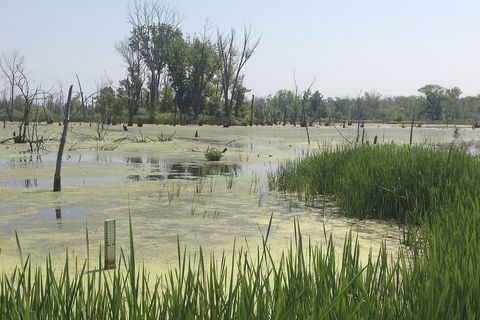
The Great Marsh near Beverly Shores.
Photograph: U.S. Geological Survey, Public domain, cropped

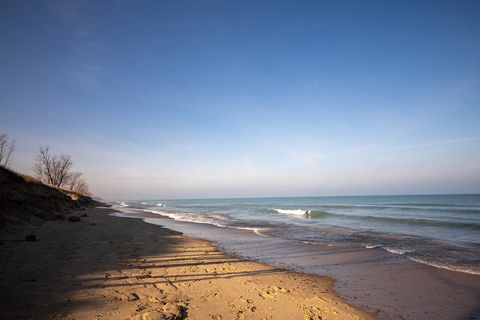
December 2019Lake Michigan breaking on a winter beach below the dunes.
Photograph: Matthew Dillon, Indiana Dunes National Park, CC BY 2.0, cropped
- Walk from the beach to the oak woods and watch the plants change. (They changed. So did my shoes, which filled with sand at the first step and stayed that way.)
- Find one blue butterfly. (Found a blue one. Found it again, or its cousin. I have written down ‘at least one’.)
- Write my name in the sand above the water. (Wrote it. The wind tidied it away by teatime.)
- In winter I admired the ice heaped along the shore from the beach, and kept my feet on the sand. It looked solid. It was only pretending.
- Catch the train to the seaside that is not the sea. (Caught it. Everyone else carried a beach bag. I carried my notebook and felt underdressed.)
A relic from Indiana Dunes National Park
Relic, entry 338The only food of the young Karner blueKept open by prescribed fire
A wild lupine on a black oak savanna. In the open, grassy places where fire-resistant black oaks stand scattered among the prairie flowers, the lupine is the only food of the young Karner blue butterfly, a federally endangered species. Once, fires set by lightning or by Native Americans kept these savannas open; now prescribed fire and careful clearing do the job, so the lupine, and the little blue butterfly, can go on.
Tally, in the marginA purple flower spike I would have walked straight past, if a small blue butterfly had not been sitting on it as though it owned the place. As far as the butterfly is concerned, it does. I walked round them both very carefully.
Getting there
- 1
By train
South Shore trains stop at Miller, Ogden Dunes, Dune Park and Beverly Shores.
- 2
By Interstate 94
The visitor center is a mile north of exit 26.
- 3
By the Toll Road
The visitor center is four miles north of exit 31 on the Indiana Toll Road.
- ✓
How to get there. The Indiana Dunes Visitor Center is at 1215 North State Road 49, in Porter: a mile north of exit 26 on Interstate 94, and four miles north of exit 31 on the Indiana Toll Road (Interstates 80/90). Most of the park’s beaches and trails are reached from US Highway 12. Trains on the South Shore line, which runs to Chicago, stop inside the park at Miller, Ogden Dunes, Dune Park and Beverly Shores. The nearest airports are Gary, South Bend, and Chicago’s Midway and O’Hare.
When to go. Lake Michigan shapes the weather. Summers are warm and humid, with highs in the mid-80s°F and about 15 days a year above 90°F; winters are usually cloudy, with highs in the low to mid 30s°F and about 15 days a year below 0°F.
What to arrange ahead. As of 13 November 2026, the national park charges an entrance fee, and its passes are not accepted at Indiana Dunes State Park, nor the state park’s at the national park. The park is open from 6 am to 11 pm Central Time; West Beach closes at 9 pm.
Safety. The State Department’s travel advisories cover other countries, so none applies here. The park’s conditions and alerts pages carry current closures.
Mark this place
The passport stamp for this place.
Common questions
Why is Indiana Dunes important to science?
Because ecology took root there. In the 1890s Henry Chandler Cowles studied how plants change from the beach to the woods on the dunes now in Indiana Dunes National Park, and his work helped establish ecology as a science.
How close is Indiana Dunes to Chicago?
Close enough to reach by commuter train. Indiana Dunes National Park is the nearest national park to Chicago, and South Shore line trains stop inside it at Miller, Ogden Dunes, Dune Park and Beverly Shores.
When did Indiana Dunes become a national park?
In 2019, after half a century as a lakeshore. Congress authorized the Indiana Dunes National Lakeshore on November 5, 1966, and renamed it Indiana Dunes National Park, the 61st, on February 15, 2019.
What was Hoosier Slide?
The largest sand dune on Indiana’s lakeshore, now gone. Hoosier Slide stood 200 feet high until a glass fruit-jar maker and a plate-glass company carried it away in railroad boxcars, which helped spur the campaign that led to Indiana Dunes National Park.
What is shelf ice?
Frozen waves and spray piled along the shore. At Indiana Dunes National Park shelf ice forms on Lake Michigan in winter; it is not frozen to the lake bottom and is full of hidden holes, and the Park Service warns never to step onto it.
How many kinds of orchid grow at Indiana Dunes?
Twenty-eight, more than in the whole of Hawaii. Indiana Dunes National Park also holds more than 1,400 kinds of ferns and flowering plants, which makes it the fifth most biodiverse national park.
What is the Karner blue butterfly?
A small, federally endangered butterfly of the oak savannas. At Indiana Dunes National Park its young feed only on wild lupine, and controlled burns at Miller Woods and Tolleston Dunes keep the savanna open for both.
Photographs on this page
Tap a photograph to see it full size.
Photograph: Matthew Dillon, Indiana Dunes National Park, CC BY 2.0, cropped
Photograph: U.S. Geological Survey, Public domain, cropped
Photograph: Matthew Dillon, Indiana Dunes National Park, CC BY 2.0, cropped




