
- Where
- Hawaiʻi Volcanoes National Park,
Island of Hawaiʻi, United States - Coordinates
- 19.4053° N
155.2819° W (Halemaʻumaʻu) - Type
- Shield volcano; summit caldera
Kaluapele, crater Halemaʻumaʻu - The lake
- First seen 25 July 2019; about 50 m deep;
boiled off 20 December 2020 - Now
- Episodic summit eruption
since 23 December 2024 - Alert level
- WATCH / ORANGE
(USGS, 28 September 2026) - Park
- Open 24 hours; $30 per vehicle,
valid seven days
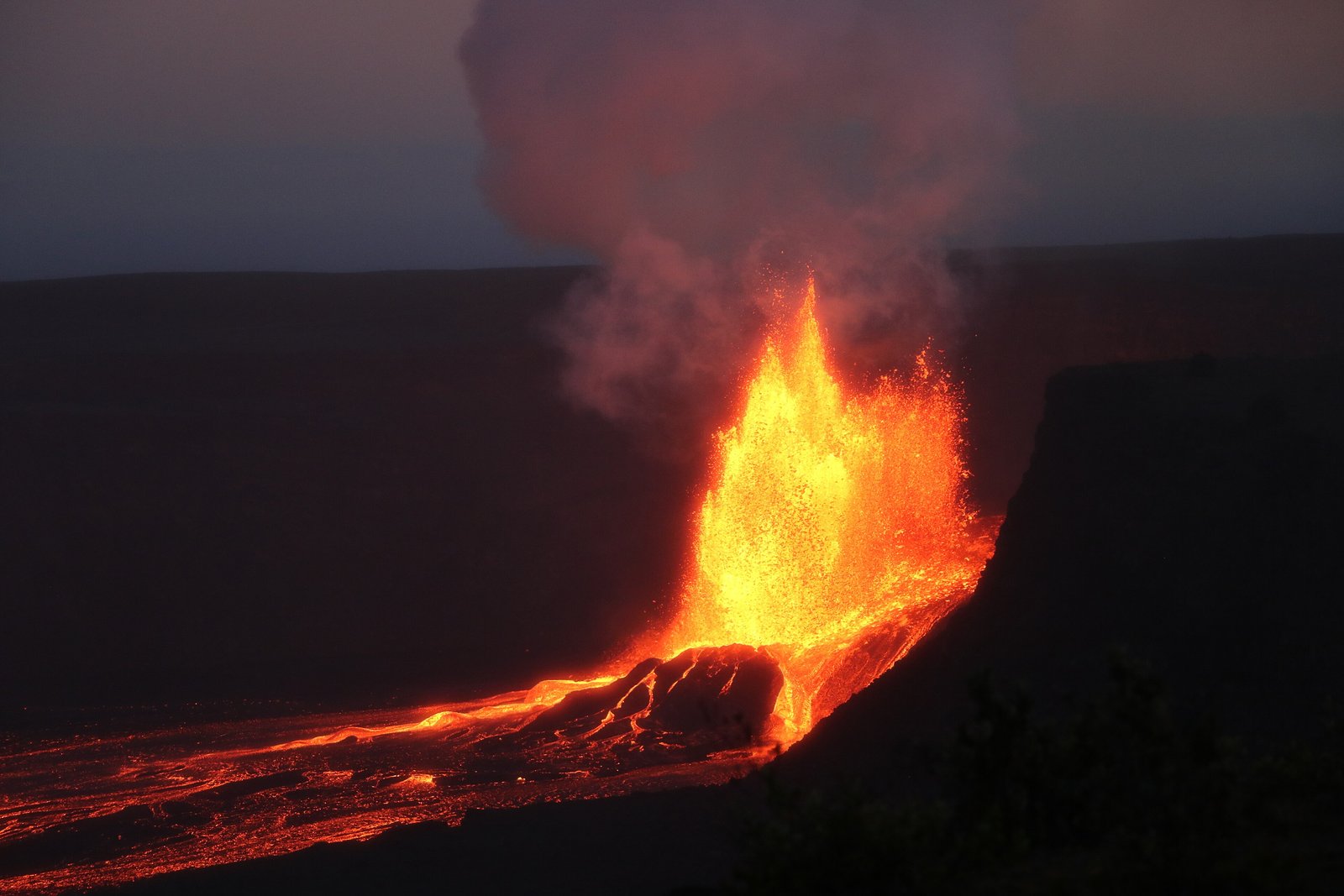
Walked out of a dripping fern forest, past trees with red brush-like flowers, onto the rim of a huge grey pit with steam leaking from cracks at my feet. It smelled of struck matches. After dark the bottom began to glow, and when the fountain rose everyone stopped talking and I could hear it, a low roar like surf. I kept very quiet. It felt like somebody’s house.
The short answer
Kīlauea is an active shield volcano on the south-eastern side of the Island of Hawaiʻi, the largest island of the US state of Hawaiʻi, inside Hawaiʻi Volcanoes National Park. Its summit is a broad caldera, Kaluapele, and inside the caldera is the crater Halemaʻumaʻu. The National Park Service describes Halemaʻumaʻu as the home of Pele, the Hawaiian volcano deity, who is embodied by lava and revered by many Hawaiians as family. The US Geological Survey’s Hawaiian Volcano Observatory, founded by Thomas Jaggar in 1912 and for many years based on the caldera rim, monitors it. By Wikipedia’s account Kīlauea erupted almost without a break on its east rift zone from 1983 to 2018. Since 23 December 2024 it has erupted in short fountaining episodes inside Halemaʻumaʻu, in an area of the park closed to the public.
Why it's worth knowing
Volcanic craters hold fire. For a year and a half, this one held water.
In 2018 an eruption far down the east rift zone, in the lower Puna district, drained magma from beneath the summit, and the summit collapsed. The US Geological Survey describes the result as a pit more than 500 metres deep inside the caldera. Its new floor lay below the water table.
On 25 July 2019 the observatory saw ponded water at the bottom of the pit. It was groundwater, seeping back in as the water table recovered, and the USGS calls it the first lake observed within Kīlauea’s caldera in at least 200 years. The observatory measured it routinely with a laser rangefinder: the water rose between 5 and 15 centimetres a day, and by December 2020 the lake was about 50 metres deep.
At about 9:30 on the night of 20 December 2020 an eruption broke out in the walls of Halemaʻumaʻu and lava poured into the lake. The USGS records that the lake boiled off in about an hour and a half. Seventeen months of water went in ninety minutes.
The field notes
The eruption now
Since 23 December 2024 Kīlauea’s summit has erupted in episodes: several hours of lava fountaining from vents in Halemaʻumaʻu, then a pause of days or weeks. The USGS numbered episode 54 on 25 August 2026, when a fountain from the north vent reached about 150 metres and the plume rose to about 5,200 metres above sea level; most of the fallout landed inside the closed area of the park. Wikipedia records fountains of about 370 metres in July 2025. On 28 September 2026 the observatory kept the volcano at alert level WATCH and aviation colour code ORANGE, reported small overflows from the north vent, and called a 55th episode possible. This paragraph will date quickly; the observatory’s own updates are the thing to check.
Pele’s house
The National Park Service describes Halemaʻumaʻu as sacred. In Hawaiian tradition, as the park tells it, Pele travelled south-east through the islands and made her permanent home in the crater; Wikipedia gives the caldera’s name, Kaluapele, as “the pit of Pele”. The park asks visitors to watch eruptions quietly, to stay out of closed areas and to give Native Hawaiian cultural practitioners space to practise their customs, and notes that in Hawaiian tradition it is customary to ask Pele’s permission to travel through her land.
Glass on the wind
The fountains make a strange weather. Pele’s hair, in the USGS’s description, is strands of volcanic glass drawn out by lava fountaining, light enough to be carried more than 15 kilometres from the vent. During episode 41, on 24 January 2026, the observatory reported reticulite, Pele’s hair and ash falling heavily through the Volcano area and across the east side of the island.
What the summit has done before
Kīlauea’s history includes loss. Wikipedia’s account records that an explosive eruption in 1790 killed a party of warriors of the army of Keōua Kuahuʻula near the summit, that the 1983–2018 eruption buried the towns of Kalapana and Kaimū in 1990, and that the 2018 eruption in lower Puna destroyed homes in Leilani Estates and Kapoho.
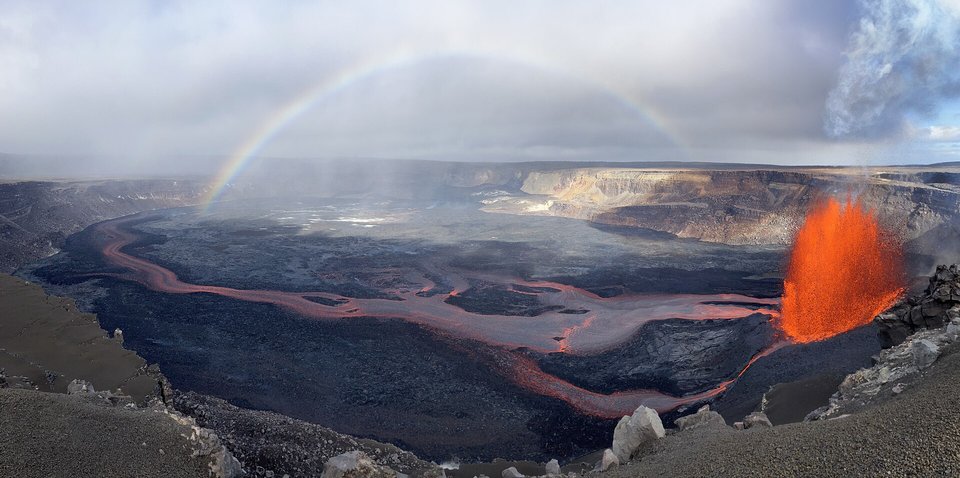
A rainbow across Halemaʻumaʻu as lava fountains during episode 21 of the eruption, 11 May 2025.
Photograph: M. Zoeller, USGS · Public domain
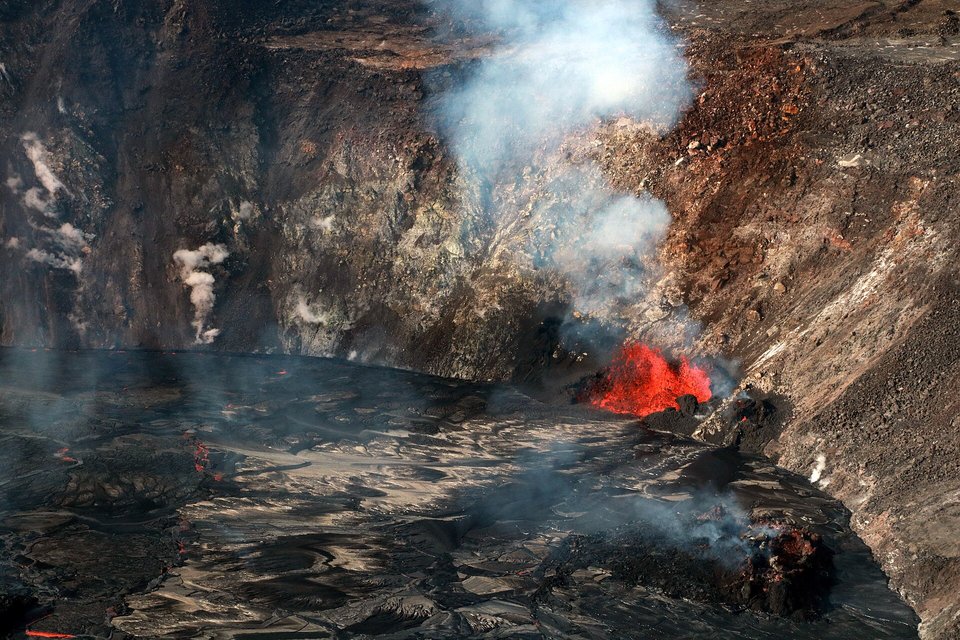
The active vent in the crater wall feeding the lava lake inside Halemaʻumaʻu, from an overflight on 30 September 2021.
Photograph: USGS Hawaiian Volcano Observatory · Public domain
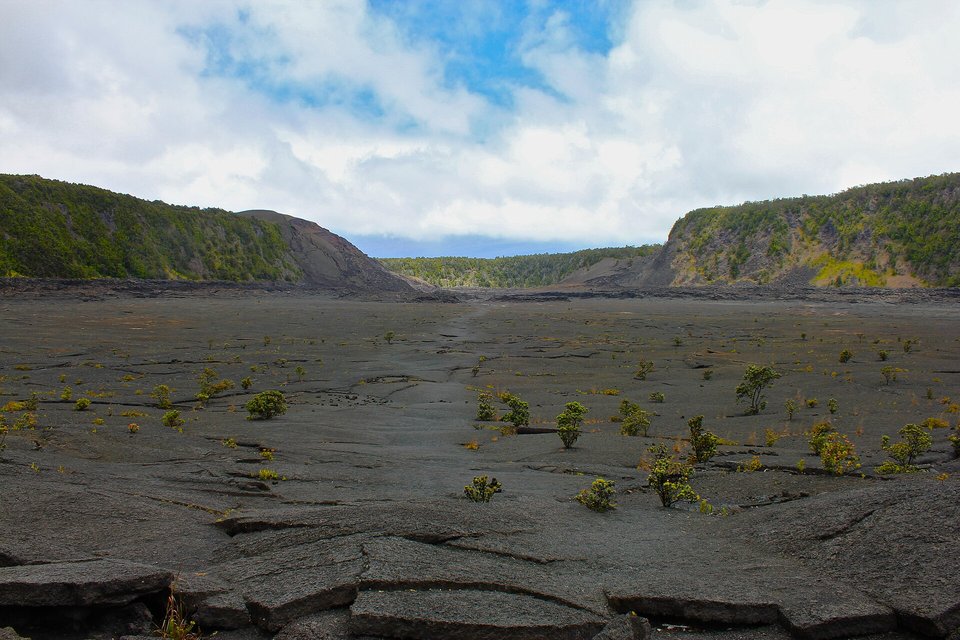
The trail across the floor of Kīlauea Iki, the crater that filled with a lava lake in 1959, June 2010.
Photograph: Navin Rajagopalan · Kilauea Iki Trail, Volcanoes NP · CC BY-SA 2.0
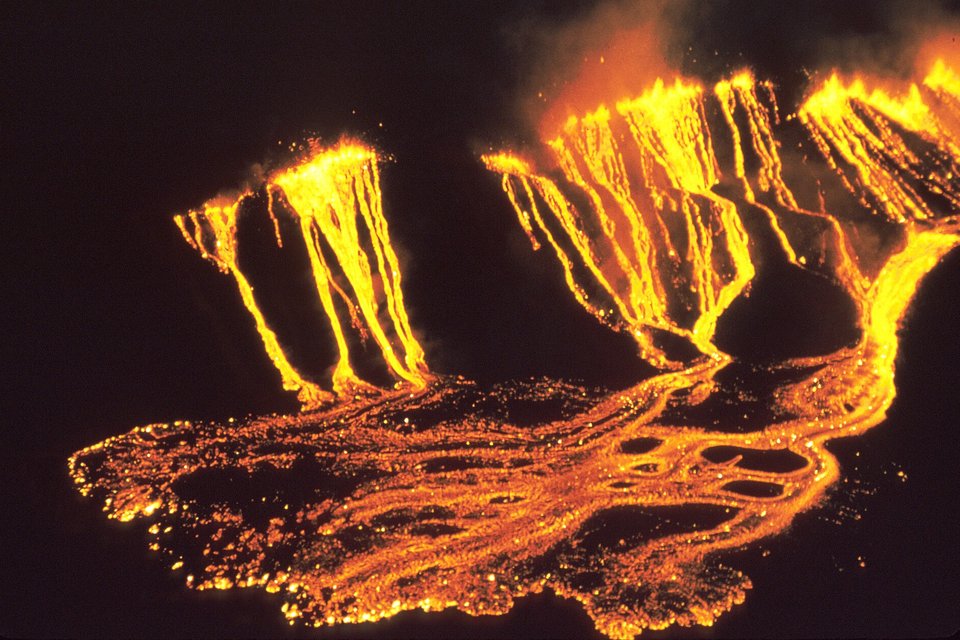
Lava cascades and flows in Kīlauea Iki crater, first phase of the 1959 eruption, seen from Byron Ledge, 14 November 1959 (historic photograph).
Photograph: Hawaii Volcano Observatory, USGS · Public domain · cropped
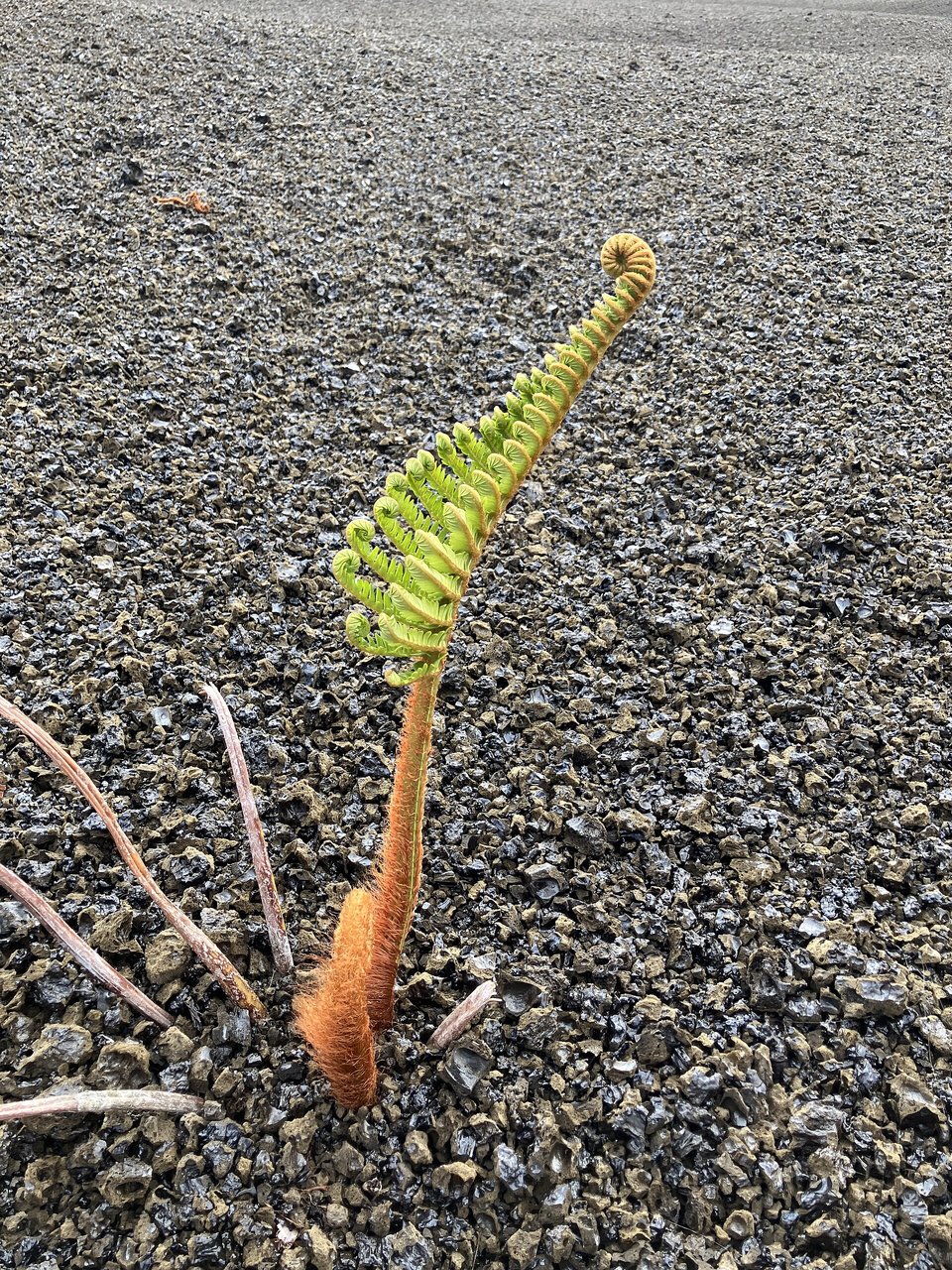
A partly buried hāpuʻu fern unfurling a new frond in tephra a few hundred metres from the crater's western rim, 11 May 2025.
Photograph: M. Zoeller, USGS · Public domain
- Check the eruption and the air before you set out, not when you reach the rim.
- Watch quietly, and give room to anyone who has come to chant or to pray. It is somebody’s home.
- Come back after dark, when the glow does the talking.
- Bring a warm layer and something for the rain, even to a volcano.
- Add nothing to the list until the fountain stops. (It did not stop. Neither did the list.)
A strand of Pele’s hair. When Kīlauea fountains, some of the lava is drawn out into threads of volcanic glass and carried away on the wind; they can travel more than 15 kilometres from the vent, and in January 2026 they fell heavily around the village of Volcano. They are named for Pele, whose home, in Hawaiian tradition, is the crater they come from. Federal rules forbid removing natural objects from a national park, so this one stays where it landed.
Tally, in the marginI took it for a spider’s thread on the railing and very nearly brushed it away. It was glass, and it had come a long way on the wind to be ignored by me.
Getting there
How to get there. Hawaiʻi Volcanoes National Park is on Highway 11, about 45 minutes’ drive from Hilo and two to two and a half hours from Kailua-Kona, by the National Park Service’s own estimate; both towns have airports. The park is open 24 hours a day, all year. The Kīlauea Visitor Center, on Crater Rim Drive, opens daily from 7:45 a.m. to 5 p.m. The park’s fees page gives $30 per private vehicle, valid for seven days (checked September 2026).
Seeing the eruption. The vents are in a closed, hazardous area. The park says the eruption can be watched from open viewing areas along the caldera rim; Kīlauea Overlook, 2.5 miles from the entrance station, looks down into the bottom of the crater. Overlooks close for days or weeks after heavy falls of tephra while park staff clear cinders, as Uēkahuna and Kīlauea Overlook did in April 2026. Episodes are brief and the pauses between them vary: follow the observatory’s updates and the park’s webcams, and if the fountain is up, go after dark.
The air. Volcanic gas and vog can reach unhealthy levels in the park. The park asks visitors to check its air-quality page before coming, and warns that even low levels of volcanic gas threaten people with heart or breathing problems, infants, young children and pregnant women. Stay on marked trails and behind the rails; the park lists volcanic gas, steep unstable cliff edges, earth cracks and tephra among the hazards.
Safety. The State Department issues no advisory for travel within the United States. The eruption’s status changes from day to day; the figures here were checked on 29 September 2026.
Mark this place
Common questions
Is Kīlauea erupting now?
As of 28 September 2026 the US Geological Survey’s Hawaiian Volcano Observatory kept Kīlauea, on the Island of Hawaiʻi, at alert level WATCH, aviation colour code ORANGE, with small lava overflows from the north vent in Halemaʻumaʻu crater. Its summit eruption, which began on 23 December 2024, runs in short fountaining episodes separated by pauses; the 54th was on 25 August 2026.
Can you see the Kīlauea eruption?
Yes, from open viewing areas along the rim of Kīlauea’s summit caldera in Hawaiʻi Volcanoes National Park, when an episode is under way. The vents lie in a closed, hazardous area of the park, and overlooks such as Kīlauea Overlook and Uēkahuna close temporarily after heavy tephra falls while park staff clear cinders.
What happened to the lake in Halemaʻumaʻu?
A lake of groundwater formed at the bottom of Halemaʻumaʻu crater, at the summit of Kīlauea in Hawaiʻi, from 25 July 2019 and grew to about 50 metres deep. On the night of 20 December 2020 an eruption in the crater wall poured lava into it, and the US Geological Survey records that the lake boiled off in about an hour and a half.
Why did water appear in Kīlauea’s crater?
In 2018 Kīlauea’s summit collapsed as magma drained to an eruption in the lower Puna district, leaving a pit more than 500 metres deep at Halemaʻumaʻu. Its floor lay below the water table, and as the water table recovered, groundwater seeped in. The US Geological Survey calls it the first lake observed in Kīlauea’s caldera in at least 200 years.
Is it safe to visit Hawaiʻi Volcanoes National Park during the eruption?
Kīlauea’s summit eruption is confined to a closed area of Hawaiʻi Volcanoes National Park, and the park keeps open viewing areas along the caldera rim. The park warns that volcanic gas and vog can reach unhealthy levels, and that even low levels threaten people with heart or breathing conditions, infants, young children and pregnant women; it asks visitors to check air quality before coming.
Why is Halemaʻumaʻu sacred?
In Native Hawaiian tradition Halemaʻumaʻu, the crater at the summit of Kīlauea, is the home of Pele, the volcano deity, who is embodied by lava and revered by many Hawaiians as family, according to the National Park Service. The park asks visitors to watch eruptions quietly and to give cultural practitioners space to practise their customs.
What is Pele’s hair?
Pele’s hair is strands of volcanic glass drawn out of molten lava by fountaining, named for the Hawaiian volcano deity. The US Geological Survey notes that it can be carried more than 15 kilometres from the vent; during Kīlauea’s episode 41, on 24 January 2026, it fell heavily with other tephra around the Volcano area of the Island of Hawaiʻi.
How much does it cost to enter Hawaiʻi Volcanoes National Park?
Hawaiʻi Volcanoes National Park, which contains Kīlauea’s summit, charges $30 per private vehicle for a pass valid for seven days, according to the park’s fees page as checked in September 2026. The park is open 24 hours a day all year, about 45 minutes’ drive from Hilo.