
Part of The Antarctic & Southern Ocean
- Where
- Southern Victoria Land, Antarctica,
west of McMurdo Sound - Coordinates
- 77.4667° S
162.5167° E - Area
- About 4,500 km²; the largest
ice-free region of Antarctica - Precipitation
- About 100 mm a year,
almost all of it snow - Blood Falls
- Iron-rich brine from under
Taylor Glacier; red in the air - Protection
- ASMA No. 2 (2004); Blood Falls
in ASPA No. 172 (2012) - Visitors
- Tour landings only in the
Taylor Valley Visitor Zone
Was set down on brown gravel between mountains, with no snow anywhere, which felt like a mistake. Glaciers stopped at the edges in tall blue walls, as if they had been told not to come in. A lake with a lid of ice. No birds, no moss, no sound but wind. The sun went round and round and never set. I whispered the whole time, and it still seemed loud.
The short answer
The McMurdo Dry Valleys are a group of largely snow-free valleys in the Transantarctic Mountains of southern Victoria Land, west of McMurdo Sound and the Ross Sea. Wikipedia describes them as the largest ice-free region in Antarctica, about 4,500 square kilometres, and as the coldest and driest desert in the world; precipitation averages about 100 millimetres a year, almost all of it snow. The mountains hold back the ice sheet, and katabatic winds, cold air pouring downhill, strip away much of the snow that does fall. The three main valleys, from north to south, are Victoria, Wright and Taylor. Robert Falcon Scott’s first expedition entered them in 1903, and since 1992 Taylor Valley has been a US National Science Foundation Long Term Ecological Research site. Under the Antarctic Treaty the area has been an Antarctic Specially Managed Area, No. 2, since 2004.
Why it's worth knowing
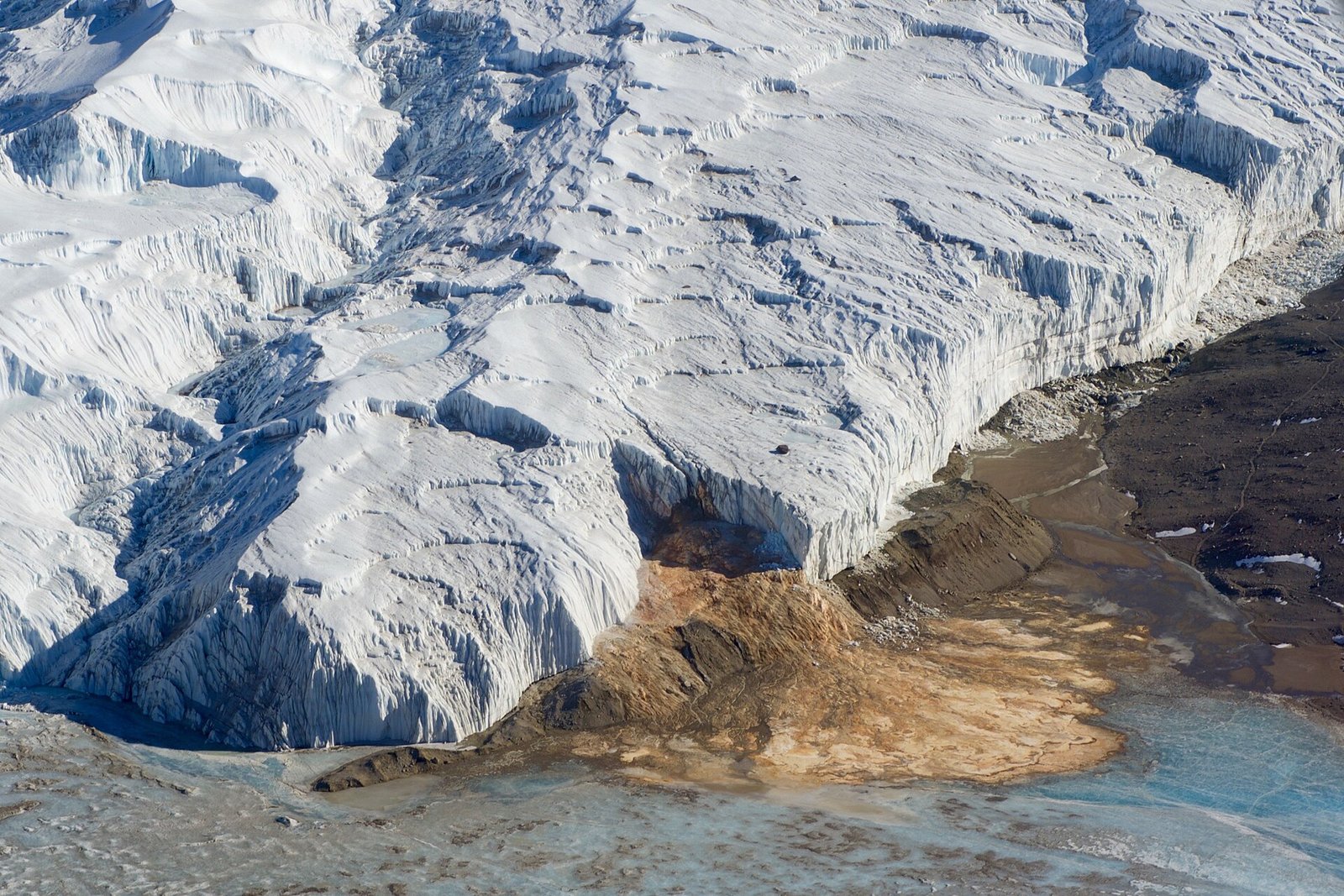
At the snout of Taylor Glacier, where the ice ends in a cliff above the frozen surface of West Lake Bonney, a red stain runs down the ice. The geologist Thomas Griffith Taylor, of Scott’s second expedition, found it in 1911; the valley carries his name. Early explorers put the colour down to red algae. It is not algae.
In 2009 Jill Mikucki and colleagues reported in Science that the water comes from a pool of ancient marine brine beneath the glacier, rich in iron and sulfate and almost without oxygen. Science’s own news report describes it as seawater trapped when the glacier closed off part of a fjord between 1.5 and 2 million years ago, now under about 400 metres of ice. It is not lifeless: the team found a community of at least 17 types of microbes living by cycling sulfur, with iron doing the work that oxygen does for us.
The colour itself was explained more recently. Ken Livi of Johns Hopkins University examined the solids in the water with transmission electron microscopes and found tiny iron-rich nanospheres, about a hundredth the size of a human red blood cell. They are not crystalline, which is why earlier searches for a red mineral missed them. The brine leaves the glacier clear. It turns red only when it meets the air, as its iron oxidises. The study appeared in Frontiers in Astronomy and Space Sciences in 2022, and Johns Hopkins announced it in June 2023.
The field notes
The valley of the dead, mostly
Scott was not impressed. “We have seen no living thing, not even a moss or lichen,” he wrote of the 1903 journey, in the lines quoted on the Long Term Ecological Research Network’s pages; “it certainly is the valley of the dead.” He was nearly right. The same pages note that the valleys do hold some moss and lichen, and algae wherever there is liquid water; Wikipedia’s account adds bacteria living inside rocks, sheltered from the dry air, and a 2013 survey of University Valley’s permafrost that detected no active microbial life at all.
Lakes with lids
For a desert, the valleys hold a great deal of water, most of it frozen. Wikipedia counts more than 6,000 lakes and ponds. For a few weeks each summer, glacier meltwater runs down streams such as the Onyx River, which Wikipedia calls Antarctica’s longest river, into lakes with no outlet to the sea, many capped with permanent ice. With nowhere to go, the water grows salty: some of the lakes are saltier than the Dead Sea, and the saltiest of all is little Don Juan Pond, in Wright Valley.
A rehearsal for Mars
The cold, dry ground made the valleys an early stand-in for Mars. Wikipedia’s account says geologists and astrophysicists have used them as a testing ground since NASA’s Viking programme in the 1970s. Blood Falls, with its buried, oxygen-poor brine and its microbes, is studied for what it suggests about life that might survive under the ice of other worlds.
Who may go where
Most of the valleys are open only to science. Within the managed area, protected areas under the Antarctic Treaty can be entered only with a permit; Blood Falls and the lower Taylor Glacier are one of them, Antarctic Specially Protected Area No. 172, designated in 2012 and revised in 2018 and 2023. Tourists and other non-governmental visitors are limited to the Taylor Valley Visitor Zone near the snout of Canada Glacier, a site chosen in consultation with the national programmes working in the area, tour operators and the International Association of Antarctica Tour Operators, and their visits must be coordinated with the national programmes in advance.
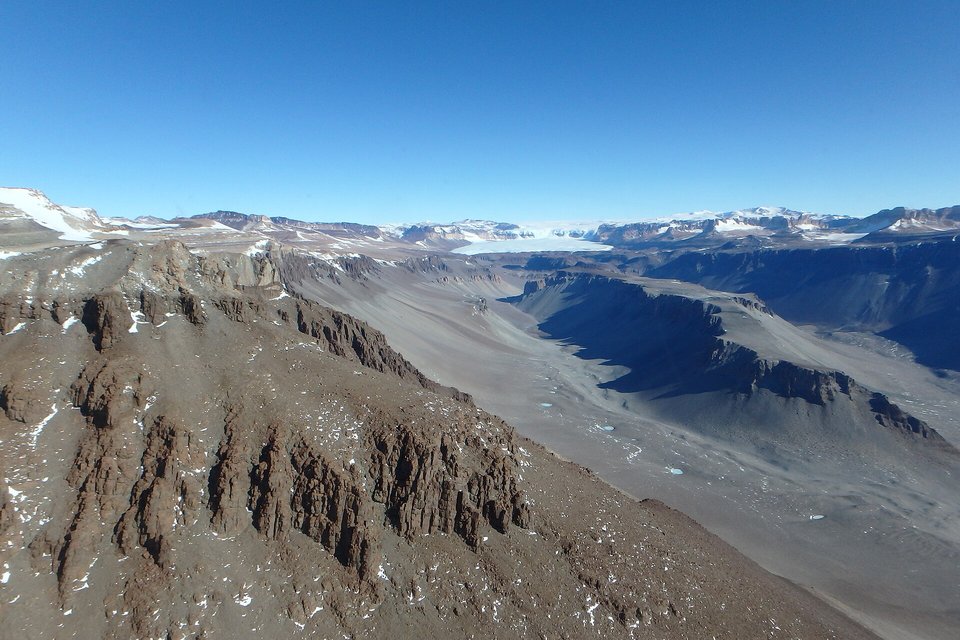
An ice-free valley floor in the South Fork of the upper Wright Valley, November 2014.
Photograph: US Embassy New Zealand · Public domain
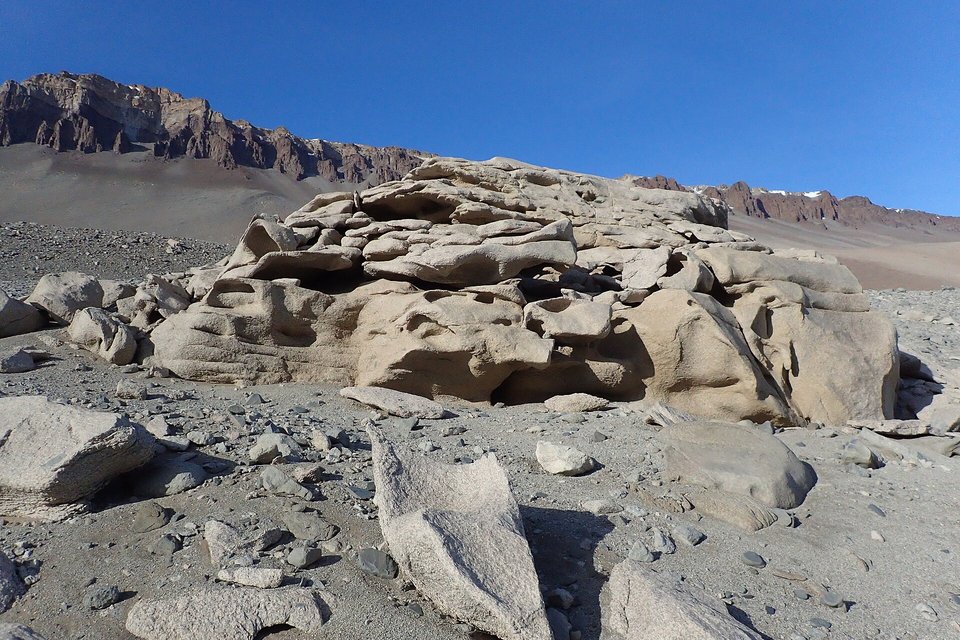
Wind-shaped boulders on the floor of the upper Wright Valley, January 2016.
Photograph: Pierre Roudier · Upper Wright Valley 2016 04 · CC BY 2.0 · cropped
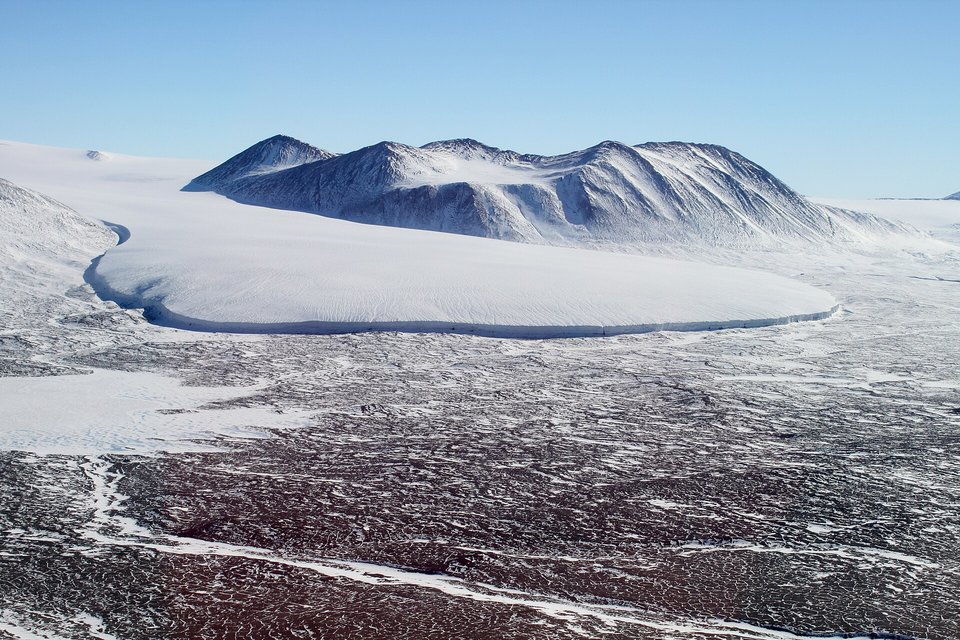
The Commonwealth Glacier ending in an ice cliff on the floor of Taylor Valley, November 2009.
Photograph: eliduke · Taylor Valley 2009 04 · CC BY-SA 2.0
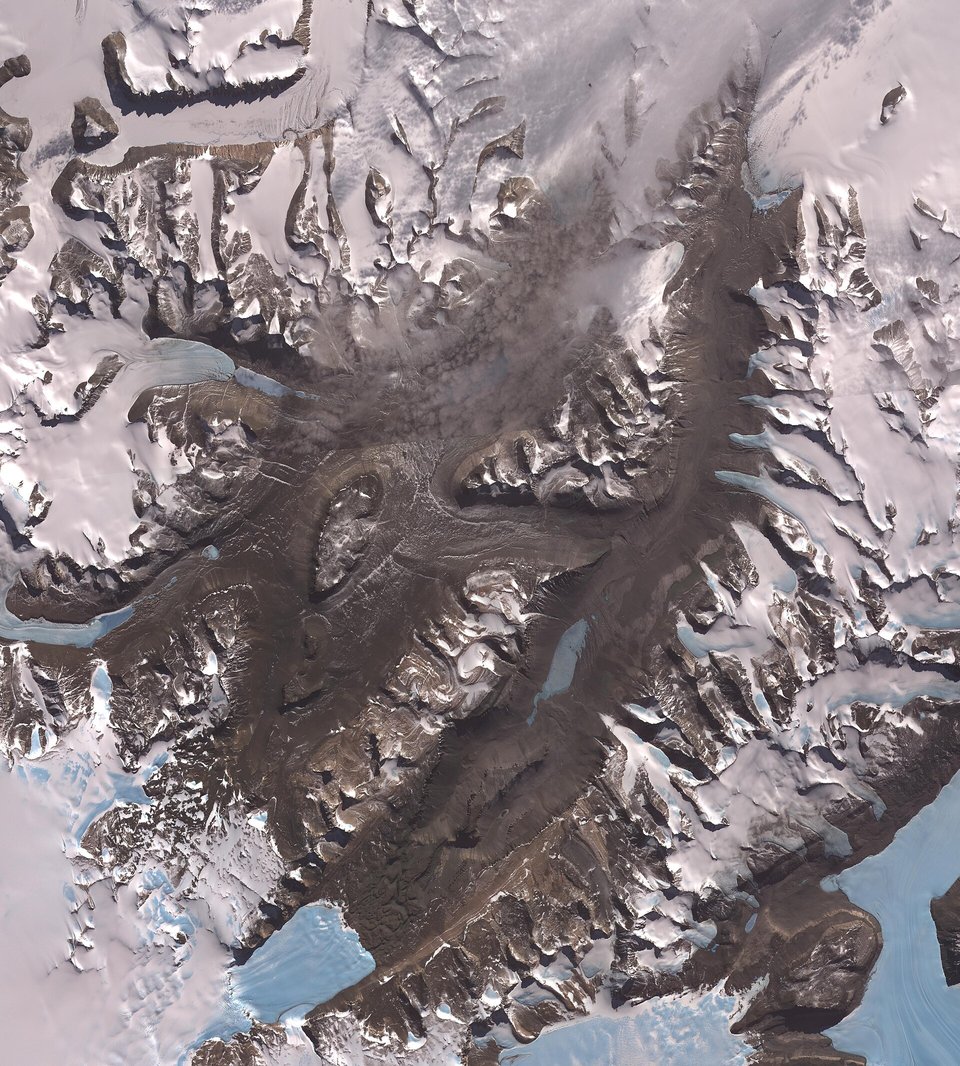
The Dry Valleys from orbit: brown, ice-free ground between the glaciers (ASTER satellite image, December 2009).
Satellite image: NASA/GSFC/METI/ERSDAC/JAROS, and U.S./Japan ASTER Science Team · Public domain
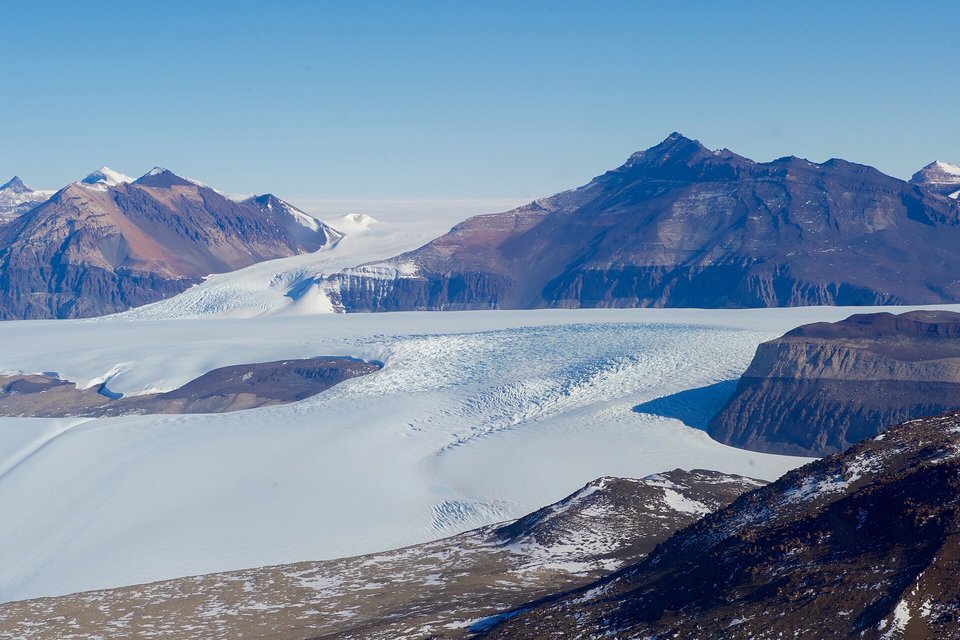
A glacier flowing between ridges into a section of the Dry Valleys, November 2016.
Photograph: U.S. Department of State · Public domain
- Step only where the guide steps, and nowhere else.
- Stand still for a while and listen to how little there is to hear.
- Look for the red stain far off up the ice, and be glad of it from where you are. Some places are for scientists and glaciers.
- Take ashore nothing you would mind carrying back, and carry everything back.
- Write down every living thing you see. (Wrote down the guide and myself. Left a space for the rock, which may yet surprise us.)
A piece of the red ice at Blood Falls. Where Taylor Glacier ends above West Lake Bonney, brine from beneath the ice seeps out through small cracks and stains the ice face and the frozen lake a rusty red. The brine is clear when it leaves the glacier; its iron turns red on meeting the air. The falls lie inside a specially protected area that can be entered only with a permit.
Tally, in the marginI had spent all week telling people, very gravely, that the glacier was bleeding. It turns out it was only blushing, and now so am I.
Getting there
How to get there. Only by expedition ship. A small number of Ross Sea voyages carry helicopters in the austral summer, and some of them, Oceanwide Expeditions’ among them, offer a landing in Taylor Valley when the weather and the national programmes allow. The Taylor Valley Visitor Zone, near Canada Glacier, is the only place in the Dry Valleys where tourist groups may land.
Blood Falls. The falls lie inside a protected area further up Taylor Valley from the visitor zone, and they are not a landing site for tourists.
What to book ahead. Ross Sea voyages are few and long; book as early as the operators allow, and treat a Dry Valleys landing as a hope rather than a promise, since it depends on the weather on the day. The operator arranges the approvals that Antarctic visits require.
Safety. The State Department has Antarctica at Level 2, exercise increased caution, because of extreme and unpredictable weather and limited emergency services, and there are no US consular services there. It recommends travelling with a professional guide or an organisation such as a member of the International Association of Antarctica Tour Operators, and buying insurance that covers medical evacuation.
Mark this place
Common questions
Where are the McMurdo Dry Valleys?
The McMurdo Dry Valleys are in southern Victoria Land, Antarctica, in the Transantarctic Mountains west of McMurdo Sound and the Ross Sea. The main valleys, from north to south, are Victoria, Wright and Taylor. Wikipedia gives their area as about 4,500 square kilometres, the largest ice-free region in Antarctica.
Why is there no ice in the McMurdo Dry Valleys?
The McMurdo Dry Valleys in Antarctica stay largely free of snow and ice because the Transantarctic Mountains block the flow of the ice sheet and cast a snow shadow, so precipitation averages only about 100 millimetres a year, and katabatic winds, dense cold air pouring downhill, strip away much of the snow that falls.
What is Blood Falls?
Blood Falls is a red outflow at the end of Taylor Glacier in the McMurdo Dry Valleys, Antarctica, where iron-rich brine from beneath the ice seeps onto the frozen surface of West Lake Bonney. The geologist Thomas Griffith Taylor found it in 1911. It lies inside Antarctic Specially Protected Area No. 172, designated in 2012.
Why is Blood Falls red?
The brine that feeds Blood Falls in Antarctica leaves Taylor Glacier clear and turns red when its iron oxidises in the air. Ken Livi of Johns Hopkins University found that the colour comes from tiny iron-rich nanospheres, which are not crystalline and so were missed by earlier searches for a red mineral; the study appeared in Frontiers in Astronomy and Space Sciences in 2022.
Is there life in Blood Falls?
Yes. In 2009 Jill Mikucki and colleagues reported in Science that the brine beneath Taylor Glacier in Antarctica, which feeds Blood Falls, holds a community of at least 17 types of microbes living almost without oxygen by cycling sulfur and iron. Science’s news report describes the brine as seawater sealed under about 400 metres of ice for 1.5 to 2 million years.
Can tourists visit the McMurdo Dry Valleys?
Yes, in a limited way. Under the management plan for the McMurdo Dry Valleys, Antarctic Specially Managed Area No. 2, tourists may land only in the Taylor Valley Visitor Zone near Canada Glacier, with visits coordinated in advance with the national programmes. A few Ross Sea expedition voyages carrying helicopters, including Oceanwide Expeditions’, offer such landings when weather allows.
Can you visit Blood Falls?
Not as a tourist. Blood Falls and the lower Taylor Glacier in Antarctica’s McMurdo Dry Valleys form Antarctic Specially Protected Area No. 172, which can be entered only with a permit. Tourist landings in the Dry Valleys are limited to the Taylor Valley Visitor Zone, further down the valley near Canada Glacier.
Are the McMurdo Dry Valleys the driest place on Earth?
Wikipedia describes the McMurdo Dry Valleys in Antarctica as the coldest and driest desert in the world, with average precipitation of about 100 millimetres a year, almost all of it snow. Recorded air temperatures there range from 12.0 °C at Taylor Glacier to −65.7 °C at Lake Vida, by Wikipedia’s account.