
- Where
- An enclave in Rome,
west of the Tiber - Coordinates
- 41.9024° N
12.4533° E - Area
- 0.44 km² (44 hectares);
the smallest state in the world - Created
- Lateran Treaty, signed
11 February 1929 - Border in the square
- A white stone line
between the colonnade’s ends - Status
- UNESCO World Heritage, 1984
(the whole state) - Entry
- Square and basilica free;
security check at the basilica
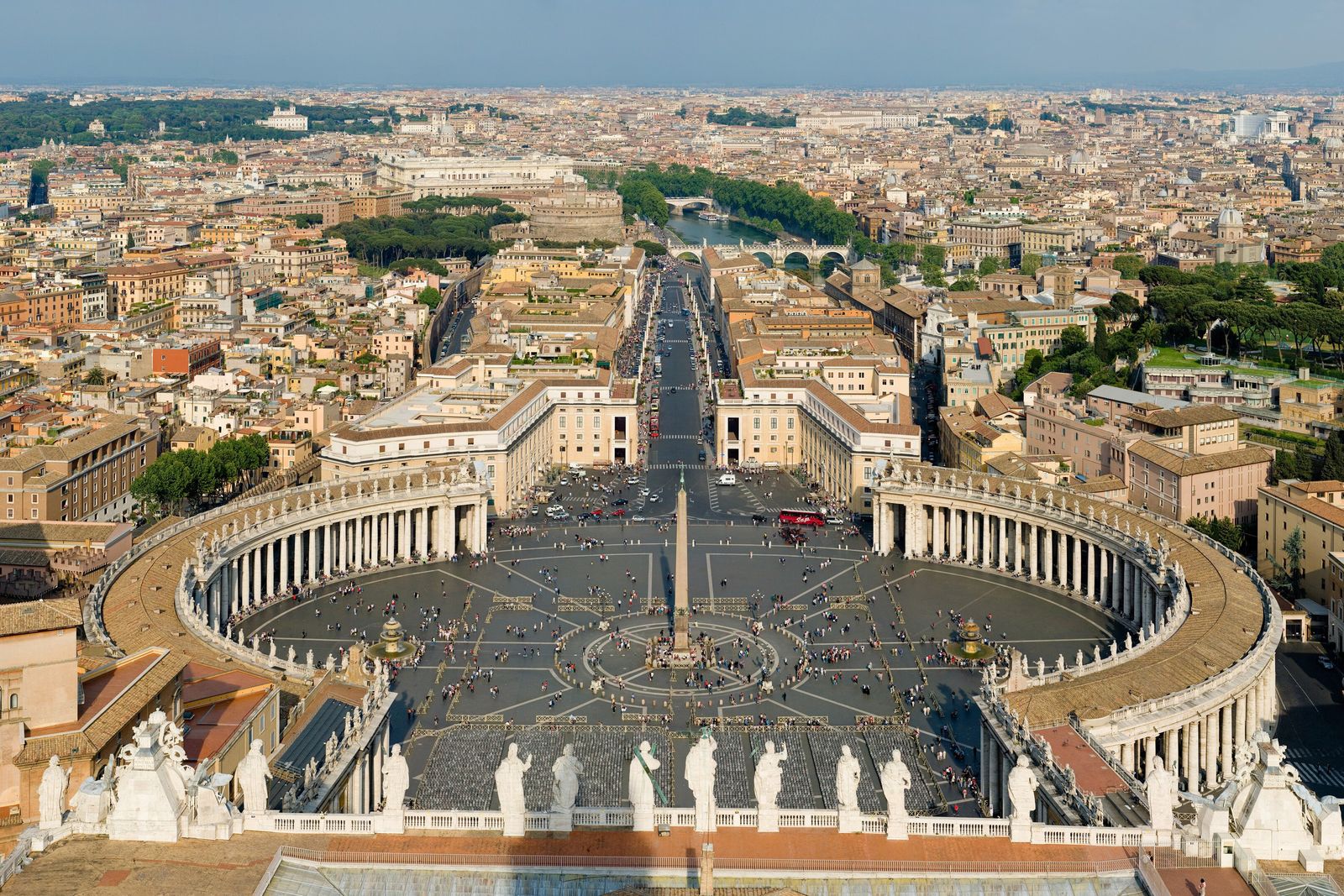
Came up a long straight street towards a great dome, and then the stone arms opened round me: rows and rows of columns, a needle of red stone in the middle. When the bells began, the whole crowd went quiet together. Somebody showed me a pale stripe in the paving and told me which side of it I was on. I stepped over it and back, very carefully.
The short answer
Vatican City is an independent state enclaved in the city of Rome, on the west bank of the Tiber, with the pope as its head of state. Its own government gives its area as 0.44 square kilometres, 44 hectares, which makes it the smallest state in the world; Wikipedia gives its population as about 882 in 2024. It was created by the Lateran Treaty between the Holy See and Italy, signed on 11 February 1929 and ratified on 7 June 1929, which ended the “Roman Question” opened when Italian troops took Rome in September 1870. Inside it stand St Peter’s Basilica, built between 1506 and 1626, the Apostolic Palace, the Sistine Chapel and the Vatican Museums. UNESCO inscribed it in 1984, and Wikipedia notes that it is the only World Heritage Site to consist of an entire state. Its borders are its walls, and, in St Peter’s Square, a white line in the paving.
Why it's worth knowing
Most borders are guarded. The Vatican’s best-known border is a strip of white stone. The state’s own account of its geography says that its territory includes St Peter’s Square up to the marble strip that joins the outer ends of the colonnade, and that this line marks the edge of the state on that side. It sits where the square meets Piazza Pio XII and the long avenue from the river. There is no gate on it, and no one asks for a passport.
The reason there is no gate is written into the treaty. Article 3 of the Lateran Treaty says that St Peter’s Square, although forming part of Vatican City, will continue to be normally open to the public and subject to the police powers of the Italian authorities, who stop at the foot of the steps leading up to the basilica and do not climb them unless they are asked in. When the Holy See holds particular ceremonies, the treaty has the Italian authorities withdraw beyond the outer lines of Bernini’s colonnade.
So on an ordinary day the square belongs to one country and is policed by another. Wikipedia describes it as one of the few places subject, on a normal day, to the police of two states: the Vatican’s own Gendarmerie and Italy’s. A visitor walking up from the river crosses an international frontier without noticing, and is watched over on the far side of it by the country they have just left.
The field notes
The line, and the road to it
The white line is easy to miss because the square’s paving is patterned with lines already: radiating strips of travertine break up the grey setts. The border strip runs straight across the open end of the square, between the two points where Bernini’s curving colonnades finish.
The approach to it is a monument to the same treaty. The Via della Conciliazione, the straight avenue from the Tiber to the square, was named for the reconciliation of 1929 and cut through the old Borgo quarter: Wikipedia’s account records that the block of buildings down its middle was demolished from October 1936, that almost all the buildings to its south went between 1937 and 1950, and that the avenue was finished for the Jubilee of 1950. Before that, visitors came into the square suddenly, out of narrow streets.
A needle older than the country
In the centre of the square stands the Vatican obelisk, a shaft of red Egyptian granite about 25 metres tall with no hieroglyphs on it. Pliny gives its origin as Heliopolis; it stood in Alexandria before the emperor Caligula had it brought to Rome in the first century AD and set on the central barrier of his circus, the Circus of Caligula and Nero, whose site is now mostly inside Vatican City. Christian tradition holds that Saint Peter was crucified in that circus.
The obelisk stood there for some fifteen centuries. On 10 September 1586, for Pope Sixtus V, the engineer Domenico Fontana moved it about 260 metres to where it stands now; Wikipedia’s account of the operation gives thirteen months of preparation, 800 men, 160 horses and 45 winches, and Fontana published his own account in 1590, which this entry could not consult. Wikipedia describes it as the only ancient obelisk in Rome that has never fallen. It had stood in Rome for about nineteen hundred years before the state around it existed.
In 1817, by Wikipedia’s account, round stones were set into the paving to mark the tip of the obelisk’s shadow at noon as the sun entered each sign of the zodiac, turning the needle into the pointer of a sundial the size of a square. The Vatican’s own guide to the square lists the sundial among its features.
The arms
Gian Lorenzo Bernini designed the square for Pope Alexander VII, almost a century after the obelisk was moved: an oval embraced by two curving colonnades of Tuscan columns, four deep, opening into a trapezoid in front of the basilica. The design had a practical brief, recorded as letting the greatest number of people see the pope give his blessing, and many constraints from buildings already on the site. Wikipedia quotes Bernini describing the colonnades as “the maternal arms of Mother Church”; this entry could not find the phrase in a primary source, and gives it as Wikipedia reports it.
Posting a card from another country
Vatican City has its own postal service, Poste Vaticane, set up on 13 February 1929, and has issued its own stamps since 1 August 1929; stamp sales help to fund the state. The Vatican’s governorate opened a new mobile post office in St Peter’s Square on 19 December 2024. A card posted there leaves from a different country from the one its sender slept in.
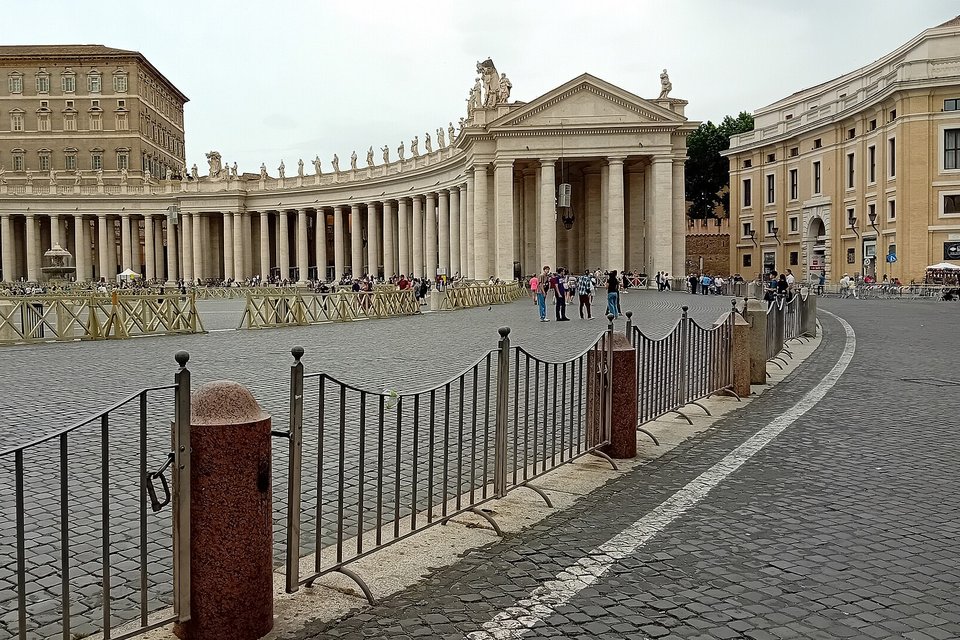
The pale strip across the paving at the end of the colonnade that marks the border between Vatican City and Italy, June 2024.
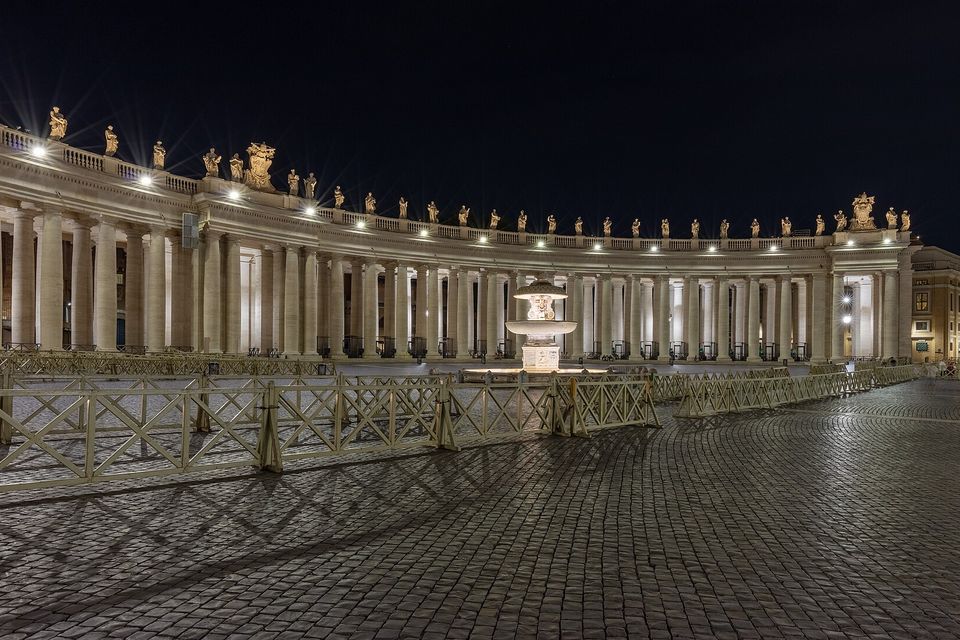
Bernini's colonnade at night, the square empty behind crowd barriers, September 2022.
Photograph: Diego Delso · CC BY-SA 4.0 · cropped
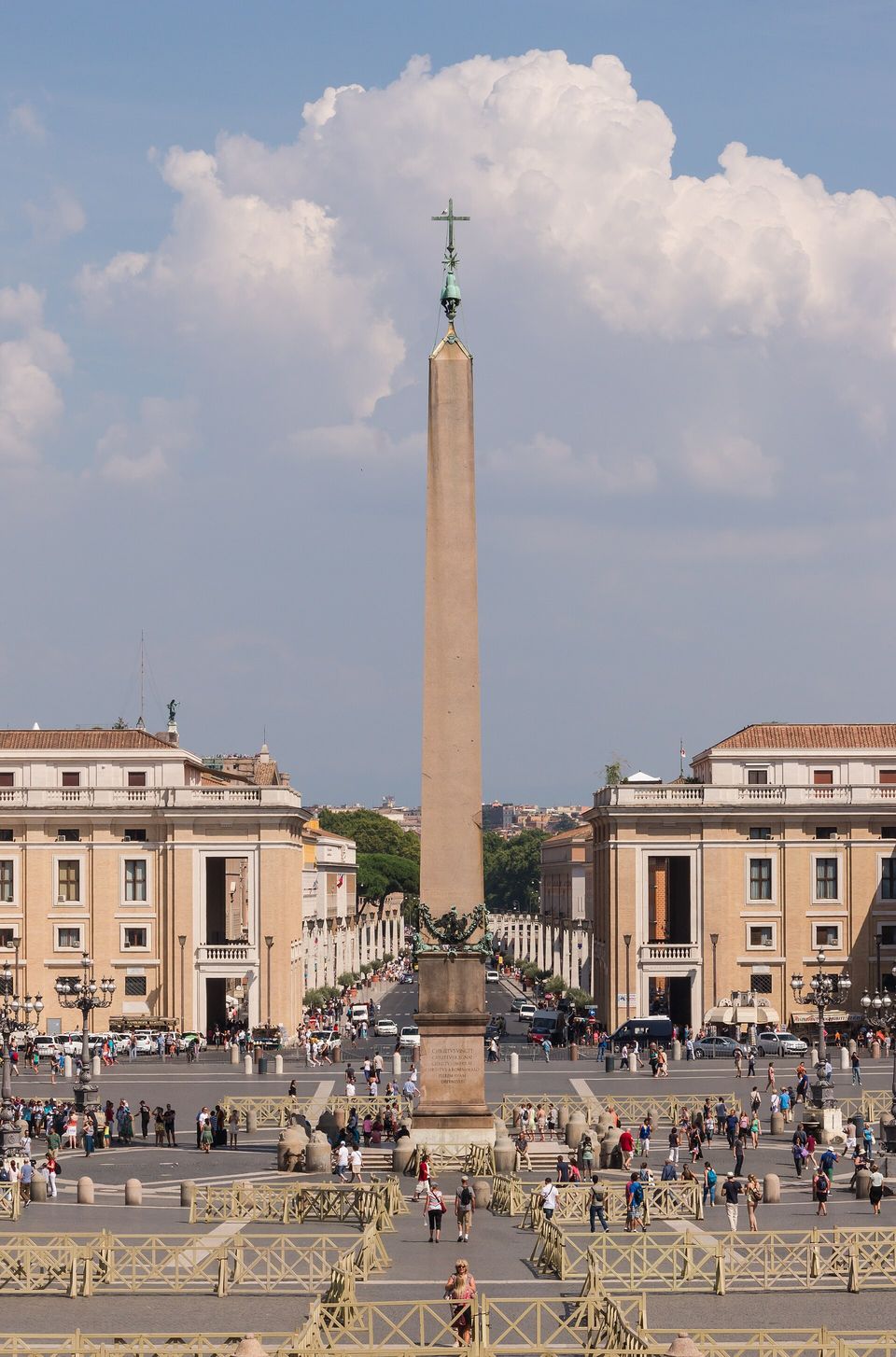
The obelisk at the centre of St Peter's Square, looking east down the Via della Conciliazione, August 2013.
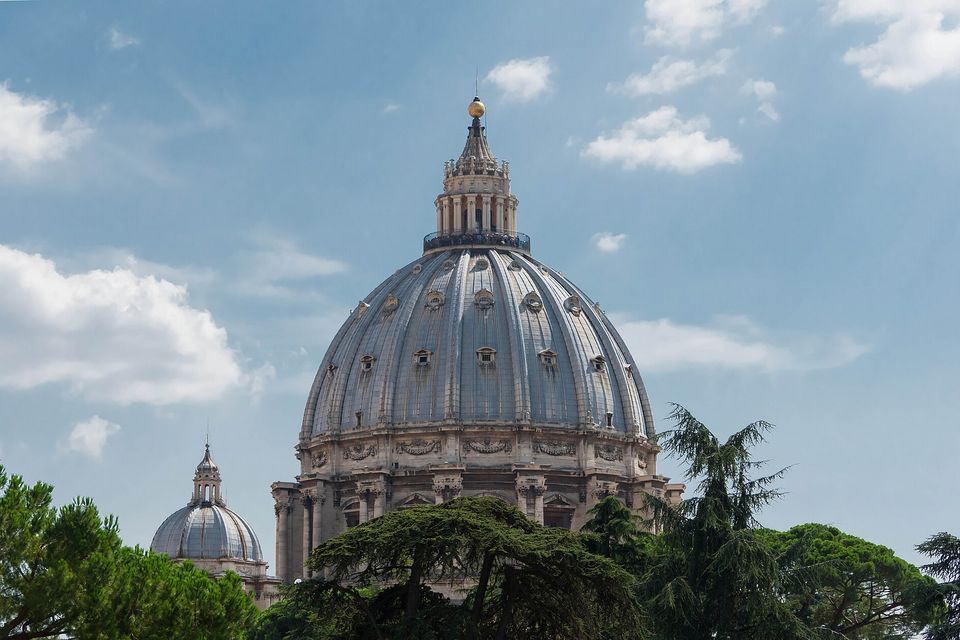
The dome of St Peter's above the trees, seen from the north, August 2013.
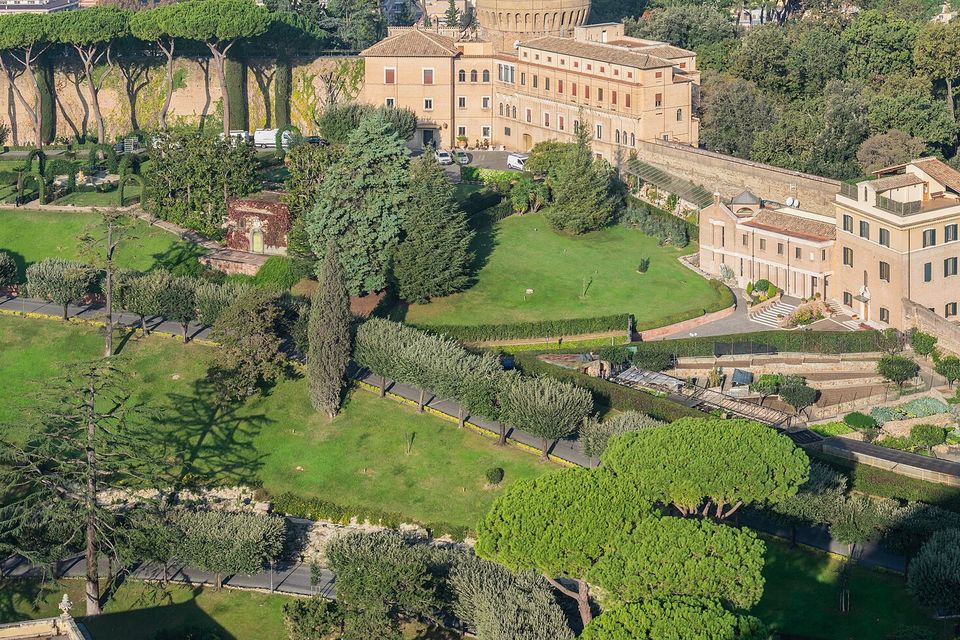
The Vatican Gardens seen from the dome roof: terraced lawns, clipped hedges and umbrella pines.
Photograph: Krzysztof Golik · CC BY-SA 4.0 · cropped
- Cover your shoulders and knees before you join the queue, not at the door. It is a church first.
- Find the pale line in the paving at the open end of the square, and cross it slowly, on purpose.
- Climb the dome on foot if your knees agree, and look back down into the arms of the square.
- Post a card home from the post office in the square, with the stamps they sell there.
- See the whole country before lunch. (Nearly managed it. Lunch was in another country.)
The white line across St Peter’s Square. A strip of white stone set into the paving across the open end of the square, joining the outer ends of Bernini’s colonnade where the square meets Piazza Pio XII. It is the state’s border on that side; everywhere else the walls do the job. There is no gate and no checkpoint on it, because the Lateran Treaty keeps the square normally open to the public, and the Italian police who keep order in the square on an ordinary day do so on the Vatican side of it.
Tally, in the marginA whole country’s front door, and it is a stripe in the paving with no door in it. I made a small ceremony of crossing it; nobody on either side so much as looked up, which is how I know it is a very good border.
Getting there
How to get there. Vatican City has no airport of its own; it is served by Rome’s airports, Fiumicino and Ciampino. The nearest metro station is Ottaviano – San Pietro – Musei Vaticani, on line A, a short walk from the square. The square itself is open and free, and there is no border control at the white line.
The basilica. Entry to St Peter’s Basilica is free, through a security check. The basilica’s official site asks for clothing suitable for a place of worship, with shoulders and knees covered, and allows only small bags. Booking is needed only for a guaranteed time slot, which carries a fee and includes an audio guide. The dome can be climbed: a lift goes as far as the terrace, and from there 320 steps lead to the top; without the lift, 231 steps reach the terrace first.
Ceremonies. Papal liturgies in the basilica and the square can draw from 15,000 to more than 80,000 people, and parts of both close for them. Check the basilica’s own calendar before planning a visit round a particular day.
The Museums are separate. The Vatican Museums and the Sistine Chapel have their own entrance and their own tickets, sold by the Museums. This entry does not cover them.
Safety. The State Department’s advisory feed carries no separate advisory for the Holy See. Italy, through which every visitor arrives, is at Level 2, exercise increased caution, because of terrorism, and the advisory names religious sites and tourist spots among the places attacks could target.
Mark this place
Common questions
Is Vatican City a country?
Yes. Vatican City is an independent state under the sovereignty of the Holy See, created by the Lateran Treaty between the Holy See and Italy, signed on 11 February 1929 and ratified on 7 June 1929. The pope is its head of state. It is enclaved entirely within the city of Rome, and with an area of 0.44 square kilometres it is the smallest state in the world.
Where is the border between Vatican City and Italy in St Peter’s Square?
In St Peter’s Square the border between Vatican City and Italy is a line of white stone set into the paving across the open end of the square, between the outer ends of Bernini’s colonnade, where the square meets Piazza Pio XII. The Vatican’s own description of its territory names this strip as the state’s edge on that side. There is no gate or checkpoint on it.
Who polices St Peter’s Square?
On an ordinary day the Italian police do. Article 3 of the 1929 Lateran Treaty says that St Peter’s Square, although part of Vatican City, stays normally open to the public and subject to the police powers of the Italian authorities, who stop at the foot of the basilica steps. During particular ceremonies of the Holy See the Italian authorities withdraw beyond the outer lines of the colonnade.
How big is Vatican City?
The government of Vatican City State gives its area as 0.44 square kilometres, or 44 hectares, which makes it the smallest state in the world by area. Wikipedia gives its population as about 882 residents in 2024, and more than half of its territory is gardens, which cover about 23 hectares.
How old is the obelisk in St Peter’s Square?
The Vatican obelisk in St Peter’s Square is ancient Egyptian, of red granite and uninscribed; Pliny gives its origin as Heliopolis. The emperor Caligula brought it to Rome in the first century AD for his circus. Domenico Fontana moved it about 260 metres to its present place on 10 September 1586, and it is the only ancient obelisk in Rome that has never fallen.
Is it free to enter St Peter’s Basilica?
Yes. Entry to St Peter’s Basilica in Vatican City is free, through a security check, and the basilica’s official site asks visitors to cover their shoulders and knees and to bring only small bags. Climbing the dome is ticketed: a lift reaches the terrace, and 320 steps lead from there to the top.
Can you send post from Vatican City?
Yes. Vatican City runs its own postal service, Poste Vaticane, founded on 13 February 1929, and has issued its own stamps since 1 August 1929. A mobile post office opened in St Peter’s Square on 19 December 2024. Mail sent from it carries Vatican stamps and is posted from Vatican City rather than from Italy.
Why was Vatican City created?
Vatican City was created to end the “Roman Question”. After Italian troops took Rome in September 1870, the popes refused the use of the Vatican without sovereignty that Italy offered in 1871. The Lateran Treaty of 1929 recognised the Holy See’s full sovereignty over a small new state, in the words of the Vatican’s own history to guarantee it an “absolute and visible independence”.