
Part of The US National Parks
- Where
- Northern Arizona,
United States - Coordinates
- 36.0570° N
112.1400° W - Size
- 277 river miles (446 km) long;
up to 18 miles (29 km) wide - Depth
- About a mile (1,857 m)
at its deepest - Rocks
- Oldest about 1.84 billion years;
rim limestone about 270 million - Status
- National park 1919;
UNESCO World Heritage 1979 - Best visited
- South Rim all year;
North Rim in summer
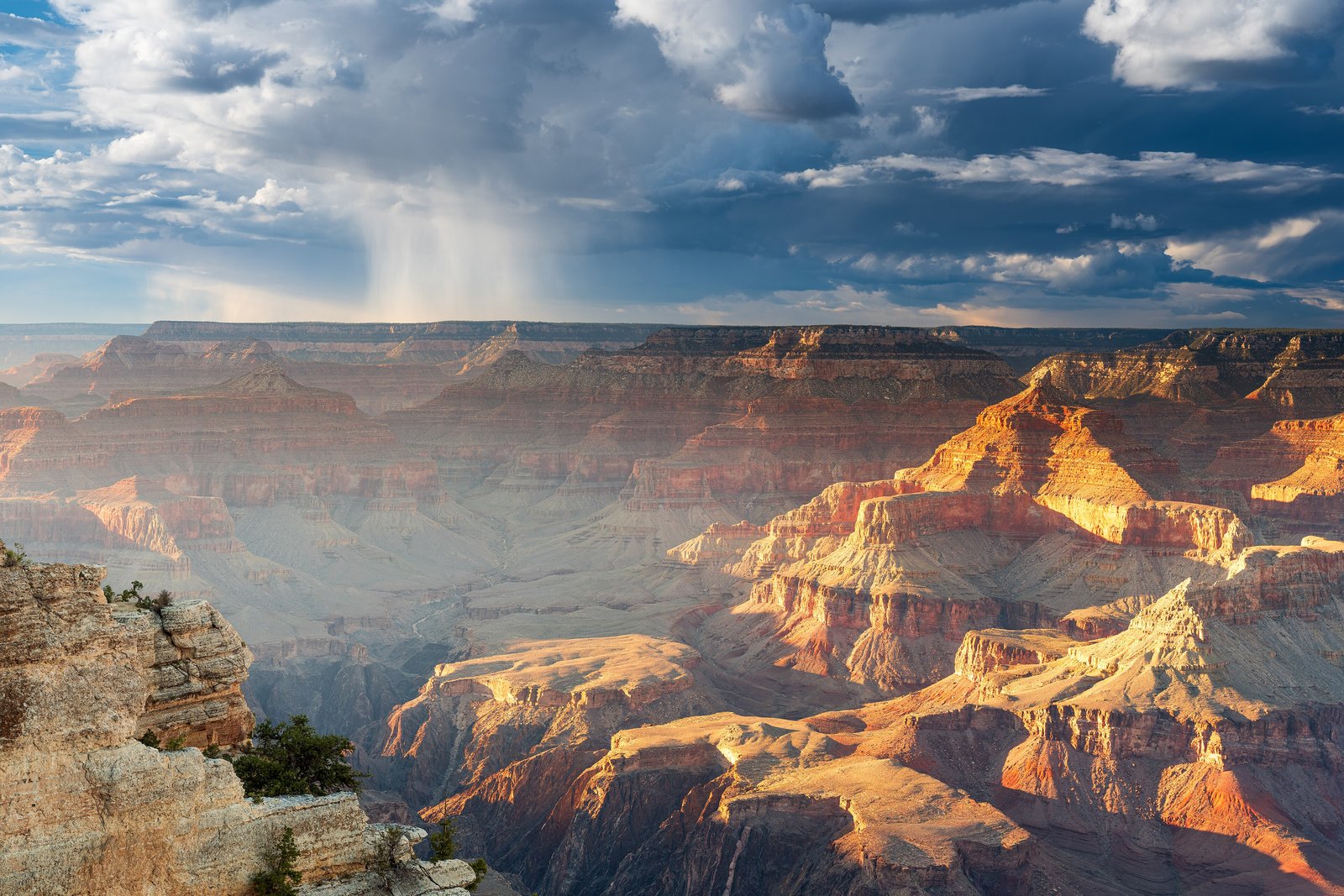
Walked out of a pine wood at first light, frost still on the path, and the ground stopped. Below me stripes of red and cream and grey went down and down, to a thin green thread of river I could see and could not hear. A very large black bird went by underneath my feet. I sat on a low wall and forgot about breakfast entirely.
The short answer
The Grand Canyon is a gorge cut by the Colorado River through the Colorado Plateau in northern Arizona. The National Park Service gives it as 277 river miles long, up to 18 miles wide and nearly a mile deep; its deepest point is about 1,857 metres below the rim. The walls expose flat-lying layers of rock that record nearly two billion years, from the Vishnu basement rocks at the bottom, about 1.84 billion years old by the Park Service’s figures, to the Kaibab Limestone at the rim, about 270 million. The park was created by Act of Congress in 1919, and UNESCO inscribed it as a World Heritage Site in 1979. Eleven tribes are traditionally associated with the canyon, and parts of its rim are Havasupai, Hualapai and Navajo land. The South Rim is open all year; the North Rim, higher and colder, opens for the summer season.
Why it's worth knowing
The rocks of the Grand Canyon are among the best-dated on Earth. The canyon cut through them is not, and the disagreement is not a footnote: it has run through the pages of Science and Nature Geoscience for more than a decade.
In 2012 Rebecca Flowers of the University of Colorado Boulder and Kenneth Farley of Caltech measured helium in grains of apatite from the canyon’s rocks. Helium builds up in the mineral only once the rock has cooled on its way towards the surface, so it records when erosion stripped away the rock above. Their reading was that the western Grand Canyon had been cut to within a few hundred metres of its present depth by about 70 million years ago, when dinosaurs were still alive.
In 2014 Karl Karlstrom of the University of New Mexico and colleagues published the opposite reading in Nature Geoscience, from the same kind of evidence taken from the canyon floor and from the rim 1,500 metres above it. Their answer was that most of the canyon a visitor sees has been carved in the last 5 to 6 million years, when the Colorado River found its present course and joined up older, partly carved paleocanyons of different ages. Some of those segments, in their account, are ancient: one formed 70 to 50 million years ago, another 25 to 15 million. That is the position the National Park Service takes.
In April 2026 a team led from the U.S. Geological Survey added a third line. Dating zircon grains in lake deposits east of the canyon, J. J. He, Ryan Crow and colleagues reported in Science that sand carrying the Colorado River’s signature had reached a basin at the head of the canyon by 6.6 million years ago, and argued that a lake there, Lake Bidahochi, eventually spilled over and set the river on its course through the canyon. Karlstrom, as Scientific American reported, accepts that an early Colorado River reached that basin but is not persuaded that it made a large lake, or that the lake cut the canyon. The rocks are nearly two billion years old; how long the hole has been there is still an open question.
The field notes
Old rock, young hole
The Park Service divides the canyon’s rocks into three sets. At the bottom are the Vishnu basement rocks, metamorphosed and stood on end. Above them, in places, lie the tilted layers of the Grand Canyon Supergroup. Over both lie the flat Paleozoic layers that make the famous stripes, ending at the rim in the Kaibab Limestone.
Between the basement and the flat layers is the Great Unconformity, the contact John Wesley Powell described, where the vertical grain of the old rock meets the horizontal beds above it and a great deal of time is missing. The Park Service’s own summary puts the paradox plainly: the rock layers span nearly two billion years of Earth history, while the canyon landscape has been carved in only the past 5 to 6 million.
Three answers and their parties
An old canyon. Flowers and Farley, Science, published online on 29 November 2012, used apatite helium thermochronology. Their model had the western canyon cooling, and so being cut, to near its modern depth by about 70 million years ago. The paper drew formal comments in Science, one of them from Karlstrom’s group, and a reply from the authors.
A young canyon from old pieces. Karlstrom and colleagues, “Formation of the Grand Canyon 5 to 6 million years ago through integration of older palaeocanyons”, Nature Geoscience, 2014. The University of New Mexico summarised it as the “paleocanyon solution”: older canyons existed along parts of the route and were reused and deepened once the through-going river arrived.
A lake that spilled. He, Crow and colleagues, “Late Miocene Colorado River arrival in the Bidahochi basin supports spillover origin of Grand Canyon”, Science 395, 2026, pp. 285–295, announced by the USGS on 16 April 2026 with the Arizona Geological Survey, UCLA and Paradise Valley Community College. The lake basin they sampled lies east of Flagstaff, mostly on Navajo land. The study dates the arrival of the river’s sediment; that the lake’s spillover cut the canyon is the authors’ argument, and Karlstrom’s doubts are on record.
None of these teams says the rocks are young, and none says the canyon was cut in one event. The argument is about when the river began cutting the gorge people stand at the edge of today, and how.
Walking time on the rim
Between the Yavapai Geology Museum and Grand Canyon Village, the paved Rim Trail doubles as a timeline. The Trail of Time, built by the University of New Mexico and the park with a grant from the National Science Foundation and finished in 2010 after fifteen years of work, runs 4.56 kilometres, one metre for every million years of Earth’s history. Karlstrom and his colleague Laura Crossey led the planning.
Rock samples brought up from the canyon, many collected by river, are set out along it at their ages. Walking west, a visitor goes back in time a million years a step, to the oldest rock in the canyon near its end. The carving of the canyon itself, on the park’s dating, takes up the first six steps.
Whose canyon
The Park Service lists eleven traditionally associated tribes: the Havasupai Tribe, the Hualapai Tribe, the Hopi Tribe, the Navajo Nation, the Pueblo of Zuni, the Yavapai-Apache Nation, the Kaibab Band of Paiute Indians, the Las Vegas Paiute Tribe, the Moapa Band of Paiutes, the Paiute Indian Tribes of Utah and the San Juan Southern Paiute Tribe. The park’s own pages call it a sacred canyon to them, with places of origin, prayer and pilgrimage in and around it.
The canyon and its rims are not all park. The Havasupai and Hualapai reservations and the Navajo Nation hold parts of the rim and the inner canyon, and each sets its own rules for visitors.
The North Rim after the fire
On 4 July 2025 lightning started the Dragon Bravo Fire on the North Rim. By the Park Service’s account it burned about 149,000 acres, more than 71,000 of them on the North Rim, and destroyed about 70 structures, among them the historic Grand Canyon Lodge and the North Rim Visitor Center. The North Rim reopened for the 2026 summer season on 15 May 2026, with its paved roads and the North Kaibab Trail open, but with no overnight lodging inside the park this season.
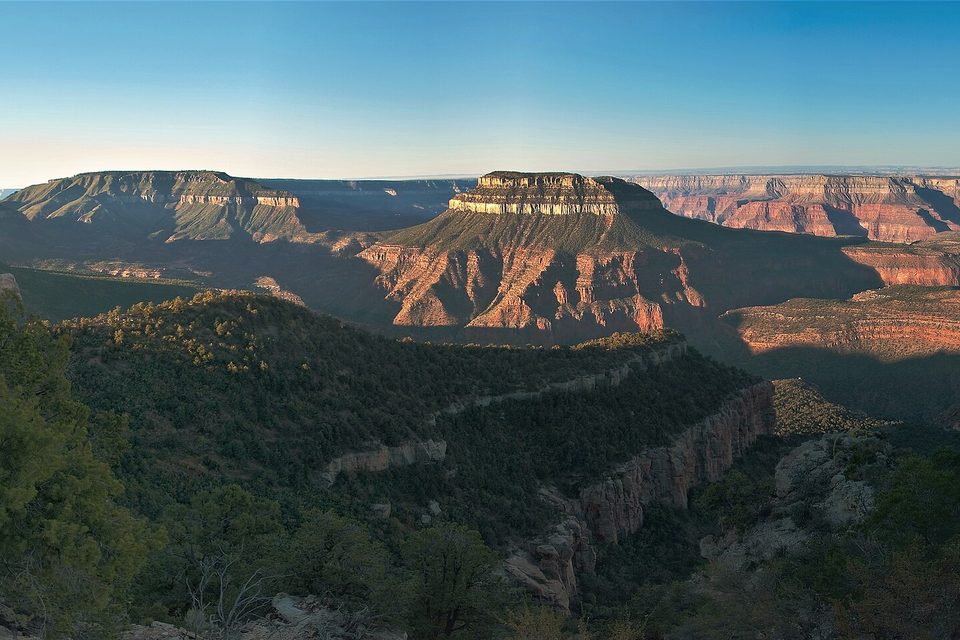
The North Rim at Steamboat Mountain in early light, September 2010.
Photograph: Deborah Lee Soltesz · CC0 · cropped
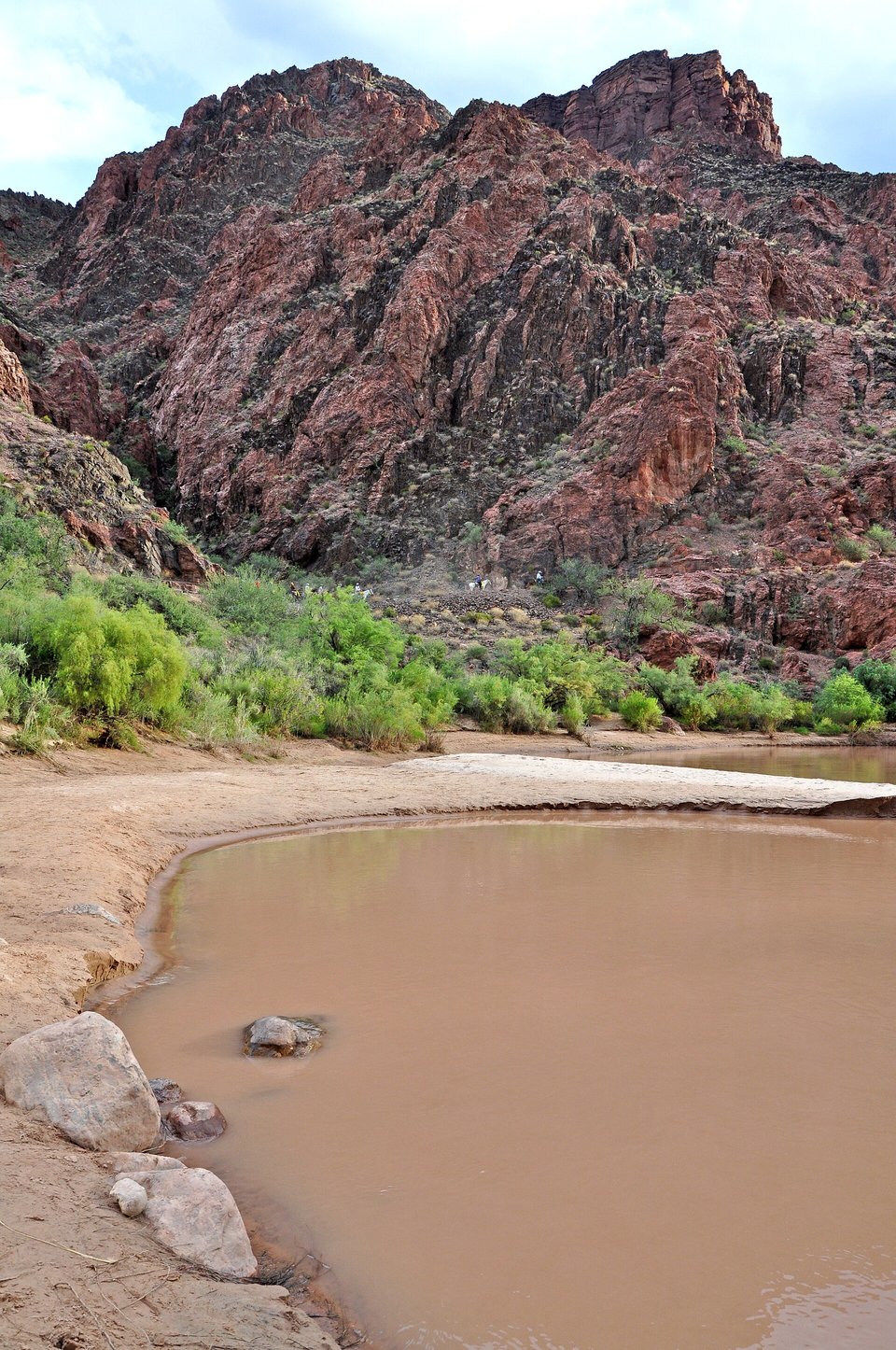
The Colorado River at Boat Beach near Phantom Ranch, below the canyon's dark basement rocks, September 2011.
Photograph: Grand Canyon National Park (NPS) · Grand Canyon National Park Phantom Boat Beach 0620 (6704337391) · CC BY 2.0
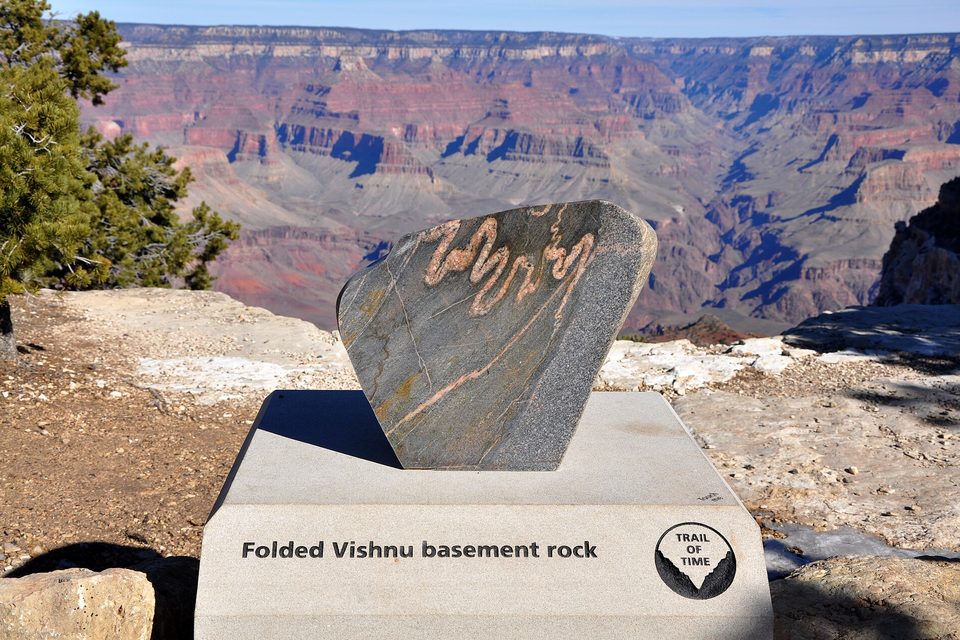
A polished piece of folded Vishnu basement rock on a Trail of Time marker at the South Rim, January 2011.
Photograph: Erin Whittaker, National Park Service · Public domain · cropped
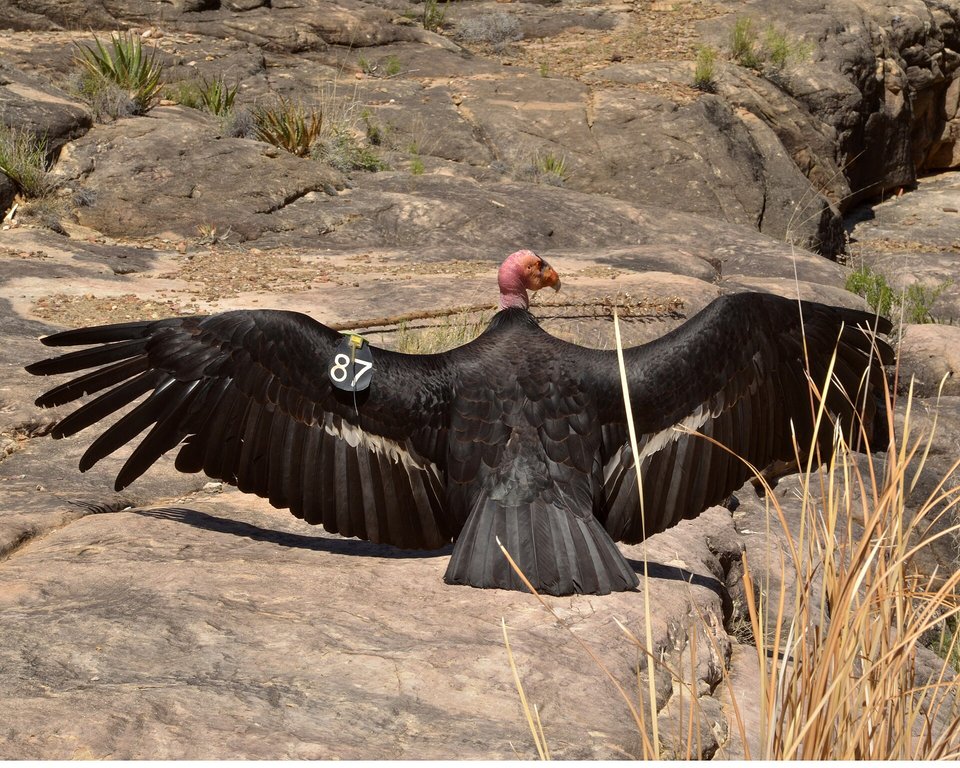
California condor number 87 spreading its wings by Pipe Creek on the Tonto Trail (NPS photograph).
Photograph: Grand Canyon National Park (NPS) · Grand Canyon National Park California Condor 87 3462 (5735691958) · CC BY 2.0
- Come to the edge early, before the buses, and let your eyes take their time. They will need it.
- Walk the path along the rim that counts time in steps, and notice how few of them the hole takes.
- Go down only as far as you are willing to climb back up, and carry more water than seems sensible.
- Remember that people prayed here long before anybody measured it, and still do. Speak quietly at the edge.
- Work out how old it is. (Item handed back to the geologists, who were arguing about it before I arrived and were still at it when I left.)
The first six steps of the Trail of Time. On the South Rim, the University of New Mexico and the park laid out Earth’s history along the Rim Trail at a metre for every million years, with rocks from the canyon set at their ages. On the park’s dating, the whole carving of the Grand Canyon fits in the first six metres from the start near the Yavapai Geology Museum; the rocks it cut through take most of the rest of the walk. Had Flowers and Farley’s date been the one used, the western canyon would have begun some seventy steps along. Most people walk the six without noticing them, on their way to the old rock.
Tally, in the marginA handful of steps for the whole canyon, and a morning’s walk for the stone it was cut through. I hurried past the handful looking for where things began, and had to go back.
Getting there
How to get there. The South Rim, where most visitors go, is open all year and is reached by road through the gateway towns of Flagstaff and Williams in Arizona; the nearest large airports are Phoenix and Las Vegas. Inside the park, free shuttle buses link the village, the viewpoints and the Rim Trail. The North Rim is a separate trip, a long drive around the canyon, and opens only for the summer season; for 2026 it has no lodging inside the park.
What it costs. The park charges an entrance fee. Since 1 January 2026, visitors who are not U.S. residents and are 16 or over also pay a $100 per-person nonresident fee at Grand Canyon, one of eleven heavily visited parks where it applies, unless they hold the $250 America the Beautiful nonresident annual pass. Check the park’s own fees page before you go.
Going below the rim. The Park Service does not recommend hiking to the river and back in a day, and summer heat in the inner canyon has killed hikers. Temperatures near the river can pass 38 °C in summer while the rim is mild. Carry water and salty food, turn around early, and remember the climb out is the hard half. Overnight trips below the rim need a backcountry permit from the park, applied for in advance.
When to go. Spring and autumn are the easiest seasons for walking. Winter brings snow to the South Rim and closes the North Rim. The Trail of Time is on the paved Rim Trail and suits any season.
Mark this place
Common questions
How old is the Grand Canyon?
The rocks exposed in the Grand Canyon span nearly two billion years, from Vishnu basement rocks about 1.84 billion years old to the Kaibab Limestone at the rim, about 270 million. The canyon itself is younger and its age is disputed: the National Park Service and Karl Karlstrom’s group date most of it to the last 5 to 6 million years, while Flowers and Farley argued in 2012 that the western canyon was near its present depth 70 million years ago.
How deep and how long is the Grand Canyon?
The National Park Service gives the Grand Canyon as 277 river miles (446 km) long, up to 18 miles (29 km) wide and nearly a mile deep; its deepest point is about 1,857 metres. The Colorado River runs along its floor for the whole length inside Grand Canyon National Park, which covers more than a million acres of northern Arizona.
What did Flowers and Farley find about the Grand Canyon?
Rebecca Flowers of the University of Colorado Boulder and Kenneth Farley of Caltech reported in Science in November 2012 that helium in apatite grains showed the western Grand Canyon had been cut to within a few hundred metres of its modern depth by about 70 million years ago. Karl Karlstrom’s group disputed the reading in a formal comment, and the authors replied.
What is the paleocanyon explanation of the Grand Canyon?
In Nature Geoscience in 2014, Karl Karlstrom of the University of New Mexico and colleagues argued that the Grand Canyon formed 5 to 6 million years ago when the Colorado River joined up and deepened older paleocanyons of different ages. In their account one segment formed 70 to 50 million years ago and another 25 to 15 million, which reconciles some old dates with a young canyon.
What is the Lake Bidahochi theory of the Grand Canyon?
In April 2026 a U.S. Geological Survey-led team, J. J. He, Ryan Crow and colleagues, reported in Science that Colorado River sediment reached the Bidahochi basin east of the Grand Canyon by 6.6 million years ago. They argued that a lake there spilled over and helped set the river’s course through the canyon. Karl Karlstrom, as Scientific American reported, doubts that the lake was large or that it cut the canyon.
Is the North Rim of the Grand Canyon open after the Dragon Bravo Fire?
Yes, for summer 2026. The Dragon Bravo Fire, started by lightning on 4 July 2025, destroyed about 70 structures on the Grand Canyon’s North Rim, including the historic Grand Canyon Lodge. The National Park Service reopened the North Rim on 15 May 2026 with roads and the North Kaibab Trail open, but with no overnight lodging inside the park that season.
Do foreign visitors pay more to enter Grand Canyon National Park?
Yes. Since 1 January 2026, non-U.S. residents aged 16 and over pay a $100 per-person nonresident fee at Grand Canyon National Park on top of the standard entrance fee, unless they hold the $250 America the Beautiful nonresident annual pass. The National Park Service applies the fee at eleven of its most visited parks, Yellowstone among them.
Which tribes are associated with the Grand Canyon?
The National Park Service lists eleven tribes traditionally associated with the Grand Canyon: the Havasupai, Hualapai and Hopi tribes, the Navajo Nation, the Pueblo of Zuni, the Yavapai-Apache Nation, and five Paiute tribes and bands, including the Kaibab Band of Paiute Indians. Parts of the canyon and its rims lie within the Havasupai and Hualapai reservations and the Navajo Nation.