The short answer
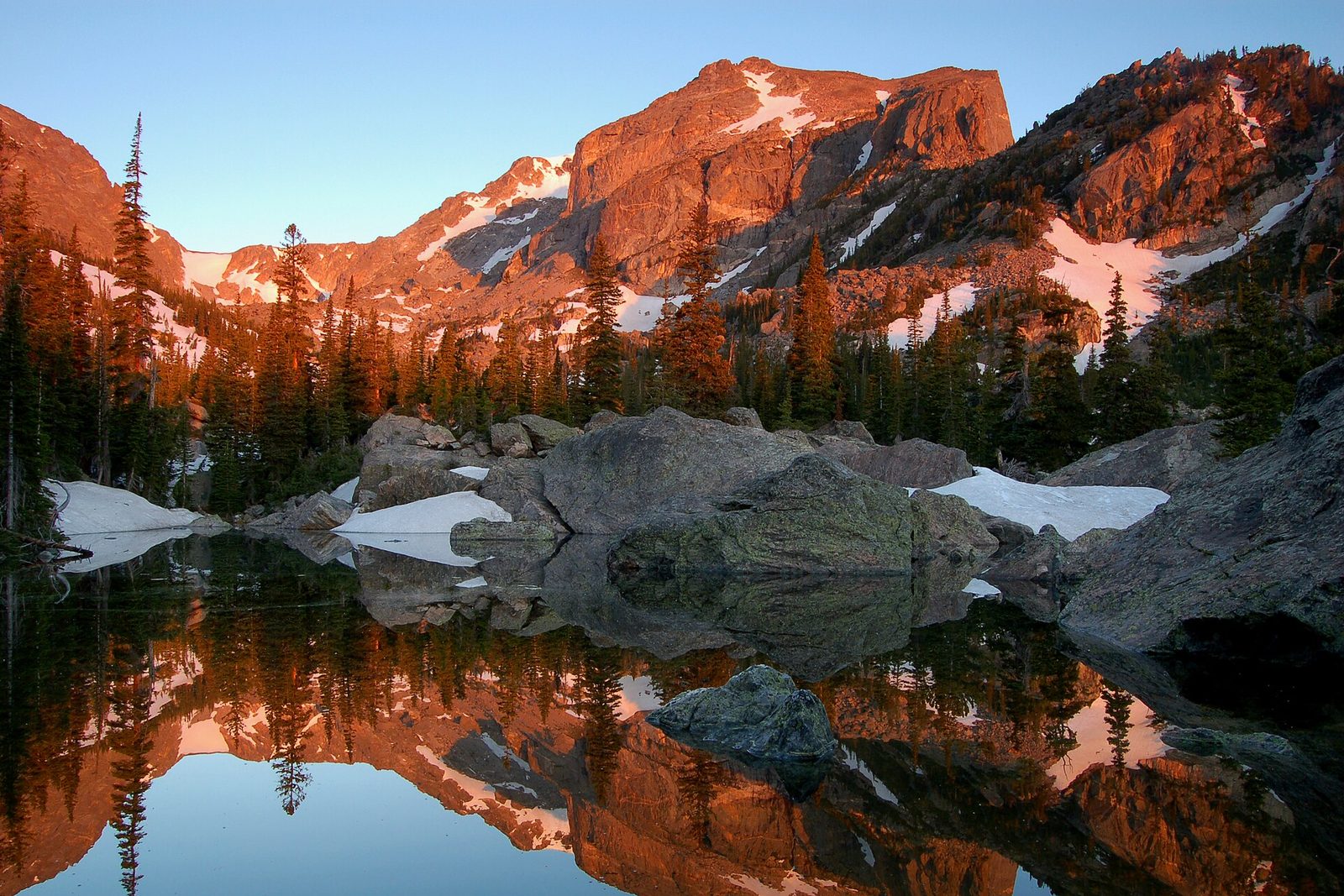
Rocky Mountain National Park lies in the Front Range of northern Colorado, about an hour and a half by road north-west of Denver, with the town of Estes Park at its eastern gate and Grand Lake at its western. It is one of the highest national parks in the country, from 7,860 feet in its valleys to 14,259 feet, with sixty peaks above 12,000 feet. The Continental Divide runs north to south through it. Ancient glaciers carved its bowls and valleys, leaving meadows and lakes, and one of the highest roads in the country, Trail Ridge Road, crosses it. President Woodrow Wilson signed the act that created it on January 26, 1915.
From Tally’s diary
The meadow had gone gold and the evening air was cold enough to see my breath, and from the edge of the trees came a sound like somebody trying to play a rusty flute while falling down the stairs. Then a great antlered head lifted out of the grass. I kept very still and very far away, and listened to the whole concert.
Inside the park
- Trail Ridge Road
The road that crosses the park over the alpine tundra, eleven miles of it above the trees.
Photograph: DXR, CC BY-SA 4.0, cropped

Why it's worth knowing
Denver to Alaska, in one park. The park holds as much change of landscape as a drive from Denver to northern Alaska: broad meadow valleys below about 9,500 feet, the montane zone, where life is richest; evergreen forest and cold mountain lakes in the subalpine zone up to about 11,000 feet; and above that the alpine tundra, where plants hug the ground and the wind rarely stops. More than 140 kinds of butterfly flit across all three.
The bugle in the meadow. Elk are one of the largest members of the deer family: a big bull can weigh 700 to 1,000 pounds and stand five feet at the shoulder, and his antlers can grow as much as an inch a day in spring. They can be seen at any time of year in the meadows and where meadow meets forest, but the autumn rut, the mating season, is when the bulls bugle. To give them room in the mating season, several meadows, among them Moraine Park and Horseshoe Park, close to people on foot from 5 p.m. to 10 a.m. each day.
Ten thousand years of crossing. People first came into these valleys some 11,000 years ago. The Ute favoured the green valleys, tundra meadows and lakes, though they never lived here all year round, and dominated the area until the late 1700s. Explorers from the East thought the Rockies here impassable, but the Ute and Arapaho had long crossed the range on foot, and the park’s two roads over the mountains follow their general routes. Major Stephen Long, after whom Longs Peak is named, steered well clear of these mountains on his expedition of 1820.
The field notes
A lady’s life in the Rocky Mountains
In the early 1870s the English traveller Isabella Bird heard in Hawaii of a place said to be “the most beautiful country in all of the Americas,” and set off for Estes Park. She stayed in a cabin on Fish Creek, roamed the valley with a mountain man and outlaw known as “Rocky Mountain Jim”, and became the second woman known to climb Longs Peak, a month after Anna Dickinson. Her letters home became A Lady’s Life in the Rocky Mountains, published in 1879 and so popular in Britain that it went on to France.
The man who wanted a park
Enos Mills was a naturalist, nature guide and lodge owner at Longs Peak who, from 1909, campaigned for a national park here: lecturing across the country, writing thousands of letters and articles and lobbying Congress. Most civic leaders were on his side, with the Denver Chamber of Commerce and the Colorado Mountain Club; mining, logging and farming interests mostly were not. A local society had already been warning that “those who pull flowers up by the roots will be condemned by all worthy people.” In January 1915 Mills got his park, the country’s tenth.
Two kinds of pika
Up among the boulders above the trees, a high-pitched “eek” is usually the first sign of a pika, a small, round-eared relative of the rabbit that looks more like a hamster, six or seven inches long. Pikas do not hibernate. All summer they gather plants for the winter and tunnel under the snow to reach them. Rocky Mountain National Park is unusual in being the place where two subspecies, a northern and a southern, meet and interbreed. Because pikas are so sensitive to summer heat and to winters without enough insulating snow, the park watches them as an early sign of a changing climate.

August 2018Bear Lake at first light.
Photograph: NPS / M. Reed, Public domain, cropped

September 2017The inlet of Sprague Lake under a storm sky.
Photograph: Christian Collins, Sprague Lake inlet, CC BY-SA 2.0

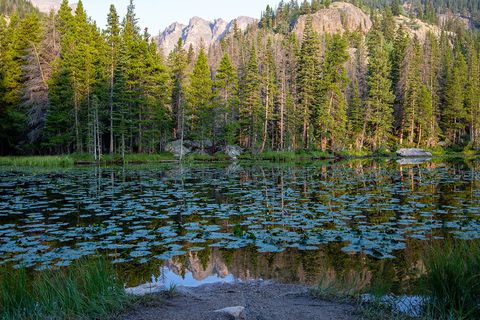
August 2018Lily pads on a lake below the crags.
Photograph: NPS / M. Reed, Public domain, cropped
- Climb until the trees stop. (They stopped. I stopped. We both looked surprised.)
- Find the small creature that shouts ‘eek’ at people. (Found it. It shouted at me. I said ‘eek’ back. We are not friends yet.)
- Count the peaks with snow on them from one spot. (Counted eleven and then the sun went behind one and I lost my place.)
- Find the meadow where the elk go to argue. (Found it, from a very long way back, in the middle of the morning. They argued till lunch and nobody won.)
- Put a toe in a lake made by a glacier. (Did. Took it out. It has not yet forgiven me.)
A relic from Rocky Mountain National Park
Relic, entry 357Gathered all summerEaten all winter
A pika’s winter store, tucked among the boulders on the tundra. Through the summer the pika works like a small farmer, harvesting grasses and flowers and carrying them back mouthful by mouthful to a cache among the rocks. A pika does not hibernate, so all winter it lives off what it gathered, darting through tunnels under the snow, and it needs that snow as a blanket: a winter without enough of it is hard on pikas.
Tally, in the marginA little heap of flowers among the rocks, I thought, as if somebody had been pressing a bouquet, and then I learned it is a whole winter’s dinner, carried there one mouthful at a time. I have never packed so carefully for anything.
Getting there
- 1
From Denver
Interstate 25 and US 36 through Boulder lead to Estes Park.
- 2
From the west
Interstate 70, US 40 and US 34 lead to Grand Lake.
- 3
By shuttle
A summer Hiker Shuttle runs from Estes Park.
- ✓
How to get there. From Denver, Interstate 25 north and US 36 through Boulder lead to Estes Park and the east side of the park, 66 miles and about one and a half to two hours; Highway 66 is a similar route. From the west, Interstate 70 to Empire, US 40 to Granby and US 34 lead to Grand Lake. Denver International Airport is the closest major airport; there is no public transport from it to the park, though commercial shuttles run to Estes Park. In summer a Hiker Shuttle, which needs a reservation, runs from Estes Park to the park’s Park and Ride.
When to go. The park is open all year. The autumn rut is a popular time for elk, and the high roads and trails are snowbound for much of the year.
Safety. The State Department’s travel advisories cover other countries, so none applies here. The Park Service asks people to stay at least 75 feet, about two bus lengths, from elk and bighorn sheep, and its road-status page carries current closures.
Mark this place
The passport stamp for this place.
Common questions
How high is Rocky Mountain National Park?
Very: from 7,860 feet to 14,259 feet. Rocky Mountain National Park in Colorado is one of the highest national parks in the United States, with sixty peaks over 12,000 feet.
When did Rocky Mountain National Park become a national park?
On January 26, 1915, when President Woodrow Wilson signed the Rocky Mountain National Park Act. It was the tenth US national park, after a campaign led by the naturalist Enos Mills.
How far is Rocky Mountain National Park from Denver?
About 66 miles, an hour and a half to two hours. Rocky Mountain National Park is reached from Denver by Interstate 25 and US 36 through Boulder to Estes Park.
Where can you see elk in Rocky Mountain National Park?
In the meadows, and where meadow meets forest. Elk can be seen all year in Rocky Mountain National Park, in places such as Moraine Park and Horseshoe Park; the autumn rut, when the bulls bugle, is a popular time.
What is a pika?
A small, round-eared relative of the rabbit that lives among the rocks above the treeline. In Rocky Mountain National Park two subspecies of pika meet and interbreed, and the park watches them for signs of a warming climate.
Who was Isabella Bird?
An English traveller and writer. In the 1870s she explored the Estes Park valley, now on the edge of Rocky Mountain National Park, climbed Longs Peak, and wrote A Lady’s Life in the Rocky Mountains.
Photographs on this page
Tap a photograph to see it full size.
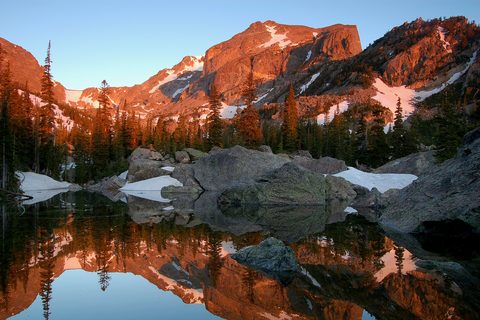
Photograph: National Park Service, Public domain, cropped
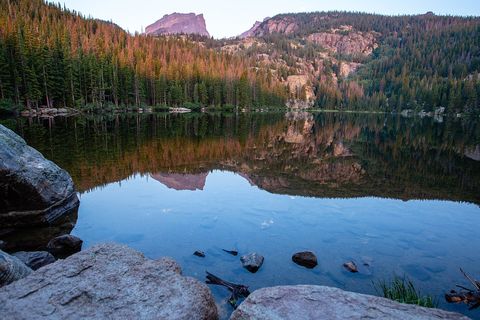
Photograph: NPS / M. Reed, Public domain, cropped
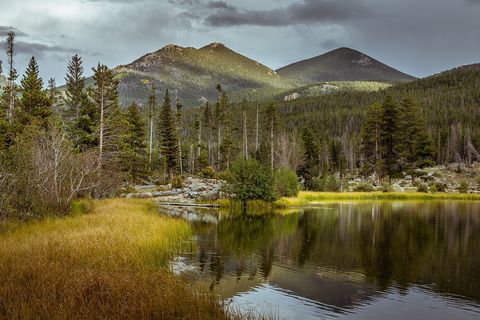
Photograph: Christian Collins, Sprague Lake inlet, CC BY-SA 2.0
Photograph: NPS / M. Reed, Public domain, cropped




